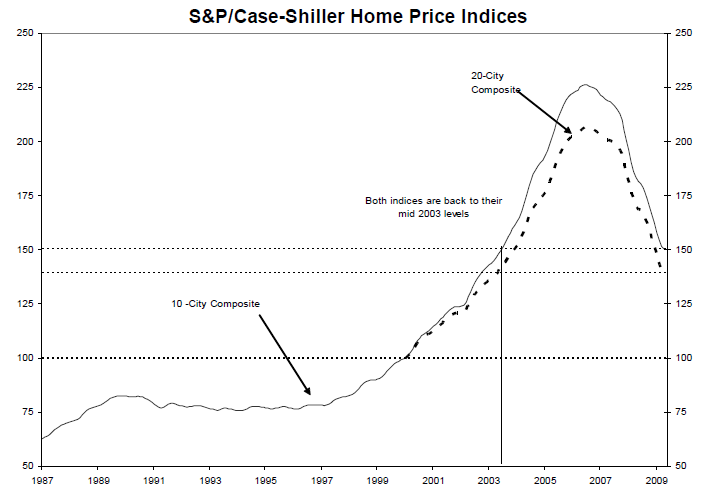
Case Shiller Index Falls 18%
Home prices continued to decline in April 2009, but at a slightly less bad rate than expected.
Don’t break out the champagne, just yet.
The reduced collapse speed (another one of those famed 2nd derivatives) is primarily a function of foreclosure moratoriums. The overall trend in housing remains weak, with soft demand, excess inventory and heavily indebted consumer unlikely to effect a V-recovery.
That is before we consider the ongoing NFP job losses, which have been contributing to additional foreclosures.
And once the various government stimuli gets withdrawn — very low rates, $8,000 first-time home buyer tax credit — we can expect even these weak reports to turn south.
>
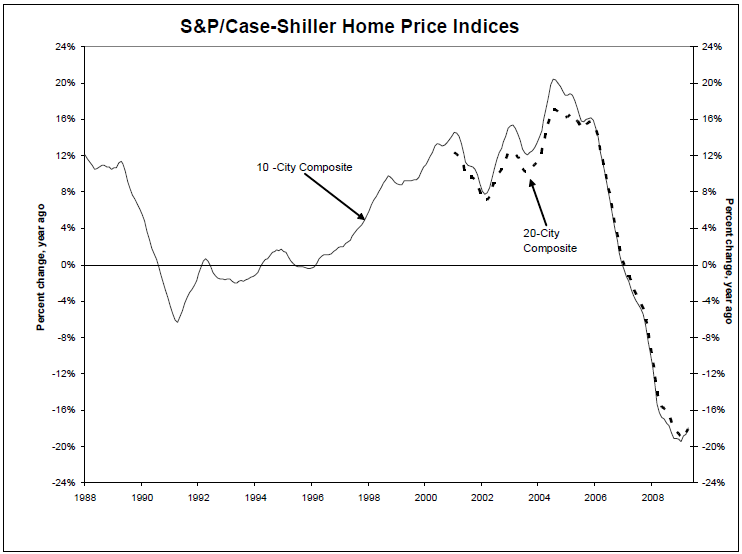
Source: S&P



June 30th, 2009 at 9:43 am
Green shoots!!! Better than expected!!!
June 30th, 2009 at 9:44 am
btw that’s sarcasm
June 30th, 2009 at 9:58 am
Green shoots, patriots. Green shoots!
The S&P/Case Shiller 20-city home price index fell 18.1% in April from a year ago versus forecasts for a drop of 18.6%.
But on a month over month basis, the index showed some improvement. Prices fell 0.6% versus March, after posting a 2.2% drop in the previous month.
http://money.cnn.com/2009/06/30/markets/markets_newyork/?postversion=2009063009
June 30th, 2009 at 9:59 am
See that little upturn at the far right? That’s proof that housing has turned the corner. Everyone currently under water in housing can rest assured that the value of their “investment” will return to, and exceed, it’s historical high before the end of the year. Condos will lead the recovery. Real estate never goes down. Buy now, or be priced out forever. Buy two, and rent one out.
June 30th, 2009 at 10:04 am
So the curve of actual prices in $ is going down at a less steep slope. I guess less brown is the new green
June 30th, 2009 at 10:04 am
Headline-
“Conference Board’s Consumer Confidence Index Slides in June, Falls to 49.3 from 54.8 in May”
Gee- I don’t know why- I thought the path for new prosperity was already in the bag
June 30th, 2009 at 10:05 am
I sent Barry my extrapolation of the 100 year chart…let’s see what that shows (hopefully he posts it above)
June 30th, 2009 at 10:09 am
@Marcus
Who said anything about a housing rebound? Green shooters only expect housing to reach a stasis point. The driver of future growth will not be housing; it will be the new economy the President is busily engineering.
June 30th, 2009 at 10:11 am
It would take tremendous manipulation and mortgaging the future (pun intended) to get housing to stabilize at this level. Rip the band-aid off quickly and we can get this over in 5 years.
June 30th, 2009 at 10:12 am
@ahab
I seem to recall that I was laughed at when I advanced the theory that the Chicago PMI contracted in May because the auto sector was weighing it down…
But no matter. I’ll take a green shoot number in manufacturing as well, even if it’s a tad belated.
Jun 30, 2009, 9:51 a.m. EST
Chicago factory activity index improves in June
WASHINGTON (MarketWatch) — Manufacturing activity improved in the Chicago region in June after a disappointing drop in the prior month. The Chicago purchasing managers index rose to 39.9% in June from 34.9% in May, according to a survey of corporate purchasing managers released Tuesday. Economists surveyed by MarketWatch had expected the index to rise to 39.0%. Readings below 50% indicate overall business contraction. The Chicago PMI is considered a leading indicator to the national Institute for Supply Management manufacturers’ survey to be released Wednesday. The increase in June brings the Chicago PMI in line with other regional surveys. Last month, the Chicago index had fallen more than other regions. Analysts blamed the drop on auto sector weakness. Economists expect a further improvement in the national ISM index in June.
http://www.marketwatch.com/story/chicago-factory-activity-index-improves-in-june
June 30th, 2009 at 10:12 am
Marcus-
I agree- sunny skies from here on out- America- best country ever- passport?? who would want one of those?- once your blessed with being an American- why bother with all those other countries
June 30th, 2009 at 10:16 am
“Who said anything about a housing rebound? Green shooters only expect housing to reach a stasis point.”
As I said above “less brown is the new green”. Set the bar low enough and even a toddler can be a winner.
June 30th, 2009 at 10:17 am
Erin Burnett was pretty excited about this today.
They had a guy on CNBC from S&P talking about all the green shoots in this data. Then Mark Haines brought up the fact that it still looked like many of the worst cities weren’t improving all that much on the report. The guest from S&P had a hard time with this and tried to say it was only those cities that are still the problem.
I got a laugh out of that. When real estate started to tumble I once heard a realtor say, “It’s only Miami and Vegas” but …. it wasn’t only Miami and Vegas.
Anyway, Barron’s also recently had that nice cover about making sure you buy a luxury home and don’t forget the Forbes list from about two weeks ago of what to buy before the economy recovers, a home was #1.
Pay no mind to the fact that unemployment is still rising, interest rates have gone up as have prime defaults on debt, and the Alt-A and Option ARM problems haven’t even really started.
June 30th, 2009 at 10:19 am
Steve Barry says:
It would take tremendous manipulation and mortgaging the future (pun intended) to get housing to stabilize at this level. Rip the band-aid off quickly and we can get this over in 5 years.
Hey Steve, I’m with you but don’t hold your breath.
June 30th, 2009 at 10:21 am
Consumer confidence crappola, S&P put a nice S-H-S pattern, we are going down. S&P tested 930 and couldn’t get past it.
June 30th, 2009 at 10:25 am
Don’t forget most of the owner occupied sales were financed around 4.75% in April. Things are about a half percent higher today.
June 30th, 2009 at 10:26 am
“Rip the band-aid off quickly and we can get this over in 5 years”
That “take the quick pain now and all will become rosy by itself” ideology is BS and completely unsupported by history. If housing were to quickly fall another 20% financial institutions and the economy would collapse. We would drop into the new depression with huge numbers of new unemployed who would have no money to consume and, therefore, the GDP would nosedive and we would be in a negative spiral. From where would the money come that could turn that around?
The only reason we got out of the great depression was that we had this huge public works program called world war II. In todays environment where would you get the political will for such enormous amounts of deficit spending? not to talk about who would lend us the money to do it?
June 30th, 2009 at 10:28 am
manhattanguy-
you are not a very good American- predicting a downturn in the SPX- Pulease keep your unbridled pessimism to yourself
June 30th, 2009 at 10:34 am
http://www.concordcoalition.org/learn/debt-facts
“Spending for interest on the debt in fiscal year 2008 ($249 billion) equaled 21.7% of all individual income tax revenue ($1.146 trillion) and more than the federal government spent on energy ($531 million), environment ($30.2 billion), education ($89.1 billion), veterans benefits ($84.7 billion), and agriculture ($27.8 billion) combined .”
OK..Ofranka….let’s do a little math. 21.7% of income tax revenue was spent in 2008 on the national debt service…fine…now we know that this year, already, tax revenues are down 34%….follow me so far?
Let’s call tax revenues for 2008 “x” and let’s call tax revenues for 2009 “.66x”
We can set up a simple equation from high school algebra…21.7 is to x as (unknown percentage) is to .66x….
…Franklin…we will spend 32.87 percent of all tax revenues on interest on the debt this year.
1/3 of tax revenues for debt service….
This thing has just gotten started good…
June 30th, 2009 at 10:34 am
manhattanguy,
everyone and their mother can see the H&S pattern so it will most likely fool people. fwiw I don’t see the start of a real downtrend confirmed yet in the indexes but the rest of this week should give us more clues.
June 30th, 2009 at 10:36 am
Agreed, DeDude.
June 30th, 2009 at 10:40 am
Franklin,
I’m in a great mood today so I want to be nice and try to help you out. Just a word of caution, when you start siding with analysts looking for reasons they got a forecast wrong re your 10:12, well, you are probably setting yourself up for some trouble. Analysts are classic herders. Also, large countertrend moves in bear markets, which is exactly what we are having right now, tend to produce numbers that almost look good as it starts to peak out. It’s social mood driving these things, hope you can recognize when it is about to change, it’s not very far away.
good luck in your investing.
June 30th, 2009 at 10:52 am
DeDude Says:
June 30th, 2009 at 10:26 am
“Rip the band-aid off quickly and we can get this over in 5 years”
That “take the quick pain now and all will become rosy by itself” ideology is BS and completely unsupported by history. If housing were to quickly fall another 20% financial institutions and the economy would collapse. We would drop into the new depression with huge numbers of new unemployed who would have no money to consume and, therefore, the GDP would nosedive and we would be in a negative spiral. From where would the money come that could turn that around?
~~~~~~~~~~~~~~~~~~~~~~~~~~~~~~
Where would the money come from? From all the cash on the sidelines…..
There are a lot of smart people sitting around in cash waiting to pick up assets and rebuild this country with a sound footing…not the current sand castles we’re sitting in….
DeDude, many high population parts of this country are already in a depression…the crap we’re doing right now is only delaying the process of wiping out the bad debts and crappy assets….too many strip malls were built; too many poor business plans were finanaced; too many flat screens were rung up on credit; too much plastic crap from China was purchased on a credit card. All of that debt has to go away….
Then we rebuild…..
June 30th, 2009 at 10:57 am
@DeDude
If housing were to quickly fall another 20% financial institutions and the economy would collapse.
We would drop into the new depression with huge numbers of new unemployed who would have no money to consume
and, therefore, the GDP would nosedive and we would be in a negative spiral.
From where would the money come that could turn that around?
I’m an econ-newbie, but there’s something I don’t follow in your logic.
If, apart from 2002-2207, house prices are supported by people’s incomes and
people’s incomes haven’t really gone up in the last decade
then how can house prices stay at the elevated levels of the last eight years?
Who exactly will be living in these houses?
I suppose that JPM and GS can take their profits and go buy housing stock,
maintaining prices with their extra dollars, but where will their renters get the money to pay rent?
Equating the health of the financial institutions with the health of the economy is certainly fashionable
in certain circles, but how does that serve the rest of us?
June 30th, 2009 at 10:59 am
@ben22: And naturally that social mood will darken again once the summer ends. Even the unemployed are in decent moods in the summertime. Heck, that just means more time off to enjoy the good weather, sun, and fun of the summer. Might as well be happy and pull out/use the plastic, right? It’s all green shoots anyway and we’ll have jobs again soon to pay it off, right? That mood will darken in the fall once the hangover and reality hits again.
This GD II. The good news is that Ben can at least he say after the fact that without his efforts it would have “been even worse”, so he can declare victory and move on. The rest of us won’t be so lucky.
June 30th, 2009 at 11:03 am
Observations from the field:
Here in the mid-Atlantic, there’s an interesting conflict between “new” and existing housing sales and between REO and non-distressed sales.
New, mid-range THs in close-in/infill areas seem to be doing well. Luxury, not so much (although mid-range now assumes the ubiquitous granite counter tops and SS appliances).
Mid-range (there does not seem to be a lower range) SFHs are seeing a smaller number of sales, but the builders are making more concessions. Those closer to metro areas/commuting routes are doing better than those on the fringes. Luxury on the fringes is getting killed. The builders have cut profit margins to the bone, but I don’t think that’s enough to get the shit through the goose.There’s the horrendous situation of holding a physically and financially deteriorating asset and being unwilling or unable to liquidate without taking a huge loss. Much of the new housing stock in inventory is effectively going to waste.
The condo market is DOA. Prices are stuck at unaffordable levels. Condo fees are outrageous (gone are the days when builders could roll the first 2-5 years of fees onto the mortgage). There will be much pain and suffering when these white elephants find their true price. A prominent DC area marketer of Condos (not a builder — but interesting in that they market most of the large condo projects in the area, for all of the builders), recently did a very nice, glossy mailer of properties they currently represent. The builder names were not used in conjunction with the properties being shown (something that would never have happened during the boom). Overall, prices had not come down to anywhere near a reasonable price (to sell the available units in any reasonable period of time, I’d say prices still need to drop another 50% (no shit)). These are the same folks who used to set up pre-construction sales “parties” where people waited in line and actively bid the prices up. Sucks to be them.
A broker friend tells me that he’s getting competing offers on his listings. He says that many buyers have come in looking for short sale/REO properties (of which he has a portfolio), but that the banks are unresponsive to offers on the properties. On more than one occasion, he’s had ratified contracts and settlement dates on short sale/REO properties repeatedly extended or put off indefinitely by the banks. In the end, the buyers have gotten their deposits back, but he doesn’t want to waste his time or that of his prospects. As a result, his buyers have concentrated on the MLS listings, where more reasonably priced homes are being bid on by multiple parties.
Some of the larger projects run the real risk of becoming derelict or slums, IMHO.
Again, the banks, like the builders, are holding physically and financially deteriorating assets off of the market in apparent hopes of some miraculous increase in demand will pull their sorry asses out of the fire. Mark my words: We will end up holding this bag o’ crap before these houses are put on the market at a fair price (a fair price, in this sense, being a price someone would pay).
Someone needs to capitulate, and it’s not going to be the buying public. A ClustreF* is a’brewin’.
June 30th, 2009 at 11:05 am
The “larger projects” sentence should have followed the condo paragraph.
June 30th, 2009 at 11:07 am
Franklin:
When you feel the green shoots mania coming over you, think of this cartoon from the New Yorker that graced the paperback edition of Galbraith’s The Great Crash. It promotes a healthy skepticism.
http://cdn.comixology.com/assets/frueh.jpg
June 30th, 2009 at 11:08 am
@DeDude
I guess you prefer the Japanese Solution…20 years of malaise and stocks still 75% off all-time highs. That’s fine…I guess it comes down to personal preference. I’d rather get to reality quicker.
June 30th, 2009 at 11:11 am
Mannwich,
Yes, I agree, I just dont’ know exactly when it will turn, the underpinnings of that social mood shift are already in place.
June 30th, 2009 at 11:22 am
@ahab: Ok Mr Blind Optimist. Join F411’s club.
June 30th, 2009 at 11:32 am
I’m still trying to figure how the economists underestimated Consumer Confidence by such a wide margin. Is is that the public has gotten wise the the green shoots lie?
June 30th, 2009 at 11:32 am
manhatteguy-
dude- you may be snarking me back- but- just in case-
please note- my 10:28 post should be tagged w / [snark] label
June 30th, 2009 at 11:38 am
@Dedude; Steve Barry:
There can be no reality in residential real estate pricing until the Fed gives up. It now owns more gse debt than anyone, buying it way above market, which is why everyone (mostly sovereigns) was willing to sell.
It is pumping $1.25 trillion into the housing market this year, which will far exceed all the mortgage originations for the entire year.
And Dedude and F411: What the hell is nearly $2 trillion in fiscal debt, never mind the monetary stuff the Fed is cooking up? And more where that came from next year.
But the quote for the day:
“The driver of future growth will not be in housing, it will be the new economy the President is busily engineering.”
Indeed. A presidentially-engineered economy is our salvation. Just like the presidentially-engineered economies of the old Soviet Union, of Mao’s China, of North Korea and don’t forget East Germany and Cuba proved so fruitful for each of them. Everyone knows that all wealth is created by government and should therefore be controlled by government. Never mind the twenty million dead of starvation after Mao’s presidentially-engineered Great Leap Forward. Never mind the millions dead of starvation in North Korea. Never mind the Soviet Union no longer exists because its presidentiall-engineered economy couldn’t compete. Just never mind. We will prove our Great Leader much greater than theirs. History doesn’t apply to us. We’re American.
June 30th, 2009 at 11:41 am
Forget my extrapolation on the 100 year chart…extrapolate the second chart above, the 22 year chart, and we could fall another 50%…most bubbles get fully wiped out.
June 30th, 2009 at 11:41 am
Forget my extrapolation on the 100 year chart…extrapolate the second chart above, the 22 year chart, and we could fall another 50%…most bubbles get fully wiped out.
June 30th, 2009 at 11:44 am
Yes Andy; I am also one of those people with cash so I know that there is a lot of people waiting to pick up cheep assets. However, that may make those people happy and “rich”, but it will not grow the economy or get us out of a depression.
The only thing that can grow the economy out of a big ressesion, is a massive overall increase in consumption. After consumption starts increasing, the prospects of companies growing and making more money, would entice people like me to invest that cash in those companies, so they can hire more people who can become consumers etc. etc. and the spiral goes up. If the prices of a stock goes way down I may use my cash to buy that stock, but that does not create anything for the economy, no new jobs, no increased GDP, nothing, my cash simply fills the hole from the cash lost by the previous owner of that stock. Someone got richer and someone got poorer, net gain is zero. Same goes for any other asset.
Will I increase my consumption because I feel richer owning more stuff that I got for what I considered a good price; hell no, the reason I have cash now is that I am a fisically conservative guy and until I see the GDP going up at least 2-3% per year I will hoard all the cash and assets I can to guard against the meltdown.
The only thing that can bring us out of a massive ressesion or depression is increased consumption. Anything that reduces consumption (such as you and I getting some great deal on an asset, that some baby-boomer now don’t have to “consume” in his retirement) is bad for the economy. Anything that gets people into paying jobs so they can increase their consumption is good for the economy.
June 30th, 2009 at 11:44 am
@MA:
I’m in the business, too. I see the same type things. The Fed is doing everything it can to reflate the bubble. If successful, then it will pop for good in another year or so. If not successful, then comes the pain, but the pain will come no matter. The sooner the better.
June 30th, 2009 at 11:46 am
@Curmudgeon;
Well said…under the engineered economy, I am willing to pay even less for stocks as growth will be muted until further notice…let’s see…7 times estimates of $40 per share in 2010 gives an S&P price of…280.
June 30th, 2009 at 11:46 am
franklin411
Message from HMS Titanic:
Water inflow at 11000 gallons per minute versus prediction of 12000 gallons per minute, will update further upon arrival New York.
Smith
June 30th, 2009 at 11:51 am
Dedude…God help us all if our only salvation lies in consuming a bunch more useless baubles and trinkets with money and time borrowed from the rest of the world. The notion of consumption as salvation, which permeates the thinking of our government shepherds by the way, are why we are on a long slow slide to hell. For crying out loud, the prescription for the economic blip of late 2001 was for everyone to go shopping. I suppose it was meant to get our minds off the burning towers. Is shopping really the cure-all for everything?
June 30th, 2009 at 11:53 am
@ahab: see I am not so good at detecting snark..ignore my comment
added more to my $DUG and $COF shorts..tomorrow might be an up day. I still stand with my prediction that S&P will test low 800s by end of July.
June 30th, 2009 at 11:54 am
would everyone please understand that Obama will invest in the future of America- more money for education and then more more for more education- PhD’s for everyone- health care- more nurses please- and other great jobs- high paying PhD jobs-
I can’t wait- this newly engineered economy is going to be the best
June 30th, 2009 at 11:55 am
Just noticed that SRS is negative again today. When will Credit Suisse be forced to disgorge some of it’s holdings of 104% of the IYR?
June 30th, 2009 at 11:58 am
Pmorrisonfl;
The important part is not the price but the monthly payment. The thing that people can or cannot afford is the monthly payment. I would not suggest that we do not need to get prices down from where they were at the top of the boubble, just that any further reduction need to happen slowly so the economy (and consumers) can absorb it.
I am in no way shape or form saying that we have to shield the leaders of the financial system, hell lets put them all in jail. I hope that the Obama administration within the next year allow a couple of those “to big to fall” institutions to go bankrupt. But if you get into a panic where it all collapses or as in October there is a massive panic, then everybody gets hurt. At that time there were perfectly good profitable businesses that had to close because they could not get any credit. People lost their jobs for no other reason than that a financial panic forced perfectly good businesses to close their doors. And as explained above, that kills consumption and the economy goes down the drain.
June 30th, 2009 at 12:00 pm
DeDude:
Thanks for the response….and I understand your point….I guess what I’m suggesting is this:
We (America) used credit to build a bunch of strip malls that contain Nail Salons, Tanning Salons, Financial advisory firms, CellPhone shops, dry cleaners, maybe a Mexican/Chinese restaurant, and the obligatory Applebee’s/Chotckies out on the corner…not to mention the stand alone WaMu/Wachovia/BoA/NameYourLocal Bank buildings that litter the canvass….
This is just one of numerous examples of how we (America) took on too much credit to build assets with no value. Dumb investors were allowed to take on debt to build poor performing assets. All that has to go away….
The capital and debt of this country was deployed in an extremely POOR manner the last several years….so I’m not just talking about people like you and me buying “cheaper” toys….I’m talking about smart money now deploying capital on better investments….this will not be allowed to happen until the bad debts get expunged….
June 30th, 2009 at 12:00 pm
Franklin, this is from CR’s website, but it should help you see the BP about housing:
http://www.occ.gov/ftp/release/2009-77.htm
Seriously delinquent mortgages increased. Seriously delinquent mortgages (60 or more days past due or involving delinquent bankrupt borrowers) increased as economic pressures continued to weigh on homeowners. Prime mortgages, which represented two-thirds of all mortgages in the portfolio, had the highest percentage increase in serious delinquencies, climbing by more than 20 percent from the prior quarter to 2.9 percent of all prime mortgages.
Prime mortgages…..highest increase….
June 30th, 2009 at 12:06 pm
@ Mike:
CS is screwed… maybe even worse than UBS but they’re the ones getting all the bad press. Let them hang onto that bag of shit called IYR… they will hit the panic button… soon.
That dude who said on ZeroHedge that thing about seeing a Swiss bank doing one thing and then immediately running in the opposite direction was dead on.
Seen a IYR chart lately? … talk about precipice.
June 30th, 2009 at 12:07 pm
Back on the stock market farm: a right shoulder is potentially forming now in the Russell 2000 as measured over 3 months. Reality may indeed bite.
June 30th, 2009 at 12:10 pm
Headline-
“As Rally Stalls, Tech May Be The Answer”
http://www.cnbc.com/id/31610435
get in now- don’t walk- but run- to your nearest broker- this is a can’t lose investment opportunity- don’t let the fact that the Nasdaq is up 30% in the last 3 months scare you- or P/E values- that’s old school
June 30th, 2009 at 12:11 pm
Steve;
I understand; you are from the investor class and a stock market that is not producing big profits is a disaster for the investor class. However, I was born and grew up with parents of the hardworking struggeling consumer class and have myself experienced going to Price Chopper for a sack of potatoes and the cheep ground meat – hoping it would last until the next paycheck. I worry a lot more about huge unemployment numbers and people being stuck in minimum wage jobs, than nursing the big shiny “Las Vegas” on Wall Street back to health. Yes the millionaires in Japan are sad that their stock market have not recovered to its previous boubble levels, but most people in that country are doing just fine.
June 30th, 2009 at 12:14 pm
Bruce in Tn@12:00 -
did you look at the tables in the attachment to that article?
modified home loans are pretty consistently defaulting at a rate of 50% within 90 days or so after the modification
June 30th, 2009 at 12:17 pm
Wes:
Yes, and that is what most blogging sites had predicted…apparently only Uncle Stupid thought differently…
June 30th, 2009 at 12:19 pm
Would a nice deflationist please read Hugh Hendry’s latest and put it in a nutshell for me?
http://www.greenlightadvisor.com/glablog/2009/06/18/hugh-hendry-june-2009-letter/
Meanwhile, what we all need to keep our eyes on in addition to the $usd:
http://www.stocktiming.com/Tuesday-DailyMarketUpdate.htm
June 30th, 2009 at 12:20 pm
Re: “rip the band-aid off”
It’s just not the american way. We will not change the behavior of what got us here until our backs are against the wall. The path forward will be determined by what cannot be controlled by the government. They will run out of ammo, and chips will start to fall. The path forward will not be a strategy for economic recovery, it will be a strategy for slow death.
What got us here? We were a producer for the world, then globalization happened, we scammed being the service provider for the world, then the internet happened, we scammed being the financial provider for the world and bubbled ourselves into oblivion trying to keep the party going. The rest of the world no longer is willing to play our game.
June 30th, 2009 at 12:26 pm
Curmudgeon;
Yes capitalism and private markets have shown their dysfuntion, so the government have had to step in and save us. If private capital has become so scared that it fails to purchase gse debt for a fair price, then we can either let those scared lemmings take all of us over the clif – or government can step in and do what it is supposed to do (save us from the attack of destructive forces – whether they are Russian or Market forces).
Right now capital owners are scared to death and refuse to put money in anything than short-term treasuries. So government is saving us from the attack of these enemy market forces by borrowing in short-term treasuries and lending it out to those healthy borrowers that the markets have shunned. That may look horrible on the balance sheet with trillions of borrowed (and spend?), and it sure gives the idiots on Fox something to yell about. However, its no big deal for those who care to understand what is going on, rather than try to use it as a political weapon. After capital markets get back to normal again (maybe after a few years of stocks and other assets going nowhere) they will purchase that gse debt from government and government will retire those short-term treasuries, and the balance sheets will get back to where even the worst idiot or political hack will no longer be paniced about them.
It’s all good, trust the big O
June 30th, 2009 at 12:33 pm
It’s all good, trust the big O
hahahahahahaha- good one- I thought you were serious for a second
June 30th, 2009 at 12:36 pm
I would aspire to be a nice deflationist, Miss Karen…but chicks dig the bad boys.
Hugh may be summed up nicely via one cogent paragraph:
“Regardless, it is my contention that many are investing in risk once more almost oblivious to the notion that a heavily indebted economy is confronted by a very real tightening of monetary policy. It is not inconceivable that the macro compass could swing violently towards deflation and wrong foot them again.”
Take your favorite mortgage broker out to lunch, or better yet to the ball park as I did, and ask them a few leading questions. Among the many tales of woe, you’ll likely hear that many self-employed types who write off everything but puppy food cannot get a new/modified mortgage because their tax returns don’t support the new-new income requirements. That’s a lot of people…and very much includes the would-be entrepreneurs that drive economies upward.
June 30th, 2009 at 12:46 pm
Thank you, uno, so Hugh is still in total disregard of worldwide QEing. He did warn in his first sentence, “I am about to repeat myself.” Nice point about those self-employed types.. also difficult for most to qualify now that the lenders are actually concerned about getting their money back..
June 30th, 2009 at 12:47 pm
Curmodgeon;
Consumtion is 70% of the GDP directly [BR: Not anymore] , and the rest of the GDP would also disappear if there was absolutely no consumption of anything anywhere. So yes consumption is the only thing that distinguish us from a third world country. However, there are two types of consumption the private and government. Right now we may try to get people to be a little less self-absorbed and accept that the government may have to consume more to invest in updating our infrastructure and repair all those roads, bridges, and energy infrastructure; and maybe also get us off our dependence on fosile fulls etc. So maybe we can forget all those Chinese trinckets and invest in a better and more sustainable future for our children.
Andy;
I am perfectly good with the idea that all this self-indulgence spending has to go away. I think we should have used all that money to get a top-of-the-line competitive updated infrastructure and and education system. However, that requires more taxes (at least on the rich) and a bigger government, and we just didn’t have the country willing to stop self-indulgence and accept bigger government. So here we are in a hole of our own making. Maybe some of the new energy infrastructure can be build be private investment, but that will require that government interfere with market pricing and that seems to be as hard to swollow for the conservatives as “tax and invest in our kids” appers to be.
June 30th, 2009 at 12:49 pm
Many years later, the Japanese stock market appears to still be in total disregard of quantitative easing. It makes for less crash-boom-bam…and that may be the only real objective of it…but short of paying people to borrow money the QE concept has its limitations, particularly in regard to stock market valuations. Debt is debt.
June 30th, 2009 at 12:50 pm
@hope
I agree and have posted many times that we have to return to a production economy. The question is: how? Only one person had advanced a feasible plan for doing so: President Obama. His argument is that we need to invest heavily in education, research/development, and make targeted bets on the high tech industries of the future, such as green energy. Nobody has offered a feasible alternative to that plan.
A lot of posters here say we just need to pull the carpet out from under the economy and let it plunge to its natural stopping point (wherever that is). I have no idea what it is that gives them such blind faith in the idea that the economy and government we end up with will be an economy and government we’d want to live under. I have no idea what it is that gives them such blind faith in the idea that doing nothing will produce change–that we won’t just end up with another 70% consumption economy as well by doing the same things we’re doing now. I have no idea what it is that gives them such blind faith in the idea when we hit bottom without a gov’t issued parachute, we won’t end up as a red splat on the ground.
Gut thinking and the blind faith that “the market is always most efficient” is what got us in this mess.
June 30th, 2009 at 12:52 pm
Gut thinking and the blind faith that “the market is always most efficient” is what got us in this mess.
…oops, I forget the government is most efficient…give me three lashes with a wet GM stock certificate…
June 30th, 2009 at 12:53 pm
Wes and Bruce:
Don’t think we have to be concerned with too many loans getting modified:
http://www.cnbc.com/id/31609070/site/14081545
If it weren’t such a serious subject for so many, it would be funny.
Karen and uno:
Hendry gave a nice interview to CNBC EU. While it’s labelled as being about Madoff, it’s got a lot more to it.
http://www.cnbc.com/id/31652780/site/14081545
June 30th, 2009 at 12:56 pm
Karen. That’s the first time I’ve read one of Hendry’s letters…..I think you should go ahead a read the entire thing…a cliff’s notes version might not do it just. Also, he quotes some of favorites….
“the news at turning points is just too strong for most people to act contrarily to it…fundamentals so intensely support the continuation of a trend just when it is ready to reverse” – Prechter.
June 30th, 2009 at 1:01 pm
Karen,
Warning, I am about to repeat myself:
For QEing to work you need cooperation from people that are willing to go into debt. That doesnt’ seem to be happening. The Fed tried so hard last year, really starting back in September of 2007 to reinflate or to force liquidity and not only were they not successfull, we crashed. This is what happens when you go after symptoms instead of the actual problem. Have you seen consumer prices of anything jump besides gasoline? Why isn’t gold confirming for us that QE has worked, it has not been able to match or eclipse the high from last year. What about the banks all out effort to raise and conserve capital? The banks are so desperate for it that they are selling some of their best assets. California is issuing IOU’s and talking about selling assets such as LA Coliseum. Yankees tickets have been slashed by 50%. All around the country people are selling prized possesions or collections to get their hands on cash. Etc, etc, etc.
All that has happened is a temporary rise in social mood to make people think that what the Fed has done is working. It seems pretty obvious to me but clearly a lot of people are crying about inflation/hyperinflation so either I’m missing something or they are. As I claim to know above, the setting is already set for that social mood to change.
June 30th, 2009 at 1:01 pm
My contention is that a lot of bank debt has been forgiven, swept under the rug, or into the abyss with accounting sleight of hand.. What’s a few trillion among the Fed, Treasury and their banking brothers? Fiat currencies and electronic banking make it too easy…
June 30th, 2009 at 1:02 pm
@ Karen:
Just read it in entirety… and of course, I think its spot on. At least thats where my moneys at. But I’ve been a bit more eager to fight this than he has.
June 30th, 2009 at 1:02 pm
“The only thing that can grow the economy out of a big ressesion, is a massive overall increase in consumption. ”
That mindset pretty much sums up the cause of the current problems.
Reliance on “massive” consumption = economic failure.
June 30th, 2009 at 1:04 pm
“blind faith”
that’s funny franklin- I was thinking the same thing about you
June 30th, 2009 at 1:06 pm
“For QEing to work you need cooperation from people that are willing to go into debt. That doesnt’ seem to be happening. ”
If you can’t get people to cooperate, then just force them into debt-by-proxy – i.e. federal government debt. That *is* very much happening – at light speed. If the people won’t borrow and spend – then by golly we’ll borrow and spend for you via bailouts, stimulus, etc.
June 30th, 2009 at 1:07 pm
The Prechter quote was awesome too… says alot about how I feel right now.
June 30th, 2009 at 1:07 pm
http://img190.imageshack.us/img190/5350/graphsectorldebtpercent.jpg
Note that while mortgage debt is flat now – federal debt is skyrocketing. We are going into debt at an even faster rate now than ever – it’s just being shifted from personal/mortgage debt to government debt.
June 30th, 2009 at 1:08 pm
ben, please stop confusing prices falling with the inflation/deflation debate. you still don’t see the bond bubble? the world is still awash in money… look the spx is in the 900s. gold is in the 900s, wasn’t too long ago it was under $300. a triple plus rise in 9 years? look at the $usd… from 121 in 2001 and 2002 to a low of 70.70 in 2008… that is what i see…
June 30th, 2009 at 1:08 pm
“massive overall increase in consumption”
wow- same old, same old- so much for change- don’t let anyone here stop you though- do your part- doesn’t mean anyone will follow
June 30th, 2009 at 1:09 pm
Karen,
Thanks for the link to Hugh Hendry. I didn’t know him before, now I’m a big fan.
June 30th, 2009 at 1:12 pm
Packman…I like the debt-by-proxy…sums it up very well..
But the result will be more debt in the form of higher taxes on John Q. Public…so won’t the final effect be less money for the consumer to spend? I mean all of us except Franklin are assuming public expenditures can’t be self-sustaining, the unencumbered private taxpayer will need more money to spend…right?
This is the problem I have with Keynes…the back-end loading that I’ve mentioned before…doesn’t go away once you’ve spent the stimulus on the front end. Just makes it that much harder for the private citizen to spend on the back end…
June 30th, 2009 at 1:12 pm
“What’s a few trillion among the Fed, Treasury and their banking brothers? Fiat currencies and electronic banking make it too easy…”
And the congregation and choir all said “Amen”.
If someone could name me one instance in history where a declining empire did not devalue its currency in a vain attempt to create the illusion of continued prosperity, power and wealth, well, I might be more willing to abide the deflationist argument. The incentive to inflate is just too great.
June 30th, 2009 at 1:12 pm
@franklin411: If we’re truly relying on one man out of 306,790,000 to save the economy, then frankly speaking I don’t like the odds.
As to terminology, “investment” happens via capital reserves. “Gambling” happens when “borrowing” via credit cards at the cashiers kiosk when one is not only lacking in capital reserves but is in fact losing by way of ill-founded “thinking.”
Quoth the Ed Seykota: “Everyone gets what they want from the markets.” Ditto in Vegas/D.C.
Having said that, Obama is not the pox that some would make him out to be…but he’s missing some major points, and for that I would give him a grade of C-, leaning towards a D. In particular, the housing problem is a supply & demand issue…plain and simple. Bulldozing some of the supply in Detroit is moronic; that’s sort of like laying people off until there’s no one left all in the name of profitability.
One important solution to the S&D issue — so far unintelligently addressed by the Big O — is fixing the immigation problem…and by that I mean eliminating or vastly increasing the caps that exist, particularly for those nations that are highly competent in terms of technology. We want and need the world’s best & brightest. As it stands, we’re only protecting/amnesty-granting towards the honest & good people that keep our homes built and clean. I love ‘em every one, but let’s not forget to tap into the best & brightest, or we’ll all be sweeping for a living.
June 30th, 2009 at 1:13 pm
@karen-
as an old inflationista and gold lover myself, i am of the persuasion that the debt bubble is bigger than the fed
the good ol’ shadow banking system (at the fed’s – read bubbles greenspan – encouragement) has created ~60 trillion USD in debt!
all the fed can do with QE is match or slow down the rate at which the bubble deflates – the fed cannot replace all of this debt.
banks are hording cash and not lending – the investment banks become commercial banks and have to reduce their leverage from 30/40:1 down to 10/12:1 – so we are not seeing the money multiplier effect
there are several more years of mortgage resets – prime resets are ending now (see BnTn article quoted above) we have alt-A’s and option Arms until Q2 2011. when these start defaulting, then the banks will have to delever again => sell off
maybe that’s when ben22’s USD takes off again
inflation will come…some day…….the fed can force it’s banks to lend
June 30th, 2009 at 1:15 pm
MikeinNola….
Thanks for the Hendry link….too bad the american version of CNBC can’t have “clear thinkers” like that on…I probably would still be watching CNBC….
June 30th, 2009 at 1:16 pm
“Would a nice deflationist please read Hugh Hendry’s latest and put it in a nutshell for me?”
Buy the long bond. See, that was easy – and I’m not even nice…
June 30th, 2009 at 1:16 pm
Curmudgeon, from now on, you can speak for me.. you are far more eloquent.
hopeImwrong, you must seek out Hugh on the internet, he’s even produced his own sensationalized videos not to mention his run-and-hide-under-the-bed cnbc interviews…
June 30th, 2009 at 1:20 pm
packman;
If I had seen evidence of anything else but massive consumption (external or internal) drag any economy out of a big ressesion then I would be happy to change my opinion. It’s hard for us who refuse to base our opinions on ideology and insist that facts should be the basis for all opinions and political actions. The reality is that with consumption being 70% of the GDP, that is who is driving this train. I wish the facts were different but they are not.
June 30th, 2009 at 1:21 pm
leftback, i’ll buy tbt when the time is right… not yet : )
June 30th, 2009 at 1:22 pm
This is one of the reasons that the $ ain’t dead yet. There are other countries and currencies that are in way deeper doo-doo. This is a race to the bottom, and the $ is some way back in the pack for the time being. Remember that although Ireland’s debt is worse than the UK, they are unable to devalue because they are on the € whereas the Brits can and will devalue their merry way out of this depression. There’s your inflation, before we will see it here.
http://www.bloomberg.com/apps/news?pid=20601170&sid=aptnrMueIerQ
June 30th, 2009 at 1:22 pm
Karen,
I’m not confused.
I see the falling prices as a result of credit deflation, not as the deflation itself, demand is weak all over because it was credit that has been fueling that demand for years, not real wage increases. It allowed billions of people all over the world to fast forward consumption, and often consumption they didn’t need. Yes, there is a bond bubble, it has developed over decades, it won’t blow up in a few months.
I’m also very bullish on the dollar. The dollar decrease that happened during the time you discuss also occured during massive issuance of credit/debt based in dollars, now that debt is being paid down or defaulted on faster than new dollars are being created, it makes the dollars that remain more valuable.
As for gold, when credit deflation really took hold last year, it went down just like everything else. Seems to me that since it didn’t go down nearly as much as other commodities (b/c it never went up as much as the others!) people are using that to explain how it holds up in inflation and is protection during deflation. I’d be happy to take the other side of that. You will be able to buy gold much cheaper than you can right now imho.
June 30th, 2009 at 1:23 pm
“leftback, i’ll buy tbt when the time is right… not yet : )”
Me too. Late December. I very much like the “replay” aspect of Hendry’s forecast, the mini-crash of 2009 is coming.
June 30th, 2009 at 1:26 pm
@Curmudgeon: And who, my friend, was buying the T-bill equivalents in all those historical references you’re implying? Oh…oh…so there weren’t any highly-objecting foreign buyers of T-bill equivalents in those examples. OK. So is this not a different lesson being served up than the ones you refer to…?
@Karen-the-lovely: Regarding “ look at the $usd… from 121 in 2001 and 2002 to a low of 70.70 in 2008… that is what i see…“…are you saying that the dollar is headed up off of its lows?
June 30th, 2009 at 1:28 pm
Andy, I can’t read it. My eyes blur over.. seriously. I much prefer to watch him on video… he is so earnest, so imploring.. : )
June 30th, 2009 at 1:31 pm
Why TBT? I prefer TMV….i am too waiting for a good entry point.
June 30th, 2009 at 1:31 pm
uno, of course, i’m looking for the dollar to rebound here and now… that’s why i’m short gold and crude oil. also bot FAZ yesterday because of the absurdity of it all. that’s a the hot potato, though.
June 30th, 2009 at 1:33 pm
manhattanguy, one word, volume.
June 30th, 2009 at 1:35 pm
@uno: Not only are there foreign buyers, but there will be domestic buyers – pension funds, individuals and broker-dealers will migrate to Treasuries from high yield and equities DURING THE NEXT CRASH. This is one of the lessons of Japan, that domestic demand stabilized the yen and the JGB market because a segment of the investing public simply gave up on stocks completely.
You know me, I just like to be ahead of the herd. That’s why I was buying at 4% on the 10-year.
@Karen-the-lovely: LB is earnestly deflationary, he said imploringly….
June 30th, 2009 at 1:38 pm
@manhattanguy,
I’d be careful TMV, I’ve seen several of the thinly traded ETF’s just get shut down and your money can hang in limbo for a time while that is going on. I’d also rather use the TBT.
PRFM and PRFE are recent examples I can think of.
June 30th, 2009 at 1:39 pm
I love Hugh Hendry…
During my dozen years living in Europe, he was on CNBC Europe all the time…I’d catch him at least about once a week in the morning…
Funniest guy you’ve ever seen in an interview…Someone like Dennis Kneale would probably turn into a pillar of salt, start to crack, and blow away in the wind in his presence…
June 30th, 2009 at 1:41 pm
DeDude sez,
Consumers won’t have money to spend.
Don’t you dunderheads realize that if we keep this up we’ll have money but it won’t buy jack. That’s history for you. Jeesuz H Christ! Anyway, back to the salt mine.
June 30th, 2009 at 1:41 pm
karen Says:
June 30th, 2009 at 1:08 pm
ben, please stop confusing prices falling with the inflation/deflation debate.
~~~~~~~~~
Karen,
How else would you define deflation, if not a “general decline in prices”?
Some might define DEFLATION this way:
A decline in general price levels, often caused by a reduction in the supply of money or credit. Deflation can also be brought about by direct contractions in spending, either in the form of a reduction in government spending, personal spending or investment spending. Deflation has often had the side effect of increasing unemployment in an economy, since the process often leads to a lower level of demand in the economy. opposite of inflation.
June 30th, 2009 at 1:44 pm
More on Hendry…
What’s interesting to me is that I remember him [Hendry] talking about the same thing that Matt Taibbi did in the Rolling Stone article…Mostly on the NEXT BUBBLE (and the formation of a “carbon credit” exchange)…
…Yet Hendry was talking about this in 2004!
June 30th, 2009 at 1:44 pm
Schadenfreude is doing sweet FA today after a bit of a late night.
Watching some $ rally trades start to come around. DZZ, SCO, DUG. Net short here, with a view to managers taking a few profits to tie up their Q2 performance, window dressing presumably having already occurred. Expecting more weakness in commodities tomorrow and next week.
June 30th, 2009 at 1:45 pm
@packman,
interesting explanation at 1:06, as if that is going to work. The bailouts really did a lot to reinflate things. The only thing that comes to mind when I think about prices going up for companies that were bailed out is the recent mania in stocks such as C.
June 30th, 2009 at 1:46 pm
@Andy T
“Deflation has often had the side effect of increasing unemployment in an economy”
How about vice-versa?
…and for that matter…when unemployment BENEFITS run out (which they’re about to), how about the deflationary effects of that forthcoming event?
June 30th, 2009 at 1:48 pm
Andy, please don’t make me wave my flag, “Inflation is always and everywhere a monetary phenomenon.”
Maybe you’ll prefer this one: “Inflation is taxation without legislation.”
I don’t have an MBA, so i can think and see more clearly than those that do. : )
June 30th, 2009 at 1:48 pm
Comrades! Behold the fruits of our newly engineered economy!
Big Rock Candy Mountain
Author: unknown
Performed by: Harry McClintock
One evening as the sun went down and the jungle fire was burning
Down the track came a hobo hiking and he said boys I’m not turning
I’m headin for a land that’s far away beside the crystal fountains
So come with me we’ll go and see the Big Rock Candy Mountains
In the Big Rock Candy Mountains there’s a land that’s fair and bright
Where the handouts grow on bushes and you sleep out every night
Where the boxcars are all empty and the sun shines every day
On the birds and the bees and the cigarette trees
Where the lemonade springs where the bluebird sings
In the Big Rock Candy Mountains
In the Big Rock Candy Mountains all the cops have wooden legs
And the bulldogs all have rubber teeth and the hens lay soft boiled eggs
The farmer’s trees are full of fruit and the barns are full of hay
Oh, I’m bound to go where there ain’t no snow
Where the rain don’t fall and the wind don’t blow
In the Big Rock Candy Mountains
In the Big Rock Candy Mountains you never change your socks
And the little streams of alcohol come a-trickling down the rocks
The brakemen have to tip their hats and the railroad bulls are blind
There’s a lake of stew and of whiskey too
You can paddle all around ‘em in a big canoe
In the Big Rock Candy Mountains
In the Big Rock Candy Mountains the jails are made of tin
And you can walk right out again as soon as you are in
There ain’t no short handled shovels, no axes saws or picks
I’m a goin to stay where you sleep all day
Where they hung the jerk that invented work
In the Big Rock Candy Mountains
The punk rolled up his big blue eyes
And said to the jocker, “Sandy,
I’ve hiked and hiked and wandered too,
But I ain’t seen any candy.
I’ve hiked and hiked till my feet are sore
And I’ll be damned if I hike any more
To be buggered sore like a hobo’s whore
In the Big Rock Candy Mountains.”
I’ll see you all this coming fall in the Big Rock Candy Mountains
June 30th, 2009 at 1:50 pm
AT,
That was a better explanation than my 1:22 response to the mistress.
June 30th, 2009 at 1:50 pm
@lefty
Yesterday, crude WENT PAST a .618 fibo retrace back to the high…But I pointed out yesterday that it might be a headfake (as it was only notching in that zone for a couple of clicks)…Today, it tried to re-establish that at the open, then hammered down hard…
Some of the tumbler locks are falling into place…
SPX hit my 930 today and pulled back sharply off that…I’m still not fully committed (I expect to see another attempt to get through 930 by July 6th or 7th)…
June 30th, 2009 at 1:54 pm
F411 – Prez Obama is “busily engineering” a new economy? all by himself? does he find time in the day to poop?
Curious, before Obama came upon the national stage, who received your impressive bounty of idolatry? John Kerry? AlGore? Hillary?
June 30th, 2009 at 1:54 pm
@Andy T: You’re arguing semantics in a diffent language than that of an Authentic Economist (Austrian).
General prices are always an effect of monetary policy. Thus, despite the confusion of the masses, inflation or deflation refer to the ‘causal’ money/credit/debt supply…not prices.
To add to the confusion of the masses, when the dollar goes up in value, then that is deflationary (things cost less in terms of $$), and when the dollar goes down in value that is inflationary (things cost more in terms of $$).
We now return you to your regular CNBC broadcasting….
June 30th, 2009 at 1:55 pm
http://www.latimes.com/news/local/la-me-budget30-2009jun30,0,6045334.story
Schwarzenegger has drawn several lines in the sand: He says he will not raise taxes, wants to address California’s entire projected $24-billion deficit at once and wants a number of fundamental changes to state government.
That stance does not sit well with the majority Democrats.
“I’ve never quite heard of a negotiating strategy that says, ‘I want $24 billion my way, and I want all my reforms over the next 37 hours,’ ” Senate President Pro Tem Darrell Steinberg (D-Sacramento) said in an interview Monday. “That’s not helpful.”
Steinberg said Democrats would be willing to meet Schwarzenegger “more than halfway,” even on a deficit-reduction plan without taxes. No such plan has been publicly released by the Democrats.
Steinberg, meanwhile, was pressing Senate Republicans on Monday evening to agree to cut roughly $3 billion from education and push other education costs into the future. The Senate planned to meet into the night to consider that proposal, which was approved last week on a bipartisan vote of the Assembly but blocked by Republicans in the Senate.
Schwarzenegger has promised to veto that plan as well, calling it a “piecemeal approach.”
It must be signed into law by midnight tonight or the potential savings expire with the end of the fiscal year.
…The end of the fiscal year is tonight. Tonight….I hope we get a full report of the shennanigans that go on in Sacramento today…
June 30th, 2009 at 1:58 pm
How many states are on the line for fixing their fiscal year today…? Some have said that there are a number in this pickle, not just Kalifornia.
June 30th, 2009 at 2:04 pm
RE: inflation vs deflation.
I think there is still not agreement on what is meant by inflation or deflation. This matters, especially when decisions are based on the answer. Anyone care to vote on what it means? And what are the consequences? I think there is a confusion sometimes between the consequences of inflation or deflation, and “what is” deflation or inflation.
Is inflation:
1) rising prices?
2) rising money supply?
3) lower standard of living?
4) something else?
If it is something intangible like rising money supply, then what are the consequences?
Same for deflation is anyone cares to weigh in.
June 30th, 2009 at 2:05 pm
Uno and Karen. We’re arguing about something that cannot be settled if you believe the conventional wisdom taught in B-schools and economics programs all over this great world.
We’re in general agreement, but what we’re really aruging about is what is the “monetary policy” and who actually controls it. Fortuantely, I’m many years removed from the brainwashing of Econ. departments and have reached the conclusion that:
“Inflation is always and everywhere a monetary AND CREDIT phenomenon.” It’s my belief that the Fed lost control over the monetary system several years ago….financial institutions have created CREDIT without the money in the bank….
So, alas….we cannot really have a debate on this subject….
June 30th, 2009 at 2:06 pm
Inflation v. deflation has more to do with the size and velocity of the money supply and the availability of credit than with prices. It is possible to have debt deflation with rising consumer prices and we may yet see that occur. Japan had some years of modest price increases driven by BoJ’s QE – between the recurring deflation years.
Look at it this way: there is a strong deflationary backdrop caused by declining demand for high value assets backed by debt. At the moment there is no political will for additional stimulus to offset the debt deflation, so it is likely that deflation will once again dominate the landscape in Q3-4. What we saw in Q2 was simply the results of extraordinary monetary and fiscal intervention designed to ameliorate the effects of deflation. No green shoots.
More people, companies, cities and states are about to go broke. Then there will be more bailouts. Rinse, repeat.
June 30th, 2009 at 2:06 pm
Bruce, no as long as the higher taxes hit the investor class, not the consumer class then the net effect of taxing to finance government spending does not have to be zero increases of consumption. It simply means to force what would otherwise be used to create asset boubbles (by investors) into being used to create jobs (by government spending). If the government is realy clever and spend on things that will make our country more competitive or bring down consumption/prices on things we import (like oil), then there are even further benefits to our childrens future. Even if the taxing all hit consumption then there would be benefits to exchanging the private consumption of Chinese trinkets with consumption of things associated with government investing in the future
thetanman; so far all the inflationistas have had a hard time pointing to anything than a ghost they see in the future. Inflation will only become a problem if the consumers get the power to demand higher wages, and that is way out in the future. Companies never price themselves out of the market, so the consumer class would have to become extremely strong to get any inflation going. The idea that you can create inflation by printing money, even if it just lay on a bank vault, is dead wrong. Only if that money gets into the consumers hands can it create inflation.
June 30th, 2009 at 2:12 pm
BTW, a muni meltdown, when it occurs, is also bullish for Treasuries. Cue the flight-to-safety trade.
June 30th, 2009 at 2:15 pm
@DeDude:
I remain skeptical that the proposals of Obama and Geithner will be seen in 10 years by historians as “really clever”…or state governments for that matter.
You think the energy bill is clever? I do not. I would call this a boondoggle. It will make energy costs more expensive in the worst recession ever. The time to make energy more expensive (if there is such a thing) is in a time of abudance and full employment.
You have inherently more faith in the government than I shall ever have.
June 30th, 2009 at 2:15 pm
@Andy T: Now, I’m curious — how do you separate “monetary” from “credit” effects? In the U.S., money is credit/debt.
June 30th, 2009 at 2:16 pm
Andy, i agree with your statement, “financial institutions have created CREDIT without the money in the bank….” However, a more than a few of those financial institutions (worldwide) has the power to create more money. The banks have been back stopped, have they not? That in and of itself was inflationary, imo.
and, i may be right of the wrong reasons, so i normally don’t like to get into these debates… just let me read the charts correctly and prevent my monetary worth from being stolen..
June 30th, 2009 at 2:18 pm
@DeDude
“Only if that money gets into the consumers hands can it create inflation.”
Or sometimes the US Government thinks it’s a good idea to bail out banks & investment firms with taxpayer dollars & those firms bid up oil prices (which acts as an inflationary force to the same taxes consumers – only it never gets reported in the CPI because it’s “ex food & energy”)…
That’s your government spending at work…
June 30th, 2009 at 2:22 pm
@Andy T, Ben22, et al, re inflation:
The thing to remember is that inflation/deflation is essentially an accounting change. Prices for goods and services (other than money) are determined by supply and demand fundamentals, but also by the metric with which we account for them. The metric with which we account for supply and demand for goods and services is money.
Inflation is when the accounting for the currrency changes because of a decrease in the currency’s demand or an increase in its supply beyond that necessary for it to perform its function as a medium of exchange, i.e, it is everywhere and always a monetary phenomenon. Prices may be rising, or they may even be falling; the point is that the changes in prices seen for goods and services when there is inflation is due to a change in the accounting, not in the underlying supply/demand fundamentals for the good or service.
The apparent deflation that we see in most consumer goods today has, IMO, two origins: First, there is the collapse in demand due to a lower level of economic activity. Then this collapse is further exacerbated by the destruction of the illusion of demand that was created by the expansionary credit/money supply regime that obtained until the latter part of last year, i.e., it is “deflation” due to the failure of the prior inflation.
Take for instance, housing. Prices for housing are falling, due to both reasons stated above. But not as far nor as fast as they might, as a massive amount of money ($1.25 t) is being printed and thrown directly at them in an attempt to keep them from crashing. Insofar as the money creation alone is keeping houses prices afloat, that is inflation. However, some measures of the government interventions are directed at propping up housing demand ($8,000 tax credit, etc.), to solve the problem of lower prices due to lower levels of economic activity. Teasing out which is the greatest influence is the question to which I don’t have an answer.
All I do know is that if the powers that be decide against debasing the currency in the face of a crumbling economic empire, it would be the first instance in history of which I am aware. That puts me squarely in the long-term inflationist camp. As for short-term moves, I think LB and Karen are probably dead on that the US $ will fare okay to well relative to its trading partners. We’ve still got the nukes.
June 30th, 2009 at 2:24 pm
UNO.
Rather than attempt to regurgitate this fellows work, I’ll supply a link to Steve Keen’s blog entry….
It’s long and it helps if you understand monetary theory, so you might enjoy it…a slightly different take on the “conventional wisdom.”
The crux: the traditional view that we have a “fractional reserve” banking system controlled by the Fed that is responsible for “creating money” is ALL WRONG.
http://www.debtdeflation.com/blogs/2009/01/31/therovingcavaliersofcredit/#_ftn6
June 30th, 2009 at 2:34 pm
[...] expected doesn’t mean it’s time to break out the champagne, FusionIQ CEO Barry Ritholtz writes on his [...]
June 30th, 2009 at 2:35 pm
Bruce; my personal energy bill in a time of severe ressesion would have made “good” energy more competitive via government subsidy rather than via taxing “bad” energy. However, that would have increased the deficit, and in the current political climate that is a no starter. I would by far have preferred that the Bush administration had made an energy policy that fixed the bad/good energy imbalances, but they didn’t so now the current administration have to. I know that there are many different opinions on this, but I don’t think we can afford to continue to ignore the problems of “bad” energy.
“bad” energy = bad for the environment, bad politically (by funding hostile regimes and terrorists), bad for the economy (trade balance).
I don’t trust the government to get things right even half the time. However, I think that when it comes to serving the interests of “we the people” then our government has a much better track record than market forces or “let it all govern itself” philosophies. Lust and greed has always, and will always, only serve itself.
June 30th, 2009 at 2:36 pm
Inflation vs. Deflation…
While some prefer to DEBATE, I just want to trade, so I am reminded of the song lyrics
DEVO/HERE TO GO
If you smell the smoke
You don’t need to be told
What you got to do…
Yet there’s a certain breed
So very in between
They’d rather take a vote…
Running short on time
Still they can’t decide
But we already know…
That we are here to go
We are here to go
We are here to go
We are here to go
We are here to go
Synthesis…Buy TLT/sell equities (until further notice)…Maybe a couple more days for the VOTERS & DEBATERS to finally exhaust themselves…
June 30th, 2009 at 2:37 pm
Bruce, I have a quote just for you: “The government solution to a problem is usually as bad as the problem. ” Friedman, again.
June 30th, 2009 at 2:39 pm
@DeDude
I’ve got news for you…
our government = Lust and greed
June 30th, 2009 at 2:44 pm
Cvienne; the blowing boubbles in different commodities at different times is not a function of government spending, and it actually does not create true inflation. The biggest boubble ever created in oil was created before we had any government bailout of banks and ibanks. And at that time prices of gas went much higher than it is today. So dependent on your time frame you can either say we have had inflation or deflation of gas prices.
However, I still think that a heavy government fee on any sale or purchase of any investment would quicly kill all speculation and create more stable markets (profits could only be made by long-term investments).
June 30th, 2009 at 2:47 pm
Karen,
can you say the banks have backstopped with certainty or confidence? Doesn’t that imply that none of the problems we are so well aware of, such as the coming wave of Alt-A’s and Options ARM’s or CRE won’t cause the banks to once again need more capital.
The banks don’t appear so confident, they keep selling off assets left and right. Why do you think they have been backstopped, I’m curious?
@TC,
While that was very well put, it’s also very textbook isnt it? Lots of things that can’t happen in the books have already done so in the last 18 months. I don’t know why there is such a wide held belief that the Fed is in control other than the fact that people have been told not to fight the Fed for so long.
They don’t even control interest rates, they just sit back and let the bond market tell them what to do. I saw a chart two days ago that illustrated this and it was a long term chart, the Fed follows, they don’t lead. They are reactionary, not ahead of the problem. I’d post the chart here but it is copyrighted so I cannot.
Do you think that the money printing has really helped the housing market? Where? Some markets have seen a 40%+ decrease in home values while the Fed has been printing. The $8,000 scheme isn’t working, that’s why they are talking about making it 15k and for all buyers. They are in complete desperation mode. Do we even know what is actually going on in housing? With all the extensions on foreclosures, etc. how can you claim any accuracy in prices?
I’m more with AT, the Fed does not have control that people think they do, very telling is the fact that they haven’t been able to stop or start anything they wanted to have happen since this meltdown started. They try to force liquidity, the market crashes, they announce QE, bonds say nice try.
I’m also a dollar bull, and not only for a trade in the short term.
All that said, I love this debate and really appreciate everyone’s comments. I think it is far and away the most important thing to understand in the coming years to do well and survive in the markets.
June 30th, 2009 at 2:48 pm
@DeDude
I’ve got news for you PART 2
If they were to tax trading (as you suggest)…There would be a RUSH TO THE EXITS because everyone who understands value knows that equities are overvalued…
Instead, they’d be happy to LEND the money to business, but at loan shark rates…
That would lead to a lot of failed business (only those who didn’t need cash would survive)…And, of course, more unemployment, and eventually less tax revenue for the IRS…
June 30th, 2009 at 2:51 pm
“our government = Lust and greed”
Yet they have a heck of a better track record of serving the people than Wall Street (at least for those who care to open their eyes).
June 30th, 2009 at 2:52 pm
I have a neologism to propose.
At times we describe the economy as being in disinflation (e.g. late 1980s) because inflation is positive, but is actually declining with time.
Just at this moment we are in a state that you could call “dis-deflation”, because the metrics of the velocity of money are probably still declining but at a lower rate than they were in Q4 – which was outright deflation. This is the 2nd derivative idea that prompted the green shoots nonsense.
What Krugman & Co are worried about (and I believe they are correct) is that absent a second stimulus we will revert to outright deflation once again, because the debt writedown mountain dwarfs the stimulus. Having no debt, I do not fear deflation, although I fear the consequences for society in general.
Karen, unfortunately in 1930 and 2009 the government was and is the only solution to the problem.
June 30th, 2009 at 2:56 pm
@LB: Oh, right-right-right…that Fannie Mae thing they came up with back in the ’30’s. Forgot about that.
Maybe they’ll come up with a more interesting name this time around. Perhaps…Maggie Mae?
June 30th, 2009 at 2:59 pm
Cvinne;
If the carrot doesn’t work use the stick
. Make the tax retroactive or prohibit all trading until the law is in effect. Prohibit lending at rates above the government approved. AND anybody who breaks the law gets 30 years mandatory with a cellmate call Brian who is not so bright but very “sexual”.
Carrots and sticks, it works with children, its works with adults, it works with capitalist, it works with…..
June 30th, 2009 at 3:00 pm
ben, have you used your ATM card lately? I have used mine and it still works; that’s how i know the banks have been backstopped. i have to leave immediately after today’s close so I apologize in advance for an intermittant appearance going forward…
June 30th, 2009 at 3:02 pm
@uno: I am not advocating any specific 1930s actions, although bringing back Glass-Steagall would be helpful in controlling the banksters – especially the Monster of 85 Broad.
I meant that US Govt is the only source for reflationary efforts, which means, as we have been told, printing money and if necessary dropping it from helicopters. I actually don’t take any political positions at all here. I am just a trader who is a fiscal conservative with generally liberal attitudes. It’s not an entirely comfortable place.
June 30th, 2009 at 3:06 pm
I’d be interested for BR to dig up an article on the idea of a “trading tax” and/or fixed lending rates mandated by the government…Then, the bloggers on this site could debate it…
My first opinion…
“trading tax” would work about as well as the “short sale ban” did…If one can’t profit from trading (in either direction), why bother risking capital at all if all of what you’re going to risk is going to be taxed…
FIXED (anything)…Reminds me of Nixon’s wage & price controls…bad idea…
Comments?
June 30th, 2009 at 3:17 pm
karen,
@ 3pm.
lol, I guess that’s one way to prove it. But then again, mine worked during September and October and even March of this year as well. I know you can do better than that explanation.
June 30th, 2009 at 3:17 pm
Traders are already taxed six ways from Sunday. First you EARN it, and pay tax. Then you SAVE it and pay tax again, then you invest/trade and pay tax YET AGAIN on the profits. The taxation system is absurd and only works for the very rich.
June 30th, 2009 at 3:18 pm
@ left:
There’s a reason we’re homies Left:
“I actually don’t take any political positions at all here. I am just a trader who is a fiscal conservative with generally liberal attitudes. It’s not an entirely comfortable place.”
You the man.
June 30th, 2009 at 3:18 pm
cvienne; you can and should use taxes to control undesired behavior. The fact that it is taxed doesn’t mean nobody is doing it at all, it just reduces the amount of it. We tax profits from selling a house you have not lived at least 2 year in. Does not mean nobody flips houses, just control it a bit (what really killed it is something else). We tax gas and people reduce their use of it (in Europe the tax is higher and they are much better at controlling its use). The prohibition of ushery (or fixed interest rates) would actually not be needed because supply of money could be used to control private investors trying to get higher interest rates on private loans.
June 30th, 2009 at 3:22 pm
So if trading gets taxed to the point of not being worth it then maybe people would go out and get a real job and do something that enrich this country not just themselves
Just being provocative, now I also have to go, just like Karen
June 30th, 2009 at 3:29 pm
@AT, thanks for the link…he makes some excellent points. I disagree with him on the Great Depression and monetary policy, mostly because a great deal of the deflation of the GD can be traced to the outflow of gold during the early years when we had a gold standard. You can’t print gold. Also, back then we didn’t have the reserve currency. Two big differences w/ today.
@Ben22:
The main point was trying to explain/define inflation/deflation, particularly regards the difference between declining prices due to an overall lowering of economic activity and declining prices due to a lower supply of money/credit. The two are intertwined, so teasing out the difference is not easy.
The example of housing pricing? Like I said, I don’t know which effect is greatest. Housing prices, whatever they are, can’t truly reflect the supply and demand fundamentals that would otherwise obtain without government intervention. $1.25 trillion represents nearly twice this year’s entire housing market. That is a massive amount of money/credit, and it is being created with nothing more than the nukes and the liquidity premium attendant to a reserve currency behind it. As you say, this is a grand experiment.
Long-term, my guess, is that just as the Romans took to scraping the gold off their coins in order to pay their debts with devalued currency, the Americans will eventually try to do the same. Will that make dollar a bad bet? Not necessarily, relative to its trading partners. England is more fucked than we are:
Sterling Crisis Looms as U.K. Unraveling Points to Budget Cuts:
http://www.bloomberg.com/apps/news?pid=20601170&sid=aptnrMueIerQ
But I think it will mean it and all the fiat currencies are a bad long-term bet against items of real, not government-decreed, value, i.e., commodities.
June 30th, 2009 at 3:31 pm
@ DeDude:
Whats more American then getting rich so you can foster philanthropic development… hospitals, libraries, schools, the Robin Hood Foundation for example?
Its blatantly obvious that the government cant handle that one. Someone’s gotta do it.
June 30th, 2009 at 3:31 pm
@DeDude: And which of these so called “jobs” (and where) exactly are you referring to? You mean the ones at Wal Mart and McDonald’s, and maybe Starbucks?
June 30th, 2009 at 3:39 pm
@TC,
It is hard to tease it out. We’ll all find out in the fullness of time. Thanks again for the comments.
@DeDude
This comment:
So if trading gets taxed to the point of not being worth it then maybe people would go out and get a real job and do something that enrich this country not just themselves
I’m only guessing this was a joke but looking at your other posts , I’m not so sure. It’s a dumb statement imo. As if people that make money trading dont’ go out and spend that money somewhere, or employ people to clean their house, fix their car, etc.
I’m so sick and tired of hearing how working on Wall St. or trading aren’t “real jobs”. What a load of shit.
June 30th, 2009 at 3:42 pm
Leftback Late Day Linkfest:
http://www.latimes.com/news/nationworld/nation/la-na-shutdown30-2009jun30,0,1912245.story
This is a deflationary story. State furloughs are coming, auto maker shutdowns are coming, and in many of these locations it’s not green shoots, it’s not even a recession, it’s a Depression.
http://www.bloomberg.com/apps/news?pid=20601170&sid=aptnrMueIerQ
This is also deflationary for the US as it will fuel a rally in the $.
http://www.nakedcapitalism.com/2009/06/iea-sharply-lowers-oil-demand-forecast.html
Further decreases in demand for crude oil mean the $ will definitely see some strength in the second half.
http://globaleconomicanalysis.blogspot.com/2009/06/corn-futures-down-lock-limit-soybeans.html
The commodity rally is over. Corn fell by its maximal amount today at the CBOT.
“It was the Dukes…”
June 30th, 2009 at 3:49 pm
@I-man @Manny @ben
Thanks for doing my heavy lifting there…
I was trying to use my very own “carrot & stick” method to bait the response from DeDude…
I’m trying a “kinder & gentler” cvienne approach today…
June 30th, 2009 at 3:51 pm
Also, to the same 3…
Did you guys notice that the “pattern” on the S&P 6/29 – 6/30 (if you were to overlay it), looks almost EXACTLY the same as it did on June 11th & 12th?
June 30th, 2009 at 3:54 pm
Yawn. Another late day pump.
I will be very interested to watch oil tomorrow and Thursday, as the fundamentals remain horrible, while the $ has put in a good base and seems poised to go on a run. If we see a large gain in crude and product inventories followed by a not-so-green-shooty NFP number, then the ‘09 oil mini-bubble may pop right in front of our eyes this week.
June 30th, 2009 at 3:59 pm
@curmeudgeon,
i was of the view that inflation is too much money chasing too few goods and, therefore, deflation is too little money chasing too many goods
what i missed was what Greenspan called the shadow banking system and that the shadow banking system created all of this credit and credit is effectively money and therefore inflation – an increase in the effective money supply (and velocity)
now that this “inverted debt pyramid” is “deflating”, the Fed cannot create enough money to counter this either through QE or low interest rates and money multiplier effect (banks aren’t lending anyway)
clearly, Bubbles kept the interest rates low for so long after the dot.com went south, that inflation was created, but, not as much by the multiplier effect, it was really levered up in the shadow banking system i.e. the investment banks and credit derivative securitization
no doubt there was some real inflation going on which manifested itself in housing prices, commodity prices, etc in the run up to fall of 2008 and the fed was worried about it
(see July 13th Commodity Massacre – http://www.investmentpostcards.com/wp-content/uploads/2008/09/basic-points-september-2008.pdf for some good conspiracy theory)
mark-to-market accounting rule changes, and then converting the investment banks (30/40:1) back to commercial banks (10/12:1)
…the fed and treasury pricked the bubble, but instead of letting the air out quickly and move on, they have regrets and the fed is trying to prevent it, but the fed alone is not capable without Zimbabwaen efforts
June 30th, 2009 at 4:37 pm
The first is from Mish, the second from Prechter’s 2002 book CTC.
1. Reduce nominal interest rate to zero. Check. That didn’t work…
2. Increase the number of dollars in circulation, or credibly threaten to do so. Check. That didn’t work…
3. Expand the scale of asset purchases or, possibly, expand the menu of assets it buys. Check & check. That didn’t work…
4. Make low-interest-rate loans to banks. Check. That didn’t work…
5. Cooperate with fiscal authorities to inject more money. Check. That didn’t work…
6. Lower rates further out along the Treasury term structure. Check. That didn’t work…
7. Commit to holding the overnight rate at zero for some specified period. Check. That didn’t work…
8. Begin announcing explicit ceilings for yields on longer-maturity Treasury debt (bonds maturing within the next two years); enforce interest-rate ceilings by committing to make unlimited purchases of securities at prices consistent with the targeted yields. Check, and check. That didn’t work…
9. If that proves insufficient, cap yields of Treasury securities at still longer maturities, say three to six years. Check (they’re buying out to 7 years right now.) That didn’t work…
10. Use its existing authority to operate in the markets for agency debt. Check (in fact, they “own” the agency debt market!) That didn’t work…
11. Influence yields on privately issued securities. (Note: the Fed used to be restricted in doing that, but not anymore.) Check. That didn’t work…
12. Offer fixed-term loans to banks at low or zero interest, with a wide range of private assets deemed eligible as collateral (…Well, I’m still waiting for them to accept bellybutton lint & Beanie Babies, but I’m sure my patience will be rewarded. Besides their “mark-to-maturity” offers will be more than enticing!) Anyway… Check. That didn’t work…
13. Buy foreign government debt (and although Ben didn’t specifically mention it, let’s not forget those dollar swaps with foreign nations.) Check. That didn’t work…
“While the Fed could embark on an aggressive plan to liquefy the banking system with cash in response to a developing credit crisis, that action itself ironically could serve to aggravate deflation, not relieve it…. Nervous holders of suspect debt that was near expiration could simply decline to exercise their option to repurchase it once the current holding term ran out. Fearful holders of suspect long-term debt far from expiration could dump their notes and bonds on the market, making prices collapse. If this were to happen, the net result of an attempt at inflating would be a system-wide reduction in the purchasing power of dollar-denominated debt, in other words, a drop in the dollar value of total credit extended, which is deflation.”
June 30th, 2009 at 4:39 pm
Lefty and others:
Sorry if I’m repeating posting a link, but I think it would be instructive for everyone to reread this year-old interview of Albert Edwards and James Montier that Barry had posted May a year ago. The foresight these guys showed was phenomenal. At that time, were in a green shoots period, although it wasn’t called that: stocks were up; oil was skyrocketing. They gave a roadmap for everything that’s happened the past year.
http://bigpicture.typepad.com/comments/files/053008_Welling_Edwards-Montier_REPRINT.pdf
Among the calls:
1. A much bigger decline in the stock market ahead despite the fact that the stock market was climbing and there was lots of talk that sounded just like the “Green Shoots” of the past few months.
2. “Decoupling” of the Asian economies which would keep them from recession was a myth.
3. Commodities, including oil were in a bubble that would collapse.
4. Fears of inflation were wrong; we would be in deflation within a year
5. The Fed was powerless because the banks couldn’t lend and no one was interested in borrowing (still true)
6. The dollar would rise
7. Demand would collapse as companies cut jobs to preserve profits, increasing unemployment
Albert Edwards recently published a report dissing the China recovery and, by implication, the current commodity bubbles and the resulting inflation fears. Can’t find the link to the original (which I had sent to Barry), but most of it is here:
http://www.investmentpostcards.com/2009/06/19/albert-edwards-expect-new-equity-lows-in-h2-china-is-global-achilles-heel/
June 30th, 2009 at 5:03 pm
Mike:
Oddly enough, both Andy T and I commented on this interview yesterday, I think this one left a deep impression on everyone who read it. Just re-read it and it still rings true. As for China, I have been eyeing the FXP again lately.
June 30th, 2009 at 5:17 pm
LOL Left… Guess what I just had up on my screen?
FXP
and
EEV
June 30th, 2009 at 5:26 pm
I-Man:
The Crash, redux. No decoupling. Dollar rally. Deleveraging. Commodity bust. Hedge Trimming.
Maybe this time we will see Panic Selling by B&Hers, Pension Funds and 301Kers. Fear and Loathing.
The Hunt for Red October, part deux. The horror….
June 30th, 2009 at 5:27 pm
@Mike in Nola:
Thanks for the great (re?)link. I now have a new term to chew on: “placebic information.”
Hey, Mark:
http://clusty.com/search?input-form=clusty-simple&v%3Asources=webplus&query=placebic+information
June 30th, 2009 at 5:36 pm
@Barry: Have you seen the Fed-follows-the-market chart of Prechter’s that someone alluded to above…? “If true” (uh…it’s factual), then that would seem to at least pour some cold water on the theory that Alan Greenspank-spank-spank is the ultimate villain in this unfolding tragedy.
Here is one reference to that of which we speak. The critical info (when the Fed moved rates vs. the bond market) is not shown in this public-domain pic, but Prechter’s factually-correct conclusion: “The bond market leads. AND, the Fed eventually follows.”
June 30th, 2009 at 5:53 pm
@leftback & I-Man: I’m with you guys. The Fall in the fall part deux coming to a town near you, but this time might be even worse. EEV? I haven’t touched that puppy since being burned by it a few months ago but it might be getting high time to grab some again for a short term trade, along with some FXP.
June 30th, 2009 at 6:11 pm
uno,
that was me, and yeah, I think the facts are the fed can only follow, they don’t have the control people like to credit them with, it’s social mood that is in control.
Re: FXP, I made a killing in that last year. That would be fun again, but I’ll say, I’m a little afraid that if this downturn is worse you won’t be able to collect.
June 30th, 2009 at 6:13 pm
does anyone know if there is a “frontier markets” etf that is short. w or w/o leverage.
June 30th, 2009 at 6:23 pm
Mike in Nola….I’m particularly proud of the comment I left that day after BR posted that terrific interview with Edwards and Montier….I don’t normally like pat myself on the back, but c’mon…..
~~~~~~~~~~~~~~~~~~~
Andy Tabbo Says:
June 25th, 2008 at 11:03 am
It’s scary. These guys are saying the exact same things I’ve been saying and blogging, that deflation is the real issue. I try not to discuss economics or the market at cocktail parties, because people become visibly uncomfortable. Nobody likes to hear that we’re heading for an economic depression and severe decline in the indexes. So now I just pretend everything is ok…but recommend to clients and friends maximum exposure to S&P puts.
bouncy bouncy on S&P 500 today….looking for a bounce back to 1372-1388 zone…which is a sell.
- AT
~~~~~~~~~~~~
June 30th, 2009 at 6:30 pm
Lefty and ben
I made a bit last year on FXP. Unfortunately I bought some more about 6 weeks ago and it’s down about 30%. I once again underestimated the ability of the market to remain irrational. I am pretty turned off by the erosion of the ultrashorts, and was hoping to buy puts on whatever etf was the long version of the fund, but had some practical problem with it which I can’t remember at the moment.
One thing to keep in mind is that in a closed society like China, the government may be able to keep the markets pumped longer even than ours can do it here. Michael Pettis has a new blog post about what he thinks is going on. He thinks a lot of the new loans there are going into the market. Another blog thinks more of it is going into real estate. They have an enormous real estate bubble that has not popped yet. That may be the story for next year.
http://mpettis.com/2009/06/china%e2%80%99s-loan-growth-isn%e2%80%99t-boosting-my-confidence-in-china%e2%80%99s-%e2%80%9cgreen-shoots%e2%80%9d/
http://www.chinastakes.com/article.aspx?id=1331
June 30th, 2009 at 6:32 pm
@AT: Your comment in ‘08 is prescient, but I would add this question: how exactly have things changed between then and now? After all that’s happened, people at parties STILL don’t want to face the music and even acknowledge that we’re in for some rough times, much less TALK about it. I find the whole thing to be quite bizarre. I know it’s a bit of a downer in a social setting, but how can we just roundly ignore what is basically the biggest elephant in the room of all-time without giving at least some cursory attention to it? Assuming that everything will work out just because they always have in the past, and because we’re American’s goddammit, sure seems more than just a little idiotic at this point.
June 30th, 2009 at 6:34 pm
uno Says:
June 30th, 2009 at 5:36 pm
I believe Alan Greenspan himself has made remarks about that concept…that he simply follows the lead of the market….which gets to the heart of link I posted earlier…that credit creation comes first….and then when they (banks) run out of reserves, then they try to come up with the dollars….from the Fed. This concept is completely opposite to the traditional idea that the Fed creates the credit by increasing the base money supply….
June 30th, 2009 at 6:36 pm
@Mike in Nola: China = the U.S. in the ’30’s. The U.S. = Britain in the ’30’s. Short term neither will fare very well but long term I think it’s China who emerges as the next super power, assuming they don’t collapse under civil unrest during their Great Depression that will hit sometime next year, I’m guessing. One has to also wonder if we’re not headed for some sort of additional large scale war in the coming years.
June 30th, 2009 at 6:39 pm
Mannwich….I think some of it is the concept that “things are bad, but ‘this area’ will get through it ok…”
People in Houston we feeling like that most of last year….I’m sensing a change now….the closure of all these crappy stores in the ubiquitous strip mall that is Houston is getting a little scary….driving the I-10 towards San Antonio yday, I couldn’t help but notice an Oil Services/Equip yard with a 100 “gleaming” new 18-wheelers parked out front….with the look of “waiting for something to do….please…please…gimme $100+ oil again.” Gulp.
June 30th, 2009 at 6:39 pm
speaking of FXP- check out what Hugh Hendry told CNBC today-
China and other countries with a current account surplus are not as safe as they seem at first glance, because their economies are still hugely dependent on exports to the US, which is still “down on its luck,” he said.
“If that’s the case, the last place you want to be is the surplus countries.”
http://www.cnbc.com/id/31649165
June 30th, 2009 at 6:45 pm
@AT: I hear you. I guess for most people it’s just their nature from a self preservation standpoint to want to ignore bad news and be “optimistic” about things, but why can’t you do both? Why can’t you acknowledge that we’re in challenging times, namely reality, but prepare for it accordingly? It doesn’t mean that we here at TBP and other folks who choose to live in reality are clinically depressed or something. In my mind, preserving oneself requires acknowledging reality and preparing for it accordingly. It doesn’t mean that you stalk around the house brooding about it all day. Everything revolves around escapism in this country. Culturally, it seems like we’re a nation of Peter Pans who refuse to grow up. I actually try not to bring up these topics anymore in social settings unless I’m asked, which when it does happen, makes me feel a bit uncomfortable because I’m not the kind to mince words. It’s very foreign to me but I’m getting better at it…..
June 30th, 2009 at 6:49 pm
Mannwich-
“I think it’s China who emerges as the next super power”
Sorry mannwich- not on board with that idea- remember Japan in the 80’s- red sun rising- USA on the way out- didn’t pan out- additionally-
China does not project itself out from its traditional sphere of influence- we may see more parity- but I don’s see China as the new 800 lb gorilla- als0-
China will have to turn inward to its own populace to become less dependent on exports- brutal on countries such as China and Germany when demand collapses
June 30th, 2009 at 6:54 pm
@ahab: I hear you, but these are different times. Who will emerge then? Will the U.S. regain its footing despite these disastrous domestic policies? I gotta think that at some point the can will no longer be kick-able. If that’s the case, then which country emerges from the rubble?
I clearly hope it’s the U.S, but I don’t like the path that we’re headed down at the moment.
June 30th, 2009 at 6:59 pm
@ben22: A complete list of ETFs by volume is available here, but note that there are only two references to the sell-side marketing term “frontier.”
You can scan it easily by way of other keywords that matter to you (MSCI, Emerging, bear, short, etc.).
June 30th, 2009 at 7:01 pm
@Mike in Nola,
I don’t buy into that China might be able to hold out longer. They didn’t last year, it shouldn’t be any different when the downturn starts again. They are too intertwined with us to mask the problems at this point. I’m going to read that link though just to see what it talks about. I think for what you are trying to do (buy puts) you are looking for the FXI?
@Mannwich,
I’m having the same thing happen to me. I get asked all the time at parties, or the weddings I’ve gone to lately about the market or the economy and as soon as I start to give my opinion (deflation) people zip it up quick and the conversation is over which. When they don’t hear that we are o.k. that’s usually the end of it. It especially easy for them to do if they are still employed and making some money.
Weren’t you told once at a dinner that you were “part of the problem” b/c you were shorting the market. I recall you posting that a long time ago. People that have a bearish outlook are often thought of as troublemakers, Franklin confuses this all the time on here. These attitudes haven’t gone away, the current mood of more optimism just masks them a little better. At the end of the day the bad times might need to equal sacrifice for these people and ignoring that is much easier than dealing with it.
June 30th, 2009 at 7:03 pm
uno,
thanks very much for that link. .
June 30th, 2009 at 7:10 pm
@ben22: Yes, I was asked that very thing sometime in March/April, I believe. Good memory. We eventually talked that issue through with another friend (who understood my point of view and agreed with me) at my b-day party a few weeks ago, and I think he finally accepts my point of view a little more now.
I think it’s hard for people to separate blind optimism from general optimism about oneself and one’s prospects. For instance, I’m optimistic about mine and my wife’s lives/prospects no matter what happens with the economy (as long as we have our health) becuase we don’t care at all about material things and as long as we stick together and support each other, we’ll be fine. That is one thing I’m optimistic about and can control. The macro picture on the other hand, not so much. That’s the key distinction that confuses people, I think.
June 30th, 2009 at 7:11 pm
two observations about that link Uno.
1. Wow, had no idea how large this ETF universe has grown. Curious that Barclay’s is selling, er, maybe they just need capital.
2. Notice that two of the top three are 3x leverage ETF’s. Greed is certainly alive and well during this countertrend rally. You’d think if the level of pain that should be felt due to how deep this bear is was fully realized there wouldn’t be so much demand for 3x leverage funds.
June 30th, 2009 at 7:12 pm
mannwich-
true- we have many issues that I have often discussed as well- however- I think the US is a huge destination for manufactured goods- if we’re not buying- someone better be- if not- then the surplus countries may have it even worse- as i posted above- Hugh Hendry says-
” . . .the last place you want to be is the surplus countries”
June 30th, 2009 at 7:14 pm
ben22: You may be right on the FXI. Maybe I was just sleepy when looking into it.
Don’t know which horse to back in the superpower stakes. China should be the favorite, but it may have a change of government because of all this. I remember reading what seemed true: Since the collapse of communism, the current governments claim to legitimacy is based on being able to provide prosperity. If it comes to a point where it cannot provide that prosperity to enough people, there could be regime change. So, it certainly has a big stake in pumping the economy as much as possible.
Our advantage could be in avoiding the demographic problems of both China and Japan. China’s one child campaign means no one to pay for the oldster. We have immigration, whether we want it or not.
June 30th, 2009 at 7:15 pm
@ahab: If China finds a way to get more people into the middle class (e.g. more jobs, better wages, etc.) and provide a better safety net for it’s people, then they will likely spur more consumption at home, which would mean game over for the U.S. Not saying its inevitable and will happen any time soon. Just saying it’s quite possible if China does all the right things, which it may well not do.
June 30th, 2009 at 7:16 pm
@Mann
re: 7:10
A. your second para is some cool stuff. that’s a wonderful attitude.
B. Maybe your friend can soon have a respectable exit point due to this countertrend rally (assuming he/she didn’t sell at the bottom and wasn’t all stock during the entire downturn) and will have an opportunity to do better now b/c of your advice. Also cool.
June 30th, 2009 at 7:23 pm
well mannwich- in the end- I don’t hold out much hope for a country that brings in tanks when people are peacefully demonstrating-
if there is to be a large middle class- an opening up of the society should occur as well- and that appears to not to be on China’s agenda
June 30th, 2009 at 7:28 pm
Mucho data coming out tomorrow-
Jul 1 8:15 AM ADP Employment Change
Jul 1 10:00 AM Construction Spending
Jul 1 10:00 AM ISM Index
Jul 1 10:00 AM Pending Home Sales
Jul 1 10:30 AM Crude Inventories
Jul 1 2:00 PM Auto Sales Jun
Jul 1 2:00 PM Truck Sales
should be interesting
June 30th, 2009 at 8:02 pm
Mike in NOLA
Your reference to demographics re: China is spot on, IMO. That’s a very key factor that is often (almost always, it seems) overlooked these days when speculating about their future and status as the next economic power. Their population is aging very rapidly and will reach a tipping point much sooner than many understand. Due of course to the one child policy. That’s a huge wild card in the game.
June 30th, 2009 at 8:14 pm
There are other wild cards as regards China. One of them is that they have an excess of young males by about 32 million or so due to sex-choosing (by one means or the other) parents that can only have one child.
Hmmm…what’s a country with growing investments in their military/defense to do with 32 million excess males? Not a good thing, in any case.
More good info on China by way of Stratfor for those who are truly interested.
June 30th, 2009 at 8:35 pm
uno:
Well, what they do, it better be in the next 20 years while they are fit for duty. Maybe there are some Sabines around.
June 30th, 2009 at 9:41 pm
Rats; I don’t have enough decimal places on my calculator to calculate the second derivative here. At this rate of declining declines, we will hit a bottom when?… 2020?
June 30th, 2009 at 10:22 pm
Walt –
you are calculating second derivatives on your calculator?
that ain’t no HP35
is MathCad passe?
June 30th, 2009 at 10:48 pm
@ahab: Well, maybe the U.S. can continue its dominance then by process of elimination, meaning being the least bad country out there, bad but still better than the rest. “Better than expected.” Not something to be gleeful about but it’s better than the alternative, I guess.
@ben22: Yeah, the good thing about this particular friend is that he’s very smart (is a sports doctor here in the TC), is open to discussions like the one we had about shorting the market, and is very open to changing his mind when presented with a good argument based on facts. He appreciates a healthy debate and doesn’t run away from talking about things because they’re serious and may be somewhat sobering to think about. Thanks for the compliments, by the way. I always enjoy reading your posts. Yours and other posts here make the TBP a must-visit/read site every day for me.
July 1st, 2009 at 2:06 am
way late to the party but DeDude….overracting much? for every right wingnut there’s a left wingnut to keep the never ending, pointless arguments warm until the next fool grabs the baton, why all the hate? why all the hate? good luck with that.
July 1st, 2009 at 7:14 am
[...] we discussed why the Case Shiller Index, which fell 18%, was not yet cause for [...]
July 3rd, 2009 at 12:40 pm
[...] Oh, wait, no it hasn’t. [The Big Picture via [...]