
Existing Homes Sales Fall 3.6%

Email this post Print this post
By Barry Ritholtz - June 23rd, 2009, 10:39AM

News on the Housing front continues to marginally improve. This is not yet a positive number, but it is getting less worse.

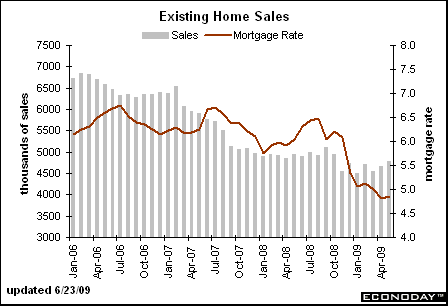
Existing-home sales fell 3.6% from May 2008. Sales in May 2009 rose 2.4% from April to 4.77 million. Note that these are apple and orange comparisons — revised to unrevised numbers. Once again, the prior monthly number was revised downwards (4.68 million down to 4.66 million).

Some more data points:

• Total housing inventory at the end of May fell 3.5% to 3.80 million existing homes available for sale;

• Inventory is a 9.6-month supply at the current sales pace, down from a 10.1-month supply in April.

• First-time buyers accounted for 29% of transactions, down from 45% last month, but up from 20% a year ago;

• Prices fell 16.8% for the national median existing-home from a year earlier;

• Distressed properties declined to 33% of all sales in May from 45% in April;

• Single-family home sales rose 1.9% (seasonally adjusted annual rate of 4.25 )million in May, but are 3.0% below (4.38 million-unit level) May 2008;

• Median existing single-family home price was $172,900 in May, down 16.1% from a year ago.

One of the more bizarre aspects of the news release was Lawrence Yun’s call for appraisers “familiar” with local neighborhoods:

“Lenders are using appraisers who may not be familiar with a neighborhood, or who compare traditional homes with distressed and discounted sales. In the past month, stories of appraisal problems have been snowballing from across the country with many contracts falling through at the last moment. There is danger of a delayed housing market recovery and a further rise in foreclosures if the appraisal problems are not quickly corrected.”

That is outrageous.

Consider:  The NAR remained notably silent during the appraisal corruption during the boom; Home sales based on loans to people who couldn’t afford them that drove prices higher were fair basis for appraisal comparables — but when these same homes are sold — inevitably through forclosure auctions,  REOs or distressed sales — they should be ignored? Only up, not down?

Even worse, they seem to be calling for a return to “local” (i.e., friendlier) appraisals — like the good ole’ days. You remember the “friendlier” era of corrupt appraisals that were rife during the credit bubble?

Am I reading this correctly? It looks like code for USE APPRAISERS (i.e., CORRUPTIBLE) WHOM YOU KNOW.

I thought I was inured to the idiocy of the NAR and the fetid stank of corruption that their press releases come with, but even I am astonished by the filth emanating from their offices today.  Shame on you  . . .

>

Existing Home Sales, May 2009 (NSA)
ehs-may-09

Chart courtesy of Barron’s Econoday

>

Previously:
Fraud in Real Estate, Mortgages & Homebuilders (August 17th, 2008)

http://www.ritholtz.com/blog/2008/08/fraud-in-real-estate-mortgages-homebuilders/

Nonfeasance in Financial Oversight (August 18th, 2008)

http://www.ritholtz.com/blog/tag/an-appraiser-from-new-york-who-sits-on-the-appraisal-foundation-board-that-writes-qualification-guidelines/

Source:
May Existing-Home Sales Continue Rising Trend
NAR, June 23, 2009

http://www.realtor.org/press_room/news_releases/2009/06/ehs_continue

30 Responses to “Existing Homes Sales Fall 3.6%”

  1. rtol Says:

    It will be interesting to see how much worse things get in the current interest rate environment. People often accelerate purchases in the early stages of a rate increase cycle, trying to get ahead of the curve. We’re past that now, and it’s hard not to think that rates going from around 4.5% t0 around 5.25% in the space of three weeks won’t impact sales volume and prices.

  2. DeDude Says:

    Barry, didn’t you get the memo? less “less worse” is the new “better” :-)

  3. Mike in Nola Says:

    Does this state mean much at this time with reports of shadow inventory, more foreclosures in the pipeline, banks not bothering to foreclose for various reasons, and the upcoming resets and recasts of new groups of mortgages? These seem to be a large group of known unknowns that prevents drawing any firm conclusions on the meaning of this number.

    I would think a better indictator would be something like sales v. real inventory, where real inventory = current inventory + foreclosures in the pipeline + homeowners likely to default when their loans reset. Seems like that would mean a lot more. But, I don’t know that there is a way to compile such numbers.

  4. DeDude Says:

    Mike, the question is whether the administration will have developed a plan for the next wave of resets before it begins. Can they get the owners of the homes and the owners of the loans, to negotiate a deal that will prevent foreclosure. Or will both parties demand to get more money and less pain out of the deal, to the point where they end up with foreclosure and more pain.

  5. mobiaxis Says:

    as per usual, MSM highlights improved m-o-m instead of worse y-o-y

    to borrow from Atrios …”The stupid – it burns!”

  6. Mike in Nola Says:

    DeDude: based on past performance, it don’t see much chance of anything constructive.

  7. ben22 Says:

    Regarding the housing data. Lately I’ve found this type of data less meaningful due to all the new programs with foreclosures and this new tax credit that you can fast forward into a down payment. Is there a way to quantify how much of an impact that is having on the data?

    Housing, at the end of the day, is about affordability, or at least it should be based on my simple thinking. There isn’t much difference in rates from this time last year to now despite the Fed’s efforts, and given that decline in median single family home price, you had homes selling at 205k last May, selling for 172k now. Assuming 20% down on either property and a fixed 30 year rate at 6% you pay $824 for princ + interest now vs. $983 last year, or a $159 difference.

    Is that really that much more affordable in an environment where job losses are still happening at a very high rate, you have things like gasoline rapidly rising in price, and credit is harder to come by.

    Credit deflation is going to trump any attempt at housing trying to come back.

    Then again, Cramer did just call a housing bottom……….

    Yesterday I posted this link on another thread:

    http://www.forbes.com/2009/03/31/consumer-behavior-recession-business-commerce-buying_slide_2.html?thisspeed=25000

    According to Forbes before the economy comes back the number 1 thing you should buy is a home followed of course by a car, and then things like vacations.

  8. Thor Says:

    On a personal note – I refinanced my house in April, getting the appraiser to pull comps for my house that weren’t foreclosures and that were nearer to my home was like pulling teeth. Although I agree that appraisers were a big part of the run up of the housing market, it is important to note than in a lot of urban areas an appraiser needs to know the neighborhood he is sent to appraise. Again, mine is a good example. Four blocks south of my home is a lower income neighborhood, four blocks north are the Hollywood Hills. Pulling comps too far in either direction from my home gives a skewed appraisal. For a good example for anyone who is interested. Pull up 90027 to see what the median home price is (mine is worth nowhere near the median)

  9. Thor Says:

    Benn22 – effort against them or not, yesterday sure was a FAZ day wasn’t it? ;-)

  10. call me ahab Says:

    b22 Says-

    “According to Forbes before the economy comes back the number 1 thing you should buy is a home followed of course by a car, and then things like vacations.”

    a Winnebago?- a threefer- home/car/vacation all in one package

  11. DeDude Says:

    Mike; but what if people learn from previous experiences. The amount of money lost from a foreclosure is substantial and “losing less money” would be a considerable incentive.

  12. phb Says:

    Can anyone comment on the correlation between the -3.6% and last weeks New Home Starts up 7.5%? Is this market so f’ed up that no real numbers can be determined?

    Finally, how does Bagdad Bob (Larry Yun) keep his job??? Why haven’t the members of NAR revolted??? These questions are rhetorical only…

  13. Mannwich Says:

    @ahab: Maybe they should start including RV sales in the home sales number. Was actually joking with a buddy that we should all buy one and live in it. You’d definitely be more mobile to find jobs and RV’s gotta be cheap right now. Not totally sold on the quality of life though. Not sure how you’d handle the whole “home address” thing though.

  14. call me ahab Says:

    mannwich-

    I think we are on to something big

  15. Mannwich Says:

    @ahab: I agree. Then we could merge the NAR with UAW and whatever the travel trade industry is…….achieve some economies of scale. Our astrologer-economists would be thrilled.

    BR could write his next book – “RV Nation”.

  16. kk500 Says:

    Barry,

    I agree that the quote you highlighted is outrageous. Lawrence Yun could have likely done a better job explaining the appraisal problem in the press release. Banks are increasingly using “appraisal models” that factors in additional declines of 20%. Comps are no longer given the greatest weight. My father-in law owns a real estate firm and told me that 8 of the last 10 residential deals collapsed in the last 2 months because the comparable sales in the neighborhood were not given considerable weight. Lenders are increasingly taking the average price of the comps and assuming additional declines of 20% (they are doing the same thing with HELOCs, REFIs, ect). Of course, this may be prudent risk management by the banks. But, it does not bode well for the housing market or the broader economy. Everyone knows that appraisal corruption was a huge problem during the boom. The real issue is whether the pendulum has swung too far in the other direction.

  17. bogwad_seigneur (the smelly one) Says:

    Barry;
    For this kind and gentle nugget of absolutely gifted prose…bless you:

    I thought I was inured to the idiocy of the NAR and the fetid stank of corruption that their press releases come with, but even I am astonished by the filth emanating from their offices today. Shame on you . . .

    I think I want to plaque that and mount it on my office wall. A memorable gem and rippling (I was going to say “vibrating”, but I wanted to keep the adjectival references like Caesar’s wife: “beyond reproach”) with righteous and well placed rage.

    This commenter – yet once more – salutes you.

  18. I-Man Says:

    BR Says:

    “I thought I was inured to the idiocy of the NAR and the fetid stank of corruption that their press releases come with, but even I am astonished by the filth emanating from their offices today. Shame on you . . .”

    Prose so good, it needed to be said twice.

    Fetid Stank Indeed.

  19. The Curmudgeon Says:

    An appraisal on a refinance is barely worth the ink it is printed with. Appraisals are another pseudo-science (see previous thread) that attempt to ascertain the “market” price of a house. They are supposed to reflect what a willing buyer would pay a willing seller, in an arm’s-length transaction.

    But which market should be used? The auction market on the courthouse steps? Or the market explicitly inflated by federal government programs designed for the purpose?

    The foundations for any “less bad” numbers are inherently fraudulent, just like the first go ’round. This too will end badly, but when it does, it will be because the fraud at the Fedres has caught up with them, exposing the Fedres as not TBTF.

    By that time, GS, MS, BAC, C, PIMPCO, etc., will have taken the last train for the coast.

  20. Calvin Jones and the 13th Apostle Says:

    ben22:
    Something smells when ever CNBC whines. Remember that CNBC jumped on the “the shorts are killing us” bandwagon. And they didn’t have a case to back them up.

  21. ben22 Says:

    Barry,

    Sorry to be so OT on this but are you noticing that lately this is a lot more discussion on ETF’s. I keep hearing CNBC in the last week that ETF’s are making up 40% of the trade volume, etc. etc.

    Today, two people in the morning advised using open end mutual funds instead of ETF’s. My company has banned the advisor ability to recommend any ultra etf’s or any inverse etf, even if it does not have leverage (SH, for example)

    Oddly enough I can still use something like PSSDX, or BEARX.

    There seems to be an effort against the ETF’s right now but perhaps its just the negative environment that has me buying into more conspiracy theory.

  22. GB Says:

    Why does the NAR even have the ability to talk after this crisis? What benefit have they had for buyers over the past 3 years? It reminds me of Chris Whalen’s piece yesterday about the CDS market. America used to lock people away that didn’t speak truthfully about investments or played fair. Shouldn’t we hold these people at the same accountability? Half my friends are under water that bought the last few years. They did the right thing putting down 10% and using fixed rate products. What would the NAR say to them now? We f’d up? There was no way to know that a correction would be this bad? Riiiiiight.

  23. thetanman Says:

    ben,

    Due to all the intervention, fudging and fiddling, markets all over the World resemble Frankenstein: big, unwieldy, unpredictable, distorted and dangerous. The G20 answer is more of the same. Another day wasted in ponziville and another day closer to Palookaville. We could have been a contender.

  24. bmoseley Says:

    i worked for a developer years ago. before the appraiser would begin his work on a job for my employer, he always ask: do you want a high or low number.
    not much new here

  25. ben22 Says:

    @Calvin,

    I almost wrote that in my post. The seem to be mentioning the ETF’s the same way they were blaming the shorts last year. Might be worth paying attention.

  26. Barry Ritholtz Says:

    Here is a blast from the past:

    http://money.cnn.com/2005/05/23/real_estate/financing/appraisalfraud/index.htm

    SNIP:

    Trouble is, pressure on appraisers is often subtle and not easy to prove, said Don Kelly, vice president of public affairs for the Appraisal Institute, which is calling for stronger regulation at the state level and legislation prohibiting lenders from meddling with the process.

    The problem is so widespread, that more than 8,000 appraisers – roughly 10 percent of the industry – have signed a petition asking the federal government to take action.

    Appraisers, like auditors, are supposed to follow a strict standard of professional behavior, said David Callahan, senior fellow at the public policy organization Demos and author of a recent report about appraisal fraud. “What is actually happening is lenders and brokers are telling them what value they want,” he said. “If [appraisers] don’t play ball, they don’t get paid or don’t get work again.”
    Inflated values

    A puffed up appraisal can have serious consequences for a homeowner down the road.

    “There are a lot of people who have refinanced for more than their homes are actually worth and they’re effectively already upside down even without a real estate bubble bursting,” said Callahan. Down the road if they have to sell or decide to refinance, a more accurate appraisal might show that they owe more than the house is worth.

    “The real issue is on the refinance side where people are cashing out of their equity on the basis of higher and higher values,” said Zielinski, who before accepting a job e-mails lenders and brokers to remind them that he is obligated to appraise property based on market conditions, not a predetermined value. “Conservatively, I’d say that 10 percent of the houses I appraise are worth less than the mortgage on them.”

    One overvalued appraisal can skew home prices throughout a neighborhood, according to the Appraisal Institute’s Kelly. “If a house is appraised for 10 percent or 15 percent more than it’s actually worth and the sale closes, it may be used by another appraiser as a comparable sale the very next day,” he said. “It has a ripple effect.”

    That could have even greater implications, said Martin. “The cumulative effect of appraisal fraud is you may have investors holding mortgage debt that’s backed by real estate worth less than they think it is,” said Martin. “It’s a train wreck waiting to happen.”

  27. Home sales improves slightly « Stocks Go Up. Stocks Go Down. Says:

    [...] sales improves slightly Jump to Comments No reason to jump for joy: • Total housing inventory at the end of May fell 3.5% to 3.80 million existing homes available [...]

  28. Winston Munn Says:

    “Lenders are using appraisers who ….who compare traditional homes with distressed and discounted sales.”

    What is a distressed and discounted home but a traditional home that is in foreclosure? To suggest there is some difference between a traditional home and a foreclosed home – as if completely different species – is, well…revolutionary evolutionary nonsense.

    Still, you have to admire this man’s guts to so blatantly call for fraud and for crony capitalism t0 rise from the ashes.

  29. NAR, NAMB Fighting Appraisal Reform | The Big Picture Says:

    [...] I noted the bizarre (and potentially corrupt) statement from NAR economists Lawrence Yun calling for appraisers “familiar” with local neighborhoods: “Lenders are using appraisers who [...]

  30. Appraisal Assault Part 2 | But Then What Says:

    [...] mine have also picked up on the story. Here’s a link to what Clusterstock had to say. Also Barry Ritholtz has been on the case. He did a little digging and came up with this letter outlining the planned [...]