
How Congress Betrayed Investors to Help Banks

Email this post Print this post
By Barry Ritholtz - June 3rd, 2009, 6:09AM

This morning’s outrage comes to us via the WSJ, and it discusses how our elected representatives rolled over for their overlords, the bankers, in grateful genuflection to their largesse: Huge heaps of lobbying monies:

“Not long after the bottom fell out of the market for mortgage securities last fall, a group of financial firms took aim at an accounting rule that forced them to report billions of dollars of losses on those assets.

Marshalling a multimillion-dollar lobbying campaign, these firms persuaded key members of Congress to pressure the accounting industry to change the rule in April. The payoff is likely to be fatter bottom lines in the second quarter . . .

The rule change angered some investor advocates. “This is political interference on a major issue, and it raises questions about whether accounting standards going forward will have the quality and integrity that the market needs,” says Patrick Finnegan, director of financial-reporting policy for CFA Institute Centre for Financial Market Integrity, an investor trade group.”

There was little surprise that FASB, like so many other organizations in the current mess, failed to show any testicular fortitude whatsoever. They rolled over in the face of intense lobbying and congressional pressure, so their masters could rub their bellies.

What else should we have expected from a group of neutered accountants?

>

click for larger interactive graphic
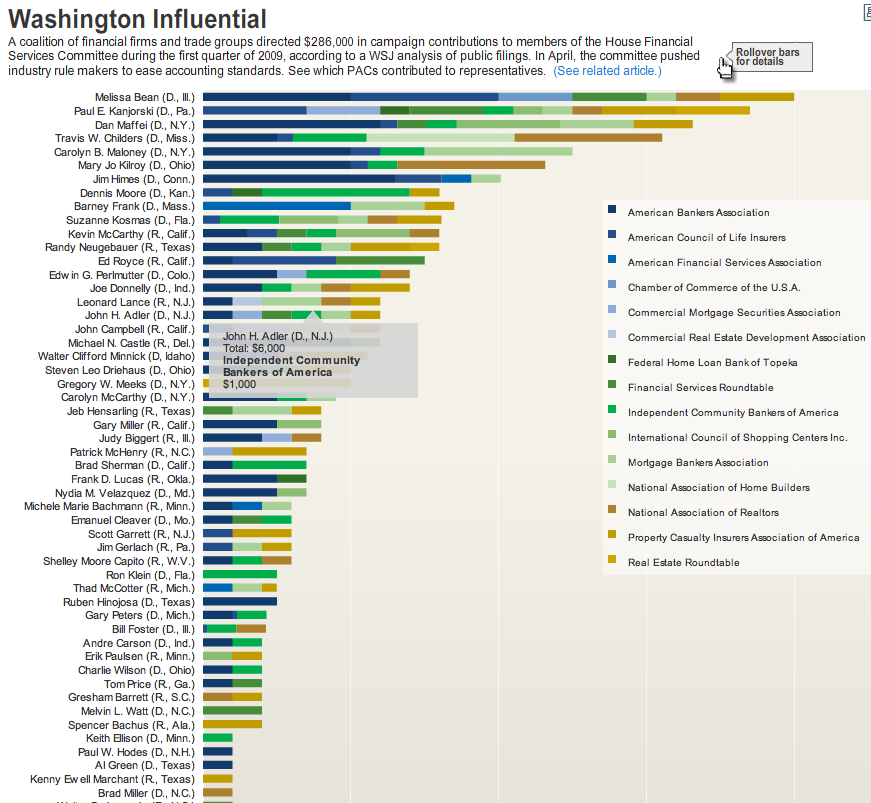
bank-lobbying-dough


>

Source:
Congress Helped Banks Defang Key Rule
SUSAN PULLIAM and TOM MCGINTY
WSJ, JUNE 3, 2009

http://online.wsj.com/article/SB124396078596677535.html

32 Responses to “How Congress Betrayed Investors to Help Banks”

  1. doug Says:

    BR, to see the graphic, one must subscribe to the source, but the comments of the article may be viewed for free and they are for the most part totally inane.

  2. granitestater Says:

    Politicians are worth exactly what you paid for. If you paid nothing for them, you get nothing. That is true of any politician of any party at any time in history. Of course that’s the reason they should be given as little power as possible so they can’t screw things up. Ideally they would be give zero power but they don’t seem to like that idea for some reason.

  3. Bankers own Congress « Stocks Go Up. Stocks Go Down. Says:

    [...] Bankers own Congress Jump to Comments Not surprising: How Congress Betrayed Investors to Help Banks [...]

  4. MattyWoo Says:

    Doug– To view any WSJ article for free, simply type its headline into Google, then click on the link to the article that shows up under “News results for [headline you typed].” It appears that doing so works for several subscription-based sites since they want their articles indexed on Google badly enough that they allow the backdoor access.

    Hope that helps!

    MW

  5. call me ahab Says:

    undoubtedly- we all knew this Barry- much effort was put into this among other things- including the “stress tests”- which were tailored to the TBTF bank’s wishes-

    now it appears that those who want to pay back TARP will have higher capital requirements- guess the Treasury is just making sure they can make it on their own-

    so what does that say about the banks that don’t pay back the TARP?

  6. Cursive Says:

    What else should we have expected from a group of neutered accountants?

    This also applies to auditors, internal or external, whether they be certified public accountants or certified internal auditors or various other specialized certifications (e.g. CISA). We cannot trust simply the function of any authority anymore, we must understand that authority’s motiviations, biases and funding sources. Sometimes those motivations, biases and funding sources work in the favor of objectivity and good rule making; most times these factors do not.

  7. Mike in Nola Says:

    Nothing new. Remember Will Rogers: “We have the best Congress money can buy.” Only the players chenge.

  8. crack Says:

    I dunno, that’s a pretty dramatic looking chart, but the top recipient got 20K. She raised over 3 million.

    http://www.opensecrets.org/politicians/summary.php?cycle=2008&type=I&cid=N00024875&newMem=N

    The securities field was her second biggest contributor, but nearly half that money came from individuals. Since she represents an affluent area of Chicago it’s not too surprising that she got money from people in the securities industry.

  9. doug Says:

    Matty Woo, Thanks. that works great. I appreciate the effort to let me know. Best Regards.

    I am shocked at how cheap a congress critter can be bought. Maybe they are only reporting the above the table handouts. Surely the critters are shaking them down for more than is reported…

  10. Gene Says:

    It’s not us that will pay the price. It’s our children and grand children that will see a real decline in living standards. I am reminded of the situation in Great Britain back in the sixties and early seventies: Crumbling infrastructure, state owned and supported dinosaurs that produced shabby, over priced products, bone crushing taxes and deteriorating services.

    It wasn’t Congress that rolled over. They are the symptom. We rolled over. We the people continue to elect and support politicians over and over and over without even a whimper of protest. We continue to elect so called conservatives or so called liberals, when in actuality, they are not true to their cause or philosophies.

  11. Moss Says:

    If u ask me nothing will change until they do something drastic about the campaign contributions from lobbyists and any other political proxy. Any individual citizen $ should be able to go directly to the candidate but any $ from any organization should be allocated into a fund that is then distributed evenly to their re-election campaign if applicable. This rule should be applied to all incumbent members of Congress and the Senate. The same should be done with PAC donations. They simply must NOT be allowed under law to contribute directly to an incumbent.

  12. Marcus Aurelius Says:

    The currency of politics in America is the single vote we each get. The politicians and the electorate seem to have forgotten that. PACs are influential due to money, not votes (a single $1M dollar donation to a PAC buys that PAC more political influence than 1M PAC members pledging nothing but their votes, and that ain’t right). It’s time we pool our votes into political investment groups outside the typical Democrat/Republican money-based framework. Too bad we’re so easily manipulated by fringe issues and a false sense of individual political poverty.

  13. The Curmudgeon Says:

    This qualifies as perhaps the understatement of the financial crisis:

    “This is political interference on a major issue, and it raises questions about whether accounting standards going forward will have the quality and integrity that the market needs,” says Patrick Finnegan

    >What accounting standards? What quality and integrity? Accounting, not only for how banks value assets but how the Fed engineers its balance sheet, etc., is utterly meaningless. Want to know what assets are worth? They’re worth whatever the government says they’re worth. Just like Alice in Wonderland. And don’t forget, even the metric used to value them, i.e., dollars, is rapidly losing meaning. How anyone would want to “invest” in any American “assets” is beyond me. From Bloomberg:

    “In the meantime, debt investors will have to consider new risk factors when weighing an investment. These include the size of a company’s workforce; the proportion that is unionized; whether or not the company, or a sizeable part of the unionized workforce, is in a political swing state; and whether it has operations in the home district or state of an important congressional committee chairman.

    The GM case showed that these issues, not usually considerations for investors, can be just as important as a bond’s yield-to-maturity or covenants. ”

    http://www.bloomberg.com/apps/news?pid=20601039&sid=a9HNldyokP.M

  14. matt Says:

    “Ironically, Kelly tells us banking executives feel they are “underrepresented” in Washington D.C . and reports on one who only half-jokingly plans to ask for a refund on his campaign contributions.” – Tech Ticker (Wall St. vs. Uncle Sam: Tensions Rise as Banks Seek to Escape from TARP)

    OT: Hey, “Toll Brothers posts narrower loss for Q2.” Green Shoots!!! It’s amazing how they try to frame all the bad news in the best possible light. Here, we have a money losing business that basically has thrown in the towel (short term) and scaled back its money losing business to reduce the size of the losses.

    I have a new plan for the government to juice the market. Any company that is losing money should go into a complete shutdown, where the only expense is interest payments. Then, when they report the next quarter, the losses will all narrow.

  15. call me ahab Says:

    from Bill Gross-

    “Bond investors should therefore confine maturities to the front end of yield curves where continuing low yields and downside price protection is more probable. Holders of dollars should diversify their own baskets before central banks and sovereign wealth funds ultimately do the same. All investors should expect considerably lower rates of return than what they grew accustomed to only a few years ago. Staying rich in the “new normal” may not require investors to resemble Balzac as much as Will Rogers, who opined in the early 30s that he wasn’t as much concerned about the return on his money as the return of his money.”

    Edward Harrison’s take from the blog Credit Writedowns-

    “But, as he suggests [Bill Gross], trillion-dollar deficits ARE the new normal indeed. Moving to eliminate these deficits too early as Tim Geithner suggests the Obama Administration wants to do risks a 1937 outcome.

    In the end, one can only conclude that the U.S. is indeed likely to deficit spend for a considerable period and that this is going to have negative effects on its credit rating and relative standing in the global economy. A diminished future for America is an inevitability of having lived beyond its means for far too long. Accepting this fact is likely to provide a better outcome than resisting it as the U.K. did when its tenure as king of the hill came to an end.”

    sad commentary indeed

  16. dead hobo Says:

    I’m still confused about this.

    One one hand, the markets were hysterical. On the other hand, a lot of marked down assets were significantly impaired in fact. I was not, and still am not, sure about how much of the valuation was due to negative sentiment and how much was due to factual worthlessness.

    All accounting is based on estimates. Depreciation is both an estimate and an abstract concept. LIFO layers don’t occur naturally in nature. Mark to market is another artificial construct.

    That being said, liars do occur naturally in nature and theft is an excellent motivation to lie. Investors are rather stupid and will believe almost anything they see in a headline or hear on CNBC. Mark to model, without objective and strong control and disclosure, is another way to say Overvalued / fictionally valued assets live here.

  17. Marie Antoinette Says:

    Deficits in and of themselves are not the problem really. I could live with trillion dollar deficits if the money were truly invested in expanding the country’s productive capacity, if it were investment rather than consumption.

    Is that the case? Sadly, it appears not. Obama talks endlessly about the coming wave of “investment” (unprecedented deficit spending) in three areas: health care, education and green energy. Let’s take a look.

    Health care is an industry–well, from a global perspective medical supplies, training and pharmaceuticals are industries. Are we going to position ourselves as ongoing leaders in these fields? Haven’t heard a word to make me think that. In fact, cost-cutting and redistributionism point to a downgrading of healthcare, while anti-trust mania on the part of Team Obama bodes ill for world-beaters in the industry.

    Likewise, we are told that “education” is an investment that government should use our taxpayer money to fund. As a former academic, let me assure you that is not true at the moment. Yes, invest more in primary and secondary ed. And go ahead and pay for college but ONLY for programs that benefit the country as a whole and which are inherently “difficult,” and (importantly) unfudgeable: science, medicine, engineering, math. You want to study Shakespearean sonnets? Tuvalu throatsinging? Pay your own way.

    Are we likely to lead the pack in “green” energy production and distribution? No. How about technology? Well, just look at what’s happening to Intel. Whoops.

    These guys don’t get it really (Team Obama). They have channeled a massive wave of money towards Wall Street, but Wall St is agnostic about investing in the USA. It is like the City of London at the end of the 19th century, when finance followed higher returns out of the country and out of the empire to the US and South America, leaving British industry to slowly rot and hollow out. It’s a testament to the engineering prowess of the Victorians that their industrial plant held up more or less into the 60s. In fact, when I travelled around India 10 years ago I was amazed at how much 19th century equipment was still in everyday use.

    But eventually you have to upgrade. We don’t seem to get that. So we’ll eat our own seed corn over the next 20 years and sink to mid-pack (or worse). Where is the visionary that will right this ship? His name is not Obama.

  18. How the Common Man Sees It Says:

    Why didn’t more significant lawsuits come out of this or did I just miss them? Are people so afraid of the PTB that they won’t sue or are all their hands so dirty they can’t afford to open the can of worms? And who came up with that term ‘can of worms’? Andy Rooney? I just had a “I’m typing like Andy Rooney” moment there.

  19. Mannwich Says:

    Yep, we bailed these f$ckers out so they can turn around and do the same shit again. Check out this email I just received from Wells (our bank, might change that one soon) literally a minute ago:

    Cash-Out Refinance

    Leverage the equity in your home.

    Begin the process online — Start Today

    Dear

    Use your home’s equity to get tax-deductible* borrowing power to:

    Consolidate high-interest debt into a single payment

    Get extra cash for home improvements or other large expenses

    Fund the purchase of other investment properties

    Begin the process online.

  20. dead hobo Says:

    Mannwich Says:
    June 3rd, 2009 at 11:21 am

    Begin the process online.

    reply:
    ———
    See how serious they are. Do you have a cat that needs a credit card?

  21. Mannwich Says:

    @hobo: No, but I have a dog. She could use some nice new treats and stuffed animals.

    These two lines are the best and proves that we haven’t learned a damn thing from this fiasco, which means another bigger one lies ahead and will probably happen sooner than we think.

    “Get extra cash for home improvements or other large expenses”

    “Fund the purchase of other investment properties”

  22. The Curmudgeon Says:

    @Mannwich…Wells is just doing what your government told it to do. The Fed’s program of buying Treasury bonds and MBS was designed to return us to the good ol’ days of 2007, plain and simple, and the bail-outs were to slow down and stop time until the time arrow could be pointed backward.

    I can understand how surprising this sort of advertisement might seem to someone that’s not in the business, but I’m in it, and it surprises me not at all. It is all a fraud, my friend, just like it was the last time ’round.

  23. km4 Says:

    Reagan started the US financial ponzi scheme in earnest ( about 30 yrs ago ) and Obama ( who admires Ronnie ) is just perpetuating more of the same for the Triumph of the Banking Oligarchs.

    Obama really cares about just two things
    1) pumping up great chunks of the Big Shitpile that’s essentially worthless unless the peak real estate values of the bubble can be miraculously restored with his Wall St bought and paid for economic team so he can
    2) get the US economy back to ‘normal” ( IMO no way those days are over ) and restore the American dream ( a mirage ) so he can get re-elected

  24. bill_from_chicago Says:

    @Gene

    “It wasn’t Congress that rolled over. They are the symptom. We rolled over. We the people continue to elect and support politicians over and over and over without even a whimper of protest.”

    Reply:

    The reason Americans “roll over” is that don’t really realize what is going on. We have been totally brainwashed by the same corporations who lobby the politicians.

    The average American gets his news from a channel like NBC. NBC is owned by GE, and GE wants to win huge government contracts and therefore NBC will never ever criticize the Government. In fact it is a key player in the cover-up, as they stand to make billions.

    The lack of independent journalism means Joe Schmoe is completely in the dark. They hear “green shoots” and they are off to the mall thinking everything is fine.

    Anyone who says America is the “country of the freedom” is delusional – its corporations that tell us what we should think, what pills we should take, who to vote for, what food is good for us, etc.

  25. Steve Merrell Says:

    I disagree with this assessment completely. FAS 157 was a well-meaning, but poorly written accounting standard that did not adequately anticipate the kind of market seizure we experienced in 2007-2008. FAS 157 enforced a “mark-to-market” accounting dogma when there was no clearly functioning market. The result was a self-reinforcing downward spiral in asset values – not because most of the assets were really worth so little, but because the forced deleveraging of hedge funds resulted in fire sale transactions that were, in turn, translated into bogus write downs to comply with FAS 157. Do you really think those bogus write downs give investors a better sense of what a company’s assets are worth?

    Steve Merrell
    http://www.SmartNestEgg.com

  26. Mannwich Says:

    @Curmudgeon: “My” government? It’s yours too.

    I agree with you and part of me isn’t surprised but this just lays it out in stark terms just how much they want to get the prior game going again, however absurd it may be. I’m a little amazed at how open they are about wanting people to tap their homes for equity again though. It’s just sobering and highly disappointing to see the evidence of it every day.

  27. Onlooker from Troy Says:

    Mannwich

    I too am disgusted and surprised (foolishly, I suppose) that this home equity withdrawal game is continuing at this point. With home prices still falling it’s crazy to still be in that business, even in the relatively staid Midwest). I see a couple of mortgage companies with the same commercials for debt consolidation, etc. (American Equity, Homestead Financial). I wonder how they’re financing this stuff since the whole shadow banking system took a dive. I thought these operations had imploded over the last year. WTF???

  28. jritzema Says:

    FASB is funded by Congress ultimately. They have always bowed to political pressure. That is why it took YEARS to pass stock option expense standards. Here is how it works: FASB comes up with a accounting standard that would improve transparency, business no likey, business lobbies Congress, Congress threatens FASB, FASB rolls over, repeat.

  29. jritzema Says:

    Sometimes Congress is too busy to threaten FASB so the SEC threates to ignore FASB’s new rule and FASB rolls over.

  30. cognos Says:

    “Mark-to-market” for banks was soo silly.

    Point 1) Consider that we did not have MTM from the mid-1930s to 2006.

    Point 2) Consider a simple analogy: you own a home. You bought it in 2006. You put only 20% down. You are current on your payments. The same house next store sells for 50% of your original “market” price in a foreclosure. The bank (or “debt regulator”) comes along and takes your house away. You are M-T-M bankrupt! You scream: but I am current on the payments, and I live here, AND I have earnings. Too bad. MTM!

    There is no “market” for illiquid assets in a crisis.

    Point 3) The basic fractional reserve banking system (think “Its a Wonderful Life”) is meant to be >10x leveraged. Its meant to be managed by accural accounting. It still has problems every 10-20 years and the regulatory regime is constantly evolving. But the basic approach is fine. MTM for accural loans is not helpful. For intelligent discourse on the subject see comments from William “Bill” Isaac former head of the FDIC. He has been quietly talking about policy mistakes (FDIC, Treasury, Fed) for over 1 year.

  31. Mannwich Says:

    So here’s my question: when will the banks lobby to have market to market reinstated? After all, they loved it when times were flush and the “market” told them they were making big profits and thus could then collect big bonuses. This nonsense is all a big game. They’ll be begging for this to be reinstated at some point down the road when it benefits them.

  32. Pat G. Says:

    Congress part of the PPT? Who would have thunk it??