Market Capitalization as a Percentage of GDP
Another interesting pair of chart from Ron Griess of The Chart Store. These two look at NYSE and NASDAQ relative to nominal GDP.
>
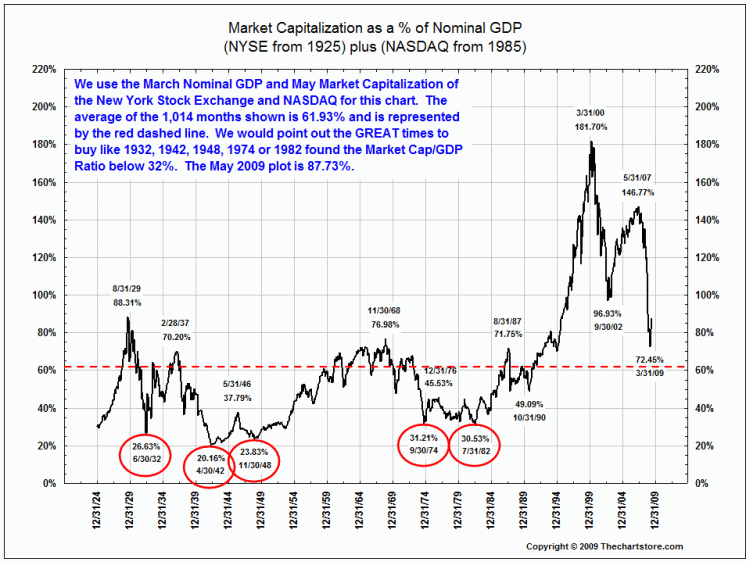
Another interesting pair of chart from Ron Griess of The Chart Store. These two look at NYSE and NASDAQ relative to nominal GDP.
>
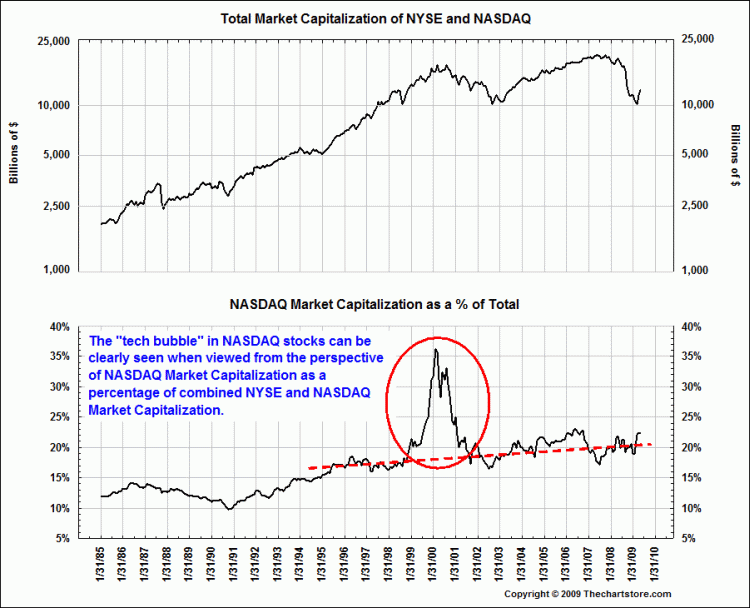
June 24th, 2009 at 12:58 pm
Considering that we are talking about (a) nominal GDP, (b) a GDP that is 70% consumption-driven, and (c) a GDP that is calculated and spun to the upside by government, an 80% ratio of market cap to GDP still leaves US equities a fat and happy market.
I already told you, Ritholtz, the Dow will still be at 17,447 after the world ends: http://www.ritholtz.com/blog/2009/06/compensation-symptom-problem/#comment-182264
June 24th, 2009 at 1:08 pm
CNBC Sucks Says:
June 24th, 2009 at 12:58 pm
the Dow will still be at 17,447 after the world ends
comment:
—————-
…. as long as some computers are left on and plugged into a brokerage account.
Actually, I like this chart. Given the way the average is skewed up due to recent bubbles, it implies a future equilibrium stock market level closer to recent lows than today. Only inflation that affects both GDP and stock market values will make it look like things aren’t as bad as they seem. One big ass bubble started in 1994.
June 24th, 2009 at 1:12 pm
I’m not sure that a chart of equity as a percent of GDP is terribly meaningful without also looking at the debt markets as a percent of GDP.
I’m pretty sure that the main thing illustrated (but by no means demonstrated in these charts) by the decline from 2000 is the increase in our GDP’s being driven by “investment” in debt markets vs “investing” in equity markets.
Not a big revelation.
June 24th, 2009 at 1:19 pm
Looks like we could be back down to 40% in blink of an eye.
That’s half.
June 24th, 2009 at 1:22 pm
Just eyeballing it, but if you pull out the last rise before the late 90s tech run up, it seems like the historical average before that point would be 45% to 50%.
Thanks for posting the chart, very interesting perspective.
June 24th, 2009 at 1:34 pm
That graph came just in time, thanks. I was about to go out and “back up the truck”. lol
June 24th, 2009 at 1:38 pm
You can see the trend is gradually up over time…there’s a reason for that…the numerator (market cap) should be growing faster as U.S. companies expand globally and derive an increasingly larger share of their profits overseas…
June 24th, 2009 at 1:56 pm
LOVE that chart!
Now that is great, great, great chart to get a feel for how whacked out things became…..
Mean reversion is a bitch.
June 24th, 2009 at 2:08 pm
This is kind of like looking at the 20 year SPX chart and realizing that even Down Here, we are still Up There.
June 24th, 2009 at 2:14 pm
@constantnormal,
I don’t think adding in the debt markets as a percentage of GDP necessarily helps because the debt markets encompass more than just the NYSE and NASDAQ companies. Your criticism is warranted, however, and maybe the enterprise values of these companies could be charted as a percentage of GDP instead of just market capitalization. That would give people a better understanding of how much debt is being carried by these companies today versus historically.
Still, I always enjoy it when people come up with new ways to look at existing data to help understand what is going on. Cool and useful charts.
June 24th, 2009 at 2:33 pm
what just happened to the Market? One minute I look and it’s up 40, two minutes later it’s down 10
June 24th, 2009 at 2:56 pm
@Thor (2:33)
That was leftback just screwing around with the tape…
June 24th, 2009 at 2:59 pm
Cvienne – there you are. Where have you been? How dare you have a life outside this blog!
June 24th, 2009 at 3:02 pm
@Thor
I can’t spend my whole day just entertaining you blokes now can I?
June 24th, 2009 at 3:03 pm
@BR
I’m sure Fleckenstein would love to see that chart…
If you notice…pretty much everything past Greenspan is a bubble…
June 24th, 2009 at 3:12 pm
Let’s see…
One could also understand that between 1974 and 2006, home values rose fairly steadily (then steep)…
Most logical thinkers believe that home prices need to come down at least another 20% to revive the market…Furthermore, late entries into the housing market are underwater, unemployment is still rising, unemployment benefits are about to expire, taxes are going up, the government is running a 2 trillion dollar defecit (and propose to add MORE this summer), everyone is maxed out on their credit cards, banks are pulling credit lines, gas prices are high…
Naw – stocks are “cheap” here, right?
June 24th, 2009 at 3:14 pm
Buffet peed in the punchbowl….
http://www.cnbc.com/id/31526130/
Reality is the enemy of Creative Capitalism!!
June 24th, 2009 at 3:15 pm
and Bitchslaps AAPL….appropriately I might add….
June 24th, 2009 at 3:44 pm
So, I made the mistake of turning on CNBC to catch the Fed statement coverage…lots of discussion about this Issa fellow making shocking allegations about Bernanke.
Is anyone else disturbed by CNBC’s coverage of this? The CNBC anchors seem apoplectic that a congressman would make these sorts of allegations about such a beloved figure…..I think Cramer basically described him has the freaking Pope.
It all makes me want to vomit….
The gist of the CNBC view is this: “Look. The world was falling apart…the system was going to meltdown. How dare you go back and second guess his actions. He saved us!”
What kind of message is that? That we should all act honorably and within the laws UNLESS things get really bad, THEN we can do things we otherwise wouldn’t? WTF kind of message is that? These people make it sound like the U.S. was going to evaporate….
“Man looks in the abyss, there’s nothing staring back at him. At that moment man finds his character. And that is what keeps him out of the abyss.”
June 24th, 2009 at 4:18 pm
EricTyson, darn good point. I wonder what the “new normal” should be. Were it not for the strong possibility that we’re on the backslope of Peak Credit/Debt, this should be a buying opportunity.
June 24th, 2009 at 4:20 pm
In other words, “were it not for the strong possibility of a thunderstorm and tornadoes, tomorrow will be a good day for a picnic.”
June 24th, 2009 at 4:57 pm
Since 40 percent of S&P500 earnings come from abroad, I’m not sure today’s ratio of U.S. stock market cap to U.S. GDP can be meaningfully compared to the ratio of several decades ago. The denominator should now include some international GDP weighting to reflect the international component of the S&P500. The S&P500, of course, represents about 70 percent of the capitalization of the U.S. equity market.
June 24th, 2009 at 6:06 pm
Andy Tabbo – You had my full agreement at the very first sentence: You made a mistake of turning on CNBC.
#54…
June 24th, 2009 at 6:17 pm
AndyT .. I saw that Issa interview and the follow-up Cramer and W.Buffet confidences in Bernanke … Issa is on again in the morning .. I think I heard Bernanke is on Capitol Hill again tomorrow too … as a Main Streeter who started to see things going crazy on Wall Street have become somewhat addicted to following this train wreck (a train is to small an analogy) via theCNBC (only FinNet supplied on my cable plan)
I like Bernanke and see him as another public servant attempting to please to many masters (which may be perfect) … back to the point of your post .. as a MainStreeter I am somewhat happy that business as usual is not a-ok with everyone in charge .. these days are interesting I’ve heard bantered .. they are also extremely life impactful for some (and everyday seems some-more)
the primary point us MainStreeters see is the massive paydays for the teams of this game on WallStreet at our MS expense … of course I can’t over generalize .. numbers of people out here on MainStreet saw many good years also in the building boom … thing is seems WallStreeters may get to keep theirs if they cashout and come back to the MainStreet of lowered expectations
June 24th, 2009 at 6:25 pm
ps – missed a point … sometime during the day a suggestion was made that Summers was not the only choice out there for the Chairmanship (other than Bernanke) … that suggestion fell to the floor like one of the Acme anvils
June 24th, 2009 at 10:04 pm
another chart that shows you absolutely nothing about nothing.
first off, is everyone aware that more american households are participating in the stock market than ever before, that more companies are using stock options as employee compensation than ever before, that a larger proportion of the usa population is within the “investor age” (40+) age demographic than ever before, and that a larger proportion of pension funds, with a fatter chunk of pension age (60+) demographic than ever before, are investing in the stock market than ever before?
then is everyone clear that more foreign nationals, foreign governments, sovereign wealth funds and baby jesus are investing in the usa stock market than ever before?
finally, is everyone clear that we are in the midst of a ginormous wealth bubble, primarily produced by third world slave wage labor and utterly reckless resource consumption — at resource prices that exclude the externalities of resource exhaustion (oil, minerals, rain forests), resource sustainability (water, fisheries), and the negative impact of global climate change?
so what is this chart telling us, exactly?
i can tell you in a phrase: there is a huge pile of cash on this planet, and if you think the previous bubble was also the last bubble, then you don’t know anything about wealth, markets and bubbles. or, it seems, about charts.
June 24th, 2009 at 11:49 pm
how interesting the average of the months on the top chart is a fibbo 61%
June 25th, 2009 at 1:43 am
Andy T if people followed crazy cramers advice they would end up living in the street! Market Ticker has a great piece on it.
http://market-ticker.org/archives/1156-More-Bernanke,-Mr.-Issa,-And-The-Media.html
June 25th, 2009 at 5:24 am
drollere,
what is your point?
June 25th, 2009 at 8:07 am
MEH on drollere .. that rant got notice from me & to research further povs/background
I’ll say the last 10 year couple spikes (both directions) to a MainStreeter … I’ve been looking around wondering why I couldn’t keep us with the Jones … I worked with a decent wage scale and took the jobs when offered .. I’m not an alcoholic, or a druggie, no prisiontime, still hauling around school day trinkets
the wondering went back to this feeling that maybe it was marketeering in WallStreet (maybe some get lucky in Vegas) … but I came around to a personal diagnosis that people were riding a wave of #s in accounts as collateral .. and thats it imo .. a banker looks at those accounts and allows (thinkin safely) working collateral at 40% or something
I’m vested in a pension (hope that means something soon) and that brings us back to your question about the rant …. so now I deduce that the marketeers have nearly drained the pool for their everyday living .. and the retiree – say to (get back to work) … my training here at TBP puts this whole thing as a giant ponzi at this point (maybe drollere thinks the kids see that)
…. was thinking of wreck analogies .. Chernobyl came to mind .. man made by mistakes in process understanding that created death and devastation for a very large area with an impact on that region for 100 years ….. still there’s difference here is this disaster .. more sublime and global ….. I’ve heard it said in the last 10 years .. if your gonna do something like this on purpose – do it big and cya
June 25th, 2009 at 9:00 am
I may be accused of sinking my own ship with loose lips:
http://www.ritholtz.com/blog/2009/06/no-change-in-rates-or-statement/#comment-186357
in my defense .. I’ve heard the market moves all by itself … imo I think there is a slow slow withdrawl going to happen .. and I hope the fund managers in my camp see that
… another point by drollere “resource exhaustion” I copy that and that bigger pool of requesters
June 25th, 2009 at 9:31 am
BARRY– can you get a chart of this v GNP? this is I believe a better gauge, as it takes out government spending in GDP.
tx
June 25th, 2009 at 7:35 pm
While we are requesting charts, what would be more interesting is the combined sales of all of the companies listed / GNP as a comparative graph. If the proportion of the economy that is listed remains constant then this graph is very interesting.
My guess is that the proportion of the economy that is listed has changed over time which could give some very different interpretations. For example if 60% of the economy is listed now but only 30% of the economy was listed in the 70s then that would explain the difference in ratios.
June 27th, 2009 at 8:53 pm
I agree with damo.
I think the chat is meaningless. It just shows the ratio of the market cap of publicly traded companies to GDP. What about the public-to-private ratio?
June 28th, 2009 at 8:22 am
[...] Barry Ritholtz, The Big Picture, June 24, [...]

