
New Home Sales Fell 32.8%

Email this post Print this post
By Barry Ritholtz - June 24th, 2009, 11:39AM

Once again down the rabbit hole:

No, we do not know what the monthly sales were for New Homes. The data point for sales of new one-family houses in May 2009 was 0.6%, but the margin of error was ±17.8%. That means the number is statistical noise.

And as expected, April’s data was revised downwards.

Year over year, sales fell 32.8% — a valid number relative to the error (±10.9%) below the May 2008 estimate of

The median sales price of new houses sold in May 2009 was $221,600; the average sales price was $274,300. The supply of new houses for sale was 10.2 months at the current sales rate.

>

New Home Sales, May 2009
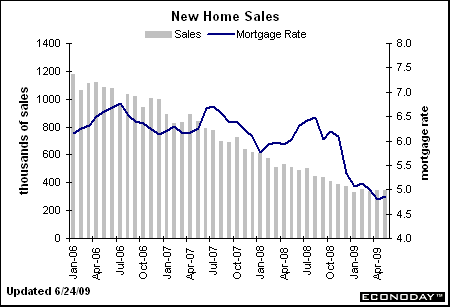
new-home-sales-may-09
Via Barron’s Econoday

>

Source:
NEW RESIDENTIAL SALES IN MAY 2009
U.S. Census Bureau and the Department of Housing and Urban Development.
JUNE 24, 2009

http://www.census.gov/const/newressales.pdf

16 Responses to “New Home Sales Fell 32.8%”

  1. Andy T Says:

    I’m no expert on housing or what a “natural” rate of sales might be, but what stands out to me on this chart is how housing sales were trending lower regardless of the mortgage rate. Notice how choppy the rate was across 06-08 and sales were on an inexorable slide. The slide continued on in 08-09 despite collapsing rates. Sales seem to have leveled off here around 350-400….is that going to be the new rate of sales for awhile? If so, how does it fit in with where we’ve been the last several years? Is the construction industry sized for this “new normal” ? (see auto industry for an example of being improperly sized for the “new normal”)

  2. HCF Says:

    The problem is, as with any economic problem, one of supply and demand. During the most recent housing boom, nearly EVERYONE who could afford a house bought one. All the exotic mortgages allowed nearly everyone who COULDN’T afford a house to buy one. The home-building and related industries all stepped up and were all too happy to supply us. Now we have a glut of housing and all interested parties are trying to prop up prices. Interest rates are only a small component of affordability… Until young people (pretty much the only buyers left, since most were in school during most of the housing boom) can buy houses without leveraging up to their eyeballs, the pundits will continue to be “surprised” by how terrible the housing market is…. I don’t see why lower prices is a bad thing in real estate (although I see why others feel that way!!!).

    HCF

  3. GB Says:

    I like the distress gap analysis CR has. It shows the magnitude of new homes that were built during the boom. Ah to have a time machine and go back to 2001 and buy up everything you can.

    http://www.calculatedriskblog.com/2009/06/distressing-gap-ratio-of-existing-to.html

  4. CapitalistCanuck Says:

    @HCF

    “Interest rates are only a small component of affordability… Until young people (pretty much the only buyers left, since most were in school during most of the housing boom) can buy houses without leveraging up to their eyeballs, the pundits will continue to be “surprised” by how terrible the housing market is…. I don’t see why lower prices is a bad thing in real estate (although I see why others feel that way!!!).”

    I believe you are right on the money! I happen to be one of those young buyers in exactly that position. Not interested in taking excessive amounts of debt. Although friends my age are doing it because interest rates are so long, but that’s because they only know how to quantify things in terms of monthly payments. I feel sorry for those buying now and the bottom of the interest rate cycle – actually, no I don’t…

  5. CapitalistCanuck Says:

    err I meant because interest rates are so low…can’t edit posts doh!

  6. Bruce N Tennessee Says:

    “And as expected, April’s data was revised downwards.”……

    Ok, look, let’s get the rules straight here, shall we? The mother ship (that is you, Barry) is not allowed to make cynical or smarty-pants comments on the initial blog posting. OK?

    That is the job of your cynical, smarty-pants readers…what would you have us do, otherwise? This is where we go to get our cynical release, and if you keep doing this you will leave us with nothing to do.

    OK…don’t let it happen again….

  7. Moss Says:

    The old normal was not at all real. Where the new normal, or the real normal is is anybody’s guess. I suspect it will not exceed 5.5 or quite some time.

  8. Onlooker from Troy Says:

    HCF

    Not only that (re: overbuilt supply) but there was a significant number of housing units (single family, condo, etc) built that was almost purely flipping inventory, built on spec and scarfed up by flippers by the dozen. I’m sure it was relatively small compared to overall numbers, but when the music stopped that supply of empty housing really exacerbated the problem, especially in the condo market.

  9. CNBC Sucks Says:

    Ritholtz is getting cranky lately. I think Ritholtz ran into Larry Kudlow, Don Luskin, and the little Ewok recently and those three ripped on Barry’s “Libertarian” ideas even as Barack W. Obama was doing everything the GOP wants.

    Ritholtz, I think you should go on Kudlow again just for old time’s sake and to stir the summer pot.

    By the way, is Don Luskin still alive?

  10. drollere Says:

    we’re in a recession and a housing slump as those things are defined in normal times, *and* we’re looking backwards at a historically aberrant tsunami of financial and regulatory delusion.

    ytd numbers have only that story to tell, and no other.

    there seems to be a “things are terrible and they’ll never get better” editorial policy at BP. statistics are chosen, and skewed, to insist on that sermon. (when unemployment figures moderate, shift to “exhaustion rate”.)

    data analysts understand the basic hygiene here. avoid lagged statistics, moving averages, ytd comparisons, difference indexes, ratios of ratios, and all other inflators of noise, measurement error and the dead hand of the moronic past.

    don’t look backwards with regret or chagrin– unless a return to free money, free wheeling and free recklessness is your terminal pleasure.

    most posters here have been proclaiming for months the ultimate crash, the “rising wedge”, the retribution for sin, the scourge of inflation, the reign of gold. i’ve been pointing out for months that the market is going up and may go upper. those who listened to me have made a nice profit. the others have very tight shorts.

  11. HCF Says:

    @ Onlooker From Troy
    >almost purely flipping inventory

    I love that term! Housing units being traded like baseball cards or Beany Babies…. If we just flip the same shit back and forth to each other at ever higher we’ll all be rich! Well, at least until the whole thing collapses… =)

    HCF

  12. GB Says:

    Can’t wait to get a vacation home cheap.

  13. Novemberrain Says:

    I think the housing crash is far from being over.

    Job losses have almost reached its peak .Foreclosure rates rise with unemployment levels as many homeowners are affected as they are not able to earn money and pay the home loans. People who want to buy new homes are also refraining from the risk as they are unsure of their employment in the coming months. Home sales

  14. Pat G. Says:

    “but the margin of error was ±17.8%.”

    An example of “pro-fraud”. How is such a variance allowed in any specific number? “New home sales”. Why is this number apparently, so difficult to derive?

  15. James R. Hagerty Says:

    FHFA Data May Signal False Bottom in Housing
    http://blogs.wsj.com/developments/2009/06/23/fhfa-data-may-signal-false-bottom-in-housing/

    The latest U.S. home-price data from the Federal Housing Finance Agency may be a false signal that the housing market is bottoming out.

    The agency reported Tuesday morning that its price index in April was down 6.8% from a year earlier, but showed a decline of only 0.3% in the first four months of 2009. “We may be starting to see signs of stabilization in prices for houses” funded by mortgages guaranteed by government-backed investors Fannie Mae and Freddie Mac, the FHFA said.

    Ivy Zelman, chief executive of Zelman & Associates, a research firm, is less sanguine. She says in a new report that the low end of the market “appears to be approaching stabilization given improved affordability for first-time home buyers and the willingness of investors to absorb distressed home sales.” But she expects prices of higher-end homes to fall swiftly in the months ahead as sellers become more desperate.

  16. Onlooker from Troy Says:

    drollere

    That’s right, it’s all better now. Nothing to see here. Happy days, just like in ‘07. A rally suddenly makes it all better, just as it always does; until reality sets in again. But thanks for the lecture, as incoherent as it was.