
Real GDP: Year over Year Change
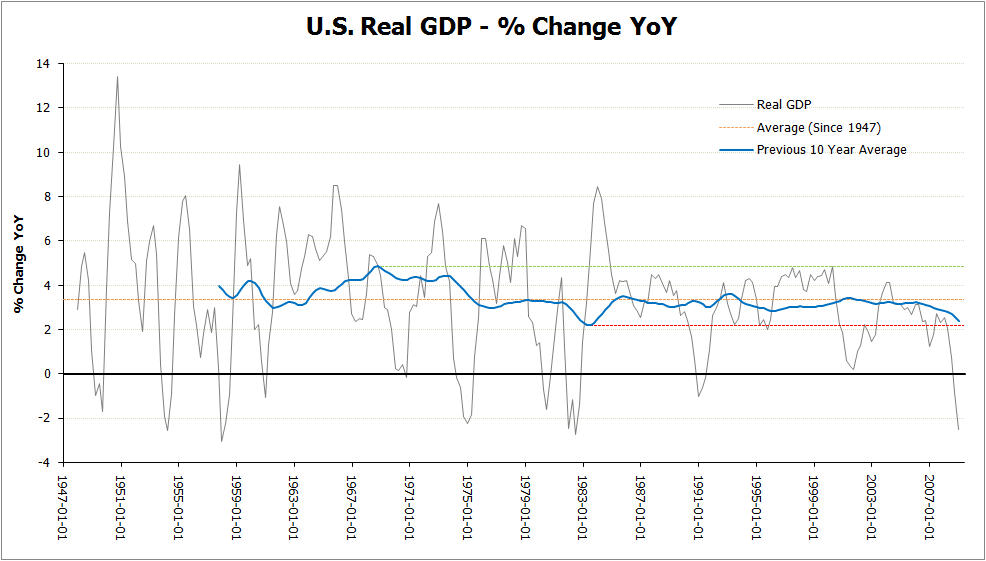
Interesting chart sent to us from Wesley Allen, a grad student at Purdue. Wesley notes: The past 10 years have been close to the worst on record for % Change YoY of Real GDP.
Why were the past 10 years so poor? My best guess is that lots of activity was artificial — based upon unusually low rates, easy credit — unsustainable, unnatural factors.
>
Thanks, Wesley!



June 6th, 2009 at 6:09 pm
looks like there is a problem with the layout.
but i am not surprised that the GDP was faked for a long time. that was to keep every one from noticing the on rushing train. its also very hard to have real GDP growth if every ones doesn’t participate. since that the consumer base
June 6th, 2009 at 6:17 pm
I
have
a
hard
time
reading
like
this.
Who
has
been
fooling
around
with
the
server?
June 6th, 2009 at 6:40 pm
You are confusing cause and effect. The use of credit to sustain living standards was not the cause; but merely the result of declining income. Of course, government policy could have encouraged real investment rather than paper trading, but that would require seeing beyond tax cuts and bombing Baghdad.
June 6th, 2009 at 6:59 pm
“Why were the past 10 years so poor? … [because of] unsustainable, unnatural factors”
Sure is a good thing that we don’t have any of those any more.
June 6th, 2009 at 7:20 pm
Barry is showing the true REAL compression of US GDP in the comments field
June 6th, 2009 at 8:24 pm
We are simultaneously at all-time record P/E for the S&P and all-time record Total credit to GDP. How can this end well?
June 6th, 2009 at 8:54 pm
1(a
le
af
fa
ll
s)
one
l
iness
e.e. cummings
June 6th, 2009 at 10:18 pm
This thread is screwed in IE8 and Firefox. All comments are squeezed into a column about 20 characters wide on the left margin. Looked back at older threads and they are fine.
June 6th, 2009 at 10:30 pm
BR or admin,
the page is messed up. Margins not wide enough.
June 6th, 2009 at 11:48 pm
Adjust for spending from mortgage equity withdrawals and the last 10 years likely wouldbe the worst on record.
June 6th, 2009 at 11:50 pm
Fleas
Adam
Had’em
June 7th, 2009 at 1:16 am
W
e
l
c
o
m
e
t
o
B
a
n
a
n
a
s
t
a
n
June 7th, 2009 at 3:02 am
It’s hard to have growth when energy costs are eating into profits. From $12 in 1998 to $68 today is a business killer. I suspect the damage starts around $40 barrel.
The concept of +$50 oil financing increased production is probably a chimera. The GDP is running on momentum right now, in a few months?
????
June 7th, 2009 at 3:17 am
Whats this?
How can
the chart be more important than we are?
June 7th, 2009 at 4:12 am
From blog to newspaper column! Now I can skinny up my browser and read TBP on the right side of the screen.
BR if you look at a similar time in history it would probably be the British Empire as they lost colonial resource pools and their share of ship, auto, and heavy equipment manufacturing declined. WWII was certainly the clincher but their economic might had declined to a pale shadow of its former self years before that event.
The US seems to be walking in Britain’s footsteps about a hundred year’s later.
It would be interesting to see a side-by-side comparison of Britain’s GDP during their decline and fall alongside current US figures.
June 7th, 2009 at 7:13 am
air-
trad-
er
good
post-
I have
thot
the
same
thing
re
UK
dest-
iny
it
ap-pears
un-
less
we
can
re-
in-
vent
our
selves
June 7th, 2009 at 8:38 am
Fixed — there was a weird code error in the chart . . .
June 7th, 2009 at 8:55 am
Starting back around 2005 it was becoming apparent that the economy was in for a rough patch because the only new storefronts being built in the sections of Queens I drove through were banks, not even retail chains. In some areas, it appeared that more banks were on the street than actual stores. All that we were making competitively was debt. Now, we can’t even do that anymore.
June 7th, 2009 at 9:21 am
Pondering my own statement “We are simultaneously at all-time record P/E for the S&P and all-time record Total credit to GDP. How can this end well?”, it dawned on me…Asset deflation coming. Remember… Assets=Liabilities +Equity. If liabilities are pumped beyond imagination and equity (think stocks and inflated housing values) are overvalued, assets must come down.
Can we have simultaneous commodity and consumer good price INflation and asset DEflation? Let me ponder that one now…feel free to chime in.
June 7th, 2009 at 9:21 am
We have low economic growth and we will continue to have low economic growth because we have a culture where no good deed goes unpunished. Americans love helping people. We are the most charitable people in the world. Opening new businesses and developing new products is a natural extension of our humanity. But with onerous regulatory and legal challenges to running a business, it gives business owners a case of “alligator arms.” Why do anything when you’ve got to file all the paperwork required by state and federal laws/agencies and face legal shakedowns from trial attorneys?
June 7th, 2009 at 9:34 am
@ Steve Barry: “Can we have simultaneous commodity and consumer good price INflation and asset DEflation?”
The answer is yes. In the 1990s, we basically had the opposite – low goods inflation and super high financial asset inflation. Different asset classes can behave very differently for long periods of time.
June 7th, 2009 at 9:44 am
@SB 9:21
“Remember… Assets=Liabilities +Equity. If liabilities are pumped beyond imagination and equity (think stocks and inflated housing values) are overvalued, assets must come down.”
Accounting has nothing to do with it. From a strictly accounting theortical construct, as owner’s equity shrinks, liabilities can grow and assets can stay at current values. The equation will always balance itself, so forget the accounting angle. It is cash flow that matters most. When the debt service becomes unserviceable for individual companies, we will see (are now seeing) bankruptcies. As less and less companies are able to pay for goods and services, the left side of the balance sheet, i.e. assets, of other companies will have to be written down. As operating income stagnants or falls and assets depreciate and debt remains current, owner’s equity begins to fall. We are experiencing this now, but a combination of government intervention along with mass delusion have blinded many to it.
June 7th, 2009 at 9:53 am
@Matt
@ Steve Barry: “Can we have simultaneous commodity and consumer good price INflation and asset DEflation?”
The answer is yes. In the 1990s, we basically had the opposite – low goods inflation and super high financial asset inflation. Different asset classes can behave very differently for long periods of time.
———
Maybe on an international level we need to trade current goods for current goods instead of current goods for future goods. Imported oil, imported manufacured goods. Instead of exporting goods we exported claims on future goods (bonds) which helped keep interest rates too low driving asset inflation more than goods inflation. Goods and assets at different rates of inflation, just move the average from net inflation to no inflation and one of the other will be in deflation while the other group is inflating.
June 7th, 2009 at 10:24 am
Huge misallocation of capital.
Wars, non productive production = capital destruction.
Excessive Financialization, asset securitization and the like = no savings thus no real investment.
Wars to keep the oil flowing, Financialization to keep the elites rich.
June 7th, 2009 at 10:38 am
“Can we have simultaneous commodity and consumer good price INflation and asset DEflation?”
imho, while possible, I don’t think so. As the credit deflation continues (it has hardly started) then consumer goods will come down in price as well, just like they all did, including gold, last year. Basically when the credit deflation takes hold everything trades as one market.
June 7th, 2009 at 11:35 am
@ben22
If at point a in time assets and goods were at a “proper” price and relationship and over time goods doubled while assets quadrupled if things were to return to the “proper” price, assets would fall 75% while goods declined in value by 50%. But realizing that a society based on electronic money collapses in that situation, and with a fiat money/no constraints on creating “money” system with dubious cpi reporting the powers create money so that goods prices remain stable while asset prices only fall by 50%. Or they create more money so that asset prices remain stable while goods prices double to reach the “proper” ratio. Of course, the concept or level of “proper” can be debated likely with different results based on the society and money system employed.
June 7th, 2009 at 12:41 pm
Steve Barry @ 9:21
Can we have simultaneous commodity … inflation and asset deflation?
Absolutely. That’s happening already…. look at the price of crude oil, or the CRB index… compare that with the Case-Schiller index.
However, I would prefer to think in terms of ratios. The RATIO of the Case-Schiller index to the CRB index is going to continue to decline for at least the next few years.
June 7th, 2009 at 12:57 pm
But the question right now (and last year) re: commodities is:
Is it inflation, or just speculation pushing prices up?
Or is there a difference? It feels like there ought to be, but I’m not sure.
June 7th, 2009 at 1:19 pm
Onlooker @ 12:57
I think that for anyone trying to answer that question, it is important to attempt a detailed and thorough definition of the term “speculator”. Last summer, we heard this term being used over and over by economists, MSM journalists, politicians, and by contributors to this blog. Not once did I see anyone attempt to define the term.
In my opinion, if you take out all of the people who have the power and the means to limit supply, then the remaining “speculators” cannot influence the spot price of commodities. Of course, these people can only be “taken out” in a hypothetical sense.
If you make an earnest attempt to provide a detailed definition of the term “speculator”, I think you’ll then have the answer to your own question.
June 7th, 2009 at 1:36 pm
@DL/Onlooker
Re: “Speculators”
This is a favorite subject of mine. Briefing.com gets it right when it refers to “market participants.” That’s really what everyone is. Some people day trade, some people swing trade. To people who call themselves “investors,” the day traders and swing traders seem like speculators. I tend to look at everyone who cannot directly manipulate the market (e.g. primary broker/dealers and market makers) as a speculator, since it’s a ca$ino.
June 7th, 2009 at 1:49 pm
Cursive,
In the case of the oil market, you’ve got to include other participants. For example, people who rent out vessels to store oil. Or the refiners who have a lot of storage capacity (I assume) and who take oil off the market in the hope of a price increase. The most important speculators of all in the oil market (IMO) are the producers themselves. Futures traders have a role, but it is indirect. Absent those who can take product off the market, I don’t think that futures traders themselves can affect the spot price of oil.
June 7th, 2009 at 1:54 pm
Yeah, I get that. I guess it goes back to the question about whether the markets are being driven by true supply and demand or whether they’re primarily being influenced by speculation about future supply and demand, as I think most would agree we’re seeing now and saw last year in oil.
There’s not an easy answer to that. And it’s not new by any means. Farmers have long complained about it in ag commodities, I believe.
Maybe it’s just being exacerbated in our times by the liquidity that’s been pumped out with no real investment demand (i.e. there’s lot’s of excess capacity in manufacturing, retailing, and real estate right now) and really low bank reserve requirements still; i.e. lots of leverage at play.
June 7th, 2009 at 2:02 pm
@DL
Yes, whether physical or futures, everyone is in the game as a speculator. This contango market is setting the speculators up for a huge fall. I won’t give any price predictions because it would be foolhardy to think that I know where it is going, but I wouldn’t be buying oil here.
OT: Has anyone seen that the f^cking FR is hiring a lobbyist? UFB. So much for their supposed independence. This fact alone should put any FR apologist on notice. These bastards have always been about power – the power to control money.
June 7th, 2009 at 2:07 pm
Oh, I forgot to mention that the lobbyist used to work for Enron. You absolutely cannot f^cking make this $hit up. Oh, and the 31-year old in charge of dismantling GM hasn’t even graduated from Yale, yet, and his closest contact with GM is that he fell asleep in the parking lot of a GM plant in Ohio when he and his dog were driving back to D.C. last Fall. U-F-B, U-F-B, U-F-B….
If clawback reads that, I don’t know what he’s liable to do….
June 7th, 2009 at 2:18 pm
Onlooker @ 1:54
“…whether the markets are being driven by true supply and demand or whether they’re primarily being influenced by speculation about future supply and demand… …farmers have long complained about it”
I’m sure that there are more than a few speculators among the farmers. They trade commodity futures….. and they have those huge grain silos which can be used to take product off the market.
June 7th, 2009 at 2:25 pm
Yes, in the end we’re all speculators of some kind; with the possible exception of some monks living in Tibet, I suppose.
And some of those farmers speculated last summer that they should hold onto that wheat, corn, etc. in those silos to get that better price as they saw the slope of the market get steeper. They ended up being very sorry for that move.
So I get your point DL. Well put.
I certainly don’t have this all figure out, no doubt.
June 7th, 2009 at 4:40 pm
[...] Real GDP [...]