
The Still Over-Leveraged Consumer

Email this post Print this post
By Barry Ritholtz - June 9th, 2009, 6:53AM

One of the primary reasons I am not a big believer in the green shoots thesis is due to the fragile financial condition of the Consumer.

Despite spending less time at the mall, throttling back consumption, and increasing their savings rate, the US consumer still finds themselves with too much debt and too little savings. Even worse (at least for the economy), they lack the income or the equity to fund their previous lifestyles.

In my opinion, consumer spending remains an unhealthy ~68% of the economy. While this is down from a peak of ~71%, it is way up from the 63% of the 1950s. The difference over that period has been the massive increase in revolving credit and accessible secure lending (2nd mortgages, HELOCs, etc.).

“Despite recent frugality, consumers have barely dented their debt load. The Federal Reserve will offer a fresh peek at that mountain on Thursday, when it releases its “flow of funds” data for the first quarter.

By the end of 2008, households were on the hook for $13.8 trillion in debt — nearly matching the $14.3 trillion output of the entire U.S. economy, not adjusted for inflation, that year.

Households are shedding debt; they’re just not doing it very quickly. They owed roughly 130% of disposable income at the end of 2008, down only slightly from a record 133% in the first quarter of 2008.”

I am not sure that really puts this into the proper context of indebtedness. Let’s go to David Rosenberg’s recent charts on the same subject:

>

HOUSEHOLD DEBT-TO-NET WORTH AT AN ALL TIME HIGH
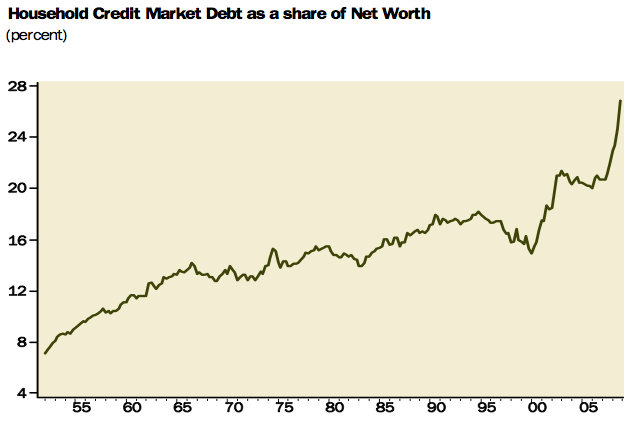
credit-net-worth
Source: Haver Analytics, Gluskin Sheff

>

HOUSEHOLD DEBT-TO-ASSETS RATIO
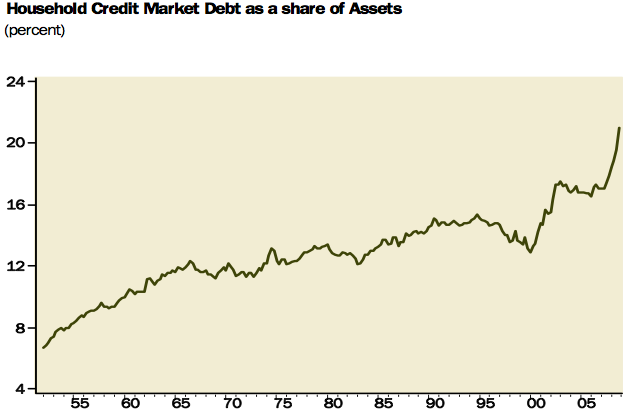
debt-to-assets-ratio
Source: Haver Analytics, Gluskin Sheff

>

Other than the scales, these two charts look identical.

The bottom line remains: Two thirds of the economy is dependent upon consumer spending, Oil is now ~$70 a barrel (gasoline coming up on $3), and the consumer’s ability to borrow, tap equity, or otherwise live a profligate, unfunded lifestyle has been radically crimped.

>

Source:
G19 Consumer Credit
Federal Reserve, June 5, 2009

http://www.federalreserve.gov/releases/g19/Current/

(will be moved here eventually)

http://www.federalreserve.gov/releases/g19/20090605/

On Borrowed Time: Consumer-Led Recovery
MARK GONGLOFF
WSJ, June 9, 2009

http://online.wsj.com/article/SB124449816432295655.html

74 Responses to “The Still Over-Leveraged Consumer”

  1. Barry Ritholtz Says:

    Hence, no green shoots . . .

  2. JustinTheSkeptic Says:

    BR, I am taking all these negatives in stride, while I watch a market that marches upward. Seems to me that money managers have way too much money to throw away. So until this market gets wrung-out again, what is one to do? I will not chase this beast!

  3. call me ahab Says:

    BR-

    I think you’re on to something Barry- the sad thing is the USG wants the consumer back to its reckless spending ways- indebted and forever spinning on the hamster wheel- let’s start a new metric- Gross National Happiness-

    http://en.wikipedia.org/wiki/Gross_National_Happiness

  4. cvienne Says:

    @BR

    This guy doesn’t think so…He’s already calling it the GREAT BULL MARKET from 2009-2013…He’s talking about investment bankers buying Bentleys again by the end of the year…


    Bull-Market Story Awaits Goldman Sachs Blessing: Matthew Lynn
    June 9 (Bloomberg) — Plenty of people will dismiss the recent stock-price recovery as a dead-cat bounce. Even more will call it a bear-market rally.

    Yet as equity prices creep higher, the bears may soon have to concede defeat. The Standard & Poor’s 500 Index has gained about 15 percent since early December and most other major benchmarks have made solid gains in the same period. At some point, it will become known as the 2009-2013 bull market.

    Only one thing is missing: a story. A real bull market needs a simple narrative that convinces investors that equities are worth double what they were valued at only a few months ago.

    So what could be the story this time around? There are four plausible candidates: rising savings, accelerating inflation, a takeover boom, and the scarcity of capital.

    Markets need stories as much as any Hollywood scriptwriter does. Stock prices go up, down and sideways for reasons we will probably never quite figure out. Human brains find that hard to handle, so we like an easy explanation that puts things in order. Chaos and randomness are the scary alternatives.

    During the bull market of the 1990s, we had the dot-com, New Economy story to explain the surge in stock values.

    During the 2003-2007 bull market, we had globalization and the emerging markets of Brazil, Russia, India and China.

    And for the next bull market? Here are four “stories” that could be used to justify it.

    *snip*

  5. ben22 Says:

    Barry,

    What do you think we will eventually move back to, the 63% figure from the 50’s? If that happens what are the impacts on GDP and employment?

    What also probably can’t be measured is that, and I’m only speculating here, people are using savings, and maybe no so much disposable income to get the debt paid down. According to U6 roughly 14.5 million people just lost any disposable income they might have had. The Net Worth chart line seems a little steeper to me. I’m not sure if this is what David’s charts are showing, or if that spike up recently is a result of debts staying fixed and assets declining at a rate of 25-40%.

    On another note, did people catch Elizabeth Warren in CNBC this morning? Wow, basically everyone on this blog laughed at the stress test when it came out because the worst case scenario was right around the corner, now she seems to be pleading that it needs to be re-done. Should I just be laughing at this sort of thing now?

  6. farmera1 Says:

    This country’s economy has been built on a mountain of debt. This graph (Total US debt-personal, corporate and governmental vs % of GDP) is at an all time high of some 350%. Not only that it is an exponential graph, oh oh.

    http://www.bullandbearwise.com/DebtOverGDPChart.asp

    The previous high for this graph was some 190% of GDP in the early 30s. Even during WWII the total debt in this country as % of GDP spiked very little. Never saw this explained why it didn’t go up significantly in WWII, but I assume it was because people could not borrow and if they could they couldn’t buy much. No cars, consumer goods etc.

    This exponential graph is inherently unstable. It won’t grow to the sky. Now it seems that the government is increasing debt to replace the debt being shed by consumers.

    Hum, wonder how that works out.

    This one graph tells me everything I need to know about the US economy. It wasn’t a question of if but when it implodes. Must be that the more skillful fed, financial engineering and other tricks has allowed this debt growth to continue so long.

  7. ben22 Says:

    cvienne,

    all I can say to that article is…. huh? I don’t even know where to start.

  8. cvienne Says:

    @ben22

    I was just shaking my head when I read it…

    He seemed to be saying at one point that the “savings” we’re seeing right now is going directly into equity market speculation…

    In a way, some of that may be happening…but if it IS true, think how scary that is when it all blows up!

    It will mean NO DEBT PAID OFF & last of any savings that there were just got sucked dry…

  9. drewburn Says:

    I would point out that some folks, such as my frugal self, are able to make purchases now on very favorable terms and thus are increasing our debt load. I just bought a new lawn tractor, 0% down, 0% payment and 0% interest for 1 year. Free tractor for a year, after which I’ll pay it off. Why not? I needed a new tractor and was prepared to pay cash. Then a sold my old one for $100 cash.

  10. Mike in Nola Says:

    And for greg, this is why I don’t think Apple can continue its customary high-flier status of the past decade. Same with all companies who have high multiples and depend on luxury consumer spending.

    Yesterday, was looking at Google as a short and it may be a candidate also. Almost as big a bounce from lows as Apple and dependent to a large extent on consumer ads. Ran across this which more or less confirmed the hunch.

    http://www.bloomberg.com/apps/news?pid=20601087&sid=a30kTObB05lA&refer=home

  11. ben22 Says:

    cvienne,

    this might be my fav. part:

    Only one thing is missing: a story. A real bull market needs a simple narrative that convinces investors that equities are worth double what they were valued at only a few months ago.

    I wonder what “few months ago” is being referred to, but lets say that was S&P 750, does this person really think stocks are going to double because of the “story” about other countries buying up American business. lol. As far as having a story, perhaps the author doesn’t realize there is a fairy tale being told about Green Shoots.

    or this:

    Now that is about to change. In the coming years, capital will be in short supply. The only place that companies will be able to get it will be from their shareholders. In return, they will have to be rewarded with higher dividends and stock prices.

    Alright, so in reading this I should load up on, say, BAC, with the expectation that they will raise the dividend and the stock price will continue its move up? According to the article, I HAVE TO, be rewarded this way.

  12. Tuesday Stories: Debt Ratios Continue to Soar; More Stress Tests?; Twitters 100 Most Referenced Brands at The Brian Sullivan Blog Says:

    [...] Courtesy: Haver Analytics via The Big Picture [...]

  13. tenaciousd Says:

    I’m 50% with drewburn on this one. It’s hard to pass up some of these deals–especially since I can’t be sure that my income won’t lose pace against inflation in coming years. As long as you can pay it off before the grace period ends I see no harm in it.

    However, I am wondering if the nature of consumer spending has changed since the 50s. Are we buying fewer durable goods? Are these goods less durable? Is a larger % of the spend going to second-world manufacturing (as I would assume) and does that mean anything?

    What I’m getting at is: Is 63-65% a suitable target for this day? Should we aim lower? Or, should we seek to change how and what that % is spent on in some way?

    I don’t know but was wondering if anyone here has any insights?

  14. Bruce in Tn Says:

    Bingo, Bongo Barryman. You have come to the conclusion that the majority of your readers reached. Perhaps you are now a victim of the Stockholm syndrome, blogger style! We could write a paper.

    I have watched the recent run-up in equities, and thought about it. Most of us know p/e ratios start to go up during a recession when risk appetite is restored, it is that “looking ahead 6 months thingy” that all of you investment types realize about the market. But it does seem that in this particular case much of the buying has been on hope, and many of the green shoots are about feelings rather than hard data.

    The market responds to the general economic condition, not the other way around. Yes, it can be irrational (uh, whatever that truly means)…and in this case, with what we’ve gone through, I have been content to watch all the Kudlow/Cramer/Krugman/Santelli/Bernanke/Obama/Japan/China/Russia/Bric/Pigs/et al reaction to the shudders in the world economy.

    My take is exactly yours. The consumer is still on a blind date on Saturday night, and it is with the ugliest girl in the entire school. He’s waiting to get back home, but the date seems like it will never end.
    …We’ll just have to endure it.

  15. Marcus Aurelius Says:

    And then there’s this (tangentially pertinent):

    http://baselinescenario.com/2009/06/08/annoying-bank-propaganda/

  16. call me ahab Says:

    farmera1 Says:

    “This country’s economy has been built on a mountain of debt. (Total US debt-personal, corporate and governmental vs % of GDP) is at an all time high of some 350%. . It wasn’t a question of if but when it implodes. Must be that the more skillful fed, financial engineering and other tricks has allowed this debt growth to continue so long.”

    well said- thanks for the link- America- spend and shop- happiness is right around the corner- probably on the very next purchase

  17. cvienne Says:

    @ben22 (8:05)

    It’s things like that that amaze me…

    Believe it or not though…Joe Retail buys into the idea…I hear it in the people I talk to (and you said yourself that you had 23 e-mails saying “get me in”)…

    I’m starting to change my viewpoint how how much more this rally has to go…I’d been pretty much in line with your 965-1k call..But I’m starting to think it could go all the way to 1,150 if this sort of thing (the “ideas” in the article) keeps up…

    Also, you have banks paying back the TARP money…I’ve always said that THAT would be a sign that the end of the rally is near…Not a ‘direct’ intraday correlation, but a sign…

    I’d wait for the TARP $$ to be paid off, let the markets rise for a few weeks after, then start looking the other way…I hate to say it, but we could be higher than 1k by then…

    I think GS & JPM know that this is going to be the last rally for awhile…They probably want to make it a doozy and suck Americans for every last penny…

  18. Moss Says:

    With the amount of fertilizer being applied green shoots are bound to be evident.
    Once that wares off, or is withdrawn, what will become of the shoots w/o additional additives?

    The shift from over consumption to a balance of saving with consumption is just beginning.

  19. Bruce in Tn Says:

    Barryman:

    (Spoken in the same tone, with the same awe as one might say “Darkman!”…if you saw the movie)

    In the first chart, what is the reason for the spike from 14% to 22% from 2000 to 2003? Is this the result of Mr. Greenjeans (Captain Kangaroo reference) keeping rates down around 1% for too long?

  20. willid3 Says:

    i agree the consumer is tapped out and isn’t going to spend any more, but if they don’t, who will? its certainly not business, they haven’t for about 8 or more years now, and show no signs of changing their spending plans (in the US anyway).

    and that leaves who?

    and i suspect the consumer has made a permanent change (just like they did after the great depression).

  21. call me ahab Says:

    interesting- cash for clunkers-

    http://finance.yahoo.com/news/Congress-to-consider-cash-for-apf-15474492.html?sec=topStories&pos=7&asset=&ccode=

  22. Bruce in Tn Says:

    http://www.usatoday.com/money/economy/housing/2009-06-08-home-loan-foreclosures-subprime_N.htm

    Foreclosure crisis spreads from subprime to prime mortgages

    “California, Florida, Arizona and Nevada represent 56% of the increase in foreclosure starts, including half of the increase in prime fixed-rate foreclosure starts, according to the MBA.”

    I know all of you have been waiting for me to find a solution for this crisis…and I have. (Hold the applause, please..)

    We take a national vote, and eject California from the union. I know, I know…brilliant…advantages?

    Since California would be a foreign country, tourism would double overnight! Think of all the empty hotel rooms that would fill! Not as cold as Canada, not too hot like Mexico! And we could all bring home a coffee cup that said “My vacation was in the country of California”..think of the potters and strip malls that would be back to work!

    California would qualify for loans from the International Monetary Fund, since it was a country. The Governator would have his solution!

    Los Angeles could have a pro football team…like NFL Europe, but we’d call it NFL California, with teams already in San Francisco and San Diego, the winner of NFL California could play the winner of NFL America in the Universal Bowl…just brilliant, I know….please…

    California could have it’s own currency like the Chinese, and keep it pegged artifically low to the dollar..bingo bongo, manufacturing enterprises rush to move from China to San Francisco to make polo shirts….

    And we could make Leftback the first English/US ambass. to California…and the Swedish twins could also tag along…

  23. Mike in Nola Says:

    Anyone see the redbook report?

    http://bloomberg.econoday.com/byshoweventfull.asp?fid=437722&cust=bloomberg&year=2009#top

    Admittedly a little out of whack because Walmart has been removed. But, it is an indication of how much sales are at the low end.

  24. franklin411 Says:

    The ultimate sucker’s play is to bet against the American consumer finding ways to spend.

  25. dead hobo Says:

    BR concluded:

    The bottom line remains: Two thirds of the economy is dependent upon consumer spending, Oil is now ~$70 a barrel (gasoline coming up on $3), and the consumer’s ability to borrow, tap equity, or otherwise live a profligate, unfunded lifestyle has been radically crimped.

    reply:
    ———————

    There is a chance that Uncle Stupid will develop programs to take over the worst of it and monetize parts when nobody is looking. Otherwise, incomes need to rise to absorb the payments and add to GDP. Since layoffs and job destruction are increasing, the prospect for rising household income looks bleak. Discretionary income is being absorbed by speculator charged oil prices. Second round effects will be back in a few months if prices continue to rise. Since oil is in a bubble powered by a positive feedback loop, the only way to see prices drop is a bubble burst, probably followed by a leveraged asset unwind.

    To put it bluntly, there is little extra money to spend on luxuries and extras. Therefore, earnings per share in a myriad of industries will fall.

    Predatory investment banks have no reason to stop pumping the stock market. Regulators either don’t care or look at is as a rescue operation. The general public is starting to see something odd, even though the financial press ignores the activities. The low volume in the markets is partly a result of it looking more and more like a rigged game; people are just saying “no” for now. It will take a group of criminally stupid money managers to buy into this racket on the basis of ‘not as bad as expected” cover stories. They will appear on schedule anyway, I expect.

    Thus, putting it all together, Consumption will be down due to lowered incomes, higher debt loads, and higher prices for necessities. Investment will be down because it looks like criminals are in charge of the financial markets. Investment-like activities, such as asset bubbles, will probably continue until the next bubble burst. The financial press will confuse the bubbles and market fraud with real Investment and continue to hype using the “Beat Expectations” mantra. Government spending will try to compensate and just create a bigger mess.

  26. Mike in Nola Says:

    F411: Think I heard that in 2006-07

  27. km4 Says:

    America needs to lessen it’s dependencies on financial engineering and consumer spending ( 70% of GDP ) as key drivers of the debt laden ‘bubble’ US economy.

    Hard to do when Obama and his Wall St bought and paid for economic team have put all their chips on the Banking Oligarchs to pump up great chunks of the Big Shitpile that’s essentially worthless unless the peak real estate values of the bubble can be miraculously restored.

    The financial engineering racket is simply the best organized white collar crime organization ever !

    In short Obamanomics is where
    1) The government champions funds
    2) Funds champion corporations
    3) Corporations champion markets and industries
    4) The people ( American taxpayers ) get the tab

    This will fail because America and Americans are swimming in debt
    http://www.usdebtclock.org/

    Most Americans had better start making the gradual adjustment that the ‘party’ since Reagan in the 1980’s where deficits did not matter is over and there will be a leveling of the global playing field.

    And I suggest that most should be recalibrating their American dream ;)

  28. Mr. C. Cheese Says:

    As we sat in front of trailer last nite ….. Jethro was wondering if things are so bad why is Priceline.com @
    116 a share…. I said Jethro, I don’t have the foggiest, while I was reaching for the shine!

  29. The Curmudgeon Says:

    Combine these graphs with a graph of population demographics, which would show an aging and declining base of consumers (ex-immigration) and it is hard to see where or how consumer spending can return to its previous levels, either in absolute terms (e.g., more trucking tonnage from yesterday) or as a relative matter (consumer spending as a portion of economic activity).

    The underlying premise of the economy in the US and the rest of the developed world is flawed. Trees do not grow to the sky. Growth is just a life-stage, followed by stasis and decline. If we’re lucky, we’ll enter stasis at some lowered level of activity for a time. If we’re not careful though, we’ll kill the tree trying to make it artificially grow.

  30. Publius Says:

    Um, isn’t bankruptcy and credit a lagging indicator?

    Leading indicators seem to have bottomed: copper and lead prices, construction permits, the Baltic Freight Index, New Orders (PMI), initial unemployment claims, and temporary help employment.

    These are not sentiment indicators, unless you count copper and lead prices as a sentiment issue.

    Now, stability is not growth. But it isn’t collapse, either.

    It seems to me that the 666 market was priced for $33 / share for the S&P. That would be a 20x multiple, and 300 basis points above a 2% 10-yr yield, also consistent with a Japanese-style L-shaped recovery, which so many here seem to expect. We’re up 50% from there, consistent with $66 / share, which is also consistent with Q1 earnings.

    Okay, cut financial earnings in half b/c of MTM and Congressionally mandated revisions to FAS 157. That’s only 5% of earnings. So be conservative and mark the run-rate from $66 to $60. At 16x, you still get a 960 S&P.

    What am I missing? That’s pretty close to where the market is now. And I’m not making up the other stuff. Aren’t we fulfilling Caesar’s dictum: “Men willingly believe what they wish?”

  31. Publius Says:

    That would also be Simon and Garfunkel: “A man believes what he wants to believe and disregards the rest….”

  32. Bruce in Tn Says:

    MikeinNO:

    I also like to read the Redbook on Tuesdays….very interesting..


    Highlights
    Redbook reports a colossal plunge in same-store sales for the June 6 week, down 4.4 percent year-on-year and down 4.3 percent compared to the full month of May. The 4.4 percent plunge is not comparable to anything Redbook has been posting this cycle. And the magnitude of the week-to-week change in the year-on-year rate, to -4.4 percent vs. +0.1 percent in the May 30 week, is also unprecedented”

  33. Publius Says:

    Yes, in 2008 retail sales had a mini-boom, if you recall due to the $1200 stimulus checks being mailed out. We only spent about 25% of those, but it gave retails sales a push. Compare Redbook sales to 2007, and they don’t look so bad. But then, that was bubble-induced, right?

  34. The Macrobat Says:

    Market psychology and fundamental drivers are often at odds with each other. Witness this morning’s lower prints on revised and current wholesale inventories, reported in tandem with higher “economic optimism” readings. Destocking in the face of a reluctant consumer leads to higher confidence surveys? Hmmmmm…

  35. Bruce in Tn Says:

    Well, data vs feelings.

    http://www.rttnews.com/CorpInfo/EconomicCalendar.aspx

    German imports and exports and industrial production were released today.

    Guess they must not be reading the green shoots journal…

  36. dead hobo Says:

    http://zerohedge.blogspot.com/2009/06/can-we-get-this-guy-on-cnbc.html#disqus_thread

    This guy covers most of it pretty well.

  37. constantnormal Says:

    The consumer can continue to spend so long as Bernanke can keep rates low. Eventually — and not some far-off distant “eventually” — the Fed will find rates rising in an unstoppable way, and printing money will only make things worse. Check out this little anecdote (Congressman Warns Chinese to Expect Bigger U.S. Deficits).

    When the inevitable reversal happens, and the tide goes out for the increasingly debt-laden US public, the repercussions will be terrible indeed, with a wave of personal bankruptcies and a credit card collapse that will hit the banksters pretty hard (Thank Goodness that Uncle Sam has their back). But on the bright side, at least we no longer have a ton of home equity debt fueling this debt binge.

    I find the charts to be literally incredible — what, exactly, is included in “household credit”? Is it simply the totality of all household debt, including mortgages? Then I would find it not so incredible, and perhaps not that bad, to have nearly 28% of one’s net worth as debt. But if it is a measure of credit card + car loans + other short-term debt, then it does seem a bit burdensome. But perhaps not catastrophic (unless we were in a deflationary environment with high unemployment). Maybe that’s part of the strategy — to shift us to an inflationary environment with high unemployment, encouraging people to borrow like it’s 1999.

    We can probably run it all the way up to almost 50% before the roof falls in.

  38. willid3 Says:

    we all seem to be in agreement that the consumer spending should be less than the %70 of the economy,

    all good and well. and with continuing collapse of consumer incomes its inevitable

    but who is going to make up for that? the only reason the consumer is that much of the economy is beause nobody else is doing any thing.

    or are we saying that the economy will just shrink to fit the new size? which will not dilute the impact of consumer spending, it will just shrink the entire economy.

  39. call me ahab Says:

    “The ultimate sucker’s play is to bet against the American consumer finding ways to spend.”

    wow- makes me feel proud to be an American- we can spend better than anybody- such a worthy goal in itself- it matters not what we buy- just that we spend

  40. Transor Z Says:

    There’s no real mystery here. The Boston Globe yesterday had a feature story about a family of four with combined income of $160,000 struggling to make ends meet:

    http://www.boston.com/business/personalfinance/articles/2009/06/07/young_couple_grapples_with_budget_predicament?s_campaign=8315

    De-leveraging will be slow because Americans have been squeezed for the last 30-40 years due to rising costs in health care and housing and child care when you factor in the need for dual incomes. I go back to that terrific Elizabeth Warren lecture that Bruce posted last week. It’s really very simple and obvious to most households.

    What people just don’t realize is that $180,000 is the new “middle class” combined household income threshhold in the US for families. I call it the “white picket fence index.” What you need in order to afford a 4 BR house with a picket fence, two cars, two kids, family vacation, 3-6 month rainy-day fund, etc. People still think I’m crazy for saying that.

    With the squeeze on, families can only de-leverage so fast. Add unemployment and you get real fast de-leveraging — also known as Chapter 7.

  41. Mannwich Says:

    Barry: Many consumers just won’t pay back their debts. Mass defaults still ahead. There. Problem solved. It’s party time again.

  42. call me ahab Says:

    dead hobo-

    priceless link- literally had tears coming out of my eyes- that is just the type of American that gets folks like franklin involuntarily wetting their undershorts

  43. Transor Z Says:

    @Publius:

    Ordinarily, bk and credit are lagging indicators. But David Rosenberg makes the point that this is a credit crisis so they are coincident indicators.

  44. Mike in Nola Says:

    hobe: looks like Dunlap from http://www.redstateupdate.com This one’s a bit too long. They are masters of sarcasm, although not political correctness.

  45. ben22 Says:

    Franklin says:

    The ultimate sucker’s play is to bet against the American consumer finding ways to spend.

    This only talks about what has happened in the past. It does not tell us what will happen in the future, or how that can happen without credit. We know the ways they “found” capital, it was called debt. To make a statement with such confidence does not show someone that is being wise with current investment decisions. Instead, it shows someone that saw something happen in the past and then believes that therefore it must happen in the future.

    Like Mike, I heard all the usual suspsects saying this same thing all the way through last spring:

    Kudlow, Kneale, Bowyer, Luskin…

  46. bmoseley Says:

    comparison with the 1950s is meaningless.
    but the graphs tell the story of overleveraging. still more to come.

  47. drollere Says:

    the consensus view here seems to be that consumer savings or household debt ratios characterize a problem (which problem exactly isn’t clear), the problem is due to a categorical “type” of person (the consumer, the average consumer, the american consumer); and that type of person is responsible for the problem because he or she has, for want of a better word, a sinful nature (greedy, slothful, envious, proud, ignorant, incompetent, etc.).

    all that is fine as an outline, but it distracts attention from the fact that it is not causal. is high household debt a problem? — why? is the average consumer responsible for that problem, or is the responsibility the result of a human failing? — how exactly?

    as a behavioral scientist, my immediate reaction to a graph such as debt to wealth, with its steadily marching upward career, is that i am looking at something structural. systemic. demographic. network influenced. perhaps even cultural, but certainly not moral, and certainly not policy related (it goes up no matter who or what is in government).

    the real reason for the consumer debt to wealth ratio? i’ll say: cheap carbon (oil, coal, gas, lumber, food via fertilizers, plastics). cheap carbon funding cheap GDP producing cheap products globally distributed by cheap transport to consumers purchasing them with cheap money and spawn cheap children fed with cheap food. transport costs, resource costs, labor costs, time costs — all collapse under the influence of cheap carbon.

    in this view, consumer debt to wealth is not a problem but a symptom of something structural. you cannot analyze something structural piecemeal, and you can’t cure it by “fixing” or campaigning against one part.

    you could radically alter the structure by changing its inputs or connections. if oil were at $130 a barrel, or gasoline at $4 a gallon, or households were energy efficient on a renewalble energy grid, you would begin to see real change in consumer debt to wealth ratio. but the change would be for structural reasons, not human reasons. humans run in packs. they behave as the incentives of the social structure dictate they should behave. keep your eye on the structure.

  48. FromLori Says:

    I know he is busy shopping and sightseeing with Mrs. BO but PLAN A SUCKS see for yourself…

    CHART OF THE DAY: We’re On The Depression Path
    If you look hard enough, you can find some green shoots, but here’s the truth. The decline in world industrial output is tracking very close with what we saw during the Depression. This chart was put together by economists Barry Eichengreen and Kevin O’Rourke, as part of a broader study comparing this downturn with the Great Depression.

    http://bluelori.blogspot.com/2009/06/is-there-plan-b.html

  49. Mike in Nola Says:

    drollere: doesn’t matter if it’s a symptom. It only matters that it exists and is going to take down the earnings of many companies and delay any real recovery for a long time.

  50. Transor Z Says:

    @drollere:

    First, I enjoy your intelligent and thoughtful comments. I think your insight into structural/cultural causation rather than the rhetoric of blame is right on. However, I think your conclusion about the mechanism of consumer leveraging being fossil fuels is incorrect.

    Increasing health care and secondary education costs have outstripped annual COLA and GDP growth % going back a few decades now. The square-footage costs of housing went haywire during the 10-year bubble. What all of these costs have in common is that they are relatively fixed: a family HMO plan is ~$1200 a month regardless of income level. Private college tuition is ~$25k – $40k a year. Housing costs are determined by the local market.

    As with all fixed costs, they disproportionately impact low and mid-range households as less able to absorb added costs that outstrip income growth.

    The “cultural” dimension here, IMO, is consumer quality of life expectations. Everyone at least viscerally understands that the brass ring has been moving further out of reach for decades now. But the failure of US consumers to reset expectations hasn’t occurred.

    IMO they have been set up for failure in part by political rhetoric — e.g., “an ownership society” and consumer culture cheerleading by MSM.

  51. Transor Z Says:

    Sorry — last sentence in fourth paragraph should read: “But US consumers have failed to reset expectations.”

  52. willid3 Says:

    and i suppose the decline in consumer spending also grantees one other thing. the decline in company profits

  53. How the Common Man Sees It Says:

    That debt won’t be going down fast because it is structural. People can’t just cash out their retirement accounts and pay down a house loan or a four year car loan they are two years into. That just isn’t practical and the fees would probably be prohibitively high. Since we are only into the second quarter of the debt bubble popping, the stats are not going to show a lot of contrast

    I think, though, that what you will see going forward is a curtailing of the use of debt and the resistance to take on new debt. We are already seeing this in the debt based industries. New car and home sales are dropping precipitously and instead consumers are ramping up their savings. I assume they will now be putting more money down, buying used cars or paying for it all with cash that they are now saving and as the structural debt slowly gets paid down they will not enter into any new contracts unless they absolutely have to.

  54. How the Common Man Sees It Says:

    @Transor Z Says http://www.ritholtz.com/blog/2009/06/the-still-over-leveraged-consumer/comment-page-2/#comment-181026

    However, I think your conclusion about the mechanism of consumer leveraging being fossil fuels is incorrect.

    I would agree with this statement but for different reasons. I think policy was the problem. It came down to cash flow. As interest rates were lowered artificially, not only did the fed encourage too many people to borrow but the low rates also encouraged too few people to save. This caused (forced) people to take unnecessary risk with their cash and in some cases buy housing that they could not afford. Had rates been kept higher (a policy decision) then more people would have kept their money in their savings accounts and the banking system wouldn’t have backed up on itself and chocked

  55. cvienne Says:

    @drollere (11:21)

    Actually, my friend, I think you make a good point…

    If I think i know what you’re saying, you’re more or less ‘pinning’ behavioral overconsumption to the fact that the world has lived on CHEAP CARBON for the last half century…

    I’m going to go along with that thesis…I’ll share this thesis with you all…I’m not interested in whether or not you agree with it…It’s simply one man’s true story…

    I don’t consider myself a ‘greenie’, yet I’ve changed my lifestyle to GO GREEN & go OFF THE GRID…

    I bought a house/farm in WVA and paid CASH for it recently…I converted all systems to solar & wind and am now “net metered” in the opposite direction (yet still am very hermitic about my consumption)…

    I have a well on the property, yet I also have created an irrigation system off the roof of my house that funnels into a containment system…It’s been particularly rainy this spring, but that system alone is OVERBRIMMING…To quantify that, just through basic rainfall, I’ve corralled 20,000 gallons of water in the past 2 months alone (and if I had additional storage capacity, it could EASILY be double)…That’s enough irrigation capacity to handle 3 months of entire drought and keep 2 acres of food healthy & vibrant…20 people could live off the food produced just from that for an entire year…

    So basically, I have no rent or mortgage (my property is paid for in cash)…I have no electricity bill (I’m OFF GRID)…I grow enough food, & have enough water to irrigate…

    As for other things…If I want to drive around in my truck, I’ve converted the engine to run off of nat gas (which is slightly cleaner burning than oil, & about 50% cheaper)…I have massive storage tanks on my property and buy nat gas contracts IN BULK during price dips…So I don’t worry about gas prices spiking…

    Yet here’s the thing…Even though these BASIC EXPENSES basically cost me nothing…I still don’t find the need to go out and “consume” a lot of things…Sure, perhaps my cable internet bill, but otherwise to just drop a couple hundred on strippers every so often…

    My point is that it’s not too hard to consume less yet live happy…Americans will eventually get to that destination…I’d say the process took me about 5 years (going from a piggish consumer – to a self sustaining entity)…It also took some investment (which IS or IS NOT difficult based on your circumstances)…But in the end it’s individual choices that get you there, not social engineering…

  56. call me ahab Says:

    Transor Z Says:

    “Everyone at least viscerally understands that the brass ring has been moving further out of reach for decades now. But the failure of US consumers to reset expectations hasn’t occurred . . .set up for failure in part by political rhetoric— e.g., “an ownership society” and consumer culture cheerleading by MSM.”

    good points- especially the elevation of consumer culture as the defining characteristic of Western civilization

    drollere-

    good points- the way I look at it-

    a permanent increase or perceived permanent increase in the cost of energy- changes people’s decisions on where they live, size of home they buy, type of car they drive, choice of community they live in(mass transit/no mass transit), etc-

    so you are definitely onto something

  57. Thor Says:

    Cvienne – Been reading this blog for awhile now and although I don’t always agree with your comments, you are a fascinating man (I mean that as a compliment).

    From what I can gleam of your personal story so far is even more fascinating. Can I ask what prompted you to move off the grid like that? If you’ve posted this in the past and I missed it let me know and I’ll go a searching, I’ve only gone back about a month in the archives.

  58. Mike C Says:

    Wow. A few commenters really surprising me who I thought were a bit more savvy. The author of that story

    (http://www.bloomberg.com/apps/news?pid=20601110&sid=a20Qdf069yYY)

    Clearly understands this quote:

    http://www.raymondjames.com/inv_strat.htm

    “The stock market is fear, hope and greed only loosely connected to the business cycle.”

    NEVER UNDERESTIMATE the power of a compelling story even if it is complete fiction.
    If there is anything …AND I MEAN ANYTHING…one should have learned from the last 15 years it is the ability for a powerful story to take equity prices much higher then justified by any sort of intrinsic value or solid economic fundamentals.

    We had Super-Bubble from 98-00 and Echo Bubble 2.0 in 06-07. You’d have to be completely ignorant of that history to not realize we could easily have Echo Bubble 3.0 if a good story can be pumped to the Joe Retail masses to get back into stocks to make up their losses from 00-02 and 07-09. Would be comical if it weren’t so sad.

    I still think this market could run much higher and much longer then many of the bears here think, and those with “short and hold” positions might just get steamrolled although eventually they’ll be right, but at some point being too early is identical to being wrong.

  59. Mannwich Says:

    @Mike C: Those “good stories” didn’t have unemployment at 9.4% (real unemployment much higher), the employed hanging onto their jobs for dear life, and people losing their homes in droves though. That’s a key distinction to be made when comparng this period to the others you cite. Howevever, I agree that this run up could go on for much longer than common sense would dictate because the administration is winning the PR/confidence game battle with masses, who WANT to believe, cut him slack (and want him to succeed due to their own self interests of survival), but not for as long as those other periods where fundamentals APPEARED to be much more positive. Once we get through part or all of the summer, if things don’t get better on the ground, the gloom will be back and the bloom will be off the rose.

  60. Tuesday links: oil, gas and Big Macs Abnormal Returns Says:

    [...] Americans are saving like mad, but they are still overleveraged.  (Trader’s Narrative, Big Picture) [...]

  61. Onlooker from Troy Says:

    ahab – welcome back!

    re: cash for clunkers. Blech! Reminds me of the plowing under of fields and slaughter of animals, etc. that was done in the GD era to fight deflationary forces. Common sense tells you it’s absurd to destroy wealth/assets in order to prop up prices. I just can’t get my mind around it.

    And it’s also just more pulling of future demand into the present. We’ve done so much of that already with the debt binge, how much more can we do and how does that work out in any kind of long term time frame?

    It’s just more of the same short sighted thinking to avoid making hard decisions and cushion ourselves from as much of the negative consequences of our irresponsible spending as possible. Ponzi type thinking also comes to mind because eventually someone pays the price down the line, unless you get some magic productivity “machine” that catches up to all that overconsumption in the past. It’s the same lie we’ve told ourselves all along about deficit spending and how it’s not that much of a problem because we’d grow our way out of it. B.S.

  62. ben22 Says:

    @Mike C,

    You miss the most crucial point about the “good stories” in the years you talk about, and that is:

    Credit was still expanding then.

    When people can spend money they feel good, and helps to swallow down the stories. Real Estate isn’t supposed to double every couple of years? So what!, check out my new flatscreen!

    Credit deflation is out of the bag now, good luck trying to put it back in with stories.

    If the most important thing we could have learned from the market is that good stories can make markets go up, we are truly doomed.

    Further, during the time you discuss through today has it not been one giant bear market witha very fake bull market in what will probably just be the middle of it? the Joe Retail you are talking about was maybe, just getting back to break-even by year end 2006 after the tech bubble burst. It might have been a long “bull mkt” from 03-07, but not a very powerful one compared to what we were seeing since 1979.

    I still say that article was garbage, despite any quotes from Raymond James. That said, regarding that quote, it might be worth paying attention to the fact that the bullish levels we are starting to see consistently in the DSI and AAII are starting to rival the bullish levels in October 2007. I don’t disagree that the rally could last longer than many expect, hasn’t it already? But if you think we could go on some bull run due to some good stories despite credit deflation and the complete disaster fundamental state the economy is in I think you are sadly mistaken.

  63. Stock market news | Must Reads Tuesday, June 9, 2009 - Contrarian Stock Market Investing News - Featuring Bargain Stocks Says:

    [...] The still over leveraged consumer Big Picture [...]

  64. Mike C Says:

    @Ben
    If the most important thing we could have learned from the market is that good stories can make markets go up, we are truly doomed.

    At the individual level, is it about “fixing” the system and our economy, or is it about making money for your own personal portfolio or clients if you are in the business. I agree with 90-95% of the structural problems that many outline here. Unfortunately, I don’t have red phone connection to Obama, and complaining on The Big Picture aint gonna change shit. I guess in the coming months we’ll see if a good “story”can keep the market moving up. “Green shoots” has been enough to get a 40% move off the bottom.

    Credit was still expanding then.

    Again, I mostly agree, and NO DOUBT this is a long-term structural headwind, but I’m not honestly sure this means s**t to where the market could move in the next 6-12 months. Markets overshoot. That is what they do. I didn’t expect crude oil to hit 150. I was surprised to see it fall to 30ish, and now it has doubled off that low. IMO, to think it is absolutely impossible for the S&P to go to 1100-1200 because of a single issue like credit deflation is naïve. I’d simply refer you to Jeremy Grantham’s most recent quarterly newsletter, and the potential impact of the massive government stimulus on the market.

    Further, during the time you discuss through today has it not been one giant bear market witha very fake bull market in what will probably just be the middle of it?

    Fake? I don’t know what that means in any practical sense. A lot of money could have been made on the long side from 03-07. I’m still sitting on a good chunk of my gains from that bull although I did give some back during the bear decline. It’s only fake if you rode it all the way up and gave it all back, and that works both ways. I’m guessing some have been consistently short and bearish since 04 so they just got killed in 04, 05, 06, and then finally right in the 08 collapse, and if one is using these leveraged ETFs then you’ve given it back during this rally. From a practical sense, that is just as fake even if you got the “call” right.

    I still say that article was garbage, despite any quotes from Raymond James.

    Well…agree to disagree and all that…I thought the article showed a reporter with a degree of sophistication “about how the market works” that most journalists don’t have which is that the stock market doesn’t have to correlate 100% with every economic datapoint if a positive story can be sold. Eventually, yes, but eventually can be a long enough time to go broke. The market can stay irrational longer then you can remain solvent.

    That said, regarding that quote, it might be worth paying attention to the fact that the bullish levels we are starting to see consistently in the DSI and AAII are starting to rival the bullish levels in October 2007.

    Bullish sentiment is getting frothy, and I am not initiating any new long positions here. I could see a 10-15% correction that gets sentiment negative again, and that the bears incorrectly interpret as the next major downleg. Obviously, market sentiment is very bullish at every major market top but it does not follow that every instance of bullish sentiment is a major market top. Logic 101. If A, then B ….does not equal If B, then A.

    But if you think we could go on some bull run due to some good stories despite credit deflation and the complete disaster fundamental state the economy is in I think you are sadly mistaken.

    What is a bull run? 6 months? 12 months? 18 months? What magnitude? 1100? 1200? I’ve got no strong opinion one way or another which is why I won’t get hurt bad either way. But I think it would be dangerous to go 100% triple short the market because of credit deflation and “complete disaster fundamental state”. It could work out, and it might also get one killed.

    http://www.hussman.net/wmc/wmc090504.htm

    In his book On Being Certain, neurologist Robert A. Burton quotes F. Scott Fitzgerald – “The test of a first rate intelligence is the ability to hold two opposed ideas in the mind at the same time and still retain the ability to function.” Buddhist teacher Pema Chodron calls it “being comfortable with uncertainty” – being willing to take every aspect of reality as the starting point, without wasting energy wishing things were different, without denying reality as it is (even if your next step is to work toward changing things), and without needing to know what will happen in the future. “The truth you believe and cling to makes you unavailable to hear anything new. The best thing we can do for ourselves is to be open to an unknown future.”

    Burton offers the same advice. Tolerating the unpleasantness of uncertainty, he writes, “is the only practical alternative to cognitive dissonance, where one set of values overrides otherwise convincing contrary evidence. Each position has its own risks and rewards; both need to be considered and balanced within the overarching mandate: Above all, do no harm. Science has given us the language and tools of probabilities. We have methods for analyzing and ranking opinion according to their likelihood of correctness. That is enough. We do not need and cannot afford the catastrophes born out of a belief in certainty.”

  65. alfred e Says:

    @deadhobo 10:27: Spectacular. Dead on.

    Why aren’t these people banding together?

    And the anger grows a little more. There’s an interesting undercurrent brewing that has not bubbled up to the surface yet.

    Will it? Guess we’ll have to stay tuned.

  66. American households are $13.8 TRILLION IN DEBT, compared with $14.3 trillion output of the ENTIRE US economy. YIKES! | Schizo America Says:

    [...] to The Big Picture blog: “Despite recent frugality, consumers have barely dented their debt load. The Federal Reserve [...]

  67. CaptiousNut Says:

    I stumbled upon some *green shoots* in Naples today.

    A building foreclosing at less than half of it’s 1999 price!

    http://marginalizingmorons.blogspot.com/2009/06/green-shoots-in-naples-florida.html

  68. willid3 Says:

    was it the boomers?

    http://blog.newsweek.com/blogs/wealthofnations/archive/2009/06/09/baby-boomers-it-s-all-your-fault.aspx

  69. primordial_ooze Says:

    @farmera1 7:49
    You are exactly right. When I learned that the average consumer was spending more than they
    were earning, i.e. when debt went exponential, I knew it was time to get out of the stock market,
    and that was back in Dec 2007.

    @cvienne 7:45
    People are saving but why would anyone think that money would go into investment? After all
    everyone just got burnt and they need to pay off their home equity loans, car loans, student loans,
    credit card debt, not to mention the mortgage. That story sounds like DOW 36,000!

  70. primordial_ooze Says:

    @willid3 10:28
    That’s it, there is no one else to fill the void. Welcome to the new normal.

  71. ben22 Says:

    Mike C,

    Wow, ease up. Not that I expect you to be reading my posts but feel free to go back and look. I’ve been saying for months I thought the rally would move us to 965-1k, something just above would not surprise me in the least. I was steadily buying stocks in Nov and all the way into March as I’ve also posted here since then. My main thinking then was that I thought reflation would certainly occur, at the time I didn’t fully understand the credit deflation issues that are already happening, I don’t think you do based on your response. As I learned more I developed a different larger picture view about what is coming for us, and it isn’t a nice reflation. You assume an awful lot about me in your post. I’m not triple short and I never said anything was impossible and I certainly never claimed to be 100% right.

    My response was towards the article and it was a Big Picture response to an article that seemed to focus on the large overall picture of a new bull market developing, not the next 6-12 months and where you think the S&P could go to, the the author tells us the last step to making it so, ending by talking about the make-up of other bull markets. You agreed with it, and good luck to you. I’m not surprised you would agree considering you only “mostly agree” with the credit expansion and what that has done to nominal values of things like stocks or homes.

    I don’t need to answer questions about what I mean by bull run because, the author of the article does it for me here:

    Yet as equity prices creep higher, the bears may soon have to concede defeat. The Standard & Poor’s 500 Index has gained about 15 percent since early December and most other major benchmarks have made solid gains in the same period. At some point, it will become known as the 2009-2013 bull market.

    Clearly there was money to be made from 03-07, again, for all of your reading of Grantham you should know the he referred to the bubble as “perceived wealth”, this is what I meant as a “fake” bull. For the record, I was certainly not short from 03-07.

    Why does everyone here think that if you have a bigger picture idea that is bearish that it automatically makes you Steve Barry and you must be holding double or triple short everything in your accounts????

    In closing Mike C, the most important thing for you to remember is that it wasn’t “green shoots” that started this move, it was “mustard seeds” as I recall.

  72. Chicago Real Estate Says:

    [...] admin | June 10, 2009 The Still Over-Leveraged Consumer | The Big Picture The Still Over-Leveraged Consumer Email this post Print this post By Barry Ritholtz – June 9th, [...]

  73. The Pool Room Friday 12th June 2009 | Steve Keen's Debtwatch Says:

    [...] The Still Over-leveraged Consumer, The Big Picture, 9 Jun [...]

  74. Tax Equivalent Yield, Pay Down Debt, Debt Free, Bond Coupon Says:

    [...] option for your cash- paying down your debt.  Household debt in the United States is still at a very high level (even after recent improvements).  You probably have some debt yourself between credit cards, [...]