
Paul Brodsky & Lee Quaintance run QB Partners, a private macro-oriented investment fund based in New York.
>
This month we discuss why we think longer term Treasury yields should be much higher than they are; why we are not investing in anticipation that they will rise; and how synthetically-low benchmark interest rates are sending false economic and investment signals. We also discuss, point by point, the justification behind our assertion that US monetary policy has been, and continues to be, terribly misguided and dangerous to the broad US economy.
American Fun House
We believe macroeconomic fundamentals imply longer-term US Treasury yields should be priced above 10%. We have been reluctant to express this view in the markets, however, because there are powerful structural forces blocking any fundamental reconciliation of value. These forces include bond markets comprised mostly of domestic and foreign investors with incentives that place them at odds with rational credit pricing, as well as central banks with unlimited spending capacity threatening (and being encouraged by all) to intervene when necessary to provide a ceiling on yields. As a result, we think the price of money and credit in the US and globally (because dollars are the world’s reserve currency) has been sending false macroeconomic signals.
Investors are being forced to judge asset values in a hall of mirrors. As Treasuries provide benchmark default-free nominal rates against which all investments are ultimately judged, we think the relative values of tertiary asset markets are also being compromised. Such illusionary forces are powerful and we do not expect them to change unless there is great economic and market upheaval. So, we have not been willing to express our fundamental view of benchmark US interest rates directly (by shorting Treasuries). Nevertheless, we believe there is great value in acknowledging this gross mispricing because it provides a critical cornerstone upon which to build more accurate valuation metrics that we think will generate positive real rates of returns from other assets.
True Inflation
Most bond investors may genuinely believe default-free interest rates are priced fairly or should be generally lower, not higher as we do. The argument against our view is that the rate of CPI growth has been minimal, even negative year over year, and that the prospects for substantial demand growth (dismissing, of course, considerations of supply growth) that would lead to higher prices seem remote. Therefore, it would follow to these investors that Treasury yields are positive in real terms today and likely to stay that way into the foreseeable future. We vehemently disagree.
As we’ve discussed at length (and won’t dwell on here), money growth is inflation and generally rising prices are frequently derivative of that money growth. When it comes to the changing prices of goods, services and assets, it is very easy to prove conceptually and empirically that, in macroeconomic terms, the changing stock of money overwhelms any potentially offsetting discrete changes in the supply/demand equilibriums of widgets, widget repairmen and Widget Inc. shares. The nominal prices for any or all of them will increase, all things equal, even if the supply of them were to rise by, say, 10%, the demand for them were to drop by 25%, yet the general money stock with which they might be bought triples. This logic should make sense to all, yet it is overlooked by the majority of contemporary investors and economists who seem to be modeling the money stock as a constant.
>
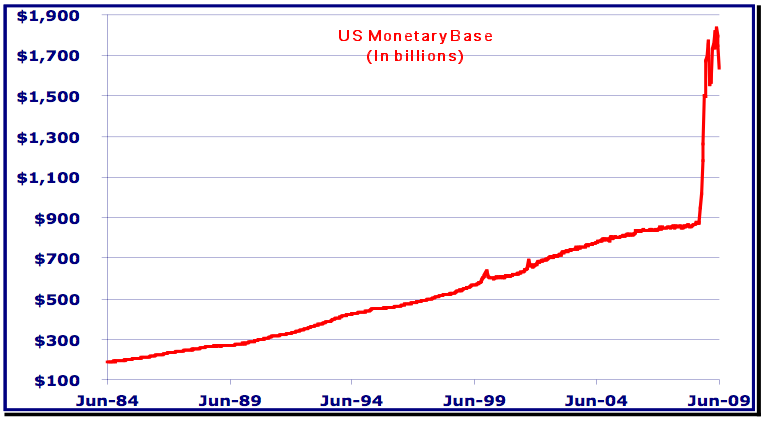
Sources: The Federal Reserve Bank of St. Louis; St. Louis Adjusted Monetary Base; QBAMCO
>
The Fed just doubled the monetary base over the past nine months (above) and has stated plans to continue this expansion (via Quantitative Easing) through at least the end of 2009. So, in monetary terms, we’ve already witnessed a massive dose of inflation. The growth in the US monetary base is the permanent addition of money to the system. It is money created from thin air by the Fed that is not self-extinguishing. Where did this new, permanent money go?
Found it (below)! It seems the Fed gave the new money to the fractionally-reserved banking system to be placed on bank balance sheets as high-powered money – money that everyone hopes the banking system will lend out to businesses, homeowners, consumers and investors at multiples of the Fed’s mandated reserve requirements.
>
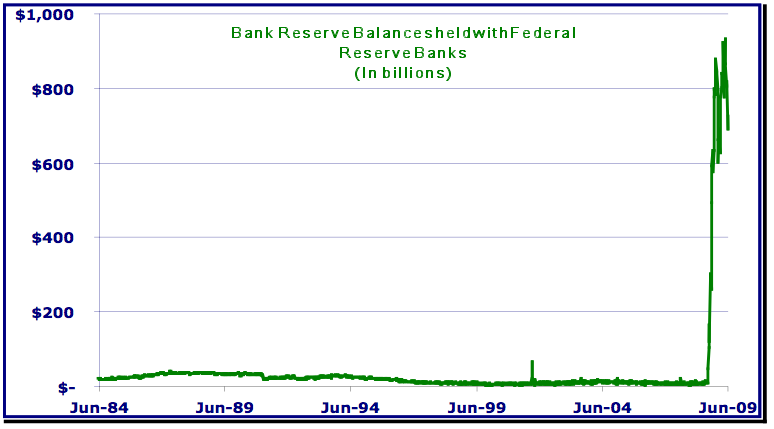
Sources: Board of Governors of the Federal Reserve Bank; Release H.4.1; QBAMCO
>
When a bank makes a $100 loan and holds 10% of that as reserves, its reserve position is $10 while its asset position is $100. Reserves grow as more credit or cash is added to the system. Depending upon how much the banking system levers its new reserves, the ultimate growth of dollars and credit in circulation could be 10, 20 or even 30 times the recent rise in bank reserves. The $800 billion increase in high-powered money already delivered to the banking system, if levered only ten times, would mean we can expect about $8 trillion in new credit chasing goods, services and assets.
This new credit must help grow the economy in nominal terms because it will increase the nominal output of goods and services (even if demand stays constant or contracts). It will also help increase the nominal prices of financial assets because nominal corporate revenues should generally rise with everything else and the new credit may be used to bid up nominal prices of investments. The consequences of the recent paradigm shift in the system’s monetary base should be obvious to all: higher prices for goods, services and assets; higher corporate revenues, employee wages and government tax receipts; and much lower values for dollar-denominated credit and dollars themselves. This is hyperinflation on a magnitude we haven’t seen before in the US.
No QB, you don’t get it! The Fed will drain all the new money from the banks before they lend it so that the prices of goods and services in the system won’t increase much! We disagree. The Fed has never drained money or credit from the system for an extended period nor in any relevant amount (though each January it tends to drain much of the credit it adds to the system prior to year-end). The US dollar monetary base has grown consistently since the Fed was formed in 1913 which, in turn, explains why most prices have systematically risen over time (more dollars chasing comparatively stable supply/demand equilibra for goods and services). (Our parents weren’t necessarily prescient because the homes in which we were raised are “worth” ten times what they paid. But, to their credit, they definitely bought them before substantial Fed inflation.) Price increases over time are a function of money growth, period.
But wait QB! What if the banks lend out their high-powered largesse only at the same rate they amortize down the value their toxic assets? Wouldn’t that neutralize any systemic inflation? The problem with this argument is that publicly-held banks in the private sector are not in the business of trying to tamp down systemic inflation. Their main incentive is to make loans and build their assets faster than they write down bad assets. But, you say, what if the Fed or Congress forced the banks to stay on schedule (as if!)? We’re beginning to go down a political road here, which, by its very nature, we think would continue to ensure that any legislative changes would be stimulative — not restrictive. And, history shows that banking regulation the Fed might put forward would also not be too restrictive. (After all, banks literally own the Fed.) Political incentives are aligned with inflation and it is difficult to imagine laws or regulations with teeth enough to actually prohibit nominal growth. If that is your argument, we would disagree.
As we’ve also written, the Fed can’t possibly lose the battle against credit deflation. Its trump card in this game has always been monetization (for every dollar of credit organically extinguished in the marketplace, two dollars of assets can be monetized by the Fed). The Fed can drop even more money from helicopters directly to debtors if need be (not just give high-powered money to banks with the objective of replacing dying credit with newly-born credit). The Fed has the explicit endorsement of virtually all US politicians, homeowners, business people, banks and consumers to create enough money and credit to ensure nominal output growth and it is openly telegraphing its intentions to do so. Everything else, as H.L. Mencken might have said, is moonshine.
And so we already have inflation. The magnitude of recent growth in the monetary base is literally moving off the charts, having increased from about $870 billion to almost $1.7 trillion in the last nine months. And this does not even begin to count the multiples of new dollar-denominated credit to be distributed to the system that everyone hopes will chase goods, services and assets. If we were to somehow attempt to annualize this paradigm shift, we would arrive at expected annual inflation that would easily exceed 10% for many years. We think the purchasing power of a dollar is declining much closer to this inflation rate than common expectations for any potential rise in the CPI. This is how we justify our argument that longer-term Treasury yields should yield over 10%. So why aren’t we shorting Treasuries?
Silence of the Lambs
We find it interesting that monetary inflation is not the inflation measure bond investors scrutinize above all others. (It was in the early 1980s.) Why is this? The reality is that virtually no one in the world today has incentive (or knowledge enough) to care if the purchasing power of dollar-denominated bonds, or even the dollar itself, is crushed; not institutional bondholders (today’s inflation is their constituent’s problem later), certainly not debtors (those leveraged buyout and private equity guys may be great analysts and financiers but they definitely have profited most by being world class borrowers), not even foreign trade partners holding dollar reserves (because they can always inflate their own currencies in sync with the Fed, as their dollar reserves are effectively their monetary base). The reality is that Washington has a free pass to inflate away the dollar’s value.
Money is no longer perceived by its holders as a store of value in itself and so political dimensions across all societies are pursuing a coordinated currency inflation race to the bottom. Yet investors don’t seem to care that the current global monetary regime is circling the drain. Bond and stock investors are focused on producing nominal returns each day. Currency traders are focused on producing gains by arbitraging relative spreads. Politicians and policymakers are focused on maintaining their popularity, which usually comes from promising to make tomorrow look like yesterday. Keeping vigilant about inflation has always landed in the laps of bond investors that hold vulnerable fixed future payments. Where is their outrage? Why aren’t they selling bonds, forcing interest rates higher?
There’s a point at which bond traders — trained in practical economics, bond math and various interest rate products and strategies — should become unwilling to go anywhere near un-hedged bond duration. The true bond vigilante is one willing to step away from the bond markets entirely until the price of money reflects the risk of losing it in real terms. This does not seem to be the case presently. In our view, yields across most bond curves provide negative real rates of return when adjusted for overwhelming monetary inflation. So why haven’t rates risen substantially? Is it because the markets disagree with our view? We don’t think so (as our logic above tried to justify). There is certainly enough market wisdom to produce enough fright. We think benchmark interest rates are unconscionably low because there are synthetic structural flaws depriving the markets of rational pricing.
Investors overseeing bond portfolios that may share our view about negative real returns in the marketplace should, theoretically, go largely into cash or opt to invest in very short term instruments, which would send longer term rates higher. But they can’t. Fiduciary managers of dedicated bond funds, obligated by charter to stay invested at all times, only tweak their funds’ durations and asset mixes regardless of their personal expectations. So, the durations of most fixed-income portfolios hug closely the durations of the underlying bond indexes against which they are judged.
The reality is that even if most bond managers fear hyperinflation, overwhelming issuance and the likelihood of substantially rising yields, it is unlikely they would stray too far from their benchmarks, given that they are judged on relative performance to the indexes and to each other rather than on maintaining their constituents’ future purchasing power. (And it should be noted that the indexes against which they are judged were structured and are maintained by Wall Street banks that market the fixed income securities embedded in those indexes.)
Indeed we note that the largest bond fund managers are currently thrilled to be “shaking hands with the government” and are lobbying the Fed to be one of the chosen few to buy troubled bank assets. They are implying that, as institutions, they don’t care if they buy fixed income streams at negative real returns that would cause their constituent investors to lose purchasing power over time. Frankly, they are not paid to care. (Of course there are exceptions. We noticed Northwest Mutual’s recent decision to buy gold for the first time in its 140 year history, implying the insurer takes its fiduciary responsibility seriously.)
The constituent investors of most bond funds (e.g. municipal and state pension funds, labor unions, small corporate pensions) either don’t know enough to force their managers to seek positive real yields or are themselves uninterested in redefining their own fiduciary responsibilities. Individual bond investors are typically unaware what the future real value of their defined-benefit plans, life insurance contracts or laddered municipal bond portfolios might be negative.
This state of affairs is possible, and on the surface yield curves seems justified, because the bond markets accept the CPI, a subjectively managed price basket of arbitrary and shifting goods and services, as an accurate measure of the loss of the dollar’s purchasing power. This is truly amazing to us. It would seem any un-trained consumer living in America over the last fifteen years would be able to correctly dispute the CPI as an accurate measure of the cost of living. And it seems that anyone owning bonds presently should be more than a little concerned that the generally accepted valuation metric is paring off current yields against the CPI. At the very least, the bond markets should be trying to handicap how current and future credit deflation is matching up against current and future monetary inflation. Nevertheless, monetary policymakers, the banking system, the shadow banking system and bond investors are all singing the same tune.
The inaccurate yet generally accepted perception of inflation today defines current reality for all of us, and it does not seem that any constituency has incentive to call “bologna” on the whole deal. Very few US homeowners and consumers have discretionary savings – savings that would be diluted by exorbitant monetary inflation. In fact inflating away the purchasing power of a dollar would appear on the surface to greatly benefit most Americans because it would raise their nominal wages and asset values, thereby diminishing the relatively fixed burden of their debt obligations (as well as government debt obligations).
And so we think, whether by design or merely through rational consequence, US dollar hyperinflation is the true public policy currently being executed by Washington (and the rest of the world has no choice but to follow its lead). The only way this policy can succeed is to have a great distortion in the price of money, which we believe exists today and will exist tomorrow unless incentives are changed. This is why we have chosen not to short bonds yet, even though we think most bonds will produce terribly negative real returns. (We would happily, however, take term financing to leverage holdings of real assets if that opportunity should arise.)
Good Inflation / Bad Inflation
Though inflation is only a process, and therefore not “good” or “bad” per se, it elicits judgment from the people it affects. We approach inflation here not as an economic function but as a political construct. Inflation may be used as a political tool that incentivizes popular behavior and we make the assertion that it is. We refer to “good inflation” here as the loss of consumer purchasing power that is acceptable, even encouraged, by politicians and policymakers. “Bad inflation” would be rising prices in certain areas of an economy that serve to diminish the power of central authorities to control their broader economies. It is cynical, yes. However, we think it is our obligation to look at “good inflation” and “bad inflation” because they provide insights into current and future public policy and asset pricing.
The kind of inflation promoted and perpetuated by policymakers (good inflation) produces slowly rising prices for goods and services, steady output growth, nominal price appreciation of homes and other financial assets, steady or rising employment, rising government tax revenues and ever-rising and leveraged revenues for the nation’s inflation mechanism – the banking system. On the surface such a policy seems ideal, yet it is unsustainable (as we are seeing now) because it demands ever more inflation to be perpetuated and ever more “bubbles” to form. (To be clear, we don’t think there should be policy objectives – explicit or implicit – regarding how much personal purchasing power savers and consumers may lose each year. Nevertheless, it exists and is generally accepted in contemporary economies.)
Politicians promote inflation thusly: The Fed pays the banking system for assets and then deposits newly created money in the banks or it extends credit to the banking system, either in the form of repurchase agreements or by encouraging increasingly dubious assets be held by banks in reserve against other credit the banks extend to the system. “Money” is literally created from thin air, which diminishes the purchasing power of all previously existing monetary units. Nominal prices for goods, services and assets must rise as a consequence.
Bonds are the ultimate receptacle for such manufacturing of US dollars. The demand for bonds forces bond yields lower, which in turn encourage leveraged asset prices to increase. The profitability of the financial system grows and loan-to-value (LTV) ratios compress as nominal asset prices rise. This process explains economic and market environments that seem healthy and attractive to most observers. They are driven by “good inflation.”
When the inevitable shift from bond price inflation to un-levered asset and consumables price inflation takes hold, not only is monetary inflation exposed with no place to be hidden, but the veil of nominal expansion produced by past monetary inflation begins to drop. Once value leaves the bond markets, no new monetary inflation is needed to drive “undesirable” price inflation (oil, precious metals, and, to a lesser extent because we are a net exporter, agricultural products). This is where the political dimension loses control. This is “bad inflation.”
Increasing prices of real assets is the consequence of “bad inflation.” Money “leaves” the bond market and seeks true stores of value, which is akin to massive amounts of dollars being taken out of mattresses and brought to market. This natural process is the death knell for a levered financial system and, as it now stands, presents a troublesome political dilemma: policymakers must either promote hyperinflation or else the banking system will naturally implode.
Presently, financial system regulators are pulling every lever they can to thwart this natural and inevitable flow of dollars into real stores of value (restrictions on shorting “financials”, raising futures margin requirements and relative capital gains taxes, selective leverage compression of “bad hedge funds” by “good prime brokers”, etc.). Central banks will clearly continue to monetize bonds with escalating intensity in their efforts to retard organic forces. Hence, bond yields are dramatically negative in real terms as per the efforts of “dumb money” early in the process and central banks in, what seems increasingly to be, the waning days before the system implodes. Hyperinflation must be allowed to prevail to “save” the banking system from nominal insolvency, or else there must be a policy directive whereby the currency is officially devalued. We argue the latter choice should be the preference of those in control should they seek to maintain control, and we think they will. But there is no outward indication of it yet, despite increasing calls of dismay from many of the US’s foreign creditors.
Amid Summers’ Nightmare
We think that past and current monetary policy is largely to blame for greatly enhancing economic and market volatility over the past fifteen years, and that current efforts to overcome past monetary sins further threaten to increase future economic volatility. This is a non-partisan look at current economic and fiscal policy, as expressed by Larry Summers, Director of the White House’s National Economic Council, and a man whose opinions and outlook we think symbolize the perpetuation a very flawed global monetary regime. We think if left as is, the current system will drive the US economy further asunder relative to other emerging and resources-rich economies.
In a March 13, 2009 speech at the Brookings Institution Mr. Summers sought to provide perspective about the US’s economic travails and the developing initiatives that were meant to remedy them. Following, we excerpt his speech and discuss its flaws and mischaracterizations:
“Economic downturns historically are of two types. Most of those in post-World War II-America have been a by-product of the Federal Reserve’s efforts to control rising inflation. But an alternative source of recession comes from the spontaneous correction of financial excesses: the bursting of bubbles, de-leveraging in the financial sector, declining asset values, reduced demand, and reduced employment.”
It is unclear whether Summers limits his observations to post-World War II economic downturns because he does not trust prior analogues or because he believes few will dispute this period as a legitimate time horizon. We think it would have been more accurate and intellectually honest to borrow economic dynamics (such as periods following substantial over-leverage) from various errors that preceded WWII, including the 1870s and 1930s in the US (not to mention 1990s Japan). Further, we believe his two types of economic downturns present a false dichotomy. There has been only one source of economic downturns since 1913, in our view – the natural economic reflex to the build-up of leverage that the Fed promotes by printing unreserved currency and promoting synthetic credit to the banking system. This leverage was subsequently either: 1) reversed by the Fed itself or, 2) was not reversed by the Fed, which then led to an organic deflation of the unreserved and synthetic credit. In both cases, Administration, Congressional and Fed policymakers were to blame for creating excessive money and credit, without which the banking system and, more recently, the shadow banking system could not have helped to lever the economy. He went on:
“Unfortunately, our current situation reflects this latter, rarer kind of recession. On a global basis, $50 trillion dollars in global wealth has been erased over the last 18 months. This includes $7 trillion dollars in US stock market wealth which has vanished, and $6 trillion dollars in housing wealth that has been destroyed. Inevitably, this has led to declining demand, with GDP and employment now shrinking at among the most rapid rates since the Second World War. 4.4 million jobs have already been lost and the unemployment rate now exceeds 8 percent.”
The current, rarer recession to which Summers referred, was caused by Washington — notably a more laissez-faire regulatory environment allowing bank reserve requirements to effectively shrink to near zero (after counting off-balance sheet derivatives); a profligate Congress and Democratic and Republican White Houses that increasingly deficit spent; and a highly stimulative Greenspan Fed that continually pushed overnight funding to its banks in an effort, we can only presume, to synthesize nominal output growth through rising financial asset and real estate prices and the resultant expansion of credit. We don’t know whether the Fed, as the chief bank regulator and the institution with effective monopoly power over money and credit creation, was motivated by political considerations or was unusually and consistently negligent in its judgment.
We believe the $50 trillion in erased global wealth, as well as the other painful consequences Summers discussed, were inevitable because prior levels of wealth, stock market levels, output and employment were effectively borrowed on synthetic credit. Ultimately debtors would have to default in real terms, as is occurring presently. Summers continued:
“Our single most important priority is bringing about economic recovery and ensuring that the next economic expansion, unlike its predecessors, is fundamentally sound and not driven by financial excess.”
If this were Washington’s true intention, Congress, the Fed and both Administrations over the last year would not have allocated trillions in new credit to banks –- the system’s creditors. In fact, they would not have allocated any new credit at all. What the Fed’s responsibility to homeowners and credit card holders –- the system’s debtors –- should be at this point is to monetize a good portion of outstanding debts to extinguish these synthetically-contrived obligations and then start a new economic cycle based on less leverage. So while Summers says he does not want a future economy driven by financial excess, his posture, along with other contemporary policymakers, is clearly promoting even more financial excess to the benefit of banks and at the expense of the people.
Summers then proceeded in that March speech to explain basic economics (please pass the popcorn).
“I’d like to describe how best to think about this crisis. One of the most important lessons in any introductory economics course is that markets are self-stabilizing.
• When there is an excess supply of wheat, its price falls. Farmers grow less and others consume more. The market equilibrates.
• When the economy slows, interest rates fall. When interest rates fall, more people take advantage of credit, the economy speeds up, and the market equilibrates.
This is much of what Adam Smith had in mind when he talked about the “invisible hand”.”
Summers’ characterization of a supply/demand curve for a good or service works well when the stock of money is relatively constant. However, in a world where government – not the organic economy – increases the supply of money and credit faster than the change in demand or supply for the economy’s underlying goods and services, the nominal prices of those goods and services begin to more closely reflect the higher rate of money growth. This is because there is more money and credit chasing a relatively constant supply/demand equilibration. The nominal price of everything – goods, services and asset prices (even Mr. Summers’ wheat) – must rise. Bubbles form when all prices do not rise in tandem. And, when relative price signals are distorted, so are fundamental economic and financial behaviors. In economies in which unlimited money and credit may be created, Adam Smith’s invisible hand, to which Summers alludes, is transferred from an objective private market function to a subjective and political one. Smith’s invisible hand becomes public policy, not organic economic cause and effect.
The government thus becomes the inflationary agent in the economy, a condition we think economists that gravitate to Washington and Wall Street overlook or conveniently ignore. Why might they accept this role of government? Could it be because generally rising goods and service prices tend to sustain employment and nominal output growth over time (good for politicians) and because inflation tends to increase financial asset prices over time (good for Wall Street)? Summers went on:
“However, it was a central insight of Keynes’ General Theory that two or three times each century, the self-equilibrating properties of markets break down as stabilizing mechanisms are overwhelmed by vicious cycles. And the right economic metaphor becomes an avalanche rather than a thermostat. That is what we are experiencing right now.
• Declining asset prices lead to margin calls and de-leveraging, which leads to further declines in prices.
• Lower asset prices means banks hold less capital. Less capital means less lending. Less lending means lower asset prices.
• Falling home prices lead to foreclosures, which lead home prices to fall even further.
• A weakened financial system leads to less borrowing and spending which leads to a weakened economy, which leads to a weakened financial system.
• Lower incomes lead to less spending, which leads to less employment, which leads to lower incomes.”
This is an indictment of the very monetary system policymakers are trying to sustain. The “vicious cycles” to which Summers alludes are not natural functions of private economies within which real money and credit is circulated and, further, in which buyers, sellers, lenders and borrowers have incentive to make rational economic decisions. Such vicious cycles are consequences of moral hazard, first speculated upon in the manic phase and then actually confirmed in the contractionary phase. This moral hazard can only be produced and maintained by governments and central banks working in tandem to inflate money and credit. Both clearly are inorganic economic forces. Summers continued:
“An abundance of greed and an absence of fear on Wall Street led some to make purchases – not based on the real value of assets, but on the faith that there would be another who would pay more for those assets. At the same time, the government turned a blind eye to these practices and their potential consequences for the economy as a whole. This is how a bubble is born. And in these moments, greed begets greed. The bubble grows.
Eventually, however, this process stops – and reverses. Prices fall. People sell. Instead of an expectation of new buyers, there is an expectation of new sellers. Greed gives way to fear. And this fear begets fear.
This is the paradox at the heart of the financial crisis. In the past few years, we’ve seen too much greed and too little fear; too much spending and not enough saving; too much borrowing and not enough worrying. Today, however, our problem is exactly the opposite.”
Really? Borrowers and investors were given great incentive by Washington to borrow more and spend more because Washington continually diluted the value of the US dollar through substantial money issuance and credit promotion. (Credit is merely a claim on a future unit of currency.) By constantly devaluing the currency, wage earners had incentive to spend or invest their money – not to save it, as that would produce negative future purchasing power. Therefore, the monetary inflation produced by the Fed in turn produced the greed and fear to which Summers blames the private sector. The irrational behavior to which he refers was not a function of animal spirits in the private economy; it was a function of greed in Washington and private actors’ attempt to stay ahead of it.
Summers then shifted in that March speech to discuss how the potential for growth was substantial:
“Earlier this week, the Dow Jones Industrial Average, adjusting for inflation according to the standard Consumer Price Index, was at the same level as it was in 1966…”
This jaw-dropping statistic becomes even more jaw-dropping when one compares the nominal level of the stock market adjusted for money growth – a truer inflation indicator because it better describes the loss of purchasing power of a dollar – rather than the popular CPI – which merely adjusts for the BLS’s basket of arbitrary goods and service prices, further arbitrarily adjusted through constant substitution, re-weighting and hedonics (subjectively assigning consumer utility to each item). If we were to adjust the DJIA for the more objective monetary inflation, it would have been trading at an even steeper discount to its 1966 level. He went on:
“While there could be many ways to question this calculation, that the market would be at essentially the same real level as it was in 1966 when there were no PCs, no internet, no flexible manufacturing, no software industry, and when our workforce was half and our net capital stock was a third of what it is today, may be regarded by some as the sale of the century. For policy-makers, it suggests the magnitude of the gains from restoring sustained economic growth.”
Whether he knows it or not, Mr. Summers argues against his implicit point here (and at the same time praising the Fed’s role as an inflationary agent). Increased productivity in an economy should naturally lead to decreasing prices for manufacturers, distributors and consumers of goods and services. Amid the myriad advancements in productivity he lists, the fact that the stock market — as a proxy for the nominal value of private sector output — was priced at the same real level (using CPI) actually implies the stock market would have been even lower without government-sponsored inflation and therefore was priced too high in real terms in March 2009.
Furthermore, Mr. Summers’ stock market recommendation above does not address the true investment objective of stock investors – which should be to maintain their purchasing power over time – nor the failure of the stock market to provide that benefit over a very long time frame. (We also don’t think he meant “the sale of the century” in the same way professional investment managers do – as a once in a lifetime chance to sell something at a ridiculously high price. So, we will assume he liked the stock market.)
Mr. Summers went on to explain at length in his March speech how the Administration planned to help expand the economy by: 1) getting banks to multiply their new Fed-generated money to lend to employers, which in turn would increase incomes and get more workers consuming; 2) making sure there is enough credit for everyone in society (What is “enough credit” and who, other than the free market, is best equipped to determine as much? Does he really mean enough credit for the banks to make a killing off of the real economy?); and 3) subsidizing the housing market by synthesizing below-market rates in order to stabilize and re-invigorate a new housing boom (all of which would place debtors deeper into debt, blowing more bubbles and setting the stage for an even more traumatic bust). The rest of the speech addressed the political dimensions of the foregoing – including the various programs being undertaken (TARP, TALF, etc) – most of which have since fizzled or have been substantially curtailed.
***
Last month, in a June 12 speech delivered to the Council on Foreign relations and carried live on business television, Mr. Summers first reflected on the government’s increasing direct involvement in banking, insurance and automobile manufacturing industries, basically stating that the Obama administration did not want to explicitly insert itself into the private economy unless it had to do so:
“Let me be absolutely clear at the outset about two aspects of President Obama’s approach about which he has been particularly consistent and firm since the crisis began while he was campaigning for president:
• The first is an unequivocal recognition that we only act when necessary to avert unacceptable – and in some cases dire – outcomes. Barack Obama ran for president to restore America’s role in the world, reform our health care system, achieve energy independence, and prepare our children for a 21st century economy. He did not run for president to manage banks, insurance companies, or car manufacturers. The actions we take are those of necessity, not choice.
• The second point on which the President has been unambiguous is that, in any intervention, go with, rather than against, the grain of the market system. Our objective is not to supplant or replace markets. Rather, the objective is to save them from their own excesses and improve our market-based system going forward.”
Again, framing the problems as the result of private sector excesses (and not Fed-sponsored synthetic money and credit creation and the moral hazard produced and perpetuated by accepted public policy) shows Washington still doesn’t get it or refuses to acknowledge the cause. He went on to discuss why intervention was necessary:
“In the long sweep of history, Franklin Roosevelt’s policies, denounced by many at the time as a radical attack on capitalism, are today understood to have helped preserve the market system. So, too, the approaches taken today are directed at protecting and strengthening, rather than replacing, the market system.”
Without judging political ideology, we would assert that many of Roosevelt’s policies formally inserted government into the ongoing functioning of the private economy and private markets. In our view, government does indeed prefer to stay out of day-to-day economic and market matters, and historically has explicitly done so as long as the economy and markets maintained an upward trajectory (in turn funding the government). (Of course, we are ignoring money creation here, in which the government and the Fed insert themselves daily and meaningfully.) In more recent times we believe far more brazen political agendas across aisles have corrupted the appearance of government’s more hands-off role. So, we interpret Summers’ statement of protecting and strengthening the current market system as his intention to revert back to the status quo in which government plays a substantial, yet far quieter role in the private economy and public markets.
Summers then repeated some remarks from his March speech to Brookings along with the same wayward logic:
“While the causes of today’s crisis will be debated for many years to come, I believe that history will confirm this moment to be one of those rare occasions that Keynes wrote of where self-equilibrating markets break down. In these rare moments, vicious cycles replace self-correcting markets. Instead of falling prices leading to more demand and less supply, falling prices lead to more supply, driving prices down and creating a downward spiral. Nowhere has this been more evident than in our housing market, where lower prices led to increased foreclosures leading to less demand – because no one wants to buy a house whose price is about to fall.”
Again, Mr. Summers’ assertion that vicious cycles replaced self-correcting markets does not concede that government’s role in private sector debt assumption caused the bubbles and the vicious cycle and he again glosses over why falling prices are not leading to more demand and less supply (because everyone is already in debt and is suffering from debt deflation). He went on to discuss why government must insert itself, in what form this intervention should take and why intervention must be temporary.
We conclude from Mr. Summers’ public remarks that he and his colleagues in Congress and at the Fed will keep rationalizing public intervention as a necessary course. We believe policymakers see substantial intervention as necessary — not to revert back to a US economy driven by private economic supply/demand functions, but to revert back to a US economy in which politicians have power to control private sector nominal output growth and employment through money creation and distribution (monetary inflation). We take this as firm confirmation that our investment strategy continues to be justified and will, over time, prove to be a profitable course of action.
Best,
Lee & Paul
Paul Brodsky Lee Quaintance
pbrodsky@qbamco.com lquaint@qbamco.com

What's been said:
Discussions found on the web: