
Financial Profits and Rising Debt Era
Last week, we looked at the Total Credit Market Debt to GDP ratio. Here’s another variation of the chart showing, looking at 2 differing periods –pre-1981 and post-1981.
Note that as debt rises, so too did financial firm profits.
Low Debt Era vs Rising Debt Era
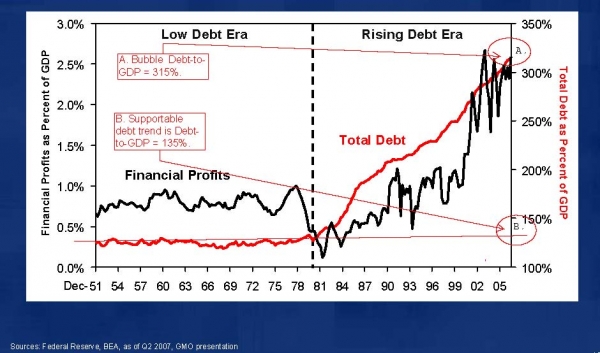
GMO chart via New Observations



July 23rd, 2009 at 11:33 am
Wow, so that’s what it’s all about, right? Keep that debt machine rolling so the real powers that control the country and world can stay flush in cash and buy that 3rd yacht, 6th vacation home, and 2nd private jet. Wonderful.
July 23rd, 2009 at 11:39 am
Barry,
In prechter’s latest there is an excellent chart from Global Financial Data and Bank calculations that shows the performance of a portfolio strategy that would have been long financial stocks/short the broad market.
From the letter:
This strategy would have produced essentially no profits from 1900 to 1974. From that point forward, and especially from 1991 to 2007, profits would have puored in to the tune of 100 times the amount of money placed on each side of the spread.
it goes on
In other words, banks made huge profits from the privilege, franted to it by the government, to create credit out of thin air and earn interest on it. Many banks also speculated in the bubble that their credit expansion had fostered, increasing their earnings even more.
July 23rd, 2009 at 11:39 am
Reaganomics graph, sweet! The red line could also be a graph of the growing popularity of punk rock.
July 23rd, 2009 at 11:42 am
Parastitic banks are basically stealing money with the fed’s help at the country’s expense. Will enough people ever wake up and realize this? It’s all the result of the financialization of our economy. Welcome to the Potemkin Economy.
July 23rd, 2009 at 11:46 am
Manny – Amen to that. Although with our societies seemingly insatiable appetite for consumer goods you might want to call it the Pokemon Economy.
July 23rd, 2009 at 11:47 am
Mannwich – perhaps you’d like to return to our economy of the 1970s?
Ben – have you ever checked Prechter’s long-term track record? Here’s a synopsis from a recent article I did about him:
Here’s how Prechter’s trading advice has done from 1/1/85 through 5/31/09 versus the broad U.S. stock market average (Wilshire 5000 index) according to Hulbert’s analysis:
Annualized Return:
Wilshire 5000 Index + 9.7 percent
Prechter’s Trading Advice -15.4 percent
Total Return:
Wilshire 5000 Index + 857.1 percent
Prechter’s Trading Advice – 98.3 percent
The underperformance of Prechter’s newsletter is nothing short of astonishing and stunning! On an annualized basis, Prechter has underperformed the broad U.S. stock market Wilshire 5000 index by a whopping 25 percent per year! Here’s what Hulbert’s analysis shows would have happened to $100,000 invested according to Prechter’s investing trading advice versus the Wilshire 5000 U.S. stock market index:
$100,000 Invested (1/1/85-5/31/09):
Wilshire 5000 Index $957,100
Prechter’s Trading Advice $1,700
July 23rd, 2009 at 11:53 am
How does that debt trend dislocation correspond to the Boomer’s participation in the labor market. It is entirely mysterious to me how a massive expansion in debt could be concurrent with an extraordinary influx of workers (and demand). Shouldn’t all that excedent have produced significant equity? How does a huge expansion in work and economic activity produce unfathomable debt levels?
July 23rd, 2009 at 11:57 am
There is a reason most of the office towers in most of the cities in most of the world have the name of some financial institution on them. Banking is very lucrative
July 23rd, 2009 at 12:01 pm
As I’ve said before, massive debt deflation and asset markdown is underway. It will take years if not decades to play out. This chart says it nicely. Expect another 25 years before debt completes its reversion back to its mean.
All that debt meant fat fees and huge salaries for mortgage brokers, investment bankers, real estate agents, college loan officials, car dealers, boat sellers, etc. There was nothing with a skyhigh price that didn’t have an army of lenders more than happy to hand you the cash to fill the gap…for a price.
Bye bye to those days, and good riddance too.
July 23rd, 2009 at 12:05 pm
I love some of the observations on this post. You guys are coming to the same realization that dawned on me about 15 years ago. In 15 years you guys should be raging lunatics like I am. Let us hope more Americans will begin to realize the scam that is going on right before their eyes. Maybe in 15 years people will be marching on the capital. If it happens that soon I’ll die happy knowing that I lived to see the Fed dragon slain in my lifetime
If you want to study the Fed phenomena I suggest the book The Creature From Jekyll Island. It changed my economic life….but not before I passed through the five stages of economic grief
July 23rd, 2009 at 12:15 pm
common man
Indeed. There are certainly times when it would be better to be ignorant; and blissful as a result. Alas it is not so, and some of us live with the frustration of seeing this go on around us. And we seem like lunatics to most people if we voice those concerns.
July 23rd, 2009 at 12:22 pm
Perhaps coincidentally (I don’t think so), the acceleration in the financial profits curve seems to take place at about the time of the repeal of Glass-Stegall. The original intent of Glass-Stegall was to prevent the types of abuses that have manifested themselves in the last decade years. By taking down the fences and allowing the children to get outside of the yard and play in the streets, we’ve now set ourselves up for the government to put an end to playing all-together and send us inside for the duration of this secular bear market.
July 23rd, 2009 at 12:24 pm
I am not surprised by the earnings of some of these companies coming in ahead of expectations…here I am thinking mainly of non-financial firms. Peeps have been thinking about what might happen with severe cost cutting and layoffs, and how a leveling out could occur in profits without increasing sales. But this should be a temporary phenomenon, as cost cutting will only go so far. And what are “expectations”? Most of us know that an analyst can be played with…and is.
July 23rd, 2009 at 12:24 pm
Look closely at the graph. There is a dip in early ’80’s. No surprise with 20% interest rates and lots of bankruptcies then. But the late ’80’s and 90’s, show a similar level to that of the ’70’s. It’s after ‘99 or ‘00 that debt levels go to the sky. Low interest rates? Push borrowing? Great chart but the line of demarcation in 1980 is wrong! It should be 20 years later.
July 23rd, 2009 at 12:28 pm
It seems to me that all of this truly began in earnest after Easy Al came to the rescue following the ‘87 crash and firmly established that he would support asset prices at all costs going forward.
July 23rd, 2009 at 12:33 pm
The chart makes it clear that the underlying bubble of the current era is not tech or housing. It is debt, and the easy money therefrom has spawned secondary bubbles. The chart also makes clear exactly why the government has been so anxious to preserve and extend the bubble… as other posters point out, a huge banking structure has been built on that bubble, and it interlinks financially with the government.
Are there other instances in history where a govenment actively tried to extend a bubble? And how did that work?
July 23rd, 2009 at 12:33 pm
Oops that note I just made is wrong! The wrong line in the chart. YES, ‘80 is the trigger year. Why is that?
July 23rd, 2009 at 12:35 pm
I’m newbie. I read Bailout Nation while on the beach in Cancun a few weeks ago and have since taken a liking to this blog and the commentators here. All of you make smart, informed and sometimes witty comments. Thanks!
I’d like to see this debt chart mashed up with a chart on wealth ownership. Is it true that “trickle down” economics has only made a small percentage of folks rich at the cost of the rest of us? My bet is, yes.
I’m also wondering about the connection between Republican party’s blood lust desire to get back into power and wealth and debt. If a meteor dropped on NYC and they could blame it on Obama, they would all be running around the Capital doing those awkward white man high fives. I don’t understand this win at any cost attitude. What’s their incentive? Something doesn’t add up based on the available information.
July 23rd, 2009 at 12:36 pm
The financialization of our economy started under Reagan and only intensified since then. Perhaps they viewed this as the only “solution” to the problems that we faced in the ’70’s? The history books may look back on this time as the official demarcation point where the U.S. started its slow decline.
July 23rd, 2009 at 12:41 pm
Great comments all around…it highlights the degree of the ponzi economy and times we live in. It is odd that the secular bull market (which ended in 2000) coincides with the rise in debt from 81 until 2000. The growth of debt then went exponential with little in the way of real productive economic growth (other than debt) to keep up appearances. We know rallies can go on longer than most expect, as once the herd mentality takes over, the market can get irrationally exuberant. I believe the market intermittently connects and disconnects from the real economy because of this.
July 23rd, 2009 at 12:47 pm
It seems to me that all of this truly began in earnest after Easy Al came to the rescue following the ‘87 crash and firmly established that he would support asset prices at all costs going forward.
BINGO! Give the man a prize!
July 23rd, 2009 at 12:51 pm
@ DG — I think that by looking for a Republican vs. Democrat explanation, we sometimes miss what I believe is more obvious…for the most part, there are no real differences between Republicans and Democrats anymore. They are both hell-bent on increasing the size, scope, and control of the Federal government. The partisan politics that they like to throw out to the public through the so-called MSM are there as a distraction, to keep us at each others throats so they can go about, nearly unmolested, in their power-grabbing and liberty-stripping in the name of helping the “common” (i.e. too stupid to think for himself) man.
July 23rd, 2009 at 12:53 pm
@Manny “The history books may look back on this time as the official demarcation point where the U.S. started its slow decline.”
Sure looks that way doesn’t it? I have always had a lot of faith in the American People to pull them selves back from the edge. Doesn’t look like all that much is changing where it counts though. You never know, we might get lucky – another crash within the next couple years would certainly be a good start in getting some change . . . . I hope
July 23rd, 2009 at 12:56 pm
Mannwich @ 11:42
“Parastitic banks are basically stealing money with the fed’s help at the country’s expense. Will enough people ever wake up and realize this?”
There are already quite a few in Congress (including, obviously, Ron Paul) who want to “audit the Fed”. So it’s a small but powerful group that doesn’t want us to see behind the curtain.
And now the Fed wants the power to be a “risk regulator” for the overall economy.
July 23rd, 2009 at 1:14 pm
GregMoon, that is close… I would posit that it isn’t so much a case of there being no difference between the parties, there is similarity as far as they are both presently controlled by elites, but the difference is that they are beholden and corrupt towards different sectors of our society. I figure it’s better to support someone who is corrupt with domestic policies like health care instead of one whose corruption rests upon profits from the destruction and reconstruction of foreign societies (much more blowback in that case).
People get caught up in the Left vs Right, Democract vs Republican, Consertivate vs Progressive game… while the real divide is a vertical one, not horizontal. It’d be interesting to see how people would react if our politicians started getting tagged as (P) Populist or (E) Elitist along with their (R) and (D)…
Both parties have been taken over by elites and corporatists that only pay lip service to the concerns of the majority, and care less about whats good for our country than whats good for their circle of friends. It has been a subtle and unannounced transition to us being a fascist oligarchy…
Too bad the majority of the lower classes are so distracted by shiny consumer goods and American Idol that they don’t realize they’re involved in a fight for what they assume to be rights granted… instead of being the privileges earned that they are. The times, they are a-changin, though… and if/when the sleeping giant that is the American public wakes up to what has happened…
July 23rd, 2009 at 1:15 pm
Looks like the era may continue. The SPX has broken the 233EMA to the upside. It also has reversed the trend on the monthly 3LB which started on 1/31/08. Shorts be patient your time will come. Just “no ahora mismo”.
July 23rd, 2009 at 1:22 pm
@DL
That whole story, to me, is quote emblematic of the problems we face, and parallels that of our country as a whole. The bill to audit the fed was co-sponsored by a MAJORITY OF HOUSE MEMBERS… yet they couldn’t even get it to a floor vote because of the House Leadership.
A majority of people (a), getting overruled by a select few (b), because of the influence of business (c).
(a) American Public / Representatives….
(b) Elites / House Leadership….
(c) Corporate America / Federal Reserve
July 23rd, 2009 at 1:29 pm
It’s pretty clear to me why the spike from 1980 – having lived through that period I can remember the sudden and radical rise in interest rates on credit card and mortgage debt, which never came back down again. Before that time, debt interest rates always seemed a few points higher than prime, it was tied to it, but because that shift was not regulated the rates didn’t come back down, we got used to paying the banks an exorbitant amount in interest, and they ended up with these incredible spreads which could only contribute to their outrageous profit margins…marry that to the fact that they were selling everyone mutual funds at the same time, and you have impending meltdown…Salaries have certainly not risen at the rate that bank profits have….what’s scary is that no one seemed to notice that 29% interest is completely out of line…we’re back to a feudal system, where we have become the serfs….
July 23rd, 2009 at 1:35 pm
@lafemmeverte: So true but at least we can all pay our debts with our cool new I-Phones, right?
July 23rd, 2009 at 1:37 pm
Another thing to note — the initial rapid rise in debt following the S&L collapse was triply fueled — by the relaxing of Fed rates as inflation was brought under control, the spendthrift Reagan policies, and the advent of the home equity loan.
July 23rd, 2009 at 1:37 pm
[...] Source [...]
July 23rd, 2009 at 1:38 pm
HUMPTY DUMPTY SAT ON THE WALL……
July 23rd, 2009 at 1:50 pm
Another way to look at the current situation is to look at the % of GDP to service the debt. In the 1950’s interest rates were in the 4 to 5 % range. so 1.35 X.045 = 6.1 %. Considering the effect of credit card debt, the average in 2008 was probably 8%, so 3.5 X .08 = 28% of GDP. Living within my means cost me a marriage but I can’t imagine what the wage slaves are having to deal with; real income is lower than 10 years ago, jobs are leaving etc.
July 23rd, 2009 at 2:01 pm
[...] Barry Ritholtz pulls a chart from a longer piece on household debt showing 1981 as the break point where rising financial profits and rising debt became joined at the hip. 2 comments! [...]
July 23rd, 2009 at 2:06 pm
A chart on zerohedge shows that debt sales for the next week will total $229 billion. The implication is that today’s stock melt up on mostly poor news is a pump to compensate for any downdraft that may be created by cash running to debt, as this amount of debt will likely require higher rates to sell. An emerging pattern is that stock melt ups occur when bad economic news is here or coming.
My lizard brain is saying buy before it’s all gone. Volume is up a little today so I wonder if any suckers have taken the bait? Probably.
Another news item on ZH deals with GS and others wanting to provide direct access for others to their HFT terminals for a fee. GS promises there will be no problems as they will front run (purely for Reg SHO purposes) and run edit checks prior to execution. Another house is less confident and claims that
a) one bad subroutine or goofy execution might cause an infinite loop to occur in order processing, at 1000+ orders per seconds that might take 2 minutes to find and stop. The example used was Long term capital type meltdown taking 5 minutes.
b) Naked shorts that settle at day end will never be detected, creating an unfair advantage for those who play by the rules.
c) All parties acknowledge these transactions all require millisecond response time or loss of advantage will result.
(I remember there once was an equities market long ago …now it’s a all warp speed daytrading.)
July 23rd, 2009 at 2:32 pm
Well, Duh!
This was the total motivation and incentive of creating the biggest credit/debt bubble of all time….and it kept going until people’s ability to finance all the debt finally peaked out…
July 23rd, 2009 at 2:39 pm
Andy – how does one get on your mailing list?
July 23rd, 2009 at 2:45 pm
Andy –
Are you still sticking to 977 and 989 as your upside targets?
July 23rd, 2009 at 2:53 pm
Debt was simply the vehicle by which incremental profits could be manufactured. The game was to get the stock market higher for the investor class. Low rates, coupled with deregulation, topped with capital gains and income tax cuts and presto you have a self propagating bubble. Oh yeah I forgot to mention the tax deductibility of interest expense (even credit card debt until relatively recently) and the disincentive to savings. WTF do u think is gonna happen eventually.
July 23rd, 2009 at 2:57 pm
@DG_Allen:
I’d like to see this debt chart mashed up with a chart on wealth ownership. Is it true that “trickle down” economics has only made a small percentage of folks rich at the cost of the rest of us? My bet is, yes.
I’ve mentioned it before: it is called the Pareto Principle.
Look at this distribution throughout the last several years: Wealth, Income and Power. Notice the steady erosion of wealth owned by the bottom 80% of the population. I think this will give you a good start.
July 23rd, 2009 at 2:57 pm
@Moss: And we hollowed out our manufacturing sector in the process as part of making the investor class rich and everyone else more poor. Well done, U.S. Well done.
July 23rd, 2009 at 2:58 pm
I should say “investor class rich-ER”…..
July 23rd, 2009 at 3:02 pm
mannwich @12:36
This link was post July 22nd in a different thread. It is very interesting, re: “official demarcation point where the U.S. started its slow decline.”
http://europe.theoildrum.com/node/5528
What I found especially interesting was the concept that peak “production” of a society is followed by peak “capital.” I always thought that the financial bubble was an attempt to continue prosperity beyond the point where we could be the “producers for the world.” And it fits nicely with the evolution of societies in general. Also, the concept of “energy in vs energy out” at a societal level, and how societies in decline end up in a loop of ever increasing energy (resources) in to get ever decreasing value out. Another theme the US seem caught up in.
July 23rd, 2009 at 3:07 pm
@hope: Thanks for the link. I’ll check it out. That’s sort of my theory as well. Obviously, I hope I’m wrong (as well). It seems that we’re following the path of other great civilizations down the toilet. It’s almost as if the evolution is inevitable to any empire, since human nature doesn’t really change. One has to wonder if we’ve simply run out of ideas to fix things and the elites don’t really want to fix them (nor can they fix them), so we’ll head down this path of trying to maintain the status quo through all sorts of financialization schemes until some big event prevents us from keeping that game going.
July 23rd, 2009 at 3:15 pm
@mannwich – I hope I’m wrong too. But it seems like a society which follows a path to prosperity (which is rare), has a predictable path to decline. Kind of like, we got overbought, the sell off can’t really be stopped.
The article discusses if the decline can be intercepted (let alone recognized real-time). It seems like human nature is too predictable to alter the course much. But, I didn’t find the proposed path taken to be very interesting.
Also, this doesn’t seem to happen quickly. It can take centuries.
July 23rd, 2009 at 3:16 pm
correction: “I DID find the proposed path taken to be very interesting” NOT “I didn’t….”
July 23rd, 2009 at 3:20 pm
@hope: Good point, so if we’re in the early stages of our decline, all of us will be relatively lucky to not be here when the excrement truly hits the fan. However, something tells me that with the advent of technology and advanced weaponry that could wipe out the planet in a nan0-second, civilizations could decline much more quickly than back in those days.
July 23rd, 2009 at 3:25 pm
Moss re: http://www.ritholtz.com/blog/2009/07/financial-profits-and-rising-debt-era/comment-page-1/#comment-196557
Indeed. And it conditioned everyone to believe that it was the new normal; that we had found the productivity miracle that tilted the growth curve up and justified the higher multiples in the market, etc.
And those who’ve been howling about it all the time have been dismissed, derided, and treated like nutty lunatics; effectively and efficiently marginalized so the masses wouldn’t pay them heed.
For a very short window of time it seems that we started to actually look through and see the truth, which brought to the lows in the market. But then denial kicked in strongly again and you can’t hear anybody in the mainstream talking about debt levels as the underlying problem. Other than mentions of the general populace being concerned about the deficit. But that’s dismissed as misinformed because we all know we have to pile on more debt to get out of this /snark/.
So talk of the market being fairly valued and that the March bottom was just an Armageddon scare is B.S. as far as I’m concerned. I think it was just a short period of time during which we came out of denial and saw the truth. But we’ve conveniently squashed that mindset. Onward to 1200!
July 23rd, 2009 at 3:28 pm
@mannwich – The wild card is, will our path be accelerated for some reason? Globalization? Something else? The future is not really clear at a high level of detail, but history sure indicates likely scenarios.
War didn’t really “accelerate” the decline of the Romans, but was part of it. So I doubt war will do it for us either.
Seems like a garden variety decline will not impact those currently alive too much. The very young will potentially have a tough second half of their lives. But, we aren’t stuck in this country. So there is some flexibility. The real problem is a global reversal of fortune, which is also possible.
July 23rd, 2009 at 3:31 pm
Being rational the thoughtful doesn’t work well in an irrational and thoughtless culture.
July 23rd, 2009 at 3:33 pm
@hope: “Being rational the thoughtful doesn’t work well in an irrational and thoughtless culture.”
So true, and is what frustrates many of us here at TBP and others in this country who seem to be in the minority.
July 23rd, 2009 at 3:42 pm
@manw
Some of the labor arbitrage is/was useful in that it was organic. But I think some of it was aided by tax incentives and a general war against unions not to mention the slave labor of China. Of course it was all done in the name of improving the bottom line, again for the investor class.
@onlooker
I am often derided when I speak about economics to those who are in denial. Most people simply do not want to hear the facts or truth. They do not acknowledge it, are too caught up in living each day to its fullest.
July 23rd, 2009 at 3:42 pm
Re: the decline of a society (empire), it seems like the cause is definitely human nature because every path I can think of which would avoid the ultimate decline is a principles based decisions culture. But, when human nature gets in the way, principles get watered down, then get abandoned, and this is especially true in highly prosperous societies where principles seemingly “don’t matter” anymore. They don’t provide short term value. They really don’t if you are prosperous. They only provide very long term value for the society, so they are scuttled. I’m talking about the societal level. Individuals may or may not lead principle based lives, but the “value” to that is not economic in high prosperity.
July 23rd, 2009 at 3:44 pm
Jeez, anyone see srs today?
July 23rd, 2009 at 3:47 pm
I’ve been selling my long positions, but not it looks like I was early.
July 23rd, 2009 at 3:51 pm
@mannwich – After you read the article in the link, Please post your thoughts.
July 23rd, 2009 at 5:09 pm
@ OkieLawyer
Thanks for the charts. This section of data is interesting vis-a-vis the original article and the break between pre and post 1981.
July 23rd, 2009 at 5:18 pm
Hey Barry – You still appear to be having problems with postings
July 23rd, 2009 at 6:11 pm
“It seems to me that all of this truly began in earnest after Easy Al came to the rescue following the ‘87 crash and firmly established that he would support asset prices at all costs going forward.”
It started earlier than that. By the early 1980s, Solomon already had a massive lobbying force in Washington and so did the other major iBanks and big banks. Securitization of the housing market was in full swing and the congress had already pushed through a bunch of legislation to make borrowing an important part of people’s lives and corporate capital structures.
July 23rd, 2009 at 6:50 pm
@hope: Great article. Seems pretty plausible to make the connection to what is happening now in the U.S. right now. Our problems are mostly intractable without much upheavel, so our leaders do everything they can to keep the game going, meaning the status quo, but in the end (whenever that will be), they will fail. I thought this passage was particularly striking:
“As things stands, we seem to be blithely following the same path that the Roman Empire followed. Our leaders are unable to understand complex systems and continue to implement solutions that worsen the problem. As the wise druid was trying to tell to Marcus Aurelius, building walls to keep the barbarians out was a loss of resources that was worse than useless. But I can see the politicians of the time running on a platform that said, “Keep the barbarians out! More walls to defend the empire”. It is the same for us. Tell a politician that we are in trouble with crude oil and he/she will immediately say “drill deeper!” or “drill, baby, drill!” Negative feedback kills.”
July 23rd, 2009 at 9:17 pm
Eric Tyson,
Where are your long term trading advice figures at? Please post them so that you can make a more compelling argument against someone else that is selling something on the internet like you are. I don’t see any links to performance history on your website.
Prechter missed the bull market of the 90’s, common knowledge, of course his returns are going to trail. Hulberts rating service reports that The Theorist exceeded the performance of the Wilshire 5 over the 13 1/2 year period ending December 31, 1993, he missed the bull market of the 90’s probably the biggest mistake he will ever make.
Besides, what I posted above wasn’t even from him, it was just in his latest letter.
I also find his books on socionomics more than interesting, even better than books for dummies.
Now, as for your article, first of all, the Elliot Wave Financial Forecast is written by Steve Hochberg and Peter Kendall currently , not Prechter so I find it odd that the data track is run all the way to 2009 and then is given to Prechter. Prechter writes the Theorist letter, not the EWFF. Also, I’m a little confused b/c you state in your article that the forecast is tracked back to 1985 but I subscribe to EWFF and in a very recent article it just celebrated it’s 10th anniversary. Are they lying about that?
Next, you don’t even provide a link to Hulberts study so that readers can review it. For example, the EWFF reviews the dow, nas, s&P, gold, silver, and treasuries, was this study only applied to the stock picks? If it did I find it very interesting since you yourself made comment to BR many weeks ago, about the importance of diversification did you not?
I also like the language you use when describing his 87 prediction, or your chuckle towards Roubini.
The icing on the cake your article is the last para though. You are a tool.
http://www.erictyson.com/articles/20090616