
Housing vs GDP 1945-2009
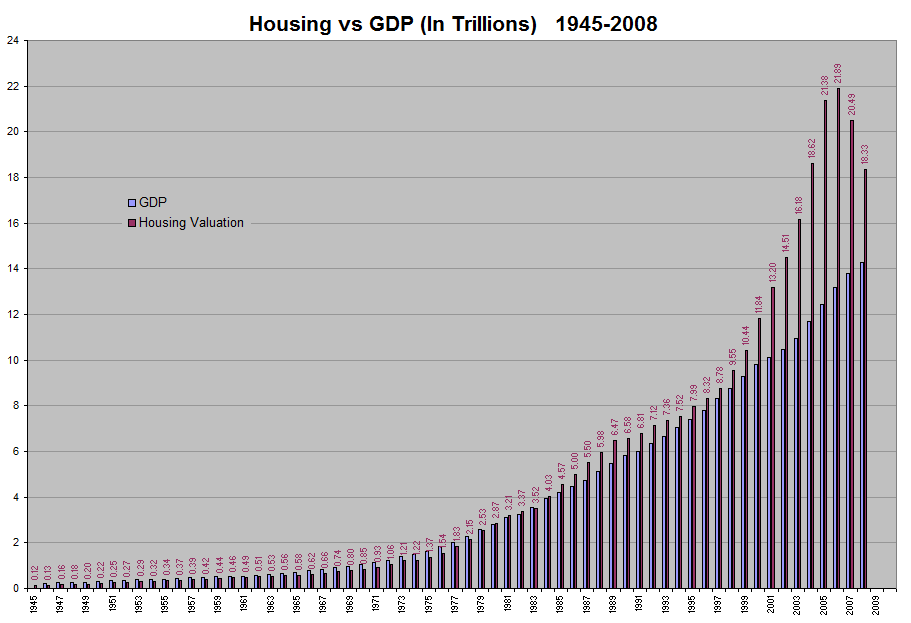
Housing Bubble Bust has this outstanding chart of Housing versus GDP going all the back to 1945.
Note the two began to diverge in 1999 — my experiences then were what we used to call smart money in the late 1990s were taking some stock winnings off of the table and diversifying then into a different asset class – namely, Real Estate.
My observations of this phenomena (at least in NY) was this rotation was less financial wealth planning and more lifestyle upgrade.
>



July 8th, 2009 at 7:40 am
It looks to me that we swapped wage/price inflation for asset inflation since the early 80’s. GDP/Housing was >1 in a big way in the 70s.
July 8th, 2009 at 8:02 am
Actually, Barry, just going by the visual, it appears that values as a percentage of GDP was highest in the 40s and 50s.
BUT, having said that, you’d want to know the extent to which the bubble and crazy notional.values distorted GDP in the last decade.
~~~
BR: That era is the beginning of Suburbia and the baby boom generation. I’d be surprised if the ratio wasn’t huge.
July 8th, 2009 at 8:17 am
How is this measured? Does it include commercial real estate?
I ran the equivalent numbers in Denmark (1990-2008 available) and housing as a % of GDP went from the 18% level in the early 1990ies to peak at 38% in 2007. There may be more public housing in Denmark, but still I can’t understand why the difference between US and Denmark should be so large i.e. housing/GDP peaking at approx. 180% in the US and only at 38% in Denmark.
July 8th, 2009 at 8:25 am
Denmark doesn’t have as much sand.
July 8th, 2009 at 8:28 am
@Michael M
Maybe Denmark actually required someone to have a job and put a down payment on a home before purchasing…
Those wacky Danes!
July 8th, 2009 at 8:49 am
@Barry: Yes, the sad difference being that the US economy was able to grow into the property values back then.
Michael M might be interested to know that the postwar era also saw a boom in public housing projects, the so-called “superblock” projects.
July 8th, 2009 at 9:08 am
Barry, I don’t believe I’ve seen you mention the 1997 era tax code changes as a possible contributor to the bubble.
http://www.nytimes.com/2008/12/19/business/19tax.html
July 8th, 2009 at 9:27 am
LOL
I was looking at the chart on my Blackberry earlier. The ratio values looked like columns to me.
Nevermind.
July 8th, 2009 at 9:30 am
Denmark actually has a sensible mortgage market
http://en.wikipedia.org/wiki/Danish_mortgage_market
According to the graph above, it looks like house values are still 20% overvalued.
July 8th, 2009 at 9:58 am
[...] “The Big Picture” posted this chart today showing housing prices & GDP growth in the US from 1945-2009. In the late 1990s housing began to pull away from GDP. Retrospectively this was the first clue that the levels of house price appreciation were unsustainable. [...]
July 8th, 2009 at 10:25 am
The other fact that struck me was that we had a GDP of barely over one trillion in 1972 and are up to about 15 trillion now. That’s a compounded growth rate of somewhere between 7% and 8 % – for all of 37 years. Seems awfully high. Else there’s some serious cooking going on.
July 8th, 2009 at 11:01 am
[...] When GDP and housing diverged. (Big Picture) [...]
July 8th, 2009 at 11:21 am
Yeah, when inflation rates were artificially being kept low, you could track the bubbles in first the stock market, then housing, then back to the market, then back to housing. Kind of ridiculous to keep saying inflation was so low when nobody could afford a home without a ridiculously stupidly configured mortgage.
I think the real problem was the way the Fed was figuring official inflation, using the equivalent rent. Perhaps if they hadn’t kept rates artificially low, we all would have saved more and spent less, and speculated less in houses and the markets, if we could have earned a decent return on our money elsewhere.
We need to get our economy back to fundamentals and investing instead of gambling.
July 9th, 2009 at 8:37 am
[...] Go here to see the original: Housing vs GDP 1945-2009 | The Big Picture [...]