
Leading Indicators Say “The End is Near”

Email this post Print this post
By Barry Ritholtz - July 27th, 2009, 9:15AM

click for larger graphic
20090725_charts_graphic
via NYT

>

I saved this from Saturday’s Off the Charts column by Floyd Norris:

THE American recession appears to be nearing an end, but only after it has become the deepest downturn in more than half a century.

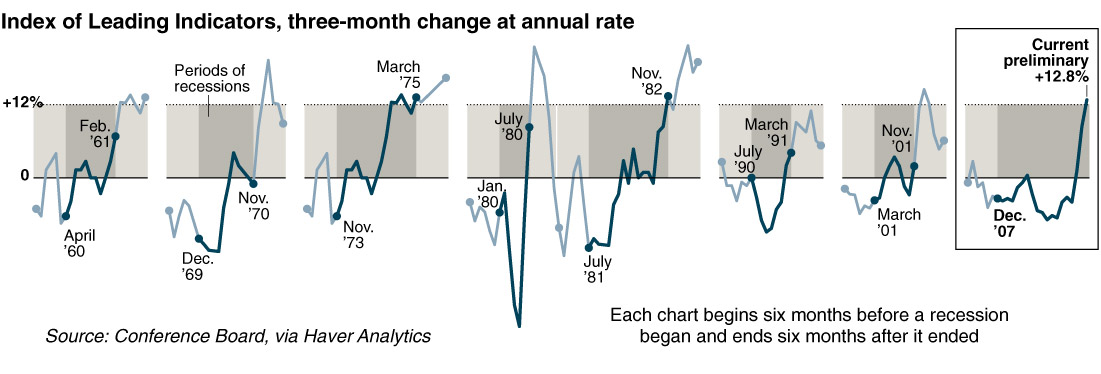
The index of leading indicators, which signals turning points in the economy, is rising at a rate that has accurately indicated the end of every recession since the index began to be compiled in 1959.

The index was reported this week to have risen for the third consecutive month in June, and to have risen at a 12.8 percent annual rate over those three months. Such a rise, pointed out Harm Bandholz, an economist with UniCredit Group, “has always marked the end of the contraction.” Mr. Bandholz said he expected that the National Bureau of Economic Research, the official arbiter of American economic cycles, would eventually conclude that the recession bottomed out in August or September of this year.

Why isn’t the Conference Board ready to declare the recession over? The index of coincident indicators — now down for eight consecutive months (down 17 of the last 19 months). That indicator is often used by the National Bureau of Economic Research in making dating decisions, and its failure to stabilize is likely why we haven’t seen any declaration that the  downturn is officially over yet.

>

Source:
Leading Indicators Are Signaling the Recession’s End
Floyd Norris
NYT, July 24, 2009

http://www.nytimes.com/2009/07/25/business/economy/25charts.html

Comments

Please use the comments to demonstrate your own ignorance, unfamiliarity with empirical data, ability to repeat discredited memes, and lack of respect for scientific knowledge. Also, be sure to create straw men and argue against things I have neither said nor even implied. Any irrelevancies you can mention will also be appreciated. Lastly, kindly forgo all civility in your discourse . . . you are, after all, anonymous.

49 Responses to “Leading Indicators Say “The End is Near””

  1. jc Says:

    Not scientific but I just can’t imagine what will restore consumer discretionary spending while wages are being lost on such a scale and the consumer has been scared into saving. Is there anything about the stimuli that could be causing the leading indicators to send a false signal????

  2. Super-Anon Says:

    Too bad the consumer isn’t participating so far. It’s going to be interesting to see how long this “recovery” lasts without them.

  3. Lugnut Says:

    Maybe because unemployment hasn’t stabilized, much less recovered

    Maybe cause bankruptcies and foreclosures are still high, and consumer spending is low

    Maybe cause commercial re is just now caving

    Maybe cause there is a massive deficit bomb looming over the Treasury market that threatens the stability of all capital markets

    Just MHO

  4. cvienne Says:

    Oh those pesky “coincident indicators”…

  5. primordial_ooze Says:

    Total BS. Tell me why the current uptick isn’t like the 1980-81 case? The index could plunge this fall.
    Past performance is no predictor of future performance.

  6. Mannwich Says:

    I wonder – can we have a true recovery with so much unemployment and people in debt to their eyeballs? Maybe those who have good jobs will keep the economy afloat right now, but I doubt that will be sufficient for a true “recovery” and a climate back to growth. Maybe once enough of that debt is defaulted on and written off but not yet.

    I think this is the new “normal” for quite a while. Not exactly Japan but a close knock-off to it.

  7. Mike in Nola Says:

    Just an illustation of Economists trying to pass themselves off as scientific by creating statistics and talking about them and making predictions about them Problem is that there is little correlation between these statistics and the real economy.

    Best example is the increase in GDP that occurs during bubbles, including the most recent one. The activity being measured is not necessarily beneficial to the economy as a whole, but produces good numbers. Best summed up by John Mauldin’s use of the phrase “statistical recovery.” We will get some artificial numbers that will be touted as better, but things won’t really be any better.

  8. hue Says:

    we’ve heard “this time it’s different” on the way up in both recent bubbles. could this recession from two huge back to back bubbles be different too? where signs of past recoveries don’t work as tea leaves?

  9. R. Timm Says:

    Employment is a lagging indicator and it will lag more than usual in this recovery. The only LEI that I see as troublesome is the recent stock market performance. This rally is overbought and will retrace back to 800 S&P before heading higher again.

  10. jc Says:

    Corning flat panel TV sales way off, trucking & RR shipments are off about 20%, people are sitting on their wallets

    http://www.bloomberg.com/apps/news?pid=20601087&sid=armS0HvL3I.E

  11. Mannwich Says:

    @jc: Are flat panel tv’s a leading indicator or lagging? Me-thinks this level of economic activity is the new “normal”, which means retailers are still in for a world of hurt and some will be ripe for shorting activities. Unless many can simply pile on more debt to their crappy balance sheets (which is possible, I suppose), many retailers are going down in the coming years. We haven’t even begun to see that carnage.

  12. cvienne Says:

    I love it when, for example, last week a time chart was put on display showing the “timeline” of the 1929-1932 period…Some wanted to negate those comparisons by saying it was essentially USELESS to draw any type of correlation…

    Do you suppose they say the same about this graph? Or does the mind just see what it wants to see?

  13. Mannwich Says:

    @cvienne: I think you know the answer to that question. Me-thinks it’s the latter.

  14. Mike in Nola Says:

    jc:

    If you relied on CNBC, you’d have thought Corning was in boom times.

  15. Mike in Nola Says:

    Zero Hedge just had a post about UBS refusing to sell any inverse or leverage ETF’s. Googled and found this article from last week:

    “Firms opt against selling leveraged ETFs after FINRA’s warning
    SIFMA SmartBrief | 07/27/2009

    The Financial Industry Regulatory Authority recently warned that leveraged exchange-traded funds “typically are unsuitable for retail investors” because such investors tend to hold them for longer than a day. The warning prompted Edward D. Jones, LPL Investment Holdings and Ameriprise Financial to ban sales of some leveraged ETFs. Direxion Funds is arguing that the ETFs can be used successfully and is trying to get the brokerage firms to reconsider their bans. InvestmentNews (07/24)”

    Anyone have any more info? Part of a plot to keep everyone long? God knows that can be bad. At least I know that from personal experience :) But God also knows long mutual funds can be worse.

  16. globaleyes Says:

    I’m bullish on interest rates, this recession and foreclosures which means I expect all three to continue into the indefinite future. I hope I’m wrong.

    http://www.marketvane.net/bull2.jpg

  17. ben22 Says:

    I might be a little more compelled by this data comparison if this recession were anything like the others compared to here, or if the causes of the past recessions were the same but from where I sit neither applies.

    Like some others above I haven’t noticed that since December 2007 we moved away from being a consumer based economy so how from here there will be a great expansion when it comes to spending, credit expansion, and job creation which in turn increases disposable income, not just for the currently employed, but also putting back to work the unemployed/underemployed, is not something I can see. I suppose it is possible that this happens, but it doesn’t seem probable. Not with the following:

    - The U-6 unemployment rate in June, at 16.5% is more than half the rate at the bottom of the GD in 1933.
    - Unemployment rates for workers 45 and older have soared to their highest level since at least 1948.
    -Employed are working fewer hours, average of only 33.1/wk in May
    -Part-time work is at a record high, overtime a record low.
    -The loss of two million jobs in the first quarter of 2009 was the largest in any three-month period since at least 1939, when the data begin.

    Certainly the market appears overbought right now but that doesn’t mean it can’t stay that way for a lot longer than anyone expects. In any event, things had better rebound quick or stocks like Macy’s, which has run from roughly $5, to almost $14 since the March lows, will have nowhere to go but down.

  18. karen Says:

    the presentation of the new home sales data was as hilarious as ever.. up 11%, biggest month over month increase since… the fact is that sales are down 22% or so from last june..

    looks like a good number of california families will be going back to one earner households.. that is when the adult kids are pitching in to help the parents keep up with their mortgage payments.. that’ll do wonders for the real estate affordability index..

  19. Mannwich Says:

    @Mike in Nola: Boom times in debt-binging China maybe, where they are following our previous bubble path. It worked so well here, the Chinese thought they’d just emulate it. They’ll do OK with that strategy until their bubble eventually pops too.

  20. DeDude Says:

    As we all know it’s always different every time, but the question is how is it different, and what those differences do to the parameters we are looking at. So I am wondering how much the stimulus package (the thing that is different this time) is influencing these leading indicatiors.

  21. dead hobo Says:

    In the weekend papers, I saw autos were heavily advertised and heavily discounted, without regard to cash for clunkers. Either they are reflecting the new cost structure (doubtful because both foreign and domestic were begging for customers) or autos are not following the fantasy recovery plan.

    I went to a Marshall’s. I was surprised to see the inventory thin and the racks spread out very obviously. Few customers and the parking lot was almost empty in front of the shopping areas. OK near a grocery store.

    I don’t think the rumored inventory rebuild is going to happen as vigorously as claimed by the pundits. If so, companies like Marshall’s would be bursting at the seams and not trying to look full. Rather, I think we’re going to a new state of equilibrium where less of many things will be the new normal.

  22. ben22 Says:

    @Mike in Nola,

    I wrote about that ETF issue weeks ago. It’s all a complete joke really, after all, reps at these places are basically not allowed to rec the etf’s due to leverage, however, can still rec a long position in a bank, many of which still have leverage of over 20:1.

    This is the kind of regulation we are going to get, hope people start to understand that soon. This sort of regulation does nothing to stop the already problematic conflict of interest in this industry which is that at these companies the rep does not get paid when the client is in cash.

    If you look further at what those companies did, it wasn’t just to ban etf’s with leverage, they have also stopped short etf sales completely, even on things such as SH. Long only and always stay invested.

  23. I-Man Says:

    Thats the American Way Ben22-

    Dont question it… just sell something already.

    Keep them long, all along.

  24. dead hobo Says:

    Also, with oil on the rise again in spite of lowered demand … people aren’t stupid when it comes to managing the household budget while income is uncertain. They can be an infinity past the point of stupefying stupidity when times are good, but reality has been a rude visitor of late.

    With oil on the rise again, people will hunker down more deeply. Excess cash will go into the bank and maybe to a dinner at an upscale chain restaurant.

    In spite of the pundits, it’s looking more and more like a double dip is on the horizon. We’re falling to a new equilibrium and not going back to the former one in any reasonable time.

  25. bdg123 Says:

    This is bull-oney. These models work until they no longer work. If one breaks down the LEI, nothing based on fundamental capital creation in the economy has moved upward. The bullishness is all based on the credit and risk components in financial markets. It’s bullshit. It’s like ECRI and their WLI that is now at multi-year highs. ECRI is also too beholden to models that work until they no longer work. They were deer in the headlights when it came to anticipating the shocks that hit us. And both will again be deer in the headlights to future shocks.

  26. Onlooker from Troy Says:

    Yes, the LEI are being influenced by monetary and fiscal policy (i.e. the stimulus package). And it’s bumping things up with a little sugar high. But that won’t be sustainable for all the reasons outlined by others and that have been covered here ad nauseum. It’s apparently good for a stock market rally, as investors don’t seem to be able to see past their noses anymore, and the herd is riding the wave.

    Once again, maybe the recession is drawing to a close on a technical basis, producing a positive GDP print. But it really doesn’t matter in any substantive way to most people. GDP is a rather crappy way to assess the economic health of the nation anyway. There are many ways that it is influenced that look good on paper but are really not healthy. One reason is the analogy I like that it’s like looking only at a company’s income statement while completing ignoring the balance sheet. That’s folly when the company is really limping along with huge debt and practically insolvent. They may be able to produce some current income due to one time circumstances, but the longer term prospects are terrible. Sounds like the banks, and our nation.

  27. tradeking13 Says:

    Why do we keep comparing this credit induced recession to past business cycle recessions?

    Also, isn’t “stock market prices” one of the indicators in the LEI? I’d like to see what the relative impact the stock market is having on the LEI.

  28. wally Says:

    Have we ever come out of a recession loaded with the absolutely crushing levels of debt that we now carry as a result of our gifts to the big banks at the expense of Main Street? Have we ever come out of one with all the credit transactions shadowed by the implicit guarantees that are now in place?

    Given that this is a first-time situation, I’d be cautious. Also, if I were Bernanke I would be cautious about playing the saviour role in front of the people he is robbing to ‘save’.

  29. Mike C Says:

    @ben 22

    This is the kind of regulation we are going to get, hope people start to understand that soon. This sort of regulation does nothing to stop the already problematic conflict of interest in this industry which is that at these companies the rep does not get paid when the client is in cash.

    Ben, there is a way around this. Why not just go independent and start your own separate RIA firm rather then work for a wirehouse. This is what I’ve done. Sure, you don’t have their back office support and marketing muscle, but you can do things your way and get paid if you decide sitting in cash is the right thing to do because you charge a flat percentage of assets and it doesn’t matter whether you are in stocks or cash as presumably you are actively deciding which is better at any given time.

    Been awhile since I posted so a position update. I’m about 60-70% invested in equities and 30-40% cash. I got faked out on that bogus head and shoulders breakdown, and trimmed 10% of my equity exposure at SPX 870ish. Oh well, you can’t get them all right, and that is why I always move gradually, incrementally and don’t make ALL or NOTHING type changes.

    The higher the market goes the more I will sell off. If and when SPX hits 1200, I expect to be very light in equity exposure. More then a few technicians have 1200 price targets even though that number makes ZERO sense to me from an fundamentals or valuation perspective. Incidentally, I’ve come more around to your credit deflation view, but I think one still cannot underestimate the impact that fiscal and monetary stimulus could have on the market in the short-term. Go back and reread Grantham’s quarterly letter.

    http://www.tradersnarrative.com/how-high-can-this-market-go-2799.html

    http://www.decisionpoint.com/ChartSpotliteFiles/090717_rr.html

    ”Bottom Line: The violation of the head and shoulders neckline has proven to be a bear trap, and my opinion is that the rally from the March lows is resuming. My upside price target is about 1200 on the S&P 500. I have to say that this doesn’t make any sense considering what I think I know about the economy, which is why I try to ignore fundamentals in favor of the charts.”

    http://www.decisionpoint.com/ChartSpotliteFiles/090724_bt.html

    ”I think the weekly chart (below) does a good job of conveying the power in this rally. We can see the breakout above the long-term declining trend line, as well as the horizontal resistance, which is the neckline of a reverse head and shoulders pattern. The pattern has executed and the minimum upside price target is about 1200.”

    Just curious, for those who have held and continue to hold a “buy and hold” short position in leveraged ETFs, what do you do here if you didn’t take any money off the table at SPX 666-700 when the market was the most technically oversold in a generation? Do you ride the position up to SPX 1200 if that is what is going to happen, or do just continue to hold with the view that at some point your fundamental valuation outlook will be proven right (SPX 450?)

  30. DeDude Says:

    And don’t forget that the economy is not reported in absolute numbers (i.e. 14.1 trillion per year) but as a second derivative, % annualized change. So numbers actually turns positive when the falling ends, not when we are back to “normal”.

  31. ben22 Says:

    @Mike C,

    I’m in the process of moving to RIA right now, thanks though, it’s the only logical conclusion far as I can tell As for giving up the marketing muscle, lol, I don’t agree with almost anything my company puts out with regards to investments. All the marketeting material is about buy and hold and stay invested, exactly what I disagree with.

  32. Onlooker from Troy Says:

    Indeed it does seem crazy that we have to cover this ground over and over again. But I guess it has to be restated continually because there are many who just don’t see the forest for the trees and continue to be sucked in by the noise, ignoring the larger signal. And people will get hurt falling for it. So we try. But it does get a bit old, doesn’t it?

    The bottom line for me is that the argument that we are on the verge of real, sustainable recovery, and therefore a sustainable uptrend in the stock and housing markets, is based on thin evidence and a huge dollop of hope and confidence that we’re different and those bad outcomes just won’t happen to us (i.e. Japan’s lost decades, another depression, etc.) On the other hand there is huge, objective, overwhelming data stating otherwise. I won’t bet on the hope and hubris side myself.

  33. alfred e Says:

    @DeDude correct about stimulus influencing LEI as well as daily SLP pumps.

    IMHO, the velocity of money is currently so low and will remain low for some time, that the LEI s are way too optimistic. The big dogs continue to pick the carcass clean.

  34. mathman Says:

    Nothing to see here, move along:

    http://rawstory.com/08/news/2009/07/25/spitzer-federal-reserve-is-a-ponzi-scheme-an-inside-job/

  35. constantnormal Says:

    Yeah, the LEI says The End is Near, go check out David Rosenberg’s & Tyler Durden’s presentation over at ZeroHedge … The End of the End of the Recession, for the bigger picture.

  36. Jdamon33 Says:

    I’m in a leveraged 3X short ETF (FXP and FAZ). I use these to hedge a pretty large long position(s) in my IRA’s.

    I will probably just ride it up to the 1,200 level (if that is where we are going). At that time, I will sell off all my Long IRA funds. At some point, I believe reality will hit the market square in the face and we will be back down to the 800 SPX range. I don’t think we will get back to the 700′s again, but I could be wrong.

  37. Jdamon33 Says:

    After reading Rosenbergs piece, I’m thinking FDIC backed CD’s for the next 3 – 4 years (at least). Dire situation we have here folks.

  38. danm Says:

    Mike in Nola:

    You’ve got to trade them. Even if you short and the market goes down over a while, the volatility kills your returns.

    HBP 60 Bear+ E.T.F = HXD (2X market)

    TSX June 08 = 14467
    HXD = 17.18$

    TSX Today = 10760
    HXD = 15.20$

  39. Monday links: bullish bandwagon Abnormal Returns Says:

    [...] The recession is likely over.  What kind of recovery comes next?  (Newsweek also Big Picture) [...]

  40. lakshman Says:

    Hi Barry,

    When I saw this in the NYT I thought you might pick up on it!

    A few comments for consideration:

    1. Current version of the LEI has issues, as Floyd points out, component estimations (using econometric models), etc., but it IS starting to fall in line behind earlier rise in ECRI’s leading indexes (LLI & WLI).

    2. ECRI’s Weekly Coincident Index, while not yet positive, seems to be fairing better — see chart mid-page here: http://www.businesscycle.com/resources/

    3. ECRI Leading Indexes in no way represent an econometric model that has been fitted to the data, but they are based on relationships that predate the Great Depression, so they have some validity in jungle variety recessions like the one that we believe is now ending.

    4. both the U.S. in the 1930s and Japan in the 1990s had business cycle expansions despite big problems:
    http://www.nber.org/cycles/
    http://ecri-prod.s3.amazonaws.com/reports/samples/1/BC_0907.pdf

    5. unlikely to get an NBER call on recession’s end until well into 2010 as they wait for jobs and GDP data revisions to settle down. The estimates of those data in the near-term, made by econometric models, systematically experience their largest errors in the vicinity of cycle turning points.

    Kind regards,
    Lakshman

  41. fusionbaby Says:

    Fiction is fact. White is black. Everything is actually the opposite of what it seems. Immorality, corruption and hidden agendas have worked their way so deeply into the system on a viral level that a once decent system with potential is now worthless. As regards material and financial survival, it has reached the point now where it is everyman for himself. We’d better have our economic solution in place for the very different future that we are speeding into like a locomotive. We’ve allowed ourselves to be had. All MSM, government or industry statistics are tripe. Go out, walk around, look around, talk to the people in the street… that is where the statistics and trends are. And they spell TROUBLE the likes of which America has not seen for a very very long time. And the global situation will mirror what happens here.

  42. cvienne Says:

    1930′s “business cycle expansion” = manufacturing for future European ally war effort

    1990′s “business cycle expansion” = building out internet infrastructure

    2010′s “business cycle expansion” = SHOW ME THE MONEY (and/or the credit to pay for such expansion)

  43. Dr. Kenneth Noisewater Says:

    When we get polywell-based fusion electric power that makes electricity too cheap to meter and makes electric or hydrogen cars feasible, and we stop spending money on home heating and transportation, _that_ should free up enough consumer spending to pay down debt and expand the consumer business cycle.

    I’m not seeing much else being able to get over the _consumer_ debt hump.

    What else out there is going to start getting 70% of the economy going again? Massive consumer defaults?

  44. Steve Duncan Says:

    Hey Lakshman,

    Why don’t you talk about what the ECRI Long Leading Index (LLI) did versus the Coincident Index during the Great Depression? The ECRI Long Leading Index went positive in 1930 while the ECRI US Coincident Index continued to go negative for two more years until the middle of 1932. The ECRI Long Leading Index then went negative for a second time and followed the Coincident Index to a bottom in 1932.

    So, the initial ECRI Long Leading Index (LLI) was predicting an end to the Great Depression in 1930 and it was wrong (and the ECRI LLI is going to be wrong again this time). Your current ECRI Long Leading Index (LLI) is jumping the gun due to being based on false indicators predicting the end of the Great Recession. You won’t tell us what the ECRI indicators are (proprietary) but they are probably made up of some of following one time or temporary increases due to Govt intervention: interest rate spreads, stock prices, money supply, commodities (oil spike), and inventory rebuilding.

    Keep putting that positive spin on it baby.

    http://www.thestreet.com/story/10039739/1/time-tested-tools-see-no-double-dip-ahead.html

    Kind regards,
    Steve Duncan

  45. bdg123 Says:

    If that truly is lakshman you are showing a large vlind spot by citing Japan post 1987 and the U.S. post 1933. The dynamics are completely different than today. And even though you are citing that some of your data points are not yet positive, you are citing on your web site that the economic recovery is at hand re the WLI

    http://www.businesscycle.com/news/press/1500

    I find it HIGHLY DUBIOUS that your use of some data points in your models pre-dates the Great Depression. Some of the granularity in statistics used are not available pre the Great Depression. And, your own research on your site shows a correlation well past the Great Depression. I can’t help but think you are taking a literal liberal liberty. And, the Conference Board LEI is just as adept as the WLI is. They are both wrong that all is clear ahead.

  46. lakshman Says:

    Hi Steve Duncan (and bdg123),

    Please re-read the article that Anirvan posted, which Steve links to in the note above.

    You’ll see that the USLLI correctly spotted the upcoming cycles in the growth rate of the coincident indicators, including the plunge into depression following a 10% recovery in the economy’s growth rate in early 1931. To put that 10% growth rate upturn (less negative growth) in perspective, it was only about a one third of one percent increase in the coincident indicator’s growth in the first half of 2008 that had fixed income markets (incorrectly) pricing in 75-100 bps of Fed tightening by Dec. 2008.

    Anirvan’s post also includes a presentation of the Japanese LLI in the 1990s. Note the business cycle expansion from 1994-97.

    Please see #3 of my earlier post above — we don’t use econometric models to forecast, period.

    Please recall that data used to define business cycles, like GDP and jobs numbers, undergo significant revision. The coincident index data shown on our site’s resources page is using the latest data available, yet there will be a few revisions to GDP data ahead, and benchmark revisions to the jobs data. I’m not complaining, or suggesting that revisions hurt our analysis. But I am pointing out that it’s possible the coincident index will be revised up (or down). ECRI’s April forecast, however, stands. The recession is likely to end this summer.

    Our LLI’s do not include stock prices which have too short of a lead.

    I’m not really a blogger, so I’m not used to the culture. I’m happy to try and answer questions about ECRI’s work, but if the discussion devolves into accusations I’ll bow out.

    Kind regards,
    Lakshman

  47. Obama, Democrats Worry as 2010 Midterm Elections Loom | Recession, Unemployment, Jobless Recoveries | Libertarian Romantic Ideal Says:

    [...] Ritholtz of The Big Picture Blog, and author of Bailout Nation comments: The index of coincident indicators — now down for eight consecutive months (down 17 of the last 19 months). That indicator is often [...]

  48. Brooklynsky Says:

    Interesting:

    I used the part about “Why isn’t the Conference Board ready to declare the recession over?” from this post in one of my posts, “Recession: The Worse is Over, Get Ready for a Long Bad” (http://libertarianromanticideal.com/?p=119), and Frank Tortorici, Director of PR, The Conference Board made this comment on my blog:

    “The Conference Board publishes the Leading Economic Indicators for the US. We have not and will not ever declare the beginning or end of a recession or depression. We do make forecasts, but those are different than official declarations.”

  49. Icanhasbailout Says:

    I might be cheered by the news if I didn’t know how deliberately the indicators are being manipulated by the Treasury and Federal Reserve.

    The leading indicator I am looking for is honesty.

    icanhasTARP.com

109 queries. 0.499 seconds.