
Worst June New Home Sales Since 1982
Most of the Media and Wall Street economists have had the inherent tendency to get this data wrong . . . the latest batch of releases is no different . . .
Consider these charts before you conclude that Residential RE is improving:
>
June 2009 NSA New Home Sales Worst Since 1982
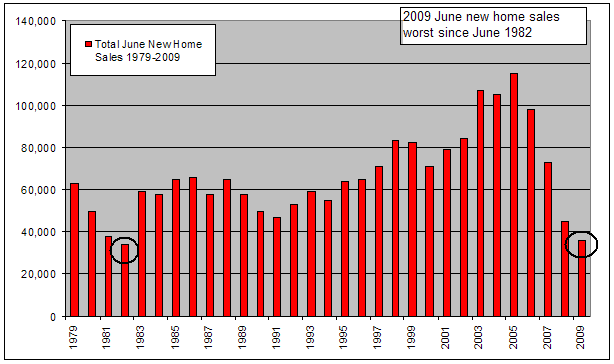
As Floyd Norris noted, “This was the second-worst June since they began counting new-home sales in 1963. It was not quite as bad as June 1982, when the country was mired in a deep recession and interest rates were sky high. Then 34,000 new homes were sold. There are twice as many households in America today as there were then, so relative to population this was the worst June ever, by far.
>
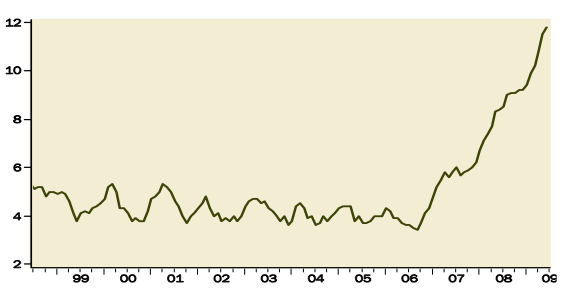
IT’S TAKING A YEAR FOR HOMEBUILDERS TO FIND BUYERS
Source: Haver Analytics, Gluskin Sheff
David Rosenberg notes in the chart above (United States: New Single Family Homes) that Median Number of Months for Sale (months)is still rising. Sign of a bottom? Hardly.
>
Builders Are Slashing Prices to Dump Inventory
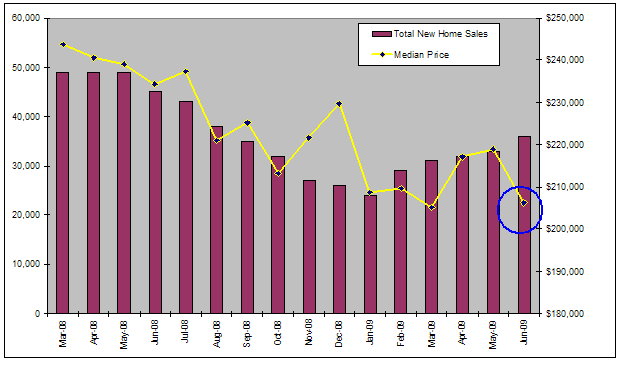
Bbuilders are slashing prices to dump inventory ahead of the slow season after the summer.
>
New Homes, NSA, Unit Sales and Prices
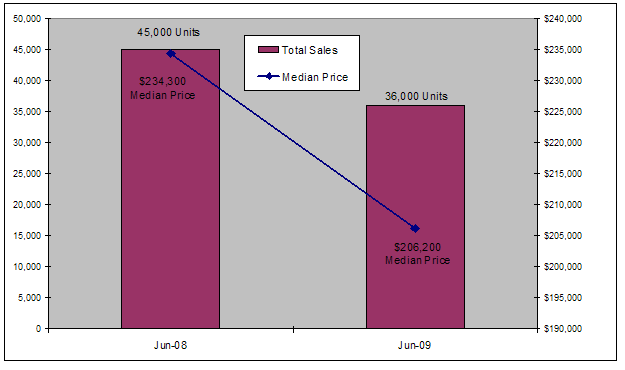
The chart above shows NOT seasonally adjusted June 2008 vs June 2009 total sales counts and median price. 20% fewer homes sold — at much lower price than last year — is somehow bullish?
~~~
CONCLUSION: The best thing you can say is the 2nd derivative argument — Real Estate is now getting worse more slowly. Expect more price decreases, foreclosures and distressed sales. A healthy market cleared out of excess inventory with genuine price increases is likely years away . . .



July 29th, 2009 at 6:58 am
How dare you rain on their parade! I have been noticing that there has been a lack of Bears on CNBC lately. Can you possibly give us a moving average of bulls vs bears on CNBC?
July 29th, 2009 at 7:56 am
A couple of things I didn’t get to post yesterday on the CS Index because of Wordpress weirdness. There are some other non-seasonal and possibly non-repeating factors.
1. Someone probably already made the point that the March/April/May time period was the low point for 30 year mortgage rates. Those who locked in in March and April and didn’t close until May got the advantage of the lowest rates. Looks like those rates are at least a half point higher now (5.36%). Prices tend to move inversely to rates.
http://www.mortgage-x.com/general/historical_rates.asp
2. Supply was likely distorted by the foreclosure moratoriums last fall and winter. It takes months to get a foreclosure to sale from the notice of default, depending on the locality, workload, etc. Mr. Mortage has some interesting bar charts here showing the effects of the moratorium:
http://www.fieldcheckgroup.com/2009/06/14/6-14-the-next-foreclosure-wave/
Two queries:
Do we know if CS counts trustee sales if the house is bought in by the bank?
Do we know if banks are buying in houses at artificially high prices to keep from having to write down loans and thus distoring the index if the sale is counted? For example, the mortgage on a house is $500k and the highest bid from an outsider is 300k. Is there any bar to the bank just bidding $500 to buy in the property? This might allow the bank to keep the house on it’s books at that price. In Louisiana where almost all mortgages are recourse, banks didn’t used to do that because it would keep the bank from getting a judgment againts the debtor for the difference between the mortgage and the auction price. In a non-recourse state or if the bank knows it won’t collect anything from the debtor anyway, there is no real incentive not to do this that I know of. It’s only a paper transaction with itself.
3. There are also reports of a large shadow inventory caused by homeowners who would like to sell, banks not bothering to foreclose because they have nothing to do with the house, or by banks not offering houses for sale because they would have to write down the loans, all in hopes of a recovery of prices. If the inventory exists, it will keep a lid on prices as the inventory comes on the market when there is an uptick.
July 29th, 2009 at 8:25 am
Here in Cleveland there is a huge of amount of foreclosure supply not yet in the market. Since Ohio requires judicial forclosure there is a huge backlog of property in default and not even in the hands of the banks. I can’t imagine what is in front of us.
July 29th, 2009 at 8:30 am
[...] « Worst June New Home Sales Since 1982 China hiccups [...]
July 29th, 2009 at 8:32 am
>> Worst June New Home Sales Since 1982
The good news is: since these are depressed levels, we’ll probably bounce up from here. Like before, all we have to do now is drop interest rates from 15% down to maybe 7-8%.
[pause]
Or we can build a giant wooden badger.
July 29th, 2009 at 8:45 am
Mike in Nola:
Prices tend to move inversely to rates.
If you think about it, people buy homes, not based on price, but on their monthly budget. So as the interest rate drops, the monthly payment on the same-priced home does as well. I learned that one from the law practice.
Is there any bar to the bank just bidding $500 to buy in the property?
Yes, there is. As you cannot buy a home out of foreclosure (at least in Oklahoma) for less than two-thirds of its appraised value.
There is no minimum bid required if there is no appraisal.
July 29th, 2009 at 8:48 am
some excellent news for the economy-
“Durable-Goods Orders Plunged 2.5% in June, Much Worse Than Expected”
quite green shooty indeed
July 29th, 2009 at 8:55 am
here is an interesting little article-
http://www.cnbc.com/id/32194655
I guess Michelle Caruso-Cabrera got a a refinance through Obama’s “Making Home Affordable” program- just as I thought it would turn out to be-
a total government forced giveaway to those that need it least-
government at its finest- Thanks Obama- you’re the best
July 29th, 2009 at 9:10 am
Talk to any real estate agent is South Florida and they will tell you that the only houses that sell are the foreclosures that are priced to move quickly. The houses in the foreclosure category on the extremely low end (below $200,000) sell quickly and prices in that category have risen a little bit over the last three months.
The bottom end has been helped by 1st time buyers getting an $8,000 gift from the rest of us coupled extremely low interest rates.
Houses in the mid to upper range here in Florida are still not selling and prices are still dropping.
July 29th, 2009 at 9:21 am
[...] market analyst Barry Ritholtz notes on his blog, The Big Picture, new home sales are the slowest they have been since 1982 (see chart below). The market may be [...]
July 29th, 2009 at 9:33 am
Isn’t this whole 2nd-derivative thing a joke? I mean, what’s worse, a short sharp shock or a long-term slide? Frankly, I’d rather tear the band-aid off in one quick rip than prolong the agony..
Of course the 2nd derivative is “improving”, banks are holding back on foreclosures and keeping a bunch of inventory off the market artificially, to protect their mark-to-fantasy.. One way or another that will have to end, and perhaps then we’ll have to start looking for 3rd, 4th, 5th derivatives to keep the chirpies on CNBC happy?
July 29th, 2009 at 9:36 am
What scares me about home prices is that they climbed when wages were going down so do we not only have to get to 2000 wages but maybe pre-dotcom wages? I know there are exceptions and other variables, rates, supply/demand, but in the end IMO wages (or lack of) are the most important factor.
Barry any thoughts?
July 29th, 2009 at 9:46 am
Okielawyer:
Sorry for the typo. My statement doesn’t make much sense as it came out. What I meant was: Is there anything to keep a bank from bidding $500k on a house with a $500k mortgage in order to keep the price up on its books?
LA has a similar provision on minimum bids although it can be waived by the lender if it doesn’t want to seek a deficiency judgment.
July 29th, 2009 at 9:51 am
Interesting chart here on the durable goods report showing what may beginning the first demonstrable failing of green shoots to blossom.
http://mam.econoday.com/byshoweventfull.asp?fid=437979&cust=mam
July 29th, 2009 at 10:28 am
[...] Barry Ritholtz wrote an interesting post today onWorst June New Home Sales Since 1982 | The Big PictureHere’s a quick excerpt [...]
July 29th, 2009 at 10:37 am
I seriously doubt that homebuilders started slashing prices in June in way they didn’t do in May. The fall in median price is likely more a reflection of two other things: 1) those who are still building are building small houses with less luxury features so they are less expensive, and 2) the stimulus package and investors have put a lot more demand into the low end of the market than the high end of the market. Both of those things will drive the median price lower, even if homebuilders are not slashing prices any more than they have been doing the last year.
July 29th, 2009 at 11:07 am
@wunsacon I laughed out loud at the badger/Python reference. Classic, perfectly applied. Well played, sir.
I can confirm sailorman’s observations about South Florida. I will add this anecdote; in a friend’s neighborhood nearby, suburban Broward County, prices went from sub 200K to over 400K over the last 10 years. Three recent asking prices were 210K, 260K and 400K. Sales have been 175K-225K… and the punchline is that the ‘400K’ house now has a ‘For Rent’ sign on it, probably the sign of an accidental landlord.
July 29th, 2009 at 12:36 pm
Thanks for explaing it nicely.
July 29th, 2009 at 12:45 pm
I’m just as bearish as everyone else on this blog currently, but in terms of new home sales, why are we not more optimistic? I understand that Y/Y numbers are horrible and that we haven’t seen these numbers since the early 80s, but aren’t we looking for positive motion instead of a still image? Isn’t it more important to know that we hit a bottom and are climbing rather than falling?
~~~
BR: Let me know when that happens . . .
July 29th, 2009 at 6:08 pm
danslepak;
If you want to know where we are (relative to where we came from), then you should look at year over year or peak/low vs current data. The fact that we fell off the clif in October is old news, and it does not tell us anything about where we are heading right now.
If you want to predict the future, it’s better to look at the trend in the last few months. The more noise the data has, the more months needs to go into that trend analysis. You also carefully have to consider the effects of any short-lived effectors that can influence the parameter in question (e.g.; the jump in median price in Nov and Dec 08 was likely due to the credit freeze blocking people with less money from bying a house).
More important than anything else is that you always stay open to pursuasion by the data, and never get into testosterone driven pi$$ing contests. No matter what your opinion was yesterday, look at the data as if you didn’t have one. Lots of people will ridicule you for changing your opinion as the available data change. Just remember that in the end those idiots are a lot more likely to be wrong than you. Personally I think Berry and DeBears here at TBP have closed their mind a little too much to the possibilities that housing has, or soon will, find a medium term low (or even the final low). I hope they are not putting their money where their mind is, because I like them and I think they are wrong
July 29th, 2009 at 10:47 pm
[...] commentator Barry Ritholtz publishes a blog called, “The Big Picture”. Barry does a nice job of showing exactly how the 11% increase number doesn’t really look all that spectacular when analyzed and [...]
July 30th, 2009 at 10:45 am
[...] is over, I thought I’d post some gloomier stories posted at Curbed. Here is a blog post from The Big Picture that has a variety of sad charts on real estate data. Some more bad news from The Real Deal. [...]
July 30th, 2009 at 11:27 am
[...] as the Calculated Risk blog’s perspective[1]. Also see what Barry Ritholz has to say–Big Picture Blog review of charts on new home sales [...]
July 31st, 2009 at 6:09 pm
[...] Worst June New Home Sales Since 1982 | The Big Picture – The best thing you can say is the 2nd derivative argument — Real Estate is now getting worse more slowly. Expect more price decreases, foreclosures and distressed sales. A healthy market cleared out of excess inventory with genuine price increases is likely years away . . . [...]
August 10th, 2009 at 6:50 am
[...] Barry Ritholtz wrote an interesting post today onWorst June New <b>Home</b> Sales Since 1982 | The Big PictureHere’s a quick excerpt [...]