
Rail Time Indicators
The Association of American Railroads has begun publishing “Rail Time Indicators,” their monthly look at Rail Transport related data.
Here’s an excerpt from their most recent report:
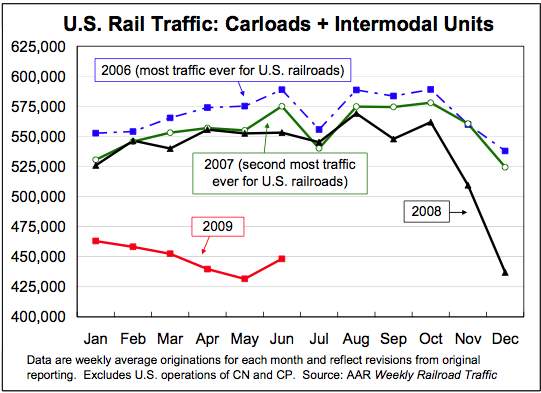
• Carloads originated on U.S. railroads in June 2009 were down 19.5% (252,078 carloads) from June 2008 to 1,037,928 carloads. June 2009 was the eighth straight double-digit monthly carload decline, but it was a smaller decline than the previous two months. Average weekly carloads in June 2009 (259,482) were 10,311 carloads higher than in May 2009.
• U.S. intermodal traffic (which is not included in carloads) was down 18.2% (168,031 trailers and containers) in June 2009 to 755,000 units. (See table next page.)
• For the second quarter of 2009, U.S. rail carloadings were down 22.2% (945,652 carloads); second quarter intermodal traffic was down 18.3% 538,345 trailers and containers).
• For the first six months of 2009, U.S. rail carloadings were down 19.3% (1,573,998 carloads); intermodal traffic in the first half of 2009 was down 17.0% (950,147 trailers and containers).
And of course, a chart — 2007, 08 and 09 — note the seasonality around June each year:
>
>
From their report:
“AAR combines rail traffic data with more than 15 key economic indicators (such as consumer confidence, housing starts, and industrial production) in a non-technical snapshot of the U.S. economy. By assembling this information in a single place, and presenting rail traffic in the context of the broader economy, Rail Time Indicators provides a convenient, clear look at the key trends that can reveal where the economy — and, therefore, rail traffic — are going.”
Weekly AAR data detail rail carloadings for 19 major commodity categories, as well as intermodal
trailers and containers, for the previous week for a group of railroads that collectively account for the vast majority of total U.S. and Canadian rail traffic.Freight railroading is a “derived demand” industry — demand for rail service occurs as a result of
demand elsewhere in the economy for the products that railroads haul. Thus, freight rail traffic is a useful economic indicator, both for the overall economy and for specific sub-sectors.
Interesting to see something that’s not pure spin from a trade group . . .
>
Source:
Rail Time Indicators
A Review of Key Economic Trends Shaping the Demand for Rail Transportation
Association of American Railroads July 21, 2009
http://www.aar.org/Home/AAR2/NewsAndEvents/RailTimeIndicators.aspx
Rail Time Indicators July 2009
http://www.aar.org/Home/AAR2/NewsAndEvents/~/media/AAR/RailTimeIndicators/Rail%20Time%20Indicators%20July%202009.ashx



July 25th, 2009 at 9:14 pm
Interesting to see something that’s not pure spin from a trade group . . .
I’ve always wondered how the NAR do it. Do people just cherry pick the data? Is it also part NAR spin? Both? It sounds to me like the AAR cares about their reputation.
July 25th, 2009 at 9:18 pm
Down year-over-year, but just not as much. That ought to be good for a 200-point gain on the DOW on Monday.
Not much change at Railfax, either.
July 25th, 2009 at 10:01 pm
But Barry, you did not point out that June traffic is up over May: a sure sign that the recovery is in progress, right F411?
July 25th, 2009 at 10:10 pm
Interesting Barry – perhaps they don’t spin because low utilization = better bargains for shippers which the assocation has a vested interest in getting the word out about…
July 25th, 2009 at 11:45 pm
Correct, Mike. No doubt prosperity is right around the corner….
July 26th, 2009 at 12:05 am
A little granularity provided by perusing some missives from rail geeks: carloads of grain and coal are up. These two categories are especially indicative of economic activity. Trucking stocks look like they have turned upward after drifting lower since early June. Rail stocks turned higher in early July.
July 26th, 2009 at 12:07 am
[...] whether or not I’ll miss it. Will I miss finding out about the latest Snow Leopard seeds, or technical indicators of how crappy the economy is? By stripping down my inputs, I’ll find [...]
July 26th, 2009 at 12:07 am
[...] whether or not I’ll miss it. Will I miss finding out about the latest Snow Leopard seeds, or technical indicators of how crappy the economy is? By stripping down my inputs, I’ll find [...]
July 26th, 2009 at 2:08 am
COT
Is it possible that even the NAR ether is beginning to wear off??
http://money.cnn.com/2009/07/24/news/economy/banks.commercial.fortune/index.htm?cnn=yes
“The rate at which these troubled loans are being resolved has been sluggish,” James Helsel, treasurer of the National Association of Realtors, told the Joint Economic Committee July 10. “Over $60 billion in assets have become distressed this year but only $4 billion worth of commercial loans have been resolved so far.”
July 26th, 2009 at 9:21 am
“Eric Tyson, best-selling author of Personal Finance for Dummies and Investing for Dummies, economist and advisor, analyzes financial news and provides financial planning insights. Eric Tyson’s got your back and is looking out for you!”
“Jeremy Siegel’s Stocks for The Long Run, now in its 4th edition, is one of the best investment books ever…
This page is available to EricTyson.com members only.
+
http://www.erictyson.com/articles/20090129
YGTBFKM~
maybe I misunderstand, though, I thought blatant link-whoring was bad form (?)
July 26th, 2009 at 10:21 am
OT:
I know that this is off topic, however, I thought that Geithner fans might find this interesting…..
http://www.salon.com/opinion/greenwald/
SUNDAY JULY 26, 2009 08:27 EDT
The war being waged on the TARP watchdog’s independence
“…Barofksy’s clashes with administration officials have intensified of late. Last week, he issued a report documenting that the actual amount of taxpayer money theoretically put at risk in the bank bailout — once Federal Reserve, FDIC and other programs are counted — is $23.7 trillion, not the widely cited figure of $700 billion, a report that prompted attacks from the White House and Treasury on his credibility….”
“…Jake Tapper conducted a 20-minute podcast interview with Barofsky, and I really recommend that everyone listen to it (it can be heard by clicking PLAY on the recorder below or can be downloaded here)….”
Best regards,
Econolicious
July 26th, 2009 at 10:59 am
EricTyson Says:
July 25th, 2009 at 10:10 pm
Interesting Barry – perhaps they don’t spin because low utilization = better bargains for shippers which the assocation has a vested interest in getting the word out about…
reply:
—————
You are correct. Just as low sales at retail create massive savings for customers (not so good for employees, though)
You are correct. Just as low auto sales create massive savings for customers (not so good for employees, though)
You are correct. Just as low home sales create massive savings for buyers (not so good for people who build houses or make things that go into them, though)
You are correct. Just as low discretionary spending create massive savings for customers who used to buy for recreation (not so good for employees, though)
Thankfully, you have a stupendous stock market pump in progress ,thanks to excess cash liquidity, really great computers, massive front running volume, a do nothing and totally disinterested SEC, and complicit exchanges. Don’t be the last buyer in, though, when excess volume is forced to leave someday. All it will take 1s an uptick rule or the end of flash trading. HA HA on you.
I’ve never read one of your books. Do they all sound as insightful as the above comment you wrote? Are you sure you’re not really F411?
July 26th, 2009 at 11:18 am
Barron’s Jim McTague does a nice job…
http://online.barrons.com/article/SB124847536976580233.html
“…that average weekly U.S. rail carloads headed up in June for the first time all year, from 249,000 in May, to 260,000. Coal shipments increased nearly 6% month-over-month to 125,000 carloads…”
“…intermodal traffic, which is largely consumer goods in trailers and shipping containers riding on flat cars, went from about 181,000 carloads to 189,000…”
“…Carloads of crushed stone, sand and gravel rose from about 15,000 cars to 16,000 cars…”
“…Daniel Keen, who is vice president of policy analysis… Keen wasn’t willing to dismiss my optimistic reading [in spite of the negative annual numbers ] of the June data out-of-hand, saying that the increases for the month could be positive…”
July 26th, 2009 at 11:57 am
Keep in mind that demand for coal transport, a major component of the data presented, is being influenced by new supplies of natural gas from U.S. shale projects. This surge of lower cost natural gas is changing utility behavior, and influencing coal demand. The impact shows up in rail data. It represents a change of fuel being consumed, not a dramatic economic decline. Something to consider before looking at this data and making broad claims about the economy.
July 26th, 2009 at 11:58 am
I have a question: considering that most construction is going to take place during the summertime (when it is warm and clear enough to build), wouldn’t a lot of this activity just be noise?
As for the increase in coal, who is buying it and for what purpose?
When I called into work this last Tuesday, they indicated that some projects are at least being talked about and that I might get back to work “soon.” So, I am willing to accept that maybe there may be some economic activity on the horizon. Is anyone else hearing anything significant?
July 26th, 2009 at 1:31 pm
[...] Association of American Railroads has begun publishing “Rail Time Indicators,” their monthly look at Rail Transport related data. [...]
July 26th, 2009 at 7:08 pm
[...] http://www.ritholtz.com/blog/2009/07/rail-time-indicators/ [...]
July 27th, 2009 at 11:45 am
@Okie Lawyer
“As for the increase in coal, who is buying it and for what purpose?”
I hear that Santa Claus is buying up tons of coal…So he can put a lump of it in everyone’s stocking this Christmas…
July 28th, 2009 at 6:47 am
[...] Sunday, I mentioned the Association of American Railroads “Rail Time Indicators.” It was not showing any green [...]
July 29th, 2009 at 10:47 am
[...] – from housing surpluses and underemployment figures to bankruptcy filings and dismal freight traffic – suggest that any recent industrial production is more a function of the inventory [...]