
SYNCHRONIZED SURGE STRENGTHENS SINCE APRIL

Email this post Print this post
By Barry Ritholtz - July 17th, 2009, 8:15AM

Lakshman Achuthan is co-founder and managing director of the Economic Cycle Research Institute (ECRI), an independent organization focused on business cycle analysis and forecasting in the tradition established by ECRI’s co-founder, Geoffrey H. Moore. ECRI maintains business cycle chronologies for 20 countries around the world other than the U.S. Lakshman is the managing editor of ECRI’s forecasting publications and regularly participates in a wide range of public economic discussions.

He is a member of Time magazine’s board of economists, the New York City Economic Advisory Panel and serves as trustee on a number of non-profit boards. Lakshman is the co-author of Beating the Business Cycle: How to Predict and Profit from Turning Points in the Economy.

~~~

The modest pullback in stock prices that followed the springtime rally, along with a worse-than-expected June jobs report, allowed the skeptics to re-emerge, asserting that without actual improvement in hard economic data, the “green shoots” had wilted away. What they do not realize, as we reasserted in ECRI’s June U.S. Cyclical Outlook report to Professional Members, “is that the cyclical improvement in the economy is proceeding in a textbook sequence, from long leading indicators to short leading indicators to coincident indicators.” In fact, “there are now pronounced, pervasive and persistent upturns in a succession of leading indexes of economic revival.”

When approaching a cyclical turning point in economic growth, the growth rate of the U.S. Long Leading Index (USLLI) typically turns first, followed by the growth rate of the Weekly Leading Index (WLI), growth in the U.S. Short Leading Index (USSLI) and growth in the U.S. Coincident Index (USCI).

As noted in the report, “the levels of the USLLI, WLI and USSLI are now all rising.” In fact, as the nearby chart shows, by May USLLI growth (top line) had already surged to a four-year high. Meanwhile, WLI growth (second line) has spurted to a two-year high, having crossed over into positive territory. Following in their footsteps, USSLI growth (third line) has shot up to a one-year high, but is still in negative territory.

Finally, the USCI is still declining, indicating that as of June, the U.S. economic recovery had not yet begun. Yet, USCI growth (bottom line), which represents the rate of growth of aggregate economic activity, has risen for three months. While still in negative territory, it is now at a six-month high. Thus, the growth rate cycle upturn that we predicted in March has evidently begun.

But the sequential upswings in the leading indexes are not just about less negative growth. We clearly have “pronounced, pervasive and persistent upswings in a succession of leading indexes of economic revival – the most powerful possible predictor of a business cycle recovery. What is impressive here is the degree of unanimity within and across these leading indexes, along with the classic sequence of advances in those indexes. Such a combination of upturns does not happen unless an end to the recession is imminent,” as we noted in our June report.

If so, why is there such widespread doubt among analysts about an imminent end to the recession? The problem “is a widespread inability to distinguish among leading, coincident and lagging indicators, along with the vast majority of economic indicators that do not fall neatly in any of those three categories. Thus, indicators are typically judged by their freshness, not their foresight. Since most market-moving numbers are coincident to short leading, while corporate guidance is often lagging, it is no surprise that analysts do not discern any convincing evidence of an economic upturn.”

The arguments marshaled by standard bearers of the pessimistic consensus hold little water. Usually, their “analysis” is based on gut feel, bolstered by any seemingly plausible argument that would support their case.

For instance, last month, with oil prices and interest rates staging somewhat of an advance from their lows, skeptics opined that this would nip any potential recovery in the bud. But it is hardly unusual for such indicators to turn up in anticipation of economic revivals, which would never take place if higher oil prices or interest rates were able to head them off.

This month, the rise in the jobless rate to a 25-year high is being taken by some as an argument against recovery because supposedly, consumers will not spend when joblessness is mounting. Apparently, they are unaware that even the 1929-33 recession ended when the jobless rate was over 25% – and still rising!

The “second-derivative rally” in equities has provoked much derision, especially from those who missed it. As we reported last month, “ECRI’s leading indexes now have positive second derivatives. But, more importantly, they have already had positive first derivatives for some months. It is worth reminding calculus-challenged analysts who doubt the significance of these cyclical upswings of the second derivative test: when the first derivative of a univariate function rises to zero and its second derivative turns positive, it marks the low point of the function. That development is already in the rear-view mirror for every one of ECRI’s leading indexes of economic activity.”

In fact, “what is impressive here is the degree of unanimity within and across ECRI’s leading indexes, along with the classic sequence of advances in those indexes. Such a combination of upturns – a resounding confirmation of our April forecast that the recession will end this summer – does not happen unless an end to the recession is imminent.

In sum, the economy has a raft of problems that will take a long time to resolve. But none of them can head off the imminent economic recovery that ECRI’s objective leading indexes are promising today.”
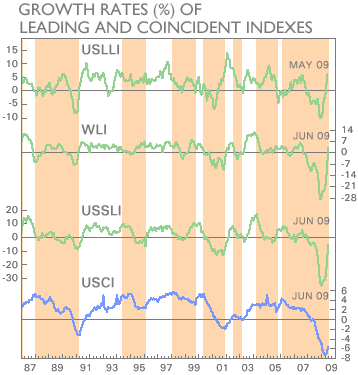
webchart_090715

Note: shaded areas in chart represent growth rate cycle downturns.

27 Responses to “SYNCHRONIZED SURGE STRENGTHENS SINCE APRIL”

  1. mark Says:

    Just another recession? Same as it ever was? Maybe.

    Let’s assume for the moment that ECRI is right. (And by the way, only an economist could call 1929 – 1933 a “recession”.) In any case, what we want to know, what we need to know, is what does that mean for stock prices? The last recession ended in 4Q ‘01 but stock prices didn’t bottom for another year.

    So what say you Lakshman?

  2. owen b Says:

    I think ECRI is going to eat everyone for lunch on this one. All these guys do is recession and recovery forecasting, and they’re looking at stuff that goes back BEFORE the great depression. It’s interesting to watch the celebrity bears like Krugman and Roubini try to cling to their negative tome, while “allowing” that a recovery this summer (ECRI’s forecast since April) is possible.

  3. SwimUpstreamToWealth Says:

    I think folks like Laksham also neglect the debt overhang relative to past recessions. With total debt to GDP still near 350% in the U.S., we have strong headwinds to the economy…unless the Fed and government can create another bubble somehow, which is highly unlikely. Just paying the interest on the current debt will provide an enormous drag to the economy, not to mention how the economy was previously boosted by debt that no longer is available.

  4. Jo Says:

    ECRI might well be right if not for the fact that they’re very wrong.

  5. tenaciousd Says:

    Some compelling points for sure. While I am quite bearish over the long run, I have always said that you can’t bet against America’s ability to paper over problems and kick the can down the road in the short run. Of course, the hard part is guessing which kick of the can will hit the great curb of economic reckoning. My guess with this recession is that it’s too early for the real post-retirement Baby Boomer dynamic to kick in. So, did the Boomers learn their lesson this time and will they get their act in gear for retirement or will they simply redouble their efforts to siphon off every short-term benefit for themselves and leave following generations to figure it out? My guess is for the latter. (They can’t help it.) Now, as a post-Boomer, I’ve got to figure out how best to invest to profit from Boomer greed on the upside and short them before the downside. But, I think we’re looking at a 15-30 year process here.

  6. Steve Duncan Says:

    These U.S. leading indicator growth rates can in fact turn positive, but then turn negative again as in the depression. Lakshman Achuthan is conveniently only showing the indicators perfomance during the past “mild recessions” and not going back to the late 20’s early 30’s where the growth rates went positive for a while and then went back negative. We proably will follow a similar path since we are not experieniing a typical recession, we have enterred some type of depression.

    The question I have, is what is driving the current ECRI leading indicator growth rates up? If it is stock prices or oil prices from March to now, big deal. If it’s actually being driven by growth in manufacturing orders then that would be impressive. But that isn’t happening, manufacturing is still consolidating and shrinking (excess capacity big time….worldwide).

    See the below Real Money link from 2002 with an ECRI chart showing the USLLI and USCI growth rates from 1928 to 1940 (2nd chart).

    http://www.thestreet.com/p/comment/spincycle/10040304.html

  7. W T F Says:

    Hmmm… “Note: shaded areas in chart represent growth rate cycle downturns.” Notice that the chart doesn’t show recessions per NBER dating nor does the chart show S&P500 performance. Wonder why?

    Someone (David Rosenberg?) recently noted that ECRI’s leading indicators were months early predicting a market turn in the 2000-2001 recession.

    I’m not accusing ECRI of suffering from LKD – Larry Kudlow disease. In fact their leading indicators did mark the turn in 2007 when the S&P 500 was rocketing upward.

    I’m disappointed in ECRI’s lack of transparency and their willingness to play fast and loose with their performance.

    Caveat emptor.

  8. cvienne Says:

    The consumer remains tapped out, has more difficulty obtaining credit, and even if they have access to credit, they’re mostly in the process of trying to repair their personal balance sheet…

    Those with jobs are still in fear of losing them or seeing their hours scaled back…Their investments (in stock portfolios) have done NOTHING over the past 10 years…Their home has lost value over the last 2-3 years, and if they recently purchased, they may either be underwater or facing an option ARM reset which will further set them back…

    So all I still see are economic “indicators” referencing massive government to stem the problem (through compensation benefits extensions – which will run out soon), and HOPE in the business community that this was, in fact, a garden variety recession…

    When people are merrily shopping again, I’ll believe this…It won’t happen unless someone happens to manufacture the artificial bubble (in something) of all time…

  9. Tom K Says:

    Imo the ECRI is on the mark, but this recovery is going to be tempered by high levels of debt and increasing taxes.

  10. owen b Says:

    In reply to Steve Duncan:

    Look closely at the ECRI chart that you cite. Their Long Leading Index was spot on during the depression. Now, if their Long Leading Index begins to falter today, I’ll be the first one to get worried.

    You can also view charts of their indexes coming out of all recession since before the great depression on the Levy Institute site: http://www.levy.org/pubs/conf_april09/18th_Minsky_ppt/session5_Achuthan.pdf

    Problem for me is that they don’t publicly release the Long Leading Index updates.

  11. anewc2 Says:

    The arguments marshaled by standard bearers of the pessimistic consensus hold little water. Usually, their “analysis” is based on gut feel, bolstered by any seemingly plausible argument that would support their case.

    I stopped reading here. When they start belittling their opponents, you know their case is weak. Especially when they seem to be of the “Customers? Who needs customers?” school of economic forecasting.

  12. Steve Duncan Says:

    In reply to owen b:

    Look closely at the ECRI chart that you cite. Their Long Leading Index was spot on during the depression. Now, if their Long Leading Index begins to falter today, I’ll be the first one to get worried.

    Yes, the ECRI Long Leading Index did predict a downturn during the depression, then it quickly went positive (like it is now) which would imply an end of the depression, but what happened? It went back down for two more years. This can happen again. You have to know what is driving the Long Leading Index positive from March 2009. If it’s primarily based on stock and oil prices going up from March then it’s not very meaningful.

  13. owen b Says:

    In reply to Steve:

    Not sure about oil, but they’ve said that stock prices aren’t in the Long Leading Index (sorry, I don’t have reference).

    Also, he was on TV this morning, new points were 2nd stimulus not needed, and high unemployment doesn’t preclude recovery (with a depression reference).

    http://www.businesscycle.com/news/press/1486/

  14. leftback Says:

    Idiotic. Everyone here knows that recessions initiated by debt deflation/financial crisis can’t be compared with regular business cycle recessions caused by tighter lending conditions, which can be alleviated by easing.

    ECRI are intellectual pygmies. Get them out of my face.

  15. Joe Retail Says:

    @ owen

    > Not sure about oil, but they’ve said that stock prices aren’t in the Long Leading Index

    Glad to hear it. Otherwise:
    - stock prices go up because investors anticipate a recovery (i.e. the markets are a leading indicator),
    - investors expect a recovery because stock prices are going up (if the markets are really a leading indicator).

    My head hurts.

  16. mkkby Says:

    People who make predictions for a living always hype their good guesses, and always neglect to mention their bad guesses.

    ECRI really gives no evidence except their black box indicators. Are we supposed to religiously follow him? The chart they posted shows several false reversals. His explanation that a second derivative turn marks the end of the function happens quite often, and signifies nothing.

    There were several false bottoms in the 2001 recession. Some were caused by inventory replenishment, some just stock traders trying to front run each other. What we are seeing now is inventory rebuilding. Whether or not it “sticks” is anybody’s guess. And for sure ECRI is guessing, same as everyone else. They have no special magic.

  17. Peter Pan Says:

    My gut feeling is that there’s too much event risk globally to call for a recovery. However, I can’t dismiss a recovery entirely.

    I agree with the (gulp) World Bank that deflation remains a substantial problem. A secondary fiscal stimulation will be necessary but will not be provided due to political constraints.

    I suspect that negative events for US muni bonds, a European financial crisis and an implosion of China’s excesses remain in our future in the coming year.

  18. David Merkel Says:

    Lakshman, I give ECRI the benefit of the doubt regarding this because of your great track record. What would help me (and possibly many others) would be if you would point out what components of your underlying indexes are showing strength at present.

  19. Friday links: conflicting signals Abnormal Returns Says:

    [...] “In sum, the economy has a raft of problems that will take a long time to resolve. But none of them can head off the imminent economic recovery that ECRI’s objective leading indexes are promising today”  (Big Picture) [...]

  20. lakshman Says:

    mark Says:
    July 17th, 2009 at 8:53 am
    Just another recession? Same as it ever was? Maybe.
    Let’s assume for the moment that ECRI is right. (And by the way, only an economist could call 1929 – 1933 a “recession”.) In any case, what we want to know, what we need to know, is what does that mean for stock prices? The last recession ended in 4Q ‘01 but stock prices didn’t bottom for another year.
    So what say you Lakshman?

    Hi Mark,

    Thanks for your question about the U.S. Long Leading Index (USLLI) after the last recovery began.

    After correctly navigating the 2001 recession in real-time, USLLI growth peaked in January of 2002 and did not bottom again until March of 2003.

    By the way, I’m not an economist (and ECRI doesn’t use econometric models for forecasting the cycle) but I do know something about business cycles. Every depression consists of one or more very deep recessions. You can see for yourself on the NBER website here: http://www.nber.org/cycles/

    Kind regards,
    Lakshman

  21. lakshman Says:

    David Merkel Says:
    July 17th, 2009 at 12:52 pm
    Lakshman, I give ECRI the benefit of the doubt regarding this because of your great track record. What would help me (and possibly many others) would be if you would point out what components of your underlying indexes are showing strength at present.

    Hi David,

    I appreciate your question, but the components of our indexes are proprietary. Nevertheless, the key reason our leading indexes work is not because of some special component(s) that we have, but rather because of what they illustrate when the three P’s are observed.

    In this case we’re seeing a pronounced, persistent and, perhaps to your point, a quite pervasive rise in the number of components contributing to the rise. For example, in the Long Leading Index it’s not just easy money that is driving it up, and in the shorter leading indexes it’s not simply the stock market, or ISM (which in fact isn’t included).

    I hope this helps to address some of your concerns.

    Kind regards,
    Lakshman

  22. alfred e Says:

    @Lakshman: You are so incredibly FOS.

    Best of luck.

  23. bruerr Says:

    When considering this last weeks move in the market, seems like too much enthusiasm, over a few firms, their data points, and a readiness to bounce the whole market, over the numbers of a few. I do not want to loose sight of the fact that banks made changes in their material accounting, which is an accounting gimmick from my perspective. How many other recessions include the steroid-like asterisk* of large banks made changes in their material accounting methods? Projected growth could easily be mis-reported in such times.

    Do you remember sale prices from last year?
    December Christmas sales prices?
    Deep discounts?

    How can companies really grow their merchandise sales in such a climate? How many manufactures? Growth economies often have improved sales on luxury or big ticket items to achieve a measure of growth over prior years. Such was virtually non-existent in 2008, as we and even our wealthy friends cut back on spending.

    We might want to start asking people what they think, if this Christmas they will spend more or less than last year? In the broader country, I tend to think you will get more responses, that people are planning to spend less. If you took the informal survey this summer outside nightclub lines, this fall at Sunday brunches, or in November standing in shopping malls, I think you will probably get the same answer. Across all socio-economic classes, people will probably say they plan to spend less this year than last.

    If true, companies are going to have to cut prices even more than last Christmas. This could result in more commercial store closings. Another wave of corporate cutbacks.

    I do not think the market has factored that far ahead.
    Same for these peculiarly named indexes.

    -=-=-=-

    cvienne says a similar idea, but added the ARM reset into the picture.
    http://www.ritholtz.com/blog/2009/07/synchronized-surge-strengthens-since-april/#comment-194724 Tie in real estate to this ECRI report, and add that asterisk about accounting gimmicks, and no one being called in to say who is taking the steroids or to denounce even the use of steroids in the banking industry, and the report is flawed right there.

    *U.S. Code, Title 12, Chapter 16, § 1831o Prompt Corrective Action (i)(1) and (i)(2)(D) restrict the activities of any critically undercapitalized insured depository institution; and at a minimum (emphasis added), prohibit any such institution from doing any of the following: Making any material change in accounting methods.

  24. 7 Reasons Why Housing Isn’t Bottoming Yet | The Big Picture Says:

    [...] of respect for their methodology and process. Over the past year, these have included Doug Kass and Lakshman Achuthan and Bill of Calculated Risk. We may reach different conclusions about a given issue, or disagree on [...]

  25. bruerr Says:

    Lakshman Achuthan,

    I have this question about irresponsibility in reporting financial news, not as it pertains to you, but to the networks and high profile firms, in general, preparing reports to the client, using charts and comparing past recessions.

    Comes into view fiduciary responsibility. If you feel moved to reply by all means please be welcome. This is a think tank, but please do not feel obligated on my behalf. Think of others, far removed, if you like to reply. Again, to fiduciary responsibility as a concept from a professional level. Here we are talking about the concept of a higher standard of conduct, however trivialized it might be by some professionals, and considered important or extremely important by others (this might include supervisors or overseers of the professional conduct, or a board of directors at a financial firm, when it comes to fiduciary duty, work product and responsibility of the company’s agents.

    Notice, not too many financial firms are writing in the subject these days. So then, let us temporarily, look that way and have discussion if you are open to it.

    Comes into view again, fiduciary responsibility:

    Shouldn’t there be a steroid-type asterisk on all these reports, (or periodic reminder on network reporting) that financials sort of juiced the books, by evading their debts, receiving injections, and also, making changes in accounting that are NOT generally considered legal, …so that going forward, it is not really a fair comparison with other sectors in our market or with past recessions (when making a change in accounting was NOT done)?

  26. lakshman Says:

    Bruerr,

    Thanks for your comments. I’ll try to address the issues you raise.

    1. Please know that ECRI is an independent institute almost entirely funded by professional members. We are not beholden to any member or group of members.

    2. We objectively monitor our leading indexes, always vigilant about any developments that could possibly trip them up. For example, in the early 1990s we had to adjust our industrial commodity index because mandatory recycling combined with the recession drove the price of old corrugated boxes negative for an extended period. As a result we had to make some changes to the index, but having said that such changes are rarely warranted.

    3. Our indexes are not significantly impacted by the “juicing up” of the books or the unusual accounting changes that have occurred recently.

    In the many decades that we’ve been monitoring the business cycle in dozens of countries our leading indexes have encountered a slew of market disturbing forces, and continued to work properly.

    The point to understand is that these kinds of issues don’t have a significant impact on the timing of the turn in the cycle, and that is the key strength of our leading indicator approach.

    I hope this is helpful.

    Kind regards,
    Lakshman

  27. bruerr Says:

    Thanks for your kindness in regards Lakshman.

    “3. Our indexes are not significantly impacted by the “juicing up” of the books or the unusual accounting changes that have occurred recently.”

    You say NOT significantly impacted but in your charts above, and in pdf file referenced by Owen b above, http://www.ritholtz.com/blog/2009/07/synchronized-surge-strengthens-since-april/#comment-194727 many charts used are seeming to make comparisons to “Stock Prices.” You are using “Stock Prices” in a deliberately vague manner (touch aloof) but when making comparisons to “Stock Prices,” it is implied you mean financials to some extent.

    Based on this comparison to “Stock Prices,” financials (many property and Casualty Insurance firms in there with Specialty/Diversified/Mortgage REITS, asset management firms, investment services firms, Retail/Industrial/Office REITS, Reinsurance/Life insurance firms, blended with banks regional and those most favored of N.Y. Fed Governors who might like to make accounting changes when it is opportune, similar to a mob boss from the streets of N.Y. or any hoodlum for that matter)… financials… might today make up 9-18 percent weighting of “Stock Prices” in general terms. In view of this, do you mean to say that a) your membership does not count the above group as significant, or that b) the indexes your membership maintain and are using to compare other indexes to, 9-15 percent of our everyday economic markets are not considered significant by members?

    Enough to include an asterisks, responsibly to denote some steroid-like doping has occurred in one sector, whereas, in prior recessions, our Presidents, Secretary of Treasury personnel, nor United States Fed Reserve agents, acted in such dishonorable ways. For example, dishonorable leadership, might act to take debt obligations a firm’s talented executives have signed the firm to be liable for, and instead of servicing that debt responsibly, put that debt on accidental tourists when they happen by, or seek to enlist the Treasury of the United States in a non-traditional role, as the debt maintenance firm for large banks of NY, and then in pattern behavior, make material changes in accounting methods, prior to paying large bonus to bank executives who have proven to be, incompetent, in managing their own debt obligations. (Note large bonuses in following pattern behavior, which is generally considered dishonorable when a mob syndicate does it, especially when the company was not profitable or when that money was earned via benefit of receiving cash infusions, that such firms, historically, were not the beneficiary of. Dishonor).

    [Side note: Then in following such an example, we might also like our military leaders to indulge themselves to reward, dishonor, with bonuses, accolades and medals?]

    Where dishonorable pattern behavior is true, this might concern some of the members of your group, enough to mention such practices are unprecedented, and have never occurred before in U.S. History. Because if a group of economists are too aloof to mention how detrimental such dishonorable practices are to economic principals in general, then who can the common American count on, to mention that, to fools at the FEDERAL RESERVE and FDIC, who think debt evading asshole bankers, merit any more bonus than a turkey, in following such pattern-behavior, which are the epitome of irresponsibility and voodoo economics.

    I wonder if you have any mature economists in your membership, who might see such practices as morally or economically flawed, such that when persons act like this, shouldn’t economists be signing a letter to the President and sending copy to the Attorney General of the United States, that something is wrong with the behaviors we have just observed (as opposed to trying to wax widely around “STOCK PRICES” index)?

    Seriously, your members do not see any pattern behavior that merits, coming together as economist or professional members and asking other top level economist to sign letter to the President, saying things have been done wrongly and forensic accounting is warranted at this stage?

    Again, thank you for your kind regards. I return same. Please pardon my asterisk, above. I cannot however, thank you for being so objective in monitoring your leading indexes, that you have narrowed your focus on the indexes alone, and seem no longer able to see beyond that narrow focus, based on gut feel, bolstered by any seemingly plausible argument that the pattern-behavior of those regulating what happened in the last 8 months, is the worst kind of economics. The worst Sir.

    If you are truly a top economist and your members genuine in professional aptitude, you have a duty to re-fortify yourselves and help Americans bring forth better reckoning. That it preserve decorum in our society, if for no other reason.

    Cordially, Chris Bruer