
Four Stages of Secular Bear Markets
As promised earlier, I pulled up a chart showing the stages of Secular Bear Markets historically.
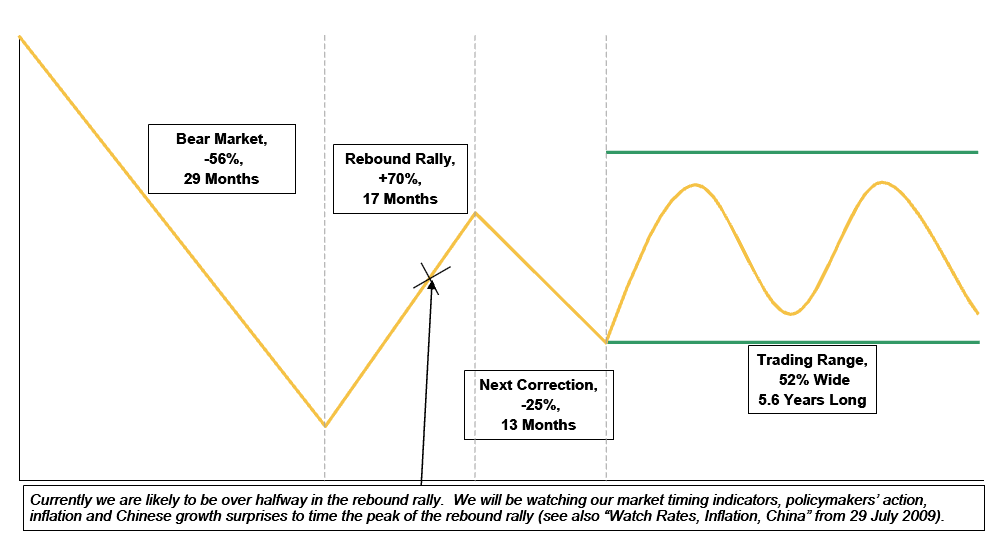
This fascinating composite chart below is courtesy of the Strategy desk of Morgan Stanley Europe. It shows what the average of the past 19 major Bear markets globally have looked like:
>
Typical Secular Bear Market and Its Aftermath
>
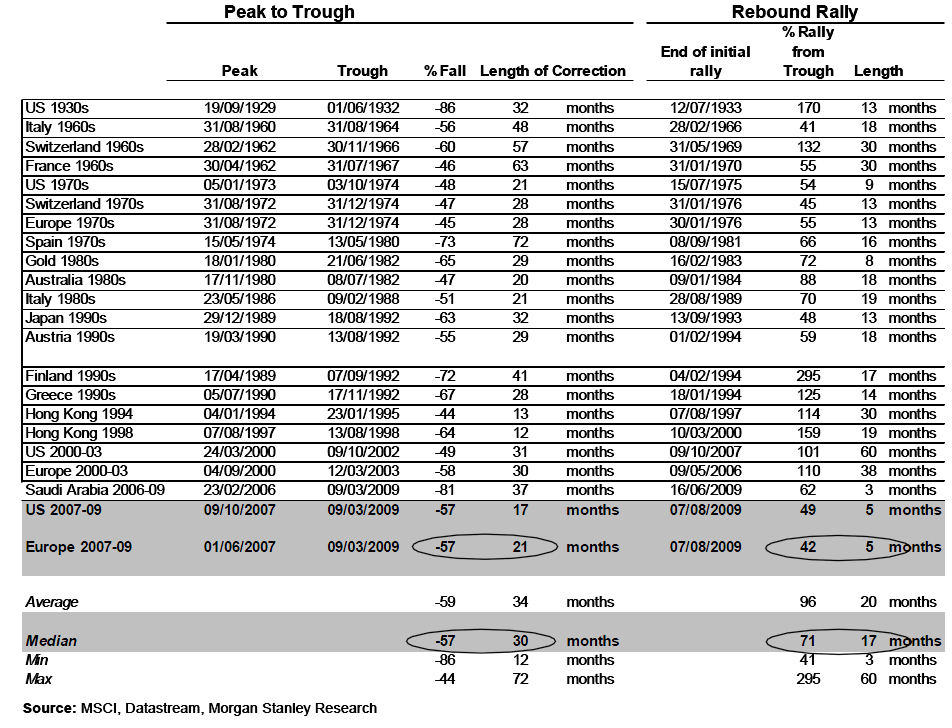
The Chart represents typical secular bear markets based on MS’s sample of 19 such bear markets as shown after the jump.
There are obvious differences and similarities — the SPX fell 43% over 18 months, and snapped back 50% in 6 months. Almost but not quite as deep, but much faster a fall. What that means for the snapback is anyone’s guess.
There is no guarantee that the current market will track that amalgam, knowing what a composite of past Bears looks like can be helpful to your understanding of what is typical.
This table shows Secular Bear Markets and Subsequent Rebound Rally:
>
>
Source:
The Aftermath of Secular Bear Markets
Authors: Teun Draaisma, Ronan Carr, CFA & Graham Secker, Edmund Ng, CFA and Matthew Garman
Morgan Stanley European Strategy 10 August 2009



August 27th, 2009 at 11:33 am
whoever made the mark on the upswing, i guess hadn’t taken note of the time in months. If we’re 17 months into the bear, why make a mark at 38 months and call it a day? FAIL.
~~~
BR: The mark was made at the 51% point of equity gains, not time. I expect most traders are more concerned with gains/losses than elapsing of time
August 27th, 2009 at 11:36 am
It looks like the saying is true that a real bear market will wear you out. If this is the case, it’ll be hard to find lasting trends to latch onto.
August 27th, 2009 at 11:41 am
So…do ya think a Finnish rally is out of the question?
August 27th, 2009 at 11:59 am
The thing I find most noteworthy about this chart is that neither the next correction, nor the trading range, undercut the lows from the first bear market period. I personally feel that the March lows are going to be violated sometime in the next two years. However, I realize it is still going to be quite difficult to profit from this and timing things right is very challenging. That is why for the average investor I think a better investment plan is to allocate a decent minority to gold related assets, given the Fed’s intent on preventing deflation at all costs. This policy is going to create big problems for the dollar in the long term, and the gold price and gold mining companies should be one of the main beneficiaries of this trend in my opinion.
August 27th, 2009 at 12:03 pm
Terrific and instructive chart — thanks!
August 27th, 2009 at 12:07 pm
I would agree with krbecarson — the question of whether this pattern is measured by relative changes or time is not a settled thing.
It is entirely possible — especially when one considers the magnitude of the forces moving the global economy and the markets — that this bear will be deeper AND longer than the “average” described in this chart.
August 27th, 2009 at 12:25 pm
“There are obvious differences and similarities — the SPX fell 43% over 18 months, and snapped back 50% in 6 months.”
It fell 57%; you must be inverting there.
Also, the snap back is closer to 54%. (I’m using 1565 –> 666 —> 1030 , which I think are the right numbers, but I could be off a few points.)
~~~
BR: I was referring to the 2008-09 fall . . .
August 27th, 2009 at 12:36 pm
I don’t know. It really feels like there’s a lot of apples and oranges and kumquats in this comparison. Averaging them together gets you what? Fruit salad? Meh
Also this:
“the SPX fell 43% over 18 months, ”
Just for accuracy; the SPX fell over 56% from peak to trough, no? Am I missing something?
August 27th, 2009 at 12:44 pm
That data shown above is all apples. We’re oranges. The situation we’re in has no precedent. The metrics we’re using apply to what could be described as being “normal” for the period of time in question. Good luck with the “W” shaped recovery (I’d agree, if the “W” was set on a baseline that slanted downward steeply to the right).
August 27th, 2009 at 12:51 pm
Wouldn’t it be more reasonable to say the secular bear started in 2000?
That way we had a 31 month, 49% decline, followed by a 101% 60 month rally, then a 44% decline, then a 54% rally and now we roll back towards bottom of trading range of 800 to 1100 on the SPX?
~~~
BR: Excellent observation. You will note that US and Europe 2000-03 are included as prior bear examples . . .
August 27th, 2009 at 12:59 pm
[...] The four stages of secular bear markets. (Big Picture) [...]
August 27th, 2009 at 1:03 pm
Marcus
And who’s to say we’re not done with our massive decline, ala 1929-32. I won’t bet against it. The parallels are haunting. (and yes, I know all about the huge Fed interventions and money galore. But we won’t know if they can hold back the deflationary forces of deleveraging forever until this is all over.)
And of course there’s the Japan scenario, which is very misrepresented in that chart, only showing through ‘93. That’s really the most likely path for us, IMO.
And gdm has a good point too. Who the hell knows, eh? But it’s fun to speculate on, isn’t it?
August 27th, 2009 at 1:12 pm
Hmm, smells like an awful Q1 2010. Chinese New Year? Not-so-jolly Christmas earnings?
August 27th, 2009 at 1:13 pm
gdm Says:
August 27th, 2009 at 12:51 pm
Wouldn’t it be more reasonable to say the secular bear started in 2000?
reply:
———-
Your observation makes sense. What comes next is the big enchilada. The world is in a liquidity trap. Spending will not go ballistic like in the recent past. Financial markets will respond to excessive liquidity rather than great economics. Once that finally is wrung out of the economy, probably years from now, the markets might look like a buy and hold environment once again.
Interest rates will probably remain low for a long time. ZeroHedge had a great article yesterday where he explained that the Fed is buying US Agencies from foreign governments using electron money with the side agreement they use the proceeds to purchase UST debt from the treasury. Thus, monetizing the UST debt and hoping the agency debt pays off someday.This will pump additional hundreds of billions of new cash into the world economy, which should create some wild rides in the markets for a few more years. In fact, I’m wondering if the stock market even has the capability of falling anymore, given all the electron cash being used to float it.
August 27th, 2009 at 1:14 pm
OfT:
True, no one knows — but I don’t think we’re done with the decline.
August 27th, 2009 at 1:17 pm
Nothing typical about this bear market. It’s a deleveraging event. The debt must be purged.
August 27th, 2009 at 1:25 pm
This is just an idle conspiracy theory but here it goes:
Foreign governments use their own printed electron money to buy US Agencies. Thus, toxic debt is removed from the world at no direct cost. The Fed prints some electron money and buys it up with the side agreement that the foreign governments buy UST debt to replace it. Maybe the toxic debt eventually pays off, maybe not. It didn’t cost anything to take it out of circulation.
On an accounting basis, it balances and the electron cash is technically backed up with actual assets: housing that is collateral for the agency debt. On the other hand, foreign governments and the Fed printed electron money to indirectly swap the agency debt for UST debt. Clever or diabolical?
Too bad for the common person that the cash generated from sales of toxic agency debt is just being used to pump the price of oil.
August 27th, 2009 at 1:26 pm
this secular bear is far from typical. it is a cumulation of excess over 60 years. i’d say the 1970’s bear is optimistic and highly unlikely. a more credible scenario is the japanese secular deflationary bear starting in 1989. we seem to be following that manuscript page by page. these were also caused by huge asset bubbles and nothing the dumb central bankers did and will continue to do with their silly keynesian ways will stop the oncoming deflation this country faces. as a matter fact our situation seems in owrse than hjapan since they were a nation of savers and unemploymnet was never over 5%. here we have unemployment of 16 plus % on it’s way to over 20% and a population with ZERO savings. the only thing that has not sent this cesspool into the complete abyss is that somehow the toilet paper dollar remains the reserve currency. what a shame what a sham.
August 27th, 2009 at 1:34 pm
barry,
for christ’s sake,
how would u rate the statistical rigor of a study like this?
y promote the sales desk of an i.bank whose track record is as good as, hmmm, cramer’s?
im going to check whether the car salesman of the ford dealer across the street has any research to contribute…
August 27th, 2009 at 1:44 pm
In pictorial form: How to monetize the debt
Foreign Bank electron Money or $$$ reserves————–> Holder of Agency or other suitable debt
Foreign Bank Fed
Foreign Bank US Treasury
Foreign Bank invest in oil
Consumer <————————————————————-high oil prices
August 27th, 2009 at 1:45 pm
crap: the pictures I drew didn’t pass through. It was a nice little text based drawing above. Sorry.
August 27th, 2009 at 2:03 pm
OT Regarding the Fed’s appeal of recent ruling under the FOIA:
“Experience in the banking industry has shown that when customers and market participants hear negative rumors about a bank, negative consequences inevitably flow,” Norman Nelson, vice president and general counsel for the group, said in the document. “Our members have accessed the discount window with the understanding that the Fed will not disclose information about their borrowing, especially their identity.”
http://www.bloomberg.com/apps/news?pid=20601109&sid=aAOhgVw78e3U
“rumor” is defined by my American Heritage as “a piece of unverified information of uncertain origin usually spread by word of mouth, or unverified information received from another”
Surely Mr. Nelson confuses rumor, which is unverified and from an uncertain source, with disclosed truth, straight from the Fed’s own balance sheet, which is verified, and from a certain source.
August 27th, 2009 at 2:03 pm
a related, but different post that shows one way in which this situation is different from pretty much all previous ones (barring possibly the 1930s) — and may or may not be relevant here is …
http://jessescrossroadscafe.blogspot.com/2009/08/plunge-in-foreign-capital-inflows.html
August 27th, 2009 at 2:03 pm
How about the notion that the current predicament is but a single leg down on an inexorable and permanent slide to the bottom?
from http://thearchdruidreport.blogspot.com/2009/08/entropy-gets-no-respect.html
“The problem here is that very few people want to deal with that reality. The great majority will make themselves believe in zero point energy and evil space lizards and any other absurdity you care to name, rather than gulp and take a deep breath and admit that the prosperity we’ve enjoyed for the last three centuries was bought at our grandchildren’s expense. I sometimes suspect that one of the reasons so many people like to imagine an apocalyptic end to the industrial age is that sudden extinction is easier to contemplate than the experience of slowly waking up to the full extent of our own collective stupidity.”
August 27th, 2009 at 2:06 pm
mobiaxis-
i wonder if he meant three decades- not three centuries
August 27th, 2009 at 2:10 pm
I honestly think you throw out all past precedent in this case. We have never gone through an even remotely similar time period, when you consider all of the government distortions that are being heaped on the markets (and basically everything). And those are the distortions that we KNOW OF. There are many others that we probably aren’t even aware of the details on (e.g. the Fed).
August 27th, 2009 at 2:15 pm
i wonder how smart it would be right now to be long banks- with a possible disclosure of all those banks held afloat by the fed- and the liklihood the fed is holding worthless collateral – and the conclusion the TBTF banks are insolvent-
that’s one trade i would run away from
August 27th, 2009 at 2:24 pm
Obviously, definitions, like mileage, may vary, but my understanding of the the term “Secular” market refers to much longer cycles that for whatever reasons seems to occur.
This is one of the most widely used to parse the 20th century:
Secular Bear: 1906-1921 (16 year duration); average return: 1.58%*
Secular Bull: 1922-1928 (7 year duration); average return: 17.9%
Secular Bear: 1929-1949 (21 year duration); average return: 2.34%
Secular Bull: 1950-1965 (16 year duration); average return: 11.4%
Secular Bear: 1966-1982 (17 year duration); average return: 3.64%
Secular Bull: 1983-1999 (17 year duration); average return: 14.96%
*Total annual return, assuming dividend reinvestment, no taxes, no transaction costs, and no discounting for inflation.
The average length of a Secular Bear market over the past 100 years has been 18 years (If you wish to use earlier data from the 19th century as reconstructed by various scholars, the average length is 17).
Note that Secular Bears are not categorized by a persistent decline, but rather can be called extended periods of stagnation when looking at the whole era.
Within those markets, there are always rally periods – cyclical bull markets. Those are what keeps the secular bear market from being completely negative.
However, if, you are a prudent long term investor (not necessarily a long term holder of individual stocks, but invested in the market for the haul), you will factor in that pesky discounting effect of inflation. In that case, Secular Bears can last in real purchasing power terms, for a number of years longer.
How long?
Well, perhaps the worse case scenario is what happened to the London Exchange: It peaked in 1900, and it took until 1954 for the aggregate value of the stocks traded on that exchange to match its 1900 high. Yes, that includes, dividend reinvestment and no expenses.
I would argue that we entered a Secular Bear market in 2000, and if the pattern holds, we are likely to stay in it until 2016, plus or minus a few years.
Not that real money can’t be made, and you don’t have to be a kinetic trader: Keynes – yes, that guy – earned 13% annually over 13 years while managing his Cambridge college endowment fund; during a period when the London Exchange averaged 0%. And, he did it while spending 1 hour a day on the fund, as he enjoyed a leisurely breakfast.
~~~
BR: Excellent comment!
August 27th, 2009 at 2:25 pm
BR:
Whenever I click on a link for comments or to refresh a file gets downloaded. You may want to check your site because it’s freaking me out.
Back to topic:
This bear market will resume in full force if the FOIA case is not delayed. All of the stops will be pulled out over the weekend to prevent this information from being released.
August 27th, 2009 at 2:25 pm
It’s difficult to fall back on that tired old notion that “it’s different this time”, and all my experience and training out in the Real World tells me to be suspicious whenever I hear that, but …
When one looks at the initial stimulus driving this one, and compare it to other large disturbances in the “economic force”, is the stimulus (as in motive force) of a ginormous real estate/lending bubble that built for the better part of a decade (maybe two) that underpins the entirety of our banking system (and is still in the process of being washed away as foreclosures mount and CRE begins to crumble) remotely comparable to the S&L crisis (Wm Black is quoted as saying that the failure of IndyMac alone produced greater losses than ALL of the the failures in the S&L crisis combined)? Or how about the oil shock of the early 1970s, when the price of crude was quadrupled overnight? Back then we imported a much smaller portion of our oil, although the Middle East provided the lion’s share then (but not now).
My point is that this is a HUGE event, that we have done nothing yet to repair the structural weaknesses in our system that produced this failure, and are STILL attempting to paper over the problems and to try to return to business as usual. That simply ain’t gonna happen.
The body of evidence persuades me that there is a fair likelihood that this time really IS different, and it is most unlikely to follow the historical patterns, except in the general shape of things (a steep decline, followed by a bear market bounce, followed by … certainly some repetition of the preceding events, but with a greater or lesser magnitude? No one can say for sure. We are either in an expanding catastrophe of a dampening one, and it seems obvious to me that the Powers That Be have failed to alter the general trends, only (possibly) having prevented a complete initial collapse. All the same weaknesses that drove this mess from the start continue to be with us, and are providing the same disruptive forces going forward.
The only things that are different are:
1) that outsiders (rightly) deeply mistrust our system as it presently stands,
2) the pummeling that the consumers have taken on the security front (unemployment and loss of asset values of all kinds) continues unabated, and
3) the high-leverage gambling in the CDS and CMO markets continues as well,
which will lead to one of a number of paths being chosen in the future, and NONE of those involves a generally upward-oscillating economy.
August 27th, 2009 at 2:35 pm
i feel like just shorting the shit out of everything- the market has become a wonderland- with most traders being sucked down the rabbit hole
August 27th, 2009 at 2:36 pm
And the rally goes onward. @ahab: Be patient. Don’t do anything major right now. This thing is going to keep marching higher for a while. We’re well beyond the point of idiocy now.
August 27th, 2009 at 2:40 pm
I see no logical reason why companies like AIG, Fannie, Freddie, Citi, BofA and other bailed out government-propped zombie firms are still publicly traded companies. Makes no sense whatsoever. It’s literally a joke at this point.
August 27th, 2009 at 2:54 pm
Same as AmenRa, BR, something’s freakygoing on with the site.
August 27th, 2009 at 3:13 pm
@AmenRa
“This bear market will resume in full force if the FOIA case is not delayed. All of the stops will be pulled out over the weekend to prevent this information from being released.”
I concur — it is actually scaring me the extent that they are prepared to go to prevent release of this data — do they really bellieve that everyone does not suspect the worst?
How bad could it possibly be? (I believe the assets taken in are probably worth a nickel on the dollar, with “face value” of a dollar being on the Fed’s books — that they won’t let anyone see).
It must be worse than I imagine — and I imagine a pretty horrific scene.
http://www.nakedcapitalism.com/2009/08/quelle-surprise-fed-uses-scare-tactics.html
August 27th, 2009 at 3:17 pm
Harold Hecuba said: “this secular bear is far from typical. it is a cumulation of excess over 60 years. i’d say the 1970’s bear is optimistic and highly unlikely. a more credible scenario is the japanese secular deflationary bear starting in 1989. we seem to be following that manuscript page by page. ”
Aye, brother. There are also many graphs of international trade where we are still following the 1930s closely.
Surely anyone who thinks this is the 1970s must be looking at the bond market upside down.
August 27th, 2009 at 3:18 pm
Mannwich Says:
August 27th, 2009 at 2:36 pm
And the rally goes onward. @ahab: Be patient. Don’t do anything major right now. This thing is going to keep marching higher for a while. We’re well beyond the point of idiocy now.
————————-
Mannwich:
The market is just like Nasdaq in 1999. The bank stocks are the new DotCom trades……. After 1999 came 2000. It was not pretty.
August 27th, 2009 at 3:18 pm
carrottop
Barry just can’t resist chart porn.
And he loves to throw it out here to provoke us gluttons for punishment to rehash all the ridiculous crap going on that’s going to lead to our demise. It’s our outlet; elst we’d be atop towers with rifles or something.
j/k
Once again, I think the Japan scenario is the most likely because I think it’s what happens when the govt throws money at a huge bubble with monetary and fiscal policy. It drags things out for a very long time and introduces a lot of uncertainty with spurts of optimism mixed with bouts of realism. Japan thru the early ’90s and us right now would look at lot like ‘29-’32 if not for the easy money. It just stretches the pain over a longer period of time. Some say that’s better. I guess we’ll have to see just how long this hangover ends up being. 20 years is not out of the question and may be a good outcome, IMO.
August 27th, 2009 at 3:50 pm
ok I thought I was maybe the only one having issues with the site so glad to see others are getting some of the same. It’s been happening for about two weeks now.
August 27th, 2009 at 3:57 pm
@leftback
“Surely anyone who thinks this is the 1970s must be looking at the bond market upside down.”
Right on. The only close analogy I can see is with the 1930s.
Old saying: “One cannot predict what one does not want to happen.”
I think we’ll get by better than in the 1930’s…we have plenty of our own food here and shelter is clearly abundant. China….well that’ll be a different story.
August 27th, 2009 at 4:05 pm
@No BS 3:18 pm
“The market is just like Nasdaq in 1999. The bank stocks are the new DotCom trades……. After 1999 came 2000. It was not pretty.”
May be, but the event that caused the dot-com bubble to burst was Y2K, and the immediate cessation of all IT spending that was fueling the bedrock spending upon which that bubble was built, with future IT spending for the next half-decade being pulled forward at every company on the globe. What will be the thing that drops (is dropping) this market?
I would contend that this one IS different (there’s that meme again) from the dot-com collapse, in that the forces that are undermining our banking system are a continuing process, and have not begun to slow in any way. The equivalent of 2000 came for this market in 2007, and it continues to grind it up like so much hamburger.
Perhaps when every last mortgage in the land has been foreclosed, and every last commercial property that is not fully owned with zero debt is gone, then there will be a period of “stability”. We have already begun our descent, the economy is collapsing, even if 4 (bankrupt) stocks are doing well with good volume and the rest are doing well with a trickle of volume. This is different from the dot-com slide, in that the dot-com slide was basically a steep glide path to a lower operating level for the economy. This one is a situation where the non-stock-market economy is being actively pulled lower and nobody is doing a damn thing to stop the process
(cue Franklin411’s entry to point out how the miniscule stimulus is going to save us all as it is dribbled out over the months to come).
“Not pretty”? You ain’t seen nuttin’ yet.
August 27th, 2009 at 4:14 pm
looks like i should read this book about range bound markets…
August 27th, 2009 at 4:19 pm
@cn
“(cue Franklin411’s entry to point out how the miniscule stimulus is going to save us all as it is dribbled out over the months to come).”
Obama Channeling Reagan Needs 5 Quarters of 7% GDP Growth Surge
http://www.bloomberg.com/apps/news?pid=20601109&sid=aQTEIt2A_YFw
excerpt:
Austan Goolsbee, a member of Obama’s Council of Economic Advisers, said one of the top priorities for the administration and the Fed is finding a way “to reignite the credit markets so we can get businesses able to access credit and banks lending again.”.
—
Yeah Austan – that’s EXACTLY what we need right now, to go further and further into debt.
August 27th, 2009 at 4:21 pm
…Bernanke literally FLOODED the banks with electron dollars to go just that. What was the result? $70 oil & a collapsing dollar!
August 27th, 2009 at 4:30 pm
doa-
from your link-
“Americans who are willing to borrow and spend are finding it harder to get credit.”
borrow and spend- Uncle Dumbass would do anything to get people back on that hamster wheel
August 27th, 2009 at 4:35 pm
Andy T
Old saying: “One cannot predict what one does not want to happen.”
That’ very sage. Just look at the history of economic forecasting by the mainstream economists. They rarely if ever forecast anything bad, much less a recession. And there’s just no way you’d get any of them to forecast a early ’30s scenario here or a major drop in the markets. It’s like they think if you don’t think it, it won’t happen; which ties into the saying you posted. That and their flawed modeling, of course.
August 27th, 2009 at 4:38 pm
ahab
“borrow and spend- Uncle Dumbass would do anything to get people back on that hamster wheel”
Alas, it’s all we know how to do anymore. Sigh. Really pathetic, ain’t it?
August 27th, 2009 at 4:47 pm
@constantnormal,
Hey man Cash for Clunkers increased consumer borrowing by up to 13 billion dollars, it is the American consumer who creates 70% of GDP, and hasn’t it been the ability of the American consumer to borrow their way to prosperity that has fueled economic growth over the past 35 + years.
So 1Billion of Uncles’ money (borrowed from the tax payer) = 13 billion more consumer debt, that means an additional 2 billion (borrowed monies) should = 26 billion in debt…… And away we go.
See that is a perfect example of how we can spend ourselves into prosperity.
So put that in your pipe and smoke it, I know I will
August 27th, 2009 at 4:59 pm
Oddly, that graph reminds me of “Koyaanisqatsi”… The Hopi Blue Star Prophecy…
Koyaanisqatsi -Hopi prophecy
http://images.google.com/imgres?imgurl=http://digitalseance.files.wordpress.com/2007/04/issue_37_1.jpg&imgrefurl=http://digitalseance.wordpress.com/2007/04/12/koyaanisqatsi-hopi-prophecy/&usg=__1ib4lxLDKgpEHiWscQCgXUxP2_w=&h=381&w=420&sz=33&hl=en&start=60&sig2=fDAUDfoPl2CIOjxijbHrrg&um=1&tbnid=gXsYOahVSMB41M:&tbnh=113&tbnw=125&prev=/images%3Fq%3Dhopi%2Bblue%2Bstar%2Bprophecy%26ndsp%3D21%26hl%3Den%26client%3Dsafari%26rls%3Den%26sa%3DN%26start%3D42%26um%3D1&ei=sKyWSqnPLYvjlAeU3oyTDA
August 27th, 2009 at 5:02 pm
@cal me ahab 2:06
nope – three centuries …coinciding with the start of the industrial revolution and the extraction of a huge windfall known as fossil fuels.
Millions of years worth of photosynthesis are stored as fossil fuels…in about 300 years we have used half of it up. Civilization as we know it is only possible because of this windfall – each barrel of oil contains the energy equivalent of 250 slaves working around the clock…without that “slave labor”, civilization as we know it is over.
It is as if you were making $35K a year, won a couple of million in the lottery and started living like a millionaire. When the money’s gone, not only do you drop back down to $35K a yr, but the chances are that your new carrying costs (expensive mortgage commensurate with your nouveau riche status, BMW lease and country club memberships) are going to make you actually LESS well off. I guess you could get a part time job to make up the difference (analagous to ‘alternative energy’ sources providing for our profligate lifestyle), but in the end, unless you win another lottery, your standard of living will decline.
The laws of physics dictate you can’t get something for nothing and in a macro-macro sense we will be coming face to face with that over the coming decades (although few will see it for what it is)
August 27th, 2009 at 7:15 pm
@mobiaxis
Oh, if we all just become schoolteachers, paid by the government, it’ll all turn out fine.
August 27th, 2009 at 10:41 pm
@deadonarrival
WTF is that supposed to mean? In the long run, school teachers are just as doomed as the rest of us.
August 27th, 2009 at 10:50 pm
Excellent stuff Barry. Def think the equity turn will not happen for a long time, as your charts suggest. I would add that unforseen events usually mark bottoms more often than most think. Please read the last piece that addresses “Obama’s Lack of Fiscal Intellect”, it spells out a similar time horizon for a recovery, and offers reasons why to expect it: http://psychologyofthecall.blogspot.com/
Great stuff, love your book as well !
Adam.
August 27th, 2009 at 10:59 pm
Mobiaxis NOOOOOO my little bro 411 is a teacher – How dare you doom him with the rest of us.
August 28th, 2009 at 12:01 am
I also wonder that the secular bear market began in 2000 rather than in 2007.
I am skeptical of the graph for another, cynical, reason. It was prepared by the Strategy desk of Morgan Stanley Europe. What it shows, is that from our present position in the “cycle” we can expect cyclical movements up and down–not wild, not dramatic, that require the “assistance” of a brokerage firm, such as Morgan Stanley to trade in.
August 28th, 2009 at 1:25 am
The scary part is somebody was paid a few thousand bucks to come up with that “Research”… If you compress the x scale… as to fit now… bla bla bla…. asshatery
August 28th, 2009 at 5:31 am
“BR: I was referring to the 2008-09 fall . . .”
I don’t see how that can be, given you said:
“There are obvious differences and similarities — the SPX fell 43% over 18 months, and snapped back 50% in 6 months.”
If we go back 18 months from the March 2009 low, that by definition takes us into the year 2007.
August 28th, 2009 at 8:18 am
@mobiaxis
It was a snark comment. I was channeling f411 (who thinks if the government spends all our money on schools & teachers, the problems of the world will be solved).
August 28th, 2009 at 9:38 am
[...] The four stages of a bear market (short and must read): http://www.ritholtz.com/blog/2009/08/aftermath-of-secular-bear-markets/ Individual investors are not as bullish as the pros. (Typically, individual [...]
August 28th, 2009 at 10:10 am
Hey, who stole my purple crayon!
Nice chart, I am sure it will help MS collect more AUM.
August 28th, 2009 at 2:43 pm
[...] fully agree with this assessment of where we are long term in the [...]
August 28th, 2009 at 4:48 pm
I would agree with most commenters but then the consensus seems to be wildly one-sided on the bearish side. And, we hear the words – this time its different for this bear market (just like we have heard for bull markets before). In either case it hasn’t been different and the consensus has suffered.
Almost no one believes in a V recovery – well what if we get it? If I’ve learnt one thing it is to not completely disregard a possibility.
The one way a V recovery is possible if the dollar falls further – equities will march higher in that case. Personally, I’m on the look out for a currency crisis – maybe the Yuan fixed peg is changed.
August 28th, 2009 at 8:02 pm
I had an interesting discussion with a private investor, former Goldman MD, currently looking at hard assets: timber, metals, etc. He was quite convinced of two things: the dollar is headed south, and the US will re-live a 9/11-like event within the next 5 years.
I know it’s fashionable and likely smart to view the current equity run-up as a temporoary reprive in what may be a secular bear.
And there are indeed a lot of things that are different this time, including the resilience of the American people, and the resevoir of financial strength we can draw on. It’s a much bigger and more powerful economy than 1972, and multiples more powerful than 1935.
No one’s ever made a penny betting against America — and that’s been true for over 200 years. What’s going to change that now?
.
August 30th, 2009 at 12:08 pm
[...] Barry Ritholz of The Big Picture provides an analysis of market rebounds and corrections during a secular bear market. [...]
August 30th, 2009 at 10:47 pm
[...] Big Picture located a graphic which tracks the stock market performance of 19 of the last major bear markets. Like other traders, I’ve been calling for a pullback in this market for a while (incorrectly [...]
September 10th, 2009 at 7:07 am
[...] The contrarian view isn’t betting on the collapse, its looking at what will frustrate the most amount of people. I suspect that a continued rally higher would have that effect, despite the historical post crash patterns. [...]
September 17th, 2009 at 8:42 pm
[...] 4) History shows that secular bear markets have deep selloffs and huge rallies; this current rally still has room to run based upon a composite of prior cycles (See Four Stages of Secular Bear Markets). [...]
October 8th, 2009 at 12:02 pm
[...] Historical Secular Bear Markets: As discussed in August, secular bear markets tend to get massively oversold, then see a huge bounce. The chart below shows [...]