Case Shiller Improves Monthly, Falls Yearly

Email this post Print this post
By Barry Ritholtz - August 25th, 2009, 10:45AM

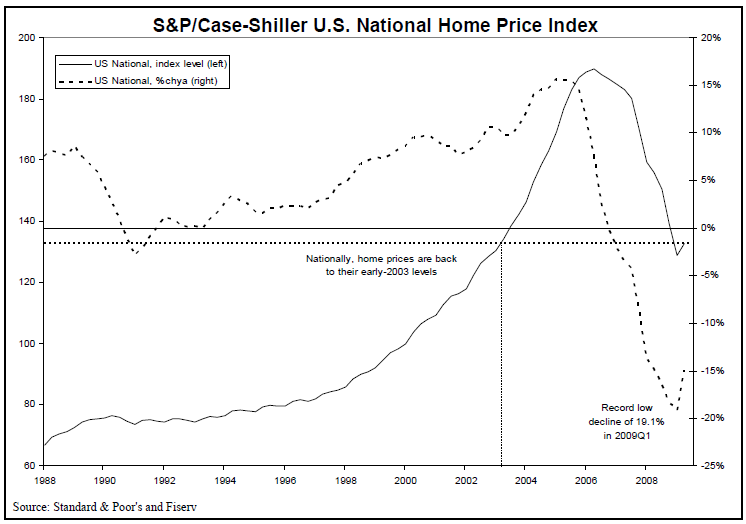
Data through June 2009 by the Case-Shiller Home Price Indices shows that the U.S. National Home Price Index improved in the second quarter of 2009, while falling year over year.

How much voluntary foreclosure moratoriums impacted pricing is an unknown in terms of degree, but they likely had a significant effect.

The chart below shows the annual returns of the U.S. National, the 10-City Composite and the 20-City Composite Home Price Indices.

Case-Shiller U.S. National Home Price Index fell Year over year 14.9% in Q2 of 2009 versus the 2nd quarter of 2008. This substantial negative annual rate of returns represents an improvement over the record decline of 19.1% reported in Q1. The 10-City and 20-City Composites recorded annual declines of 15.1% and 15.4%, respectively, an improvement over recent respective record losses of -19.4% and -19.1%.

>

609-caseshiller

>

609-case-shiller-natl-homes

40 Responses to “Case Shiller Improves Monthly, Falls Yearly”

  1. DeDude Says:

    Now it is not just an issue of stabilizing the housing market, it looks to me like there is a serious risk that we will get into a period of panic bying. A lot of people have been accumulating on the sideline because of fear that if they purchased a house, it would lose value from day one. Now those same people may start fearing that if they don’t get it now, it will be substantially more expensive later. Those overloaded with residential RE paper may come out of it better than expected just a few month ago.

  2. HCF Says:

    @DeDude:

    I think the scenario you suggest can only play out if
    1) Jobs come back, and
    2) Credit comes back

    The dynamics may be similar to panic buying in the stock market, but it will play out a lot more slowly.

    HCF

  3. alfred e Says:

    How can anybody say housing prices are on the rebound given the artificial props squirreling market prices and holding real estate off the market?

    Are those manipulations going to continue?

    Look at the inventory.

  4. Tom K Says:

    Has the housing collapse ended? Maybe.

    Is the media giving adequate coverage to the next impending bubble, the national debt? Most certainly not.

    After months of hand-wringing over how the media and politicians failed to foresee the housing/financial crisis, we’re in the midst of a massive explosion in government borrowing – and the MSM is completely disinterested.

    We’ve been told the bank bailouts, auto bailouts, and stimulus legislation are good, necessary things. We’ve been told cash for clunkers, national healthcare reform, Medicare, Medicaid, and Social Security are all good things. We’ve been told all this wonderful spending will be paid for LATER by people earning north of $250k a year, and any tax increases will coming down the pipe will have little negative effect on economic or job growth.

    Where are the canaries? Is there ANYONE with an ounce of foresight in the MSM? In the blogosphere?

  5. Marcus Aurelius Says:

    As soon as people are willing to borrow — regardless of their underlying credit worthiness or the value of the secured asset — the banks will be ready to lend. After all, there is no longer any moral hazard to govern their reckless greed.

  6. Mike in Nola Says:

    That chart is so freakin’ green shooty it’s unbelievable. I just want to go online and by a thousand shares of Countrywide Financial.

  7. leftback Says:

    From Macro Man’s blog this morning, on speculation in FRE, FNM, AIG and the like:

    “Macro Man asked one of his banks, a US institution that is generally assumed to be extremely well-placed, WTF was going on with FNM and FRE. And the answer that he got virtually defied belief. To paraphrase, he was told that interest in these stocks is primarily driven by retail, who believe that the low share prices mean there is less downside and that the stocks have the furthest to rally.”

    UFB. Our friend BRIAN may be even more creative in polishing turds to sell to JOHNNY than we suspected.

  8. Mannwich Says:

    The bubble is back baby! Just confused knife-catchers. The Feds will never be able to get out of propping up the housing market becasue once they do, prices will go down again. On another note, I hope prices keep going up. I’ll be happy to sell our place down the road.

  9. olephart Says:

    The second derivative is positive. The first derivative is becoming less negative. If we jump up we might be able to touch bottom. This looks like the soft landing in the housing market we’ve been waiting for.

  10. Steve Barry Says:

    CNBC is just giving downright wrong info now. Francis just said she looked at 07-08 and 2Q usually does not show a rise in prices m/m, so this is great news. of course she is wrong and know very little baout anything. The disconnect in the market and then crazy trading in worthless stocks is very encouraged due to poor reporting at CNBC . Earlier, Burnett said that one month of flat prices in single cities means a bottom is reached.

  11. Thor Says:

    Alfred and HCF – I don’t see any reason whatsoever why we could not have a round of panic buying. What on earth do either unemployment or credit have to do with either people rushing back in to buy and banks once again loaning money to people who couldn’t possibly afford to purchase these homes? Both your arguments assume that the banks, as well as the consumer have changed their behavior and I would argue that neither has. . . . .

  12. Cohen Says:

    @DeDude

    The flipside of that is people looking to sell will list their homes, increasing the inventory.

  13. karen Says:

    LB, we can add GM to that list as well.. and maybe C??

  14. karen Says:

    “… the Case-Shiller Home Price Indices shows that the U.S. National Home Price Index improved in the second quarter of 2009…” LOL.. maybe the index improved but that doesn’t mean home prices, especially at the mid to high end, won’t continue to fall. where is the price per square foot index?? that would be more telling.

  15. OnlineBrokerReview Says:

    Housing has clearly bottomed. The only hiccups that can occur are (1) the government purchasing incentives DON’T continue in perpetuity and (2) rates rise above 5.5% at some point. What are the chances of either happening? Ohh wait – nevermind.

  16. DeDude Says:

    HCF; I agree that credit has to get back to seriously blow the bobble again, but a lot of people want the “good old times” of 2004-7 to come back in real estate. It created a lot of income for a lot of people within the financial industry. Those people would push from within the system for letting gread topple fear, and losen the lending standards to get a bigger piece of the pie. A lot of people could get loans if mangement were to be convinced that housing prices will not fall again. Downpayments could be done on a 8-12% loan on the side, and the “80% of the value” main loan could be shipped off to Fannie and Freddie. That looks pretty good if you are sure prices will not fall and people are not put into more house than they can afford. I don’t think that U3 at 5% rather than at 10% would make a lot of difference as long as everybody have bought into the idea that it’s heading lower rather than higher.

  17. JohnnyVee Says:

    Seasonally, this is the peak of the real estate market. It is all down hill from here. Plus, gov’t incentives and artificially low interest rates cannot hold. When will such supports end? IDK, but it will end and when it does, the march south will continue.

  18. DeDude Says:

    Cohen; yes I think that a lot of people being on the sideline for selling their house will jump in on rising prices. However, those people who can afford to just wait, will need a place to live, and are likely to have the money to “move up”. Those of us who own our houses may be tempted if we can get another 800 sq.ft. for 50K and that could start the “elevator” again. I don’t think it will work out in the long run, but in the short run we could have a burst.

  19. Transor Z Says:

    That chart is so freakin’ green shooty it’s unbelievable. I just want to go online and by a thousand shares of Countrywide Financial.

    LOL

    Aug. 25, 2009
    American consumer has bottomed
    (AP) The chief economist for the American Beverage Licensees announced that U.S. consumers bottomed in July. Speaking at the organization’s annual convention in New Orleans, economist Ben Koopted said that consumer data definitely shows a bottoming. “The data show a 78% increase in homeless consumers waking in puddles of their own vomit and filth. Folks, we have hit a saturation level,” Koopted proclaimed to loud applause. “We have hit rock bottom!”

    This announcement is good news for an industry that saw a sharp drop off in high-end liquor purchases in 2008. But not everyone is happy with the news. Shares of Honeywell (HON) continued to fall on the announcement that sales of Prestone anti-freeze are expected to drop 50% in the third quarter. Johnson & Johnson (JNJ) revised its second-half outlook with expected drops in sales of rubbing alcohol and cough medicine lines.

  20. cvienne Says:

    So great…

    There is going to be this rush (no, STAMPEDE) to buy houses again and get us back to 2006-2007…

    As I recall, being there didn’t end too well…

    So after Obamas gift of “cash for clunkers”, and $8,000 tax credits, is the next step for him to mandate that we go back to NO DOC loans?, which, as I recall, was one of the prime feeders of the original problem.

  21. Cohen Says:

    @DeDude

    Maybe, but there are a lot of banks out there whose loan portfolios are grossly overvalued that’s not speculation, its being disclosed in the footnotes to 10Qs

    http://www.bloomberg.com/apps/news?pid=20601039&sid=a04oVutXQybk

    It’s one the reasons excess reserves are so high because banks know that they can mark-to-myth but there’s no solution for non-performing loans and they’ll need the capital. Is a bank like Regions interested in pumping out credit in the face of stagnant wages, job losses and rising delinquencies coupled with plummeting cure rates? I guess we’ll see.

  22. Mike in Nola Says:

    Transor – v. good :)

    We are taking a trip back to NOLA next week. Trying to make an itinerary to squeeze in as many eats as possible.

  23. leftback Says:

    Calm down, everyone. This summer’s housing rally is simply a pimple on the elephant’s arse of this recession.

  24. HCF Says:

    @ DeDude:
    >a lot of people want the “good old times” of 2004-7 to come back in real estate.

    I agree, but unfortunately, some of the people who want the “good old times” are the policy makers themselves. They are not only adding whiskey, vodka, and rum to the punchbowl, they are giving away some meth and Vicodin on the side…

    @Thor:
    >Both your arguments assume that the banks, as well as the consumer have changed their behavior and I would argue that neither has. . . . .

    I forgot that economics is akin to alchemy and not a real science… What’s the central assumption of economics? That people behave rationally? That is clearly bullsh*t…. No wonder our policymaking has been so wonderful…

    HCF

  25. DeDude Says:

    Cohen; I agree that there is a lot of conservative business sense that would suggest that banks should not losen their standards to get more loans going. But then again there was a lot of sense that got swept under the rug in the 2004-7 period, because those juicy fees and bonuses were more important than the long-term health of the company. Unfortunately the interests of the shareholders and the interest of management are the opposite in todays business models. Management has all the power, since they bribe those big institutional shareholdes that block any attempts against the excessive and unhealthy incentive structures. So my guess is that we again will see stupid loans to allow CEO’s to get quick zillion dollar bonuses and retire before it all collapses. But that is just my guess and we shall see.

  26. Mannwich Says:

    This chart also tells me that Joe Retail is probably feverishly buying stocks (not at the March lows) but NOW, to try to recoup losses. This insanity could go on a lot longer than many of us (including myself) think. ‘Tis a time for patience, IMO. Meanwhile, enjoy the show.

  27. leftback Says:

    C is not looking healthy today, maybe abandoned now that penny pickers have moved on to AIG, FNM and FRE.
    Those familiar with the early 1930s can name the equivalent lottery picks of the day. How’d that work out for ya?

  28. Cohen Says:

    @DeDude

    I don’t think it has as much to do with conservative business sense as it does with the reality of the situation. While I’d guess that bank execs has a sense that their actions were of above average risk, none of their models suggested anywhere near the losses that have been experienced.

    Now they see it, they see the level of non-performing loans (i.e.: real losses), the alt-a and option ARM resets coming and the rising delinquencies. When you couple that with the growing acrimony towards government deficits and debt, I don’t see how another round of bank bailouts would be accepted by voters without a painful election for Dems in 2010. And at the end of the day, politicians fight to get elected and re-elected. I just can’t imagine a situation where banks tear through bailout funds, go nuts again and then ask for more in the near future.

  29. mcHAPPY Says:

    This is what I’ve been waiting for:

    Bottoms called. Recessions ending. World has been saved. Markets push higher and higher still. Expectations are high and rising. Bullish comments on TBP. CNBC not even considering the possibility of another crash or rise in USD.

    The markets are following the script perfectly and the directors at the FED, USG, and GS are grinning ear to ear, marvelling at their wonderful production.

  30. Pat G. Says:

    Call me old fashioned but I will continue to use traditional y-o-y comparisons. Thank you…

  31. Peter Boockvar Says:

    To highlight the seasonality of housing and its impact on pricing where the spring selling season is the busiest of the year, the S&P/Case Shiller HP Index, which does not seasonally adjust its m/o/m pricing, has shown its best performance in Q2 in every year except one going back to 2001. 2009 is of course not complete but Q2 saw a gain of 1.3% after a drop of 7% in Q1. On the downside in ‘07 and ‘08, Q2 saw the smallest decline and in the boom years in ‘04, ‘05 and ‘06, Q2 saw the biggest rise. In ‘03, Q3 price gains barely exceeded the Q2 rise while in ‘01 and ‘02, Q2 had the best price increases. The price data seen is welcome relief but it’s that time of the year and the $8000 tax credit and slowing foreclosure rate had its impact. Add to this the still punk Present Situations component in Confidence and it helps to explain again, the lack of belief in the sustainability of recovery that the bond market has relative to stocks.

  32. leftback Says:

    “The markets are following the script perfectly and the directors at the FED, USG, and GS are grinning ear to ear, marvelling at their wonderful production.”

    Agreed, Tiny Tim and Banana Ben know how to put on a Broadway show. The chorus line has been remarkable.

  33. The Curmudgeon Says:

    The only difference with now and 2006/07 is that the government has expressly agreed (not just with a Greenspan/Bernanke put) to underwrite all of the stupid risk-taking of the commercial and investment banks, unless they happen to be not so big enough that everyone knows their name. It’s “Cheers” for the sacred nineteen, and of course, the gse’s; “Lillith” for the rest.

    Yet the sheep they shear with their loans still must have some means of growing wool. Except for the politically-favored automobile industry worker, that requirement is problematic, even if you give away part of the wool in the form of a tax credit. No matter how “good” (I wonder when an increase in prices become categorically “good”?) this report looks, the simple reality is that explicit government bubble-blowing is not apt to end any better than the bubbles it blew by implication before.

  34. DeDude Says:

    Cohen; I agree they would not get bailed out of a second hangover from drinking the same punch. However, I also doubt that they care, as long as they think they can bail out of the company with a couple of years worth of zillion dollar bonuses. I don’t think that they predicted they would be bailed out last time – yet they did it anyway because the money was so good. There were pleanty of warning last time, but greed trumphed fear. That always happens, and will again next time.

    Pat G; it’s fine to use y-o-y, if you want to be at least half a year late in catching the change in trendline ;-)

  35. Cohen Says:

    @DeDude

    Greed was a prime motivator for sure but if you read about the models that decisions were based on, especially the ones at AIG-FP, to say they were unrealistic would be generous. They didn’t expect bailouts bc the idea of the losses creating such a scenario were not even a possibility. Now reality has slapped them (and continues to) in the face. The level of leverage we saw is simply not coming back.

  36. Cohen Says:

    Re: treasury yields vs. equity markets

    I notioced this a couple of weeks ago but now the divergence is becoming more drastic with the 10-year yield down again today.

  37. DeDude Says:

    “The level of leverage we saw is simply not coming back”

    Only the future will tell. I always said that greed is a constantly roaring engine, whereas fear is a short-lived “kaboom”. We shall see how long the “kaboom” of “jez house prices can fall” will last ;-)

  38. Onlooker from Troy Says:

    LB

    This from a comment on that Macro Man post:
    “He has taken on a big FAZ position, and he was looking at a graph of it on his laptop during his flight out here. The stewardess was coming up on the aisle, glanced at his screen, and said to him, “No, no. That’s not the one you want. You want FAS!”"

    Classic. The flight attendant giving stock/ETF tips (assuming it’s a factual anecdote; which I don’t doubt right now). Nothing could go wrong from here, eh?

  39. Dr. Kenneth Noisewater Says:

    How much overcapacity is still out there, unsold, underwater and rotting away (or having commodity metals stripped out by opportunistic vandals)?

    How much underwater paper still sits in bank vaults, marked to fantasy, and un-foreclosed in order to maintain the kabuki solvency dance?

    Could it be a “short squeeze” on available housing ginned up by cheap credit (for those who can still have it) and government funny money stimulus ($8k)? I bet prices would not be rising if the banks were forced to mark their trash to market, as they should have had to this whole time..

    Let the large dinosaurs die, and a thousand small mammals feast on their carcasses…

  40. leftback Says:

    “Let the large dinosaurs die, and a thousand small mammals feast on their carcasses…”

    Words to live by, Dr. Kenneth…. what a splendid image to hold in mind.

    Onlooker, it’s a momo world out there for retail inwestors, and they are about to be left holding the bag o’ banks.