
Fair-Value Accounting

Email this post Print this post
By Barry Ritholtz - August 17th, 2009, 11:45AM

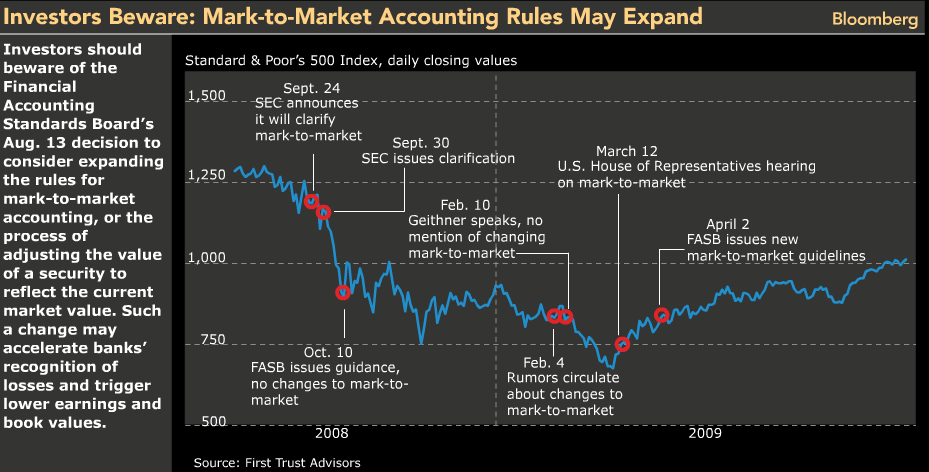
I cannot figure out why some people (like my pal Brian Wesbury) want to hide investment values from Shareholders.

As a company, if you don’t want to report the daily price fluctuations, you can easily move any investments into an account that is “Held to Maturity.” That way, there is no reporting of volatility unless there is an actual (realized) loss.

Of course, that leaves room for not reporting losses ntil the very last possible undeniable minute. But that is still better than mark-to-make-believe.

But not reporting the actual value of trading assets? That is fraud as far as I am concerned.

>
mark-to-market-accounting-rules

>

Source:
Fair-Value Accounting Is ‘Horror Flick Monster’: Chart of Day
Brendan Moynihan and Tom Contiliano
Bloomberg, Aug. 14 2009

http://www.bloomberg.com/apps/news?pid=20601109&sid=a1Qa_Q_PbGWc

Comments

Please use the comments to demonstrate your own ignorance, unfamiliarity with empirical data, ability to repeat discredited memes, and lack of respect for scientific knowledge. Also, be sure to create straw men and argue against things I have neither said nor even implied. Any irrelevancies you can mention will also be appreciated. Lastly, kindly forgo all civility in your discourse . . . you are, after all, anonymous.

27 Responses to “Fair-Value Accounting”

  1. Mannwich Says:

    Because Wesbury is still trying to get back to “even”. He surmised the week before last that the S&P was still 40% undervalued. Has he ever believed the S&P was overvalued?

  2. GB Says:

    I wonder if Madoff used mark to market… sorry had to say it.

  3. Shnaps Says:

    I don’t think HtM accounting helps NPAs much. But what do I know? At least I am qualified to appear on CNBC now.

  4. dead hobo Says:

    BR suggested:

    As a company, if you don’t want to report the daily price fluctuations, you can easily move any investments into an account that is “Held to Maturity.” That way, there is no reporting of volatility unless there is an actual (realized) loss.

    Reply:
    ———-
    You can’t move an investment into held to maturity if it doesn’t mature. You can fudge things a bit by moving them between trading and available for sale. The latter is a below the line recognition until the investment becomes liquid or is disposed of. However, to move from trading to available for sale, you must have to have positive intent to hold for a while, and not do it to be deceptive. That would be lying. You’re not supposed to do that.

    If the investment has a maturity and is otherwise dead meat, then you have maximum flexibility. Just don’t lie. It’s wrong.

  5. Mannwich Says:

    I posed this question here last week but nobody answered me. I’ll ask again – why at this point would we believe anything that’s on any public companies’ reported books? Why?

  6. dead hobo Says:

    Mannwich Says:
    August 17th, 2009 at 12:28 pm

    I posed this question here last week but nobody answered me. I’ll ask again – why at this point would we believe anything that’s on any public companies’ reported books? Why?

    reply:
    ——–
    Because most people don’t waste lies on unimportant things. They only lie about the big stuff. Some things on the financials are not big or important. They are probably true-ish. Like petty cash.

  7. Mannwich Says:

    @dh: But I think that A LOT of publicly traded corporations are still lying about big things in their financials? What’s to stop them from doing it? And don’t say their auditors, because we know how reliable they’ve been.

  8. dead hobo Says:

    Mannwich Says:
    August 17th, 2009 at 12:35 pm

    @dh: But I think that A LOT of publicly traded corporations are still lying about big things in their financials?

    reply:
    ——–
    I guess I didn’t make my point. Sorry. Nobody’s going to tell a whopper about depreciation expense. That would be a wasted lie. It’s best to expend the effort only on the big things and try to make a good cover story that can fool any snooping discovery proceeding that might come by later.

    Auditors are supposed to consider fraud when planning an audit, but they are not required to go out and look for it. They only have to look into the effectiveness of internal control, which includes a subset of fraud. They’re mostly interested in ghost employees and cutoff shenanigans. If a big fraud slaps them across the face like a big fish, they have to look into it. Otherwise, management just has to be cool and look stupid if they get asked an uncomfortable question.

  9. The Curmudgeon Says:

    Never mind the fantasies on the balance sheet, what about the ones that don’t even make the mark (pun sorta intended)?

    In that regard, how about the $5 trillion or so GSE debt that doesn’t make it to the Fed government’s balance sheet? The feds own the gse’s–every bit of their debt is now more or less explicitly guaranteed by the feds. Why doesn’t it count against the government debt?

    But the thing about marking to fantasy is that obligation to pay things back doesn’t decrease just because the liability decreases in value in the marketplace, where the ability to raise cash from the sale of an asset does.

  10. BSNEATH Says:

    How do you suppose the banks would justify bonuses if they were required to properly mark down their losses?

    Inflated valuations are allowing the banks to report fictitious earnings and pay excessive bonuses when they should be retaining capital to cover future losses.

    Who do you suppose will have to come to their rescue when these losses can no longer be disguised?

    At least times will continue to be good in the Hamptons.

  11. urbandigs Says:

    one moment here. Whole loan books are not required to mark to market. They are in hold (accrual) books or as BR states, classified as held-to-maturity. This is the way it is for whole loans and its silly to have to mark these to market. Of course if you had to, it would cripple the banks because there are trillions held in whole loan books that have a carrying price way above the current market bid. Lets say its carried at .90 on the dollar, and the bid is 0.70. That writedown across the board would bankrupt our banks. But, you dont have to mark these to market, and rightfully so. Would you mark down the value of your house daily?

    http://www.urbandigs.com/2009/08/marking_the_whole_loan_accrual.html

    These guys are marked as the book starts to non perform, and I believe it is now mgmt discretion as to what that means. Loan losses against these are done on a quarterly basis I believe.

    The issue, is the recent FASB 115-2 rule change in April that allows OTHER assets to be classified as ‘held-to-maturity’. No doubt banks did some shady moves and reclassified assets that should be marked to market, into a category that is not required to do so. This is in addition to anything held in off balance sheet conduits that are hidden. I think this FASB has ruled to revert that change starting in 2010. So whether that gets extended we will see. I think 19 largest banks held about 95.2Trln in off balance sheet assets at end of 2008.

    Anyone know an update to that?

  12. urbandigs Says:

    complex crap keeping up with it, but I found this note on the changes top be helpful

    http://www.stinson.com/files/FASBRelaxes.pdf

  13. BSNEATH Says:

    One can perhaps buy into the concept that it is not a good idea to impose mark to market accounting rules in the middle of a financial crisis when credit markets are frozen and valuations are difficult to come by. However, are we not now in a more stable environment and aren’t banks once again lending to each other? Therefore, isn’t the market valuing assets at much closer to their true fair value? Are we not being dishonest to allow banks to inappropriately value assets at greater than fair market value, particularly if in doing so they are encouraged to continue wasteful practices such as $30 billion in bonuses that would be better utilized as retained earnings to cover past investment losses? Do you really expect us dumb-shits out in the boonies to let you guys continue to rape and pillage our economy?

  14. hohandy Says:

    This – FASB Looks to Expand Mark Rules was in the WSJ on Friday on Page A20.

    Money Quote:

    “Many financial assets already must be marked to market, meaning their value is pegged to the ups and downs of the market. The new proposal being weighed by the Financial Accounting Standards Board would apply mark-to-market rules to all financial instruments, including loans, which make up a big chunk of banks’ balance sheets and typically don’t have to be marked to market.

    “FASB discussed the plan last month and is slated to do so again Thursday, though a formal proposal from the board on the issue isn’t expected until late this year or early in 2010.”

  15. Onlooker from Troy Says:

    Because Wesbury’s a shyster, a huckster, a clown, a snake oil salesman, a fool, either stupid or a con artist, etc.

    The secular bear will expunge these fools from the market scene, and it can’t come too soon. Of course they’ll go off to retirement on OPM that they fleeced over the years. I hope they grow a conscience some day and it haunts them til their end days.

    Was I unclear? :)

  16. constantnormal Says:

    “That is fraud as far as I am concerned.”

    Amen, bro’

    Of course, fraud is the New Normal.

  17. dead hobo Says:

    http://www.reuters.com/article/pressRelease/idUS149051+12-Jun-2009+BW20090612

    This one is supposed to be a big enchilada with respect to bringing off balance sheet information into better view. Fas 166 and 167 are both dense and I have trouble understanding them. Neither is a quick read.

  18. danm Says:

    Because most people don’t waste lies on unimportant things. They only lie about the big stuff.
    ———–
    LOL!

    http://www.cosmopolitan.co.uk/your-life/average-person-tells-four-lies-per-day/v1

  19. Mannwich Says:

    @danm: I would imagine that number triples (at least) if you’re a corporate exec, politician or Wall Streeter.

  20. I-Man Says:

    This chicanery is precisely why you cannot “OWN” stocks anymore… only rent them.

    Talk about “funny mentals”…

  21. leftback Says:

    They will bring back M2M when they need to crash the equity market in order to safeguard the Treasury market.
    Until then, fraud trumps fundamentals.

  22. danm Says:

    I think M2M will be brought back when everything is so ugly that marking stuff down makes no difference.

  23. Pat G. Says:

    “That is fraud as far as I am concerned.”

    Totally agree. And because this is allowed to go on with the regulator’s blessings (USG) I continue to be concerned about the eventual fallout upon this country.

  24. philipat Says:

    And whilst we are on the subject, what about the Conduits, SIV’s and other “Off Balance Sheet” items which make it all but impossible for anyone other than the CFO to understand the published financials of Banks?

    This practise was discovered with Enron and still seems to be in fashion, despite the “Reforms”?

  25. NakedHedgeFund Says:

    The FASB changes were a chewed piece of bubble gum stuffed into a hole on the bottom of the boat…. the gum is getting loose.

    http://www.nakedhedgefund.com/finance/must-watch-video-on-toxic-loans/

  26. Jim Bianco Says:

    Let’s remember that mark-to-market (FASB 157) became the rule because of the way Andy Fastow (CFO) and Jeff Skilling (CEO) used the old rules to perpetuate the fraud that was Enron. Now that we do not like the answers we are getting with mark-to-market, we all seem ok with going back to the rules Enron successfully gamed.

    Regarding the application of FASB (or SFAS) 157, let’s remember how it is supposed to work. Assets are divided into three levels, 1, 2 and 3. The controversy is in Level 3 assets, the “hard-to-value” asset. The rule says that they should be valued using “management’s judgment.”

    However, Level 3 securities are not being valued by management as per FASB 157, but by liquidation value. Why? When Enron blew up, we felt it necessary to impose the death penalty on their accountant, Arthur Anderson (Anderson was liquidated because of the sins of Enron). Accountants would like to keep their jobs, so they are using the most conservative marks possible (distressed liquidation value) when pricing these securities. The Enron/Arthur Anderson debacle has shown that the auditor will not be around long if the financial firm understates losses, so no auditor is going to be put into this position.

  27. Edith Orenstein Says:

    dead hobo Says:

    August 17th, 2009 at 1:32 pm

    http://www.reuters.com/article/pressRelease/idUS149051+12-Jun-2009+BW20090612

    This one is supposed to be a big enchilada with respect to bringing off balance sheet information into better view. Fas 166 and 167 are both dense and I have trouble understanding them. Neither is a quick read.

    Reply:
    A summary of highlights from FAS 166 and FAS 167 (replacing FAS 140 and FIN 46R) can be found in slides you can download from FASB’s Aug. 24 webcast (1 hour), avaialble here: http://www.fasb.org/cs/ContentServer?c=Page&pagename=FASB%2FPage%2FSectionPage&cid=1176156235199

81 queries. 0.389 seconds.