
How Not to Reduce Excess Reserves
Here is something I never expected to be linking to on a Saturday afternoon, via the St. Louis Fed’s David C. Wheelock: How Not to Reduce Excess Reserves:
The Federal Reserve’s actions to support financial markets and the broader economy have resulted in a large increase in bank reserves—both total reserves and reserves held in excess of legal requirements—since September 2008.1Excess reserves have risen from an average of less than 5 percent of total reserves during the 5 years ending in August 2008 to more than 90 percent since November 2008. Many observers contend that the large increase in excess reserves poses a significant inflation risk. A look back at a similar episode during the 1930s provides some insights about how not to reduce excess reserves.
Consider the chart below as a textbook example of what David says not to do:
“In 1936, officials decided to increase reserve requirements in three steps—from 13 percent to 26 percent on transactions deposits and from 3 to 6 percent on time deposits . . .
The chart shows the dates of each increase in reserve requirements. The policy was successful in reducing both total excess reserves and the ratio of excess to total reserves. However, interest rates also rose, money stock growth declined sharply, and in May 1937 the economy entered a reces-
sion (the shaded region in the figure represents the recessionary period).”Excess/Total Reserves Money Stock Growth
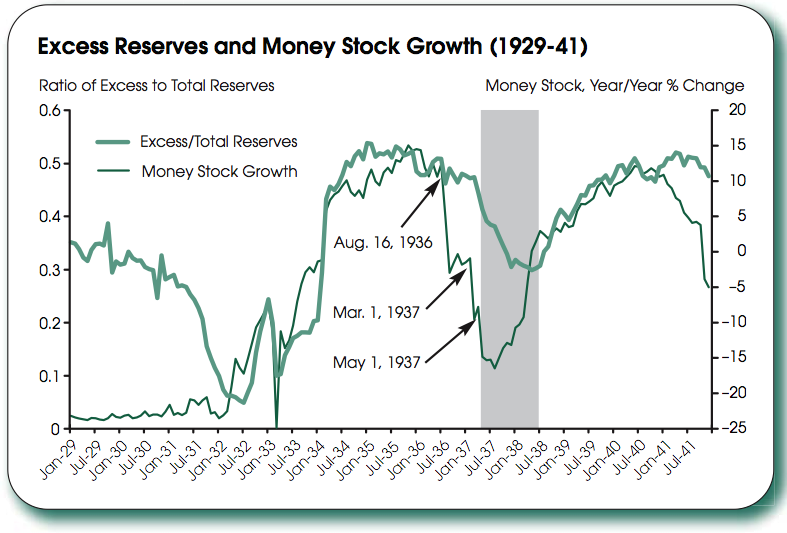
Chart courtesy of St. Louis Fed
>
Source:
How Not To Reduce Excess Reserves
David C. Wheelock
St. Louis Fed September 2009
http://research.stlouisfed.org/publications/mt/20090901/mtpub.pdf



August 22nd, 2009 at 1:49 pm
Fits the Thinktank P/E posting. Free c*s*n* money. Wordpress filters suck.
144. A new record.
The chart looks strikingly similar to the oil price chart last year.
Who says the bankster/speculators and money changers can’t manipulate prices at the expense of the sheeple?
And of course commodity prices are tracking. And the sheeple get sheered.
S o I suppose all we can do is go out and spend so things don’t get any worse than they already are.
Baaaaaaa.
August 22nd, 2009 at 2:34 pm
Here’s a little view you can gander at… Kinda confirms historical perspectives that, “once a pattern is established, it will change.”
S&P vs. dollar index
Daily:
http://futuresource.quote.com/charts/charts.jsp?s=SP&o=DX&a=D&z=800×550&d=medium&b=bar&st=
Weekly:
http://futuresource.quote.com/charts/charts.jsp?s=SP&o=DX&a=W&z=800×550&d=medium&b=bar&st=
Monthly:
http://futuresource.quote.com/charts/charts.jsp?s=SP&o=DX&a=M&z=800×550&d=medium&b=bar&st=
I question the rationality of the markets. However the question is, how long can the markets remain irrational? As Gunga Din would say, “In a very soon moment…..”
Best regards,
Econolicious
August 22nd, 2009 at 3:47 pm
so, if u project out, the dollar is going too 62 and we rally in equities, hmmmm, something to consider
August 22nd, 2009 at 4:59 pm
Did the banks practice “extend and pretend” in the 1930s? Was there “mark-to-model?” I’ll believe the banks really have “excess reserves” when they start voluntarily expanding credit again.
August 23rd, 2009 at 10:52 am
but but but … if they cannot drain excess reserves without crashing the economy, how will the Fed combat the inflation that is certain to occur once the dollar has declined sufficiently to crank up prices via our import economy?
I mean, I know that we have cut the amount of imports a lot, but the fact remains that we have offshored a huge amount of the manufacturing that we used to to in this country, and we still continue to import a huge amount of raw materials (oil, nuclear fuel, …). There just ain’t no way, no how that we are going to become self-sufficient to the degree necessary to prevent imports cranking up prices once the dollar slides enuff.
If the dollar continues to slide — and it seems that the only thing which will halt the slide in the dollar is a rise in rates (draining reserves) — inflation seems to be GUAR-AN-TEED at some point down the road.
Maybe stocks CAN grow to the moon on inflated whisps of earnings. Maybe.
August 23rd, 2009 at 4:05 pm
“Many observers contend that the large increase in excess reserves poses a significant inflation risk.”
Yep… And they won’t take up rates until post-elections, next year. If then. “Got no where to run baby, no where to hide”.