NYT Reviews Bailout Nation
The Sunday New York Times has a nice review of Bailout Nation in the Business Section:
Excerpt:
“MANY people were outraged when Goldman Sachs returned $10 billion in federal bailout money just in time to report its biggest quarterly profit ever, along with a plan to pay $11 billion in employee bonuses. Barry Ritholtz, who writes The Big Picture, a popular financial blog, wasn’t heartened by the news, either.
Mr. Ritholtz, however, tried to keep his sense of humor. He posted a satirical story on his Web site by the comedian Andy Borowitz, titled “Goldman Sachs in Talks to Acquire Treasury Department: Sister Entities to Share Employees, Money.”
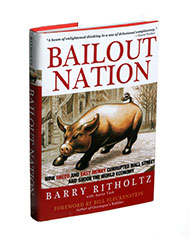
This is very much in the spirit of Mr. Ritholtz’s book, “Bailout Nation: How Greed and Easy Money Corrupted Wall Street and Shook the World Economy” (Wiley), in which he argues that the American financial system has been twisted beyond recognition by cynical bankers and their Washington enablers, who champion the free market in good times but cry out for government rescue when times are hard.
The author writes with the fury of an insider mortified by the behavior of his heretical peers. Mr. Ritholtz is himself a creature of Wall Street — the chief executive of FusionIQ, an online equity research firm that profited last year by shorting the shares of companies like A.I.G. and Lehman Brothers . . .
Yet there is much to be said for the book’s irreverence. Mr. Ritholtz has written an important book about a complicated subject, and yet you could still read it at the beach. Here’s hoping that some policy makers in Washington take it with them on vacation this month.
(Emphasis added)
Very cool . . .
>
Source:
Rescues Unlimited: Government as Wall Street’s Enabler
By DEVIN LEONARD
NYT, August 2, 2009
OFF THE SHELF
http://www.nytimes.com/2009/08/02/business/economy/02shelf.html



Tweet
Facebook
Reddit
Digg this!


August 2nd, 2009 at 12:15 pm
Good stuff, Barry. I will be finishing the book at the beach this week in Northport, MI, about 40 minutes north of Traverse City, MI. Gorgeous summer beach spot on Lake Michigan if you are ever in the area.
August 2nd, 2009 at 1:32 pm
it is a nice book, but the main flaw in my eyes is that it omits some of my pet peeves, which I think are rather important:
* That the story begins in 1995-1996, when Japan started their ZIRP (a single mention in passing) and the USA effectively abolished capital requirements for most lending (and a few other things happened around that time as well).
* That the housing-related bailout was just one of several bubbles to be put in play, all fueled by unlimited, not just cheap, credit. In particular I am very disappointed that a very important graph that was published on TBP, about percent of stocks purchased on margin across decades, was not given more prominence.
* That the bubbles and the bailouts have been international has not been highlighted. it was a global (mostly anglo-saxon though) phenomenon.
* The pension angle was not mentioned very much: sure, Greenspan was shilling option ARMs and the like, but the overall goal of policymakers was to try to sort out the pension bust by driving asset prices up so people could retire on the increasing value of their 401ks and their houses without requiring over tax increases. That the goal of the government(s) was overall to bail out seniors with a series of asset bubbles seems also clear by how strongly the bubble policies and the bailouts of investment funds (unsecured bondholders) were endorsed by voters, with the election and reelection of the culprits.
Overall the book is clearly useful, but to me it is too not just USA-centric, but even too Wall Street centric. Thus putting Greenspan in a central position is not quite right. he was a very willing enabler, but the big story does not center around him (I would name Gingrich as someone who is more strategically responsible), or even around the USA.
August 2nd, 2009 at 1:54 pm
“Many people were outraged when Goldman Sachs returned $10 billion in federal bailout money just in time to report its biggest quarterly profit ever”
Not really cause for outrage. It’s when the bailout recipients don’t pay it back that the outrage is justified.
August 2nd, 2009 at 1:57 pm
….what i said…
Wes Schott Says:
June 18th, 2009 at 12:54 pm
BR,
send ‘em the book, a copy to all of the key WH staff
i finished it a couple of days ago
really stiches the whole story together nicely – and the last chapter is especially good – namin’ names
more power to the Fed? WTF?
August 2nd, 2009 at 2:07 pm
Blissex,
Thanks, again, for thinking.
and, to be clear, this: “Overall the book is clearly useful” I, also, concur with..
August 2nd, 2009 at 2:07 pm
From the NY Times review:
“Mr. Ritholtz notes that the government wasn’t always so willing to provide a safety net to banks. He contrasts efforts of Bush last fall to those of FDR… [who] came to the rescue of ordinary people, financing public works programs that created jobs and making mortgage loans to homeowners facing foreclosure”
This is a very important point which the bailout advocates will never acknowledge. The bailout advocates have always liked to argue that we only had two choices, (a) bail out the banks, or (b) do nothing.
Those who adopt the rhetorical position of the bailout advocates are either idiots or liars.
There were indeed other (and better) choices.
August 2nd, 2009 at 2:22 pm
«“Many people were outraged when Goldman Sachs returned $10 billion in federal bailout money just in time to report its biggest quarterly profit ever”
Not really cause for outrage. It’s when the bailout recipients don’t pay it back that the outrage is justified.»
It is the reason why and the conditions on which they repaid it that are the outrage (never mind the extraordinarily easy terms on which GS got the money).
The Buffett investment in GS is still generating nice cash for Berkshire.
August 2nd, 2009 at 2:34 pm
«fueled by unlimited, not just cheap, credit.»
The idea is that credit is rationed both by price (interest rates) and availability (driven both by the leverage of the lender and the quality of the borrower in normal times). The giant credit bubble kept expanding even when nominal rates returned biefly over 5% (which was barely positive, if at all, in real terms) because supply was not constrained.
«In particular I am very disappointed that a very important graph that was published on TBP, about percent of stocks purchased on margin across decades, was not given more prominence.»
Forgot the graph:
http://bigpicture.typepad.com/2007/10/margin-debt-gro.html
The other charts that I have often mentioned as telling the big story are those of the prices over a few decades of blue-chip stocks, the sort that pension funds have been hoarding. A classic is Coca-Cola:
http://finance.yahoo.com/q/bc?s=KO&t=my&l=off&z=l&q=l
What caused the price of KO to quadruple between 1994 and 1998 is not so obvious to me, and why KO price has been around THREE TIMES in 2000-2008 what it was in 1990-1998 amazes me. The sensational P/E explosion from 1995 onwards is truly remarkable.
August 2nd, 2009 at 2:44 pm
The old site link to the graph on margin debt is gone, and I cannot find the page in the new site (by searching). Anyhow another pointer from the searching:
http://www.wallstreetexaminer.com/blogs/winter/?p=511
and that is for a somewhat shorter period.
August 2nd, 2009 at 2:48 pm
Blissex Says: “It is the reason why and the conditions on which they repaid it that are the outrage”
It is an outrage that they got the money at all, regardless of the circumstances. However the government chose to unwind this fiasco, it should never have involved opening up the public treasury to private investment banks, regardless of the terms. Any argument to the contrary is self-interested sophistry promulgated by the robber barons on Wall Street.
August 2nd, 2009 at 2:48 pm
I thought bailouts were a bad idea last fall, but I can understand how many weak-kneed politicians went along with it. Wall Street and the supposedly smart people in D.C. scared the crap out of them will all kinds of end of the world scenarios.
What I find most disturbing now is TARP is now being used as a government slush fund for everything under the sun. Just because government bailouts were a bad idea doesn’t mean the politicians should use these funds for what the Dems believe are ‘more worthy’ initiatives.
Americans should be demanding to see an end game for TARP, not a revolving door of taxpayer subsidies and bailouts.
August 2nd, 2009 at 3:03 pm
«Americans should be demanding to see an end game for TARP, not a revolving door of taxpayer subsidies and bailouts.»
Real Americans have thumpingly re-elected essentially all the incumbents that had voted for TARP, as voters (and campaign donors even more so) are largely older, retired or about to retire people, and they want another series of bubbles to lift the prices of their assets already.
Please everybody reread that classic comment by [bullbust]. Everything is going according to his plan :-).
http://economistsview.typepad.com/economistsview/2008/02/why-bubbles-occ.html#c105213332
«The state of received wisdom (as elucidated by various actors) 2004-2007.
[ ... ]Middle-class pre-bubble owners:
Stratospheric housing prices are great, because we get free money. It is a great thing that given todays prices, we cannot buy the house we live in, with our current income. (just read the comments on this very blog by the boomer middle-class on housing topics). Roubini et. al. are chicken littles»
«State of received wisdom today, by the same actors
[ ... ] Middle-class pre-bubble owners:
Inflate, inflate, inflate. We are so stupid that we think its good for us.»
August 2nd, 2009 at 4:44 pm
@DL 1:54
My outrage stemmed mainly from Goldie paying the TARP back when they recieve all manner of other subsidies (e.g. federal government backstopped GS’s counterparty risk to AIG with a special credit facility, Maiden Lane II and Maiden Lane III; granting BHC status to GS when that is merely a facade; allowing GS to increase its leverage ratios after granting BHC status; allowing GS special dispensation from VAR restrictions on BHC’s; TSLF, TOP, and TAF). BTW, I left a few out. TARP was nothing to GS financially – if you remember, JPM and GS tried to decline it. Then, they used the repayment of TARP to garner great press. Yeah, I’d say it’s worthy of a lot of outrage.
GS is also a primary broker-dealer, so they’ll be making money off of the huge new issuances of government debt. Here’s to hoping that the bid-to-cover goes negative and GS has to eat it. Doubtful, since Helicopter Ben will ramp the FR’s buying even more than last week.
August 2nd, 2009 at 4:48 pm
@Tom K
TARP is the proverbial tip of the iceberg. If it were only TARP, it wouldn’t be so bad. TARP was to divert public attention to the right hand while the left hand of the UST/Wall Street Alliance was stuck firmly in the collective taxpayer’s pocket. Check this out from the inspector general of TARP, Neil Barofsky:
http://www.ritholtz.com/blog/2009/07/total-bailout-cost-237-trillion-dollars/
August 2nd, 2009 at 6:35 pm
“Mr. Ritholtz has written an important book about a complicated subject, and yet you could still read it at the beach.”
Writing about important, complicated subjects, but in an accessible way is a rare talent. This is why I’ve been reading your blog for the past year, why I bought and enjoyed your book, and why I’ve bought copies for friends. Hats off to you. Great review. Well deserved.
August 2nd, 2009 at 6:47 pm
Barry Ritholtz,
I am tapped out – none of my shorts are working(I know, dont short with money printing going on) – IS your book coming out in Paperback soon for the cheap folks?
August 2nd, 2009 at 7:31 pm
“Writing about important, complicated subjects, but in an accessible way is a rare talent. This is why I’ve been reading your blog for the past year, why I bought and enjoyed your book, and why I’ve bought copies for friends. Hats off to you. Great review. Well deserved.” Plan 9, above
x2
August 2nd, 2009 at 8:44 pm
Barry, it’s not important who wrote the book, only that the book was written.
August 3rd, 2009 at 12:13 am
@MEH: Tres cool.
Is BR your alter ego?
August 3rd, 2009 at 12:21 am
@BR:
OT
Don’t exactly recall how it happened. But you giving me a chance to deal with speculation was pretty damn cool.
Thanks.
And now we can move on to “oops bad word”.
August 3rd, 2009 at 9:48 am
Congrats, Barry! A nice review in the Times is something that may only come around a few times during the life of a great author …
August 3rd, 2009 at 12:03 pm
Congrats Barry. You have been getting a lot of good reviews and people saying cool stuff about your book. Must be satisfying to put concerted effort into something like this and get right reviews.
Its got to be thrilling to have your book end up on beach fronts. Just dont swing that into an endorsement for Sheila Bair and everything will be good.:)
Hold the line! And keep up the good work.
*salute*
August 3rd, 2009 at 4:01 pm
BTW, a late comment. A very disappointing part of the book is the final list of suggestions of which BarryR says they are all good ideas
Some are instead crazy cons, none more so than the first idea, but Kass, of driving house prices up again with a surge of affluent sucker immigrants.
The idea is so bail out asset speculators by creating more competition for USA workers.
Sure, this is what has been unofficial USA policy for the past 15-20 years, but it is the very idea that Usians just want to MAKE-MONEY-FAST with speculative capital gains on unproductive assets at all costs, instead of creating and producing value added like good Yankees. But Dixie values and attitudes now dominate…