
1929 Versus 2007: Employment Change
This chart makes it pretty clear that the current recession is no Depression:
>
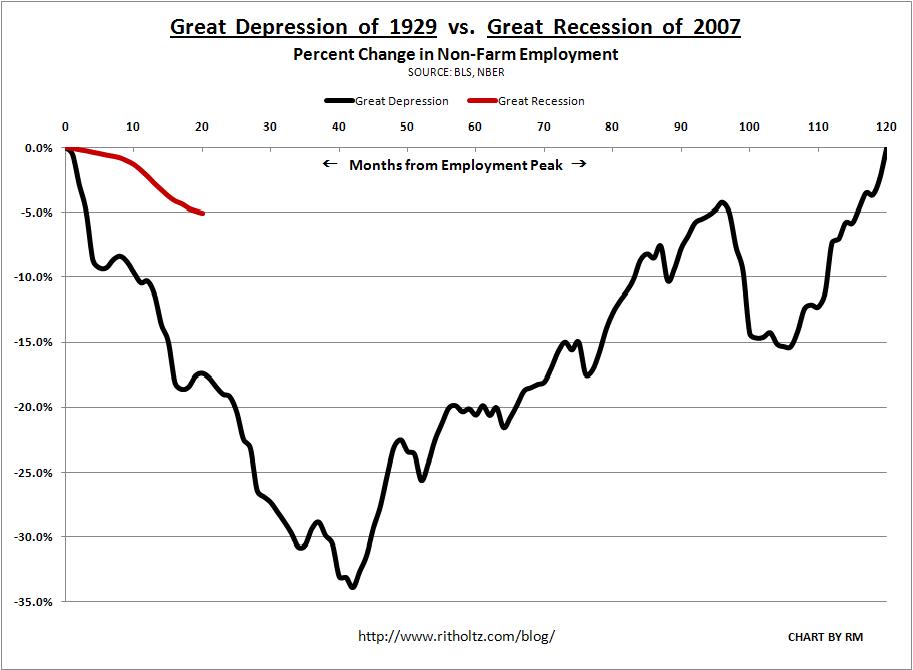
Data from 1929 is not seasonally adjusted, Current 2007 data is SAAR.
>
UPDATE September 9, 2009
Mish disagrees with my assessment:
>
Sources:
NBER Database
http://www.nber.org/databases/macrohistory/contents/chapter08.html
http://www.nber.org/macrohistory/
Hat tip Rob


Tweet
Facebook
Reddit
Digg this!


September 8th, 2009 at 9:24 am
All the media folks who were screaming about a depression late last fall and into the winter should be held accountable for scaring people out of the stock markets at or near the bottom.
http://www.erictyson.com/articles/20081114
September 8th, 2009 at 9:28 am
Outside the SAAR of the current trend, were the same metrics used to determine the levels, or are we comparing apples and oranges, here? What would a shadow stats trend line look like for the current decline in employment? According to the chart, the current unemployment is down 5% from the peak. That doesn’t seem to square very well with the reality outside the internets tubes.
September 8th, 2009 at 9:30 am
EricTyson:
Of course, without “the media”, people would never have understood the sudden and extreme losses their portfolios had suffered.
Was the media what done it.
September 8th, 2009 at 9:41 am
What Marcus Aurelius said.
Leaving one set at SAAR raises doubt that any effort was made to normalize the two data sets and, with U3 closing in on 10% and U6 approaching 17%, the “Great Recession” line simply looks implausible on its face.
September 8th, 2009 at 9:41 am
This one caught my eye this morning. Notably the only sector planning on postive hiring growth is in financial services. Full speed ahead with the financialization of our “economy”…….
http://www.nakedcapitalism.com/2009/09/manpower-hiring-plans-hit-new-low.html
For each industry, here are the figures for the net employment outlook for the fourth quarter, not seasonally adjusted, in order of most negative outlook first.
Construction, -10%, down from 2% for the third quarter
Mining, -9%, flat from -9%
Transportation and utilities, -9%, down from -3%
Government, -8%, down from -4%
Manufacturing, durable goods, -8%, down from -6%
Information, -5%, down from -4%
Manufacturing, nondurable goods, -3%, down from 0%
Other services, -1%, down from 0%
Financial activities, 1%, down from 2%
September 8th, 2009 at 9:45 am
Didn’t unemployment figures in the 1920′s and 1930′s use something more like U6 rather than U3?
September 8th, 2009 at 9:57 am
Apples and oranges, now plot it again using our U6 numbers. U6 is about 17% and that’s right on the button.
September 8th, 2009 at 9:57 am
As I understand it, 4 consecutive quarters of negative GDP defines a depression, no? We have had 6 consecutive quarters of negative GDI. Unless my economics escapes me, when correctly calculated, GDP = GDI. In 1929, unlike today, there was no SSA, SSI, SSDI or TANF so there was a truer read on unemployment because there were no other income streams available for households to survive on. Comparing one single statistic like non-farm unemployment to then and now to arrive at a conclusion that we are in a recession and not a depression is fairly simple minded, especially for you.
September 8th, 2009 at 9:58 am
Ditto aitrader and RW. Apples and Oranges.
September 8th, 2009 at 10:01 am
Even apples to apples, this time isn’t as bad (yet?). But notice that they had a “green shoots” (2nd derivative) moment at about the same time as us.
September 8th, 2009 at 10:04 am
We’re just getting started.
September 8th, 2009 at 10:11 am
Although I agree with you and it won’t change the conclusion, I think the way unemployment was defined at those two different times in history is different. The current curve would look worse if you used U6 as the more similar way of calculating it.
September 8th, 2009 at 10:14 am
Sorry; didn’t realize it was total employment numbers, you can remove the above.
September 8th, 2009 at 10:25 am
I think it’s a bit early to be claiming “no depression”.
The ONLY indicator that might be the case is the stock market. And it is a stock market that is covered with the footprints of manipulation (just look at the 30%-40% of NYSE volume being in bankrupts stocks and say it isn’t so).
From an employment perspective, a home foreclosure perspective, a debt-to-GDP perspective, a sales perspective, profits, a shipping traffic perspective, (I can go on all day like this …) there is NO indication of a significant recovery.
A recovery implies growth, not a lessening of contraction. Show me the unequivocal indicators of economic growth.
Traders and media dweebs … THE STOCK MARKET IS NOT THE SAME AS THE ECONOMY.
This event happened for REASONS, not random fluctuations in the aether, or a statistical improbability. I’m kinda surprised to see Mr Ritholtz claiming “no depression”, as he has written a fine book on the causes, and must be aware that none of the things that drove us into this mess have been corrected. Why then, sir, would you expect us to be driving out of it? Because we have had a ginormous rally in the stock market?
It may not be a Depression to rival the Great Depression, but it has all the hallmarks of being a depression — large and persistent unemployment, self-reinforcing economic contraction, persistent deflation.
IF, in 2 or 3 years, we are still climbing higher and have seen unemployment subside, the real estate (homeowner and commercial) disaster subside (the real estate calamity is still rising today), and real economic growth occur, then I will be forced to admit that no depression has occurred, only a severe recession.
But if we are still in the economic cesspool by then, I expect some sort of confrontation with reality to be taking place among the “no depression” crowd.
Pretty amazing that people refrain from calling the Japanese experience since 1990 a depression. it certainly looks like one from any rational assessment of their history. I guess that following the Great Depression, it was somehow agreed that “there will never be anything called a depression again”.
September 8th, 2009 at 10:26 am
The American economy is substantially different than 1929 so we should not expect exactness. In 1929, we were overindustrialized. Today we are overfinancialized. We are in a massive financial bubble that has yet to collapse. That means massive unemployment is dead ahead in the financial sector. Something I have been writing about for four years. Both the bubble and the collapse in financial employment. All you need to do is look past the government bailouts directly point blank at the financial community to a world that would exist were these bailouts not to have taken place. To see true fundamentals, you simply need to envision what would have happened without this bailout. Wall Street would fail to exist. That is the true horror before us. Wall Street’s problems are far from over. To the contrary, Wall Street is doing exactly what behaviorial dynamics would anticipate. They are back to creating their own demise.
September 8th, 2009 at 10:37 am
(second breath) … corporate bond failures (defaults) still rising, bank failures still rising, overall energy consumption still declining, … tax revenues still shrinking, with state and local governments teetering on the edge … US dollar plummeting amid calls for a change in the global reserve currency … gold on the rise … the Federal Reserve fighting tooth and nail to keep from disclosing its financial position …
Oh yeah, it’s crystal clear that this is only a recession.
September 8th, 2009 at 10:47 am
Very sloppy reporting.
As has been widely reported on other blogs, it is not even possible to compare 2007 with 1982. The measurement criteria have been changed repeatedly and dramatically. Adjusting today’s rate using 1980′s criteria puts the unemployment rate at roughly 50% higher than is reported today. That puts it much closer to the Great Depression levels.
Are you trying to tell us that you didn’t know this?
September 8th, 2009 at 10:51 am
@bdg123 10:26 am
“… massive unemployment is dead ahead in the financial sector.”
but but but … that would mean that the people who provide the payola that runs our gummint would be gone …
what will we do?
Oh, the humanity of it all !!!
September 8th, 2009 at 10:53 am
@constant & bdg123: The Naked Capitalism link to the Manpower survey that I posted would suggest otherwise. Financial services is the only sector that plans to add staff this quarter. Maybe you’re right that they’ll eventually see massive unemployment, but not yet. Not before they pump this thing to oblivion first.
September 8th, 2009 at 10:56 am
Just once I’d like to see a chart that looks ‘thru the windshield and not the rear view mirror’.
(courtesy of the corrupt tax cheat, Tom Daschle)
September 8th, 2009 at 10:56 am
@Mannwich 10:53 am
That’s better — wouldn’t want to see a job left half-done.
Are they hiring any more clueless senior management? I have a need to supplement my income.
September 8th, 2009 at 10:57 am
Looking at global data, instead of focusing on US alone, is more instructive regarding the state of the global economy.
Eichengreen and O’Rourke have updated their “Tale of Two Depressions”:
http://www.voxeu.org/index.php?q=node/3421
We will see whether the upswing in the global industrial production is just a temporary wobble within a longer-term downtrend, or the start of a stronger upward deviation from the trajectory that was followed by the world economy during the Great Depression.
rc
September 8th, 2009 at 11:25 am
@constantnormal 10:25 am
“Pretty amazing that people refrain from calling the Japanese experience since 1990 a depression. it certainly looks like one from any rational assessment of their history.”
What are you talking about, you clueless buffoon? Go look at the Economist’s essay on what constitutes a “depression”, and you’ll see that the Japanese experience failed to meet the 10% reduction in GDP criteria.
http://www.economist.com/businessfinance/displayStory.cfm?story_id=12852043
OTOH, the Japanese experience HAS met the other commonly used criteria for classifying a severe downturn as a depression, that being a recession that lasts more than a certain number of years.
If we see the GDP fail to expand over the next couple of quarters and we slide into the next down-leg of the W-shaped recession (or stair-step down) — and based on consumer activity and exports, that seems not all that distant a possibility — then we might well achieve the widely agreed criteria of a 10% decline in GDP.
We’ll see if any of the sages are willing to call it a depression then.
But I forgot — this is going to be a V-shaped recession or at worst a U- or L-shaped one — and we have already seen the worst that will happen in the stock markets, back in March (although with so much weakness ahead of us, the stock market seems to have been looking MUCH further out than the normal 6-12 month time horizon).
September 8th, 2009 at 11:29 am
rc- thanks for the link- quote from article as follows-
“The question now is whether final demand for this increased production will materialise or whether consumer spending, especially in the US, will remain weak, causing the increase in production to go into inventories, leading firms to cut back subsequently, and resulting in a double dip recession.”
still appears that all world wide hope rests on US consumption- increased production with the hopes that the US consumer will come to the rescue- so-
we are the reason the goods are being made- and- unless borrow and spend resumes for the US consumer- which seems unlikely- then the result is apparent
September 8th, 2009 at 11:29 am
How does the fact that women account for so much more of the work force now as compare to the 30′s. In other words the basis for unemployment figures is much larger now as women make up a much larger portion of the work force historically. Having said that this would bolster the fact that unemployment is much better than it was in the depression.
However we still have the problem that instead of creating jobs we have been losing jobs. I just don’t see how we can have meaningfull long term growth until we get back at least 2 million jobs and we are still loosing 100,000 – 200,000 a quarter!
September 8th, 2009 at 11:33 am
constantnormal
you: “I guess that following the Great Depression, it was somehow agreed that “there will never be anything called a depression again”.”
I think that’s what it comes down to. But as you would agree, just because it isn’t another GREAT depression, doesn’t mean it’s not a depression. And it’s only this way because even after taking great quantities of wealth from future generations going into this thing, we’ve had no compunction about doing even more of it, at alarming rates. Something to be proud of and pat our heroes on the back for; yeah.
September 8th, 2009 at 11:34 am
constantnormal
Party pooper! ;)
September 8th, 2009 at 11:38 am
I dub thee “The Benign Depression”.
September 8th, 2009 at 11:52 am
manny my man-
the way i see it – we are there- as good as it gets- permanent high unemployment- permanent large underclass-
there is something inherently wrong with a society that pays the top tier folks 300x the normal worker- akin to nobility- w/ no self assessment by those who are the beneficiaries- entitlement-
it cannot continue unabated – without something “going down”- an event that changes the direction of this country
September 8th, 2009 at 11:53 am
@ Manny
LOL
September 8th, 2009 at 11:55 am
That’s a cute graph, the problem is it’s misleading…U6 + Discouraged workers = 21% Unemployed
That would be an apple to apple comparison, methodologies matter when you compare stats.
September 8th, 2009 at 11:58 am
@ahab: Just wait until Wall Street bonus time at the end of the year. We ain’t seen nothing yet on the anger front. Hasn’t even started yet. I wonder if Wall Street is stupid and arrogant enough to pay their peeps big dough at the end of the year? I’m sure they are. We’re still dazed and confused with that deer in the headlights look. That will change in time though.
September 8th, 2009 at 12:02 pm
S Brennan,
I thought U6 *includes* discouraged workers. I’m thinking this is a common misperception.
September 8th, 2009 at 12:05 pm
Growing up in farm country I can assure you, there are is no apples to oranges comparison, in all honesty you can not compare apples to apples. Granny Smiths are completely different then Gala and Fuji are different the Rayburn, one year an orchard can produce an abundance of softball size, sweet and tasty fruit, the next bitter golf ball sized nubbins.
The chart what does it mean?
Your guess is as good as mine, but what I do read is “Percent Change in Non-Farm Employment” is right at -5% but as we all know the total national unemployment (U-3) rate is VERY close to 10%.
The chart also compares just over 25% of the total time of the Great Depression and until both graphs close we can not even know what kind of apples we are looking at.
So I ask why is the total unemployment rate twice what the non-farm rate is? What is driving the difference? Are there more people in agriculture today then in 1930s? That is doubtful.
Who cares what we call it now, Depression, Recession, Indigestion, the bottom line is things in our economy suck and are going to continue to suck for quite some time, but WHAT does that chart mean? Is it fair to compare one years crop against another, or a Fuji against a Granny Smith?
Anyway I am truly at a lose on what the chart means today, let alone what future it implies, so if any one can help shed some light it would be much appreciated.
What I am certain of though is no matter what we compare against, it is going to be a long while before things get better.
September 8th, 2009 at 12:07 pm
Mannwich,
Let’s hope they’re that stupid! BTW, I think “dazd and confused” started to fade away in March (that’s when I got really angry), but the huge rally has calmed people down. I wonder if that’s why so many people are angry about the pump and dump, because they know it’s deflecting attention away from the crime? (I appreciate the gains, but I would be one of those people.)
September 8th, 2009 at 12:10 pm
Just to elucidate on clawback’s point …
(from Wikipedia)
* U1: Percentage of labor force unemployed 15 weeks or longer.
* U2: Percentage of labor force who lost jobs or completed temporary work.
* U3: Official unemployment rate per ILO definition.
* U4: U3 + “discouraged workers”, or those who have stopped looking for work because current economic conditions make them believe that no work is available for them.
* U5: U4 + other “marginally attached workers”, or “loosely attached workers”, or those who “would like” and are able to work, but have not looked for work recently.
* U6: U5 + Part time workers who want to work full time, but cannot due to economic reasons.
September 8th, 2009 at 12:11 pm
Did the Manpower survey tell you of Wall Street’s collapse in 2008? Did the Manpower survey tell you of coming liquidity shocks? Did the Manpower survey tell you of the collapse in globalization? Wall Street has no clue what is going on. Of course, they are ramping back up to serve their failed ideology. Of course, they are only able to do so with $12 trillion of our money. Money we don’t have.
September 8th, 2009 at 12:16 pm
@bdg123: Oh, I agree, but am just saying they’re going to pump this thing for as long as they can (it won’t likely take as long this time for it to blow up again) before facing that day of reckoning. Everyone scrambling to get what they can while they can before the excrement hits the fan again. That’s what our economy has sadly become, a massive game of pass the steaming bag. Final holder loses.
September 8th, 2009 at 12:25 pm
@franklin420d 12:05 pm
Other interesting differences between then and now are that there was no social safety net like unemployment insurance back then, the impact of people losing their jobs was translated into reduced consumer spending MUCH more quickly back then, leading to a more vicious downward spiral. Also, looking at the upturn in unemployment in teh Great Depression, it occurs at about the same time that the WPA was created (1935). Pretty clear that without the WPA, the downward spiral of unemployment would have continued.
That’s not to say that the WPA ended the GD, only that it served to put some friction in the downward spiral and possibly allowed things to stabilize. Our national economy operates so much differently from that of the 1930s that comparing a single metric like unemployment can be only the loosest comparison. Comparing real GDP would be a better comparison, but even then it’s not apples and apples. You can say some things, but nothing really definitive. But you might be able to say whether the current downturn qualifies as a “depression” depending on when the economy (not the stock market, the economy) climbs out of the pit.
Meanwhile, here’s an unemployment link to contemplate …
http://www.nakedcapitalism.com/2009/09/40-of-working-age-californians-jobless.html
I’m sure they are celebrating the roaring stock market in California.
September 8th, 2009 at 12:33 pm
[...] By one measure it is clear that the current economic downturn is no depression. (Big Picture) [...]
September 8th, 2009 at 1:04 pm
Let’s not forget that massive change in demographics between 1929 and now. In 1930 21% of the population lived on farms – today that number is close to 2.5%.
September 8th, 2009 at 2:23 pm
The GD unemployment number are considered a U8. So for best comparison you should be using U6 and that isn’t truly the same because GD numbers include farm payrolls. So if you compare U6 to the GD, then we are talking something quite strikingly similar since Aug U6 came in at 17%. Shame on you BP you should know better.
September 8th, 2009 at 2:51 pm
Someone, Nelson Andrews, has done the real work in looking at unemployment during the Great Depression versus the present situation.
http://www.scribd.com/doc/13282170/Unemployment-1930s-vs-Today
To summarize:
“For the period of 1900 – 1947 we have two unemployment statistics available, Unemployed Non-Farm employees and Unemployed Civilian Workforce. These two data sets pose a challenge as they were developed during a period of ever-changing data collection methodologies. The data in the sets has been adjusted by the sources listed in Bicentennial Edition: Historical Statistics of the United States, Colonial Times to 1970 in an attempt to sync the data sets with the methodology that was put in place as of 1940 and was the basis for methodologies since. We can compare the two available data sets … and we see that the Unemployed Non-Farm employees and Unemployed Civilian Workforce measures of unemployment appear to be a close analogue of modern U3 (Unemployed Civilian Workforce) and U6 (Non-Farm employees).”
At the peak of the Great Depression, U3 was 25.2%. U6 was 37.6%.
While the unemployment picture is terrible, it by no means compares to what people experienced during the 30′s.
Another note: The economic safety net was was far more limited during the Great Depression, making it a more frightening period for the average American. On the other hand, a large number of people were able to return to the farms that their relatives owned (there still were a vast amount of family farms), which helped mitigate the situation – a place to sleep, food on the table.
A small footnote: The term “recession” didn’t come into usage until the 1940′s. Prior to that, all economic slumps were called either depressions (or panics). The major reason why the contraction of the 1930′s was labeled “Great”, to distinguish it from others. Although, using the 30′s as a benchmark, there were two other “Great Depressions” in 19th century: The Panic of 1837-1843, and the “Long” depression of 1873-1897 (some break that down into two; there was a limited, but robust, recovery from 1879-1892).
September 8th, 2009 at 2:53 pm
Let’s not forget that massive change in demographics between 1929 and now. In 1930 21% of the population lived on farms – today that number is close to 2.5%.
Thank you. Was going to make the same point. If NFP was 79% of the workforce during the GD (as opposed to 97.5% today using Thor’s numbers) you want to know what impact the Dust Bowl displacements and agricultural sector overproduction/supply destruction had on farm jobs.
Unemployment is expected to decrease another 1% to 2% into 2010. What’s the last 36 month recession anyone here remembers?
September 8th, 2009 at 3:03 pm
I disagree. The definition of unemployment was far less restrictive in1929 than it was in 2009. At the very least, you should compere U-6 to the 1929 numbers.
U6 in August, 2009 was 16.8%, in May, 2007 it was 7.9% (http://www.bls.gov/webapps/legacy/cpsatab12.htm).
This is a delta of 8.9%, which, while less than the 17% or so from the graph, is closer, but remember the 1929 numbers are even less restrictive than U-6.
An apples to apples comparison, would likely yield something on the order of 10-12% for the current data.
September 8th, 2009 at 5:11 pm
[...] Source: Big Picture [...]
September 8th, 2009 at 5:40 pm
Pretty amazing that people refrain from calling the Japanese experience since 1990 a depression. it certainly looks like one from any rational assessment of their history. I guess that following the Great Depression, it was somehow agreed that “there will never be anything called a depression again”.
Well since we follow Keynesian and monetarist policies now, yes, a depression is supposed to be impossible. I suspect this is the main reason economists have banned the term from their lexicon. To say nothing of the Orwellian need to keep confidence propped up in an economy based upon assuming higher and higher levels of debt.
September 8th, 2009 at 5:44 pm
Also, looking at the upturn in unemployment in teh Great Depression, it occurs at about the same time that the WPA was created (1935). Pretty clear that without the WPA, the downward spiral of unemployment would have continued.
Really? Wow, that’s amazing how you are able to peer into an alternate universe where the WPA never existed, and tell us that unemployment would have kept rising, when the stock market had already started to rebound in 1933!
Using the same powers of deduction, I surmise that without the Republican federal government shutdown in 1994, the equity bubble of the 1990s never would have gotten off the ground.
September 8th, 2009 at 6:04 pm
You should compare 1929 private sector unemployment with 2009 private sector unemployment: a direct total-employment comparison is flawed due to the fact that government employs a large sector of the labor pool, and is adding jobs rather than trimming payrolls.
And, of course, the government is lying in order to prevent a panic.
September 8th, 2009 at 6:49 pm
Ouch! Mish just shredded this post:
http://globaleconomicanalysis.blogspot.com/2009/09/depression-debate-is-this-depression.html
September 8th, 2009 at 6:49 pm
He disagreed with it, essentially saying its not a recession, its a bad recession
But how does that make it a depression?
September 8th, 2009 at 7:11 pm
@ aitrader
I have the same question. Are the numbers still calculated the same?
September 8th, 2009 at 7:38 pm
It may be more useful to graph GDP from the top in 1929 and the following 10 years forward, and then (with another scale) also give the same for GDP at the top in 2008 and forward. It is probably better to define a depression by the loss of economic activity, rather than employment or unemployment.
September 8th, 2009 at 7:52 pm
@BR
Ouch, that was a big one wasn’t it. I mean, break out your KY jelly!
I read Mish’s article and he is not (as you put it) “essentially saying its not a recession, its a bad recession”. He just compares now to then – forget the name you put on it. His point is ‘depression’ as a term is ambiguous.
September 8th, 2009 at 8:28 pm
“This chart makes it pretty clear that the current recession is no Depression”
BR, your holiday weekend in Haughtyville out on the North Fork has definitely twisted your world view. Spend your next holiday weekend just about anywhere in the USA, and get your groove back!
September 8th, 2009 at 9:42 pm
Hey, does everyone remember Elizabeth Warren’s lecture on the two-income families’ precarious financial position? Today’s households often need 2 jobs to service their debts!
September 8th, 2009 at 9:43 pm
For the record: “Depression! I sayz.” (Isn’t that right, Winston Munny?)
September 8th, 2009 at 11:34 pm
Its not a depression (yet)..and its more than a recession. So I’ve taken to calling it a Deprecession. Barry, the unemployment level depends on how you count working adults today vs back then. Also, I think it is wise to look at more than unemployment as one measure of depressionary statistics.
I would love to say I’m well versed to tell you which numbers to look at, but I’m sure housing numbers, spending habits, etc should be used in addition to unemployment.
September 9th, 2009 at 3:53 am
Barry
I believe we are in a depression.
Prior to the “Great Depression” the word recession did not even exist.
I do not know where the dividing line is, I just know we are over it.
If that sounds strange, note the NBER does not have a formal definition for recession.
Some people get together and decide when it started and when it ended, based on many factors of unknown and probably varying weight.
Recessions are not based on two quarters of negative growth as many people think.
To say we are in a depression one needs to look at a lot of factors and I certainly mentioned them.
Note that we can have “a depression” even if it does not match “the great depression”.
There are just too many parallels to things that happened in the 30’s in regards to housing, credit, the stock market, jobs, treasury yields, etc etc etc that “recessions” since then did not have.
Treasury yields and consumer spending might easily be deciding factors. The Fed’s reaction is another difference. This is certainly not like the stagflations in the 70’s and 80’s at all. And it differs from the 2001 recession in that consumers threw in the towel.
So it’s not just a case of being more severe, there are numerous parallels in play that do not match prior recessions.
Mish
September 9th, 2009 at 10:55 am
[...] of Mish In 1929 Versus 2007: Employment Change Barry Ritholtz posted a chart of unemployment with a comment: “This chart makes it pretty [...]
September 13th, 2009 at 11:50 am
Earth to Eric Tyson the stock market bottom is in yet doofus.
September 13th, 2009 at 11:51 am
Re-do meant to say bottom is NOT in yet doofus.
September 17th, 2009 at 8:35 pm
[...] You may recall that last time, Mish & I disagreed as to whether this was a recession (Me) or a depression (He). • 1929 Versus 2007: Employment Change [...]