
I am pleased to introduce Bob Bronson. For the past 42 years, Bob Bronson has applied a disciplined, analytical approach to understanding and forecasting capital markets and advising investment advisors. Through his rigorous analysis of capital markets and economic data and his background in mathematics and financial economics, he has developed a number of unique investment concepts and refined portfolio-management techniques that improve returns and lower downside-volatility risk.
To learn more, read his BIO.
~~~
A Conversation About Payroll Data That You Never Saw On CNBC
by Robert E. Bronson, III
Bronson Capital Markets Research
~~~~
Joereal at CNBC: We’re very pleased today to introduce Constant Pangloss for his take on today’s payroll data report.
Pangloss: Thank you, Joereal. I’m delighted to be here. Today’s report was just outstanding! To be factual, July’s loss of jobs was 44% less than June’s jobs loss and a huge 64% less than the biggest jobs loss in February! This “green shoot” is proof positive that the recession has nearly, if not already, ended, which is confirmed by today’s breakout bull market rally to a new intraday high at 1018 for the S&P 500!
Joereal: Did you notice that the 9.4% unemployment rate from the household survey would have been 9.7% rather than 9.4%, if some 422,000 unemployed people had not left the labor force during the four weeks prior to the survey, many of them so discouraged that they did not look for work because they know there are no jobs for them?
Or that the seasonal adjustment of the payroll data artificially created 28,000 jobs in the auto industry, when, in fact, automakers cut 8,600 jobs, so that the reported 247,000 jobs lost in July were really closer to 285,000 jobs or 15% worse than reported?
Pangloss: I’ll take your word for it, Joreal, but I find that hyper-technical, and in any case, it doesn’t change the solid uptrend of “green shoots” in the payroll data because of the current administration’s stimulus and their other constructive interventions.
Joereal: Ok, but we’re putting up on the screen the long term history of the growth in payrolls since the BLS first started tabulating them during The Great Depression.
Pangloss: Well…OK…I guess the more contextual information the better.
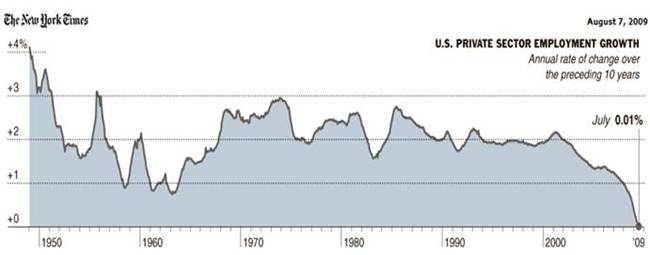
Joereal: Ok, here’s the chart that appeared in Rex Nutting’s article illustrating the record-breaking descent in the 10-year growth rate in private sector payroll employment since 1939.
Source NYT
Pangloss: No, no, no…that’s way too much data. I prefer the shorter term chart that the rest of the media is presenting. If you simply ignore the fluke in June, just look at this year’s strong uptrend of solid “green shoots!”
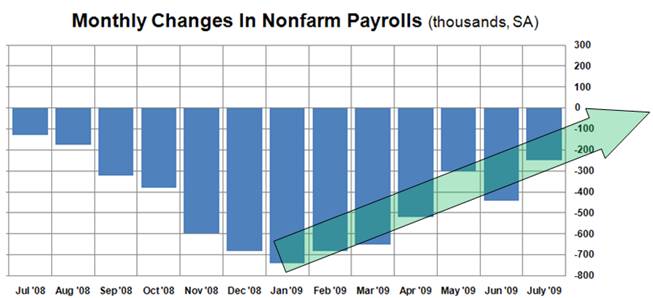
Joereal: I see what you have selected, but do you mind if we also consider both the raw or base employment data, as well as their monthly changes, at least since just before the recession started?
Pangloss: I guess not.
Joereal: OK. Notice that the cyclicality and the downtrends in both of the following datasets, suggest job losses in the coming months may be worse.
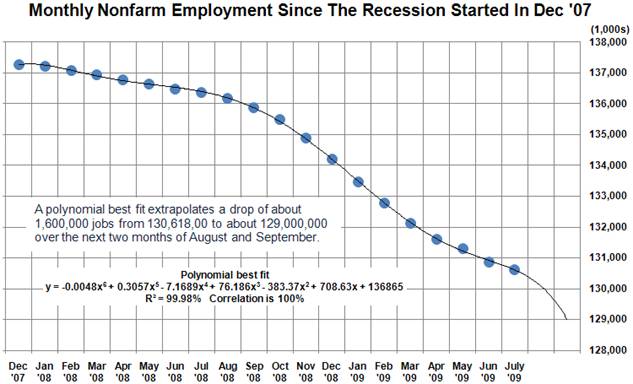
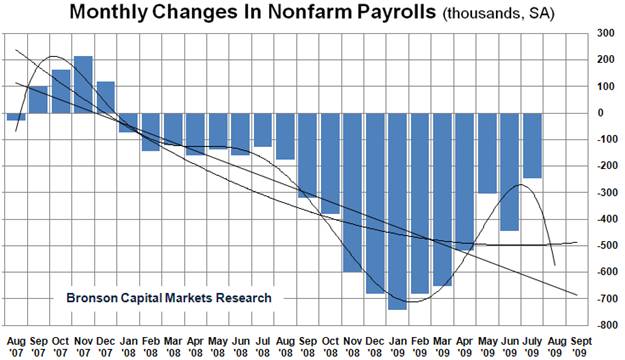
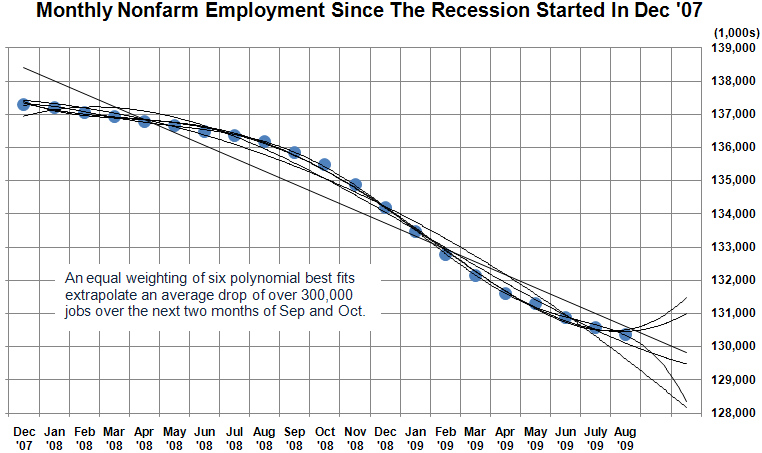
Pangloss: What? I’m just going to ignore the so-called perfect polynomial fit in the first chart. In the second chart, I believe that the linear downtrend is irrelevant, and the cyclical extrapolations are obviously too influenced by both the longer term data since the recession began and by the recent June fluke in the data.
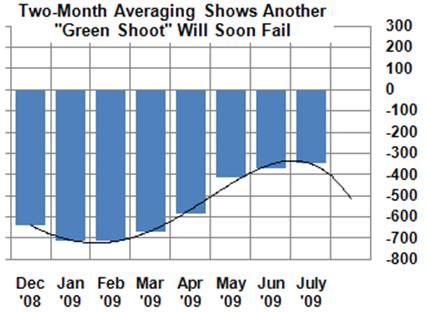
Joereal: Well, here’s a two-month average of just this year’s data, and a curvilinear best-fit of the data suggests the same outcome of lower payroll data coming in the months ahead….
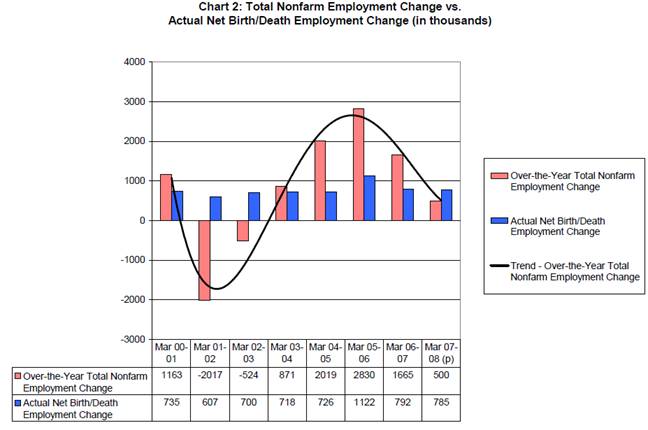
Joereal: …and there’s another consideration. As you can easily extrapolate visually from the downtrend in the last three years of data and from the curvilinear best fit of all eight years of data in the following table prepared by the BLS, their annual payroll benchmark revisions to be reported in early October for the 12 months of employment data through March 2009 (which was the worst part of the banking crisis), along with the regular monthly report of September (2009) data, will likely show a downward change of a whopping 2,000,000 jobs, if not more, similar to the 2,000,000 downward revisions reported in October 2002 as a result of the last recession. A huge, downward revision in payroll jobs expected in the report this October is all the more likely because the BLS data are only sample-based estimates and do not include any business cycle considerations, and because the current recession is much more severe than the last one.
Source: BLS
Joereal: ….Surely you’ll agree that this will raise questions about the “green shoot” proof that the recession has ended, or nearly ended, right?
Pangloss: This is all hyper-technical and I don’t respond to hypothetical questions.
~~~
Bob Bronson, August 12, 2009
Bronson Capital Markets Research
Contact Information
Email
A note to visitors ~ We do not have a website but, in addition to very infrequent postings on FinancialSense.com, we maintain an active private e-mail list supported by confidential honor-system subscriptions. To be added to our private e-mail list right now, please explain, at least briefly, your occupation and background. After you’re added to our private email list, you will be immediately emailed more extensive information about our research, forecasting track record and latest expectations. After you have time to digest all of that information, you will be asked to subscribe at whatever amount you believe our work adds value to your business and/or you personally.

What's been said:
Discussions found on the web: