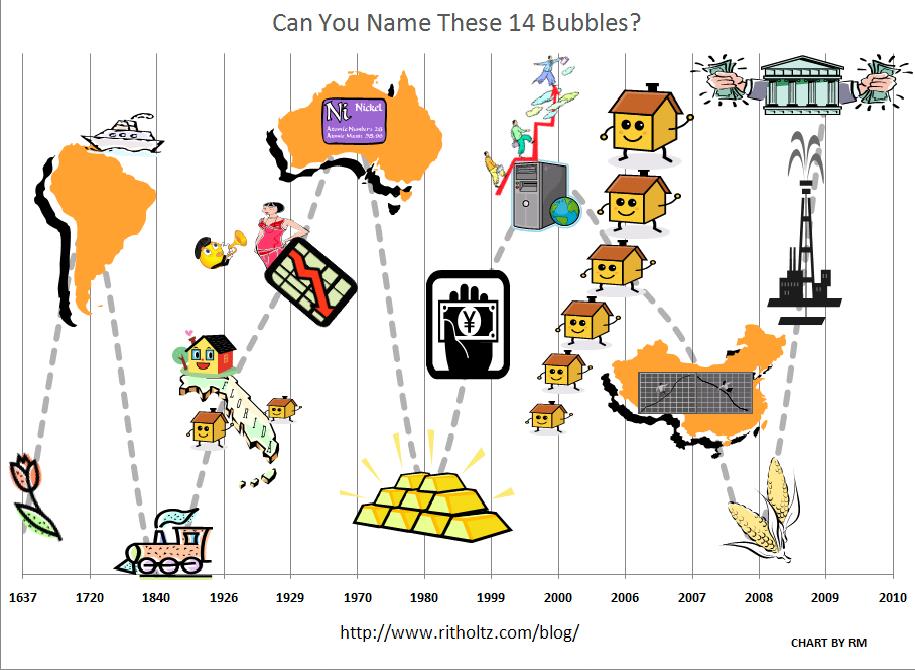
Can You Name These 14 Bubbles?
Here’s a fun graphic to play with: Can you name these 14 historic bubbles?
>
>
Answers after the jump . . .
List of bubbles:
1. Tulip Mania
2. South Sea /Mississippi Company Bubbles
3. Railway Mania
4. Florida Speculative Building Mania
5. Roaring 1920s/1929
6. Poseidon Bubble
7. Gold
8. Japanese Asset Bubble
9. Dot Com/Tech/Telecoms
10. Global Real Estate/Credit Bubble
11. China/Shanghai Index Stock Bubble
12. Commodity Bubble
13. Oil Bubble
14. Leverage/Derivative/Financial Bubble



September 9th, 2009 at 11:37 am
For more than 300 years, there were 7 illustrated examples…
In less than a decade, Ben Bernanke has a direct (or indirect) hand in the other seven…
Now THAT’s what I call a competent central banking!
September 9th, 2009 at 12:05 pm
1637 Tulip bubble, Holland
1720 South Sea bubble
1893 US Railroad bubble
1920-1923 Florida housing bubble
1924-1929 US stock market bubble
Nickel?? missed this one
1980 Gold bubble
1997 Asian Crisis
1998-2001 Tech bubble
2007 Housing Bubble
2008 Shanghai stock market
2008 commodities
2008 oil
2009 bailouts
September 9th, 2009 at 12:19 pm
The trick is to guess the next bubble. I think tulips are ripe for a comeback, but as history never exactly repeats, it will likely be some other farmable item. I’m banking on genetically-modified, glow-in-the-dark flowers.
And pumpkin futures — Halloween is approaching.
September 9th, 2009 at 12:20 pm
Cvienne — how is your pumpkin crop coming?
September 9th, 2009 at 12:31 pm
@cn
No pumpkins… Shoot! I’ll miss out yet again…
The more I look at that graph, the more it looks like a board game (like chutes & ladders, or Candyland)
September 9th, 2009 at 12:43 pm
Interesting to see the Poseidon bubble in Australian nickel mining shares from 1969-70.
http://en.wikipedia.org/wiki/Poseidon_bubble
September 9th, 2009 at 12:55 pm
Speculation — what will pop the current bubble? It clearly has not yet imploded, as the debt bubble continues to expand, despite the collapse in consumer borrowing, and deep contraction in legitimate business borrowing.
Government borrowing dominates the global scene.
My two cents is for a major economy imploding in a very noisy and spectacular manner — I say Japan.
September 9th, 2009 at 1:00 pm
@constant. Nothing, so says HarryWanger. Time to buy, buy, buy!!
September 9th, 2009 at 1:16 pm
@Manny
The Wanger bubble?
September 9th, 2009 at 1:26 pm
There have been 4 Major bubbles from 1630 -1930, 2 were in 1920’s ( specifically in US) and 8 bubbles from 1970-till now ( 3 were mostly US centric – Gold, Tech & Housing). Are you aware of any research papers or article that tries to explain the increase frequency of these bubbles ( Bailout Nation does a great job addressing the plausible reasons for the rise of these bubbles). But is there any structural aspect that helped increase the frequency of such bubbles? Moreover 6 of these bubbles were mostly US centric (Rail roads, Florida, and 1920’s, gold, tech,housing) and 4 of those (Mississippi,nickel, commodities & oil) are tangentially connected to US. That makes 10 /14 either directly or indirectly.
Been reading ” The wealth of Nations” by “Adam Smith” again and some of his collected essay’s ( available at the Glasgow university Library archives ) this summer. Many of today’s arguments about free markets distort his writings. He prescribed a well defined role for the visible hand of govt in pursuing policies that provide level playing field for everyone, making justifiable laws and enforcing contracts. his writing and philosophy understood the required conditions for a well functioning free markets ( not in a perfect sense as he understood the limitation of such). It seems the free market ideologists are not opposed to govt when it distorts the playing field, but only when it tries to adjust it.
September 9th, 2009 at 1:36 pm
@marquis: Correction: Free market ideologues (the fake ones) are not opposed to gov’t intervention when it helps them personally. There, fixed it for you.
September 9th, 2009 at 1:42 pm
Free Market ? You have better chance of seeing Elvis and Bruce Lee together than seeing a “Free Market”.
September 9th, 2009 at 1:51 pm
@marquis:
“Are you aware of any research papers or article that tries to explain the increase frequency of these bubbles”
Add to your reading list Alvin Toffler’s Future Shock. He described (back in 1970) the same sort of exponentially increasing rate of change that one sees in the Singularity folks’ writings, and predicted an increasing frequency of booms and busts, as well as an increasing fragmentation and polarization of society as a whole, and the increase in the popularity of fundamentalist religions with society being pulled and stretched along the curve of increasing change until it fragments into what Toffler called “personal stability zones”, where individuals cloister themselves around anchoring beliefs and practices in some areas, while embracing change (that does not threaten their anchor points) in other areas.
September 9th, 2009 at 1:55 pm
Thank you Mannwich.
On a related note, recently received an e-mail from a friend back from grad school who did an internship with the fed ( he’s an international student from Italy, currently working in singapore).
” I’ve had clients asking me why the fuss about auditing the fed? Many central banks are not partly owned by banks they supervise. Unlike many central banks member banks has a stake in the fed and many of their executives are on fed’s board, which gives them access to information about the fed’s actions. But the taxpayers does not have the same access to information. to have a level playing field either you give access to everyone or to no one”
Seems reasonable to me. What do you think?
‘
September 9th, 2009 at 1:59 pm
cn,
this book –Alvin Toffler’s Future Shock, really was a good one..
September 9th, 2009 at 2:05 pm
Thousands Of Abandoned, Foreclosed Homes Threatened By Florida Hurricane
http://www.theonion.com/content/news/thousands_of_abandoned_foreclosed?utm_source=onion_rss_daily
September 9th, 2009 at 2:08 pm
Many bubbles )
In the wine )
Make me happy
Make me feel fine
Many bubbles
Make me warm all over
With a feeling that I’m gonna
Love ‘em till the end of time
So here’s to the golden moon
And here’s to the silver sea
And mostly here’s a toast
To you and me
So here’s to the TARP
I give to you today
And here’s a subprime loan
That will not fade away.
September 9th, 2009 at 2:09 pm
@Transor: That Onion article pretty much sums it up – this is tragi-comedy of epic proportions.
September 9th, 2009 at 2:13 pm
@MEH
Yeah, he utterly fails when he tries to predict technology advances (as does everyone, including sci-fi authors, and especially scientists and technologists), but as for his social science predictions, his accuracy has been uncanny thus far.
September 9th, 2009 at 2:15 pm
Thank you Constantnormal.
September 9th, 2009 at 3:39 pm
wasn’t there a bubble in like 1870’s that ended up being the long depression (originally it was the great depression until the one in the 30s came along). seems like i read it was housing in Europe that had gone over the top (sort of like here) and their jobs started disappearing (sort of like here).
September 9th, 2009 at 3:47 pm
@willid3
I think you mean the panic of 1873 that resulted in a 20-year plus span of low economic activity. IMO we should be so lucky in light of current trends.
September 9th, 2009 at 4:17 pm
@marquis: I don’t think bubbles occur at an increasing rate rather than history having a steady rate of decay; forgetting past events of lesser importance.
Oil speculation in Ancient Greece anyone? http://www.anselm.edu/homepage/dbanach/thales.htm
September 9th, 2009 at 6:15 pm
aitrader, yes you are correct the original term panic is what depressions are called today. the origination of the problem was that houses in Europe had been sky rocketing, and jobs were being sent away because of a cheap upstart (us). and then it went from there to the US.
September 9th, 2009 at 7:34 pm
In Washington state there was a real estate bubble that left us some really nice brick buildings in towns like Bellingham and Port Townsend in the late 1880s. I think it had to do with speculation on where the rail road would meet the ships coming in from the pacific. Was it more wide spread than just here?
September 9th, 2009 at 8:13 pm
Who said these were the only bubbles? Who said the “bubbles” cited were bubbles? I didn’t know that lemmings still existed.
September 10th, 2009 at 1:26 am
@ Darkchocolate
I think you might be referring to the “Panic of 1893″, which in retrospect is viewed to have been caused by excessive speculation in railroad building. I guess you could liken it to that generation’s tech crash of 2001.
The “panic of 1873″ and the “panic of 1893″ are considered book ends to a 20-year period of low economic growth by many historians that is often called the Long Depression.
As I’ve mentioned, my read on global trends makes me much more pessimistic than our esteemed blog host here. I think we would be ‘lucky’ to merely suffer a Long Depression. My opinion is that we have entered the beginning of a period much worse than that.
September 10th, 2009 at 9:03 am
BR
We really need a “name the next bubble” contest.
My submission is green energy/smart grid. Big companies are already climbing all over each other to get at the US pot of gold (GE, Cisco, IBM). Even defense contractors are diving in!
http://www.greentechmedia.com/articles/read/defense-contractors-pursue-the-smart-grid
The US grid is outdated anyway and this will improve energy efficiency and can shift energy sourcing to North America.
I didn’t think it would be big enough but now I feel that the utilities will be able to get rates cases thru that will use US energy grant money as a multiplier to get really sizeable projects rolling. The beauty of utility funding is it is non discretionary funding, if you don’t pay they can cut service so consumers will be forced to fund the green energy bubble – with US priming the pump. The big companies will hype their participation in this freeforall and that will create a tech type bubble.
It’s enhanced by the feel good effect of being “green”