
Consumer Credit Falling Fast

Email this post Print this post
By Michael Panzner - September 8th, 2009, 7:00PM

consumercredit

>

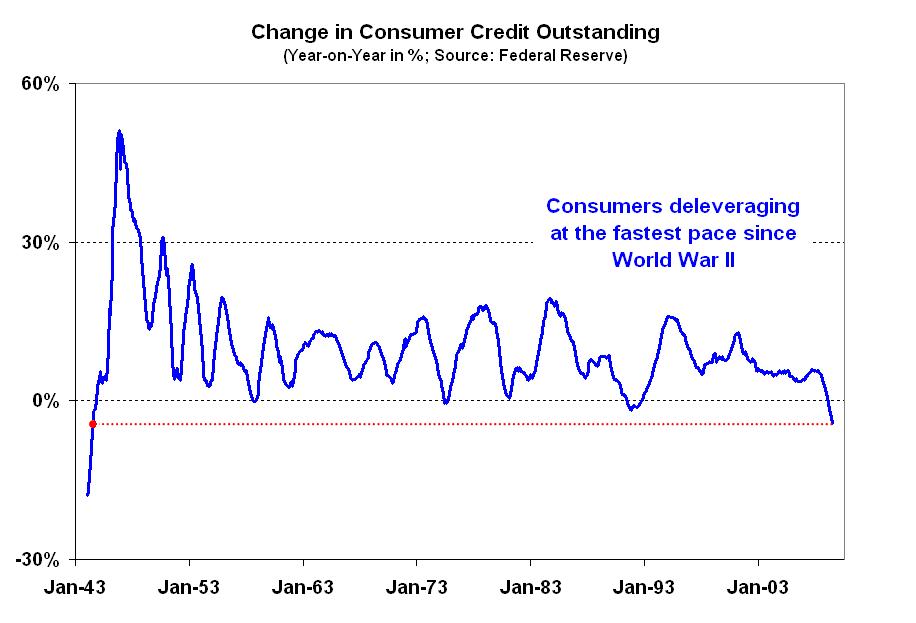
Aside from what Bloomberg reported (below, bold/italics mine), the year-on-year change in consumer credit outstanding has been negative for five straight months, and has just reached its lowest level — i.e., the fastest pace of deleveraging — since World War II.

7/31/08
2,581.41 4.9%
8/31/08 2,574.94 3.9%
9/30/08 2,579.20 3.5%
10/31/08 2,574.76 2.9%
11/30/08 2,565.45 2.1%
12/31/08 2,558.63 1.6%
1/31/09 2,562.80 1.5%
2/28/09 2,551.40 0.6%
3/31/09 2,535.30 -0.5%
4/30/09 2,518.00 -1.6%
5/31/09 2,509.20 -2.2%
6/30/09 2,493.60 -3.1%
7/31/09 2,472.10 -4.2%

>

Given the above,what might this mean in terms of Consumer Spending? Is it deleveraging or job losses — or both? — that is having the biggest impact on “back to school sales?”

Here’s Bloomberg:

>

Wire: BLOOMBERG News (BN) Date: Sep 8 2009 15:00:01
U.S. Consumer Credit Fell by a Record $21.6 Billion in July
By Vincent Del Giudice

Sept. 8 (Bloomberg) — U.S. consumer credit plunged more than five times as much as forecast in July as banks maintained more restrictive lending terms and job losses made households reluctant to borrow.

Consumer credit fell by a record $21.6 billion, or 10 percent at an annual rate, to $2.5 trillion, according to a Federal Reserve report released today in Washington. Credit dropped by $15.5 billion in June, more than previously estimated. Credit fell for a sixth month, the longest series of declines since 1991. (emphasis added)

Rising unemployment, stagnant incomes and shrinking household wealth are casting doubt on the strength of the economic recovery. The category of credit that covers car loans also plummeted by a record amount, even as the “cash for clunkers” auto trade-in program helped push up personal spending in July.

“Consumer credit is being rationed severely and this is one factor that argues for a slow recovery from this biggest recession since the Great Depression,” Chris Rupkey, chief financial economist at Bank of Tokyo-Mitsubishi UFJ Ltd. in New York, said before the report. Meanwhile, he said, consumers are “getting hit from both sides and they are desperately trying to get their credit-card debts under control.”

Economists had forecast consumer credit would drop $4 billion in July, according to the median of 31 estimates in a Bloomberg News survey. Projections ranged from declines of $12 billion to no change from the previous month. The Fed initially said consumer credit decreased by $10.3 billion in June.

losses

41 Responses to “Consumer Credit Falling Fast”

  1. Barry Ritholtz Says:

    For more Mike Panzner, see:
    http://www.financialarmageddon.com/

  2. Mannwich Says:

    Nobody could have predicted………..

  3. torrie-amos Says:

    Believe it or not, people do talk to one another, this thing about interest rates on credit cards and what folks pay, and fear of losing a job, etc……………in KISS terms when u ain’t got it and can’t get it, yees don’t. I belive that is the law of supply and demand. Just wait until a falling dollar pushes that precious gallon a gas over 3 buck, 3 and a quarter

  4. Simon Says:

    As I understand it Americans spending less and saving more is supportive for the dollar…

  5. willid3 Says:

    might be that the consumer/employee combo has come to the conclusion, that if their jobs aren’t safe, and the incomes are shrinking then taking on debt makes no sense. and of course the banksters have cut back credit limits too. so what is going to drive the economy now? just where business get those willing customers who can afford the offerings? i guess we may have found the other have of that shoe. the one where business sent to many jobs of their customers over seas. so their sales tank here. problem is there are no large swaths of sales coming from where they sent those jobs to help them out any more

  6. VennData Says:

    Double up the cash back deals, triple miles if you buy before XMAS, let’s get this sucker going again.

  7. smokeyjack Says:

    …as in rising anger and petulant discontent the money-changers cry, “Turn those machines back on!!”

    Seems the tide has turned…and the smart ones are are staying out of the riptide. An economy built on the willingness of the public to spend will without doubt encounter a period when they are no longer willing to spend. That doesn’t seem so farfetched. This period of frugality is upon us, and some don’t believe it.

  8. pgibbns Says:

    Looks like we might be heading into a depression.

  9. willid3 Says:

    insiders are selling their stock, i guess they know that reality is coming

    http://www.time.com/time/business/article/0,8599,1920635,00.html

    or that all of their smoke mirrors are in short supply

  10. km4 Says:

    To me this confirms Structural Unemployment is rising ( a polite way of saying there won’t be any jobs for the long-term unemployed this year, next year, or the year after that ) so with no job how the hell can can you continue to get credit !

  11. constantnormal Says:

    But while individuals are reducing credit by card-fulls, and corporations are reducing credit demands both voluntarily and involuntarily, the feds are creating credit at a rate that dwarfs that efforts of the rest of the system to reduce it.

    Funny thing is, the credit by the smallest citizen spends just as well as that of the US Treasury or the Feral Reserve (I spelled it as I intended to).

    If the system is choking on too much debt (and it certainly seems to be complicating things, if not outright flinging monkey wrenches into the works), we are losing the battle to bring things into a stable regime of operation.

  12. aryman99 Says:

    Does anyone know if writedowns on foreclosures is a factor in the de-leaveraging?

  13. constantnormal Says:

    What am I saying, “losing the battle”? The battle being fought is to reinflate the imploded economy and return to the comfort of the previous bubbles. An idiotic plan, composed by idiots for idiots. The past is dead, and nothing will bring it back again.

  14. constantnormal Says:

    @ Simon 7:43 pm

    “As I understand it Americans spending less and saving more is supportive for the dollar…”

    But the plan is to sacrifice the dollar in order to re-inflate the economy. Like all offerings to craven idols, there must be a sacrifice, and the dollar will be it.

  15. How the Common Man Sees It Says:

    Awesome! The only way to beat the banking beast is to starve the banking beast. I never thought we’d see that come to pass but at least now there is hope. The sooner folks get out of debt slavery, the sooner the dragon starves to death.

    That is a more powerful shot to the banking cartels than all the marches on Washington and all the new regulations combined. If people stop borrowing then what can the banks do? They lose control that way and even the Fed’s interest rate policy becomes useless. Especially if people apply the same thinking to their businesses. It’s time to take back control! It’s time for Americans to take away the power of the fractional reserve gearing and become self financing again!

  16. Doc at the Radar Station Says:

    “U.S. consumer credit plunged more than five times as much as forecast…”

    Well. That just about says it all right there… so much for those forecasts.

  17. Onlooker from Troy Says:

    This may also be the most misunderstood economic statistic of the day. People will see this and just figure it’s only a good thing without understanding the implications of credit contraction/debt deflation.

    Think about the conversation you’d have with your average neighbor and their reaction. It’s just not within most people’s ability to comprehend.

    Pretty awesome number when you realize what’s going on here. We’ve got a long way to go though before we get back to a healthy, balanced economy (with other factors at play too, obviously).

  18. Bruce in Tn Says:

    This is the best news since 9/2008. Now if we could only get our elected representatives to grow up and understand what the average Joe understands…that the time has come to pay the bill of living beyond our means…

    …or not.

  19. Onlooker from Troy Says:

    Common Man

    Amen. It will be a tough process with some pain involved, but the satisfaction of getting there would be so worth the hard work and sacrifice. (Kind of like most of us who started with little and worked and saved to get where we are.)

    Can we actually change the mentality of the majority to embrace that? I sure hope so.

    It ties into my boycott the banks message too. Starve the beast. Take your business away from the big banks and get back onto a stable financial foundation that’s not dependent upon credit. It’s liberating. Debt slavery is no way to live.

  20. Onlooker from Troy Says:

    To that economist that predicted zero change; way to go! I’m sure he still has his job though. Gotta keep cranking out those prescient forecasts.

  21. JoWriter Says:

    Mr. Man – Onlooker – that’s fine – I’m really starving that beast now, since I have no debt whatsoever.

    BUT, where should we store our money? If the banks go away, or starve to death, and we get out of the market because of the coming decline – what do we do with the cash?

    Anyone?

  22. How the Common Man Sees It Says:

    Think about this. If a guy owes $10,000 at 8%(paying $800/yr.) and goes to a position where he has $10,000 and is only earning 5%(earning $500/yr.), his cash flow has swung 13% in his favor. A lot of people will belittle the 5% return on investment but a 13% cash flow swing is huge and would do wonders for the American economy. It isn’t the magic of compound interest but it is the magic of ownership versus loanership.

    Now when you consider that some credit card rates are double digits then you begin to see the amount of cash flow being sucked into the banking money pit.

  23. constantnormal Says:

    I guess I said it backwards earlier — no matter how fast the consumer pays down debt, the gummint is printing new debt a zillion times faster. And the gummint’s debt is every bit as much debt as the consumers’, dollar for dollar.

    The rapid pay-down of consumer debt is but a small blessing in an ocean of madness. Insufficient to change the course of things.

  24. constantnormal Says:

    @JoWriter 10:07 pm

    “… where should we store our money?”

    IMHO, find a nation (or nations) that is not utterly dependent on trade with the USofA, that has sensible economic policies and is well-positioned to weather the coming global economic storm. When the dollar begins that final SERIOUS slide into oblivion, move all your dollars into solid foreign stocks and bonds into these foreign equities and debt instruments. A smattering of commodities wouldn’t hurt either.

    As with any approach to dealing with an unknown and unknowable future, a well-selected diversification is the way to go. I don’t think there is a way to avoid taking a huge hit to the assets, but at least you can position yourself such that your assets will recover quickly, and not be completely and irretrievably washed away.

  25. insaneclownposse Says:

    From personal experience, I think this is a one time event caused by credit card companies under severe stress. I doubt that this type of contraction goes on for more than a month or two.
    I previously owned one credit card with a large credit line and low interest rate. I carried a fairly large balance because I’m lazy and the monthly interest charges weren’t that consequential. In June my credit card company sent me a notice saying that for no particular reason they were doubling my interest rate, but it wouldn’t go into effect for another twelve months.
    I promptly called India and told the company to f off and cancel my card. I told the CSRs that they should go work for another company that valued its customers. I laughed at the manager when she told me 18% was a great interest rate for an unsecured credit line.
    Anyway, I paid off my balance on the card within the week and got a new card with a new issuer at a lower interest rate than my original rate with the previous company — my limit is far lower however. I am now running up my balance once again.
    Banks can borrow money for nothing to lend to me at 10%. New players will enter the market and lend to customers who are credit-worthy. Banks who are gouging their customers won’t survive. Life goes on….

  26. cvienne Says:

    @htcmsi

    Think about this. If a guy owes $10,000 at 8%(paying $800/yr.) and goes to a position where he has $10,000 and is only earning 5%(earning $500/yr.), his cash flow has swung 13% in his favor. A lot of people will belittle the 5% return on investment but a 13% cash flow swing is huge and would do wonders for the American economy. It isn’t the magic of compound interest but it is the magic of ownership versus loanership.

    Now when you consider that some credit card rates are double digits then you begin to see the amount of cash flow being sucked into the banking money pit.

    Now think about this… If most of those people WAKE UP and declare BK… The banks are fucked!

  27. Mannwich Says:

    @cvienne: I have a sneaking suspicion that will be the final card that’s played. It’s just sitting there waiting to be played…..

  28. Mannwich Says:

    The backlash is only beginning…..

    The Card GameOverspending on Debit Cards Is a Boon for Banks

    http://www.nytimes.com/2009/09/09/your-money/credit-and-debit-cards/09debit.html?hp

  29. How the Common Man Sees It Says:

    One of the reasons Canada was able to balance their budget and support their economy in the ’90’s was they drove down the value of their dollar to 66 cents to the US $. What this did was made exports cheap and thus drove down our employment rate while increasing our trade surplus. The destruction of the US $ value may be an attempt to boost US exports and heal the economy that way. It won’t help with countries that link their currency to the US $ but it will make US goods competitive with those that don’t

  30. How the Common Man Sees It Says:

    @cv

    Now think about this… If most of those people WAKE UP and declare BK…

    With the added bonus that the courts won’t let that person borrow any more for years :)

  31. Todd Says:

    This decay in the total outstanding debt is like water seeping into an earthen dike. The dike holds until it hits total saturation. Then in a blink of an eye it breaks and the flood waters go where they please. The Fed is stacking up sand bags as fast as they can in the hopes that the rain will stop and the flood recedes before total saturation is reached.

    This all plays into the TBTF strategy that the Fed is doing. Banks are being closed closer and closer at the point of total liquidity failure. I define total liquidity failure as the point where they do not have enough cash on hand to meet daily demand. Citi, BofA, JPM are big enough to cause a MACRO scale event, the same goes for CA

    We already know that everything is almost perfectly correlated and if one domino falls they all fall. I think we are moving closer to that point instead of away.

  32. Andy T Says:

    I think there has been a permanent shift in psychology towards spending. Being frugal and saving is the new “cool” thing to do. Just as the GD changed Americans attitudes towards spending and saving, so to will this time period. It’s simply “the way of things…”

  33. Onlooker from Troy Says:

    Andy

    You know I’ve been wondering where we truly are in that shift. Many are understandably skeptical. I’m pretty isolated from much of the pop culture these days (for many reasons, most by choice) so I don’t know what the real feel on the streets is, so to speak. My closest personal experience is a SIL who went BK after a lifetime of irresponsible borrowing and consuming. She’s finally been reformed by force. Otherwise my family (and my wife’s aside from said SIL) is pretty frugal already, so there’s not a significant shift there.

    Are the folks who haven’t been directly hit by job loss, foreclosure, etc. really changing their ways? Of course those who’ve been hit would be; and probably those in close proximity. I’ve seen it in the media that frugal is the new cool, but I’m never sure how much to trust of what I read. Fad and fashion are so very fickle.

    Have granite countertops and overpriced stainless steel appliances gone out of vogue? Are new house sizes shrinking to more modest and affordable size? etc.

  34. AmenRa Says:

    I now see where the market found the ability to go higher. The dollar index turned down on 5/8/09 and started trending down on 5/29/09. It hasn’t been able to reverse the trend as of yet.

    TLB of Dollar Index (weekly):
    http://www.charthub.com/images/2009/09/08/US_Dollar_Cash.png

    It broke below the 13EMA on 5/8/09 & 233EMA on 5/22/09. Currently it’s on the way to making a new low this week.

    And you think the consumers are retrenching now. Just wait.

  35. torrie-amos Says:

    Troy, if one does not voluntarily change, change is forced upon you, so IMHO, it’s an unemployment thing plus folks actually considering costs like interest rate chares, it’s cumulative, I’m like you though I don’t feel it’s draconian.

  36. Wednesday – Beware the Beige Book Blues Says:

    [...] we’ll see just how well Q3 is really going but yesterday’s data on Consumer Credit, which dropped $21.6Bn last month (a 10% annual rate) turned us bearish into yesterday’s [...]

  37. Wednesday - Beware the Beige Book Blues | syntech finance blog Says:

    [...] see just how well Q3 is really going but y&#101&#115&#116erday’s data on Consumer Credit, which dropped $21.6Bn last mont&#104&#32&#40a 10% annual rate) turned us bearish into yesterda&#121’s [...]

  38. somejerk69 Says:

    Doesn’t this number include the reneg’s by the credit companies that happen’d about 2 Thursdays ago? ie: I signed up for a Capital one Credit card a year or so back and the said I had to take a 25k limit.. @ +1 over prime. Last month they cut my limit to 10k (which they said was across the board for everyone) and reneg’d on my rate and moved it up to 5.89%… a significant forced reduction in ‘credit’ which is good on one side (makes it look like people are saving more) but bad on the other when you need to consumer to water those green shoots with consumption…

  39. trackerman Says:

    I am one of those who is seriously deleveraging. But it isn’t due to my circumstances, but rather the actions of the banks. I get very peeved when my credit card interest rate is doubled with for no valid reason other than the bank deciding that they need more income.

    When Capitol One first boosted my rate in early 2009 to double digits, I replaced the card with a new lower rate card and just moved the balance to the new card. But as the wave of increases continued from the other banks (Bank of America, Chase and Citibank), I developed a plan to pay them all off over a 2 year period and maintain my balances near zero.

    But my plan required flexibility to deal with really aggressive banks. When Discover Card sent me a notice of a second rate increase in less than 9 months (from 6.99% to 15.24%), I really flipped and just took a withdrawal from my 401k and paid off the entire balance.

    I feel a great relief knowing that in less than 2 years and with a minimal effort I will no longer care what the interest rates are on my credit card. I would wager that there are many people that feel the same way and are just plain tired of banks paying .01% on savings and charging 15-20% on credit. Maybe if all Americans can pay off their credit cards, we can get force banks to return to BANKING instead of LOAN SHARKING!

  40. DeDude Says:

    Banks having tightened the lending limits, means that people reach the end of the line and go bankrupt earlier. So instead of going bankrupt after you raked up 40K of credit card debt, you go bankrupt after you raked up 15K. However, as soon as the debt has been resolved in bancrupcy, it is not longer counted as consumer credit.

  41. Chart Junkie: Consumer Credit Deflation, Shorts Getting Squeezed, S&P Futures Pivots, MON Misses, and a Chart of the Week | Wall St. Cheat Sheet Says:

    [...] This first chart from Michael Panzner shows a very disturbing truth for bulls who are holding their breath. (Source: The Big Picture) [...]