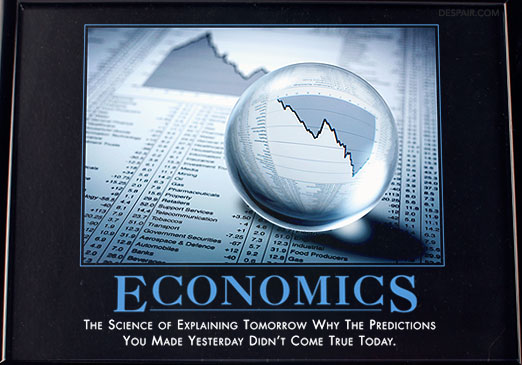
A social science fiction trying its hardest to appear to the academic community like a hard science by needlessly excessive mathematization and futile claims to be “predictive” of events predicated on largely erratic human behavior
Nice try. Please step back in line with sociology and political science where you belong until we call you.
@BR: I know you don’t want to hear this, but it seems transfers from cdn.eyewonder.com still seem to hang occasionally. It could be as simple as a too busy server or router dropping the request on the floor and moving on. Got any stats on that?
quote: “I do see one opportunity for Americans; after the debt bust in Japan many housewives became currency traders (seriously). With the US markets now deemed by the Federal Reserve outpouring of liquidity a “no lose” situation – everyone can now trade pieces of paper back and forth for profits.”
quote: “If you believe the screaming from US and UK bankers if you dare even blink an eye at compensation practices they will all move to another country, then you have to believe that the Royal Bank of Canada is set to lose almost all its employees. So, New York City and London – make way for an influx of immigrants – you can hear the moving vans from here, eh?”
There are two insurmountable problems for economists:
1. Theirs is not a field that is a real science, dismal or otherwise. Economics is what Richard Feynman called a “cargo cult science” – they’re going through the motions of being a science, but they achieve no actual results.
2. Most economists have little to no actual experience in what they claim to be experts in. Most economists are tenured academics, which is to say, they have no experience with having to deal with consequences of being wrong (ie, being fired), they’ve never had to make payroll or hire/fire/train employees, they’ve never had to deal with a competitive market and margin pressures, etc.
For all the supposed learning that economists have, it would be far more entertaining to see them dress in a grass skirt, shove a bone through their nose and paint their faces before they’re interviewed on Bloomberg or CNBC. It would also befit their actual credibility.
Thanks for that Royal Bank of Canada link, Onlooker. I especially enjoyed remarks such as:
“. . . how is it in almost every other form of PRIVATE employment, global competition is pressuring wages downward – but in the banking elite it is driving up wages? …. aha, they have a unique skill set that adds more social and economic value than say a physicist – gotcha.”
“. . . remember, we have 2 classes of people (CEOs and bank employees) who are not motivated by the normal things the rest of the peons are. The peons are motived by “doing a good job”, or “providing food for their family” or ” putting a roof over their head”. These are not things that motivate the special people in our land. If you only provide compensation at a level say 50x the average peasant you will have a subclass of unmotivated CEOs and bankers. That cannot be allowed to happen. Or they will move.”
Move they will… quite right… We must guard against this at all costs, even it were to mean that we put the entire nation’s economic future at risk again many times over in pursuit of rescuing the big banks.
To find real world evidence of deleterious effect the abridgment of the right to “fair” compensation for our illustrious financial and administrative talent, look no further than the sorry state of Europe where a veritable brain drain has been taking place for years. High taxes have promted the majority of the old countries’ best and brightest to head for the exits, departing for greener pastures in places like Brazil, Mexico, India, China, Pakistan, and Zimbabwe, where avoiding taxes are the national pastime, and economic freedom, public safety, respect for property rights, and healthy government/industry “cooperation” make for better business conditions and higher standards of living for these deserving elites.
The veritable evacuation of Europe’s talent has had a tremendously negative effect on the standard of living for the mostly useless, ungrateful masses left to suffered innumerable hardships on their own without their more able compatriots to provide them with much needed investment schemes and other, I’m certain, good and useful stuff.
Whereas in countries like Russia on the other hand, where the vigorous classes have no need to flee as they are quite free to earn a fairer share of the economic pie they well deserve for their heroic efforts – commensurate with the indispensable service they provide to their more humble countrymen – the entire population enjoys a quickly rising prosperity virtually unparalleled in Europe. If you do not believe me, just ask any sober Russian with a steady non-dead-end job if you can find one.
YOGI BERRA, that famous baseball player turned “economist” once said “It is tough to make predictions, especially about the future.”
I think we love predictions because if we make predictions, and/or concoct explanations for those events we predicted wrong, then we won’t feel like victims of randomness. We feel more in control. But are we more in control or just intoxicated by some illusion of control?
People’s ability to forecast is absolutely pathetic, flat out laughable, not just in economics, but in all matters of life. Of course, human vanity and pride does not stop you from trying anyway.
"It is generally agreed that casinos should, in the public interest, be inaccessible and expensive. And perhaps the same is true of Stock Exchanges." —John Maynard Keynes
Proving that how one feels don't necessarily translate to how they act, the first look at March U of M confidence fell to 72.5 from 73.6 and matches a 4 month low and is 1.5 pts below expectations. Both Current Conditions and the Outlook fell. One year inflation expectations rose .1% to 2.8%, matching the highest since Oct '09, likely due to the slow creep higher in gasoline prices which last night hit a fresh 17 month high. The key to confidence is the labor market and notwithstanding the improvement in retail sales, the labor market picture is still uncertain....
September 22nd, 2009 at 6:48 pm
Gotta love the creative folks at Despair.com … although my personal all-time favorite is still “Achievement”.
September 22nd, 2009 at 6:53 pm
even sadder: it’s “the science of explaining why you’ll be right about tomorrow even though you were wrong about today”
September 22nd, 2009 at 7:03 pm
Economics…
A social science fiction trying its hardest to appear to the academic community like a hard science by needlessly excessive mathematization and futile claims to be “predictive” of events predicated on largely erratic human behavior
Nice try. Please step back in line with sociology and political science where you belong until we call you.
September 22nd, 2009 at 7:54 pm
Shiz is priceless.
September 22nd, 2009 at 8:43 pm
fo’ shizzle my nizzle.
September 22nd, 2009 at 9:17 pm
@BR: I know you don’t want to hear this, but it seems transfers from cdn.eyewonder.com still seem to hang occasionally. It could be as simple as a too busy server or router dropping the request on the floor and moving on. Got any stats on that?
September 22nd, 2009 at 10:03 pm
Or changing slightly the old saw:
If you have read nothing of economics, you are uninformed…
If you have read something of economics, you are malinformed…
September 22nd, 2009 at 11:22 pm
BusinessInsider: The Real Problem is the Economy Does not Need You Anymore
quote: “I do see one opportunity for Americans; after the debt bust in Japan many housewives became currency traders (seriously). With the US markets now deemed by the Federal Reserve outpouring of liquidity a “no lose” situation – everyone can now trade pieces of paper back and forth for profits.”
September 22nd, 2009 at 11:24 pm
Trader Mark: Royal Bank of Canada Set to Lose Almost all Employees to USA
quote: “If you believe the screaming from US and UK bankers if you dare even blink an eye at compensation practices they will all move to another country, then you have to believe that the Royal Bank of Canada is set to lose almost all its employees. So, New York City and London – make way for an influx of immigrants – you can hear the moving vans from here, eh?”
September 22nd, 2009 at 11:46 pm
I know this is in poor taste and I apologize if I offend anyone – but this has always been my favorite motivational poster spoof
http://i35.tinypic.com/15oxnuo.jpg
September 23rd, 2009 at 12:04 am
There are two insurmountable problems for economists:
1. Theirs is not a field that is a real science, dismal or otherwise. Economics is what Richard Feynman called a “cargo cult science” – they’re going through the motions of being a science, but they achieve no actual results.
2. Most economists have little to no actual experience in what they claim to be experts in. Most economists are tenured academics, which is to say, they have no experience with having to deal with consequences of being wrong (ie, being fired), they’ve never had to make payroll or hire/fire/train employees, they’ve never had to deal with a competitive market and margin pressures, etc.
For all the supposed learning that economists have, it would be far more entertaining to see them dress in a grass skirt, shove a bone through their nose and paint their faces before they’re interviewed on Bloomberg or CNBC. It would also befit their actual credibility.
September 23rd, 2009 at 12:53 am
Thanks for that Royal Bank of Canada link, Onlooker. I especially enjoyed remarks such as:
“. . . how is it in almost every other form of PRIVATE employment, global competition is pressuring wages downward – but in the banking elite it is driving up wages? …. aha, they have a unique skill set that adds more social and economic value than say a physicist – gotcha.”
“. . . remember, we have 2 classes of people (CEOs and bank employees) who are not motivated by the normal things the rest of the peons are. The peons are motived by “doing a good job”, or “providing food for their family” or ” putting a roof over their head”. These are not things that motivate the special people in our land. If you only provide compensation at a level say 50x the average peasant you will have a subclass of unmotivated CEOs and bankers. That cannot be allowed to happen. Or they will move.”
September 23rd, 2009 at 7:54 am
@nemo
Move they will… quite right… We must guard against this at all costs, even it were to mean that we put the entire nation’s economic future at risk again many times over in pursuit of rescuing the big banks.
To find real world evidence of deleterious effect the abridgment of the right to “fair” compensation for our illustrious financial and administrative talent, look no further than the sorry state of Europe where a veritable brain drain has been taking place for years. High taxes have promted the majority of the old countries’ best and brightest to head for the exits, departing for greener pastures in places like Brazil, Mexico, India, China, Pakistan, and Zimbabwe, where avoiding taxes are the national pastime, and economic freedom, public safety, respect for property rights, and healthy government/industry “cooperation” make for better business conditions and higher standards of living for these deserving elites.
The veritable evacuation of Europe’s talent has had a tremendously negative effect on the standard of living for the mostly useless, ungrateful masses left to suffered innumerable hardships on their own without their more able compatriots to provide them with much needed investment schemes and other, I’m certain, good and useful stuff.
Whereas in countries like Russia on the other hand, where the vigorous classes have no need to flee as they are quite free to earn a fairer share of the economic pie they well deserve for their heroic efforts – commensurate with the indispensable service they provide to their more humble countrymen – the entire population enjoys a quickly rising prosperity virtually unparalleled in Europe. If you do not believe me, just ask any sober Russian with a steady non-dead-end job if you can find one.
September 23rd, 2009 at 8:27 am
YOGI BERRA, that famous baseball player turned “economist” once said “It is tough to make predictions, especially about the future.”
I think we love predictions because if we make predictions, and/or concoct explanations for those events we predicted wrong, then we won’t feel like victims of randomness. We feel more in control. But are we more in control or just intoxicated by some illusion of control?
http://viewpointsofacommoditytrader.com/419/suckers-for-prediction/
September 23rd, 2009 at 9:23 am
People’s ability to forecast is absolutely pathetic, flat out laughable, not just in economics, but in all matters of life. Of course, human vanity and pride does not stop you from trying anyway.
September 23rd, 2009 at 10:02 am
@Thor
Re: motivational posters
This one was always one of my favorites.
http://www.ratemymotivational.com/13555-WOMEN-Because_this_shit_aint_folding_itself
or this…
http://www.demotivateus.com/dishes-do-them-now-demotivational-poster/#
September 23rd, 2009 at 6:24 pm
[...] Ht Big Picture [...]
September 28th, 2009 at 3:37 pm
[...] http://www.ritholtz.com/blog/2009/09/economics-the-science-of-explaining-tomorrow/ a few seconds ago from web in context [...]