Finance Giants: From $1.87T to $290B to $947B

Email this post Print this post
By Barry Ritholtz - September 13th, 2009, 10:30AM

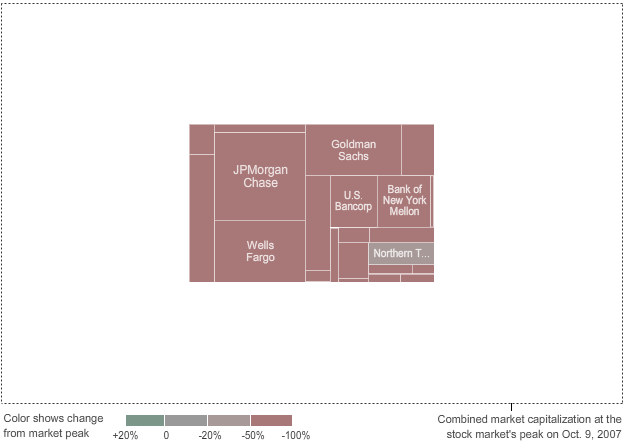
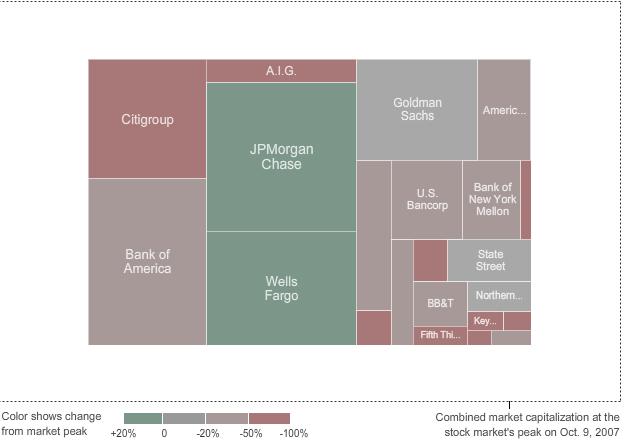
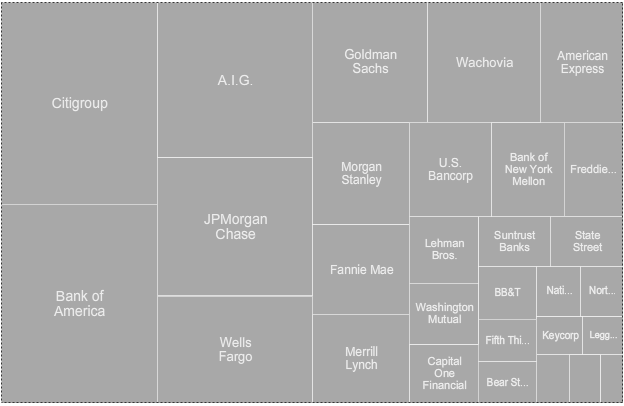
Fabulous interactive graphic in the NYT showing how the major finance shops fell, bottomed, then rebounded.

Karl Russell and Shan Carter used Bloomberg data to track the market value of these 29 finance firms — from giant Citigroup down to the much smaller Comerica — and how it waxed and waned throughout the crisis.

At the market peak, the capitalization of these firms was $1.87 trillion dollars; At the March ’09 lows, they were worth a mere $290 billion. They have since snapped back to $947 billion — more than triple the value at the lows, but still half the peak:

>
click for interactive graphics
fin gi1
fin g 2
fin gi 3

chart courtesy of NYT

>


Ain’t finance grand?

>

Source:
How the Giants of Finance Shrunk, Then Grew, Under the Financial Crisis
KARL RUSSELL and SHAN CARTER
NYT, September 12, 2009

http://www.nytimes.com/interactive/2009/09/12/business/financial-markets-graphic.html

Comments

Please use the comments to demonstrate your own ignorance, unfamiliarity with empirical data, ability to repeat discredited memes, and lack of respect for scientific knowledge. Also, be sure to create straw men and argue against things I have neither said nor even implied. Any irrelevancies you can mention will also be appreciated. Lastly, kindly forgo all civility in your discourse . . . you are, after all, anonymous.

21 Responses to “Finance Giants: From $1.87T to $290B to $947B”

  1. Cursive Says:

    This could make the FAZ/SKF trade very profitable again!

  2. Marcus Aurelius Says:

    A more interesting question is where they actually got the money (outside of TARP) to recapitalize (surely, Joe and Jane 401K didn’t jump right in and invest the piles of excess cash they had laying around after losing that which they had already “invested”). The Fed’s Primary Dealers, using free money from the Fed’s OMOs are buying their own stocks and securities.

    This will not end well.

  3. R.D. Says:

    I Liked the “stronger than ever” comment for JPM. IT seems the

    mighty derivative problem has all just gone away. ; ) I’d like to

    see a fresh CHRIS WHALEN analysis of those banks.

  4. Mark E Hoffer Says:

    so the ~13 Tn we ponied up results in in Mkt. Cap improvement of ~650 Bn ?

    Suite~

  5. Onlooker from Troy Says:

    It’s amazing what ignoring the balance sheet can do for you ain’t it? And having the govt tilt the playing field in your favor with an extreme yield curve and the ability to rape your customers.

    Ah yes, capitalism at it’s best. Just wonderful.

  6. Onlooker from Troy Says:

    http://baselinescenario.com/2009/09/13/economic-donkeys/

    Simon Johnson: “The pre-crisis activities and portfolios of Barclays, Goldman Sachs, and other “survivors” of this crisis were only slightly different from Lehman Brothers or Bear Stearns, which failed. The “good” banks also securitized subprime assets, helped build the intricate web of IOUs between banks and insurance companies, and leveraged their balance sheets to enormous levels. The winners were not better, they were just smart enough to make sure someone else held the bad assets when the music stopped, and they were powerful enough to win generous bailout packages from their governments.”

    As usual, very cogent analysis. Simon Johnson for Treasury!

  7. MRegan Says:

    Tout suite, Mark! Very droll. Let’s 1/13th=50 bil of market cap reflation. All we need to recover the 1.87 tr m.c. is another 26 trillion! Magnifique! Laissez roler les bontemps!

    Interesting ‘green shoot’ anecdata:

    http://www.nytimes.com/2009/09/13/business/economy/13manufacture.html?_r=2&ref=global

  8. alfred e Says:

    Interesting article

    In Shift, Wall Street Goes to Washington

    http://www.washingtonpost.com/wp-dyn/content/article/2009/09/12/AR2009091202932.html?wpisrc=newsletter

    “This crisis has and will fundamentally change the relationship between Wall Street and Washington for decades to come,” said Richard H. Clarida, an assistant Treasury secretary under President George W. Bush who is now an economics professor at Columbia University. “It’s often said that Wall Street is no longer the financial capital, that it’s Washington, D.C., and that’s certainly true. I don’t think this is destined to change. I think this is going to be a fact of life.”

    Washington Calling

    Before the financial crisis, BlackRock’s chairman Laurence Fink would speak with federal officials at most a few times a month, for instance when they called him in New York for information about mortgage markets or pensions funds or other areas in which his company was active. But now, as the chief executive of the nation’s largest asset manager, Fink says he talks to officials at least once a day. He plans to open an office in Washington by next year to influence policy and has hired the lobbying powerhouse of Quinn Gillespie & Associates.

    Three decades ago, Fink was a pioneer in bundling large numbers of mortgages, then slicing up these packages and selling off shares as securities. More recently, firms packaged subprime loans, which soured when the housing market collapsed, igniting the crisis.

    So the Treasury and Fed have tapped Fink’s expertise. BlackRock emerged as one of their principal advisers as the agencies bailed out major companies and tried to put a price on their toxic assets. BlackRock is also managing tens of billions of dollars worth of AIG assets for the government. In August, officials selected the company to help arrange the purchase, partly using taxpayer money, of toxic assets from banks.
    ad_icon

    “We made ourselves available on issues that many people don’t understand,” Fink said.

    Although BlackRock, which avoided the plague of toxic assets, has turned to Washington by choice, some firms have been forced to Washington.

    Take Citigroup, which has allowed its general counsel to move his office from Midtown Manhattan to a penthouse atop a historic Beaux-Arts building on Pennsylvania Avenue. The bank, whose executive board chairman was former Treasury secretary Robert E. Rubin, is no stranger to Washington. But badly hit by toxic assets during the mortgage meltdown, Citigroup received $45 billion in infusions from the Treasury and in return gave the government a majority ownership.

  9. alfred e Says:

    BR: Surprised you haven’t mentioned the tire tariff sanctions against China.

    Protectionism rears its ugly head in this fascist regime.

  10. MRegan Says:

    Bush instituted steels tariffs specifically to protect Wilbur Ross’ ISG gambit. Was that fascism, or just good ole buddy system capitalism? Didn’t help a wit, lil Wilbur is still a goblin. No matter how high he piles the money, his mother will never have loved him. Poor Wilbur.

  11. alfred e Says:

    @MRegab: Good point difference is Bush’s was a good ole buddy thing. Obama’s was a “let’s make a deal” thing with the Steelworker’s Union. You know, the let’s take control of “free enterprise”.

  12. MRegan Says:

    That’s right, the other guys want a free market.

  13. godly Says:

    Useful.

    Obama has done it again. Another Blunder. Imposes tariff on china.

    US takes on CHINA

  14. km4 Says:

    Stiglitz Says Banking Problems Are Now Bigger Than Pre-Lehman
    http://bit.ly/2Htceb
    “In the U.S. and many other countries, the too-big-to-fail banks have become even bigger,” Stiglitz said in an interview today in Paris. “The problems are worse than they were in 2007 before the crisis.”

  15. constantnormal Says:

    If only these data points had been taken under similar conditions using a common set of accounting rules!

    Then they might mean something.

    But with the goobermint blowing credit up their collective arses, and changing the accounting rules to make it seem like there was value when in fact there was none … I don’t think one can do very much with these particular data points.

    The imposition of tariffs on international trade is another step in the direction of the Great Depression, and away from the Japanese experience.

    Can you say “away from the frying pan and into the fire”?

  16. Simon Says:

    What happens now when something unexpected happens and and the market gets the colliwobbles? Another dose of deleveraging anyone?

  17. constantnormal Says:

    @Simon — what deleveraging? Total debt continues to rise, even as the economy shrinks. No net deleveraging thus far.

  18. jc Says:

    So the fed needs to retrieve the free money from the big banksters to avoid hyperinflation while the banks pass the baton to the 401K crowd at Dow 10K while hoping somebody starts hiring and somebody starts buying stuff before the the 401K crown realizes they’re Wiley Coyote at unsustainable ratios?

  19. constantnormal Says:

    @jc

    Robert Reich’s Labor Day blog made reference to a BoA-ML report (“The Myth of the Overleveraged Consumer”) that essentially says that we shouldn’t worry too much about Joe Sixpack and his brothers and sisters, ’cause they are not the ones that account for most of the consumer spending that drives the United States of Bananamerica — at least that’s my interpretation of his interpretation. Basically, the report says (again, my secondhand word-of-mouth interpretation, without benefit of having actually read it) that we can, as the saying goes, the ones who form the bottom 2/3-to-3/4 of the economy, “let them eat cake”.

    Reich, being a small-d democrat, is understandably outraged. You can (and should) check his reaction out for yourself:
    http://robertreich.blogspot.com/2009/09/real-news-about-jobs-and-wages-ode-to.html

    But the point that I took from the logic that drove the report is that it might be true. We could be descending another step, with a permanently higher unemployment rate, an even smaller middle class, and ever-higher productivity required to support the increasingly unstable enterprise of Bananamerica. But the system could actually work like this, albeit in a much less stable manner.

    For it is the large and relatively prosperous middle class that has kept America and its economy stable and growing for the past 2+ centuries. The relentless progression of productivity over the years has driven a great many changes in our society, but I fear that capitalism as we have known it, dependent upon a pyramid of labor, is at a crossroads, and probably a transformation into either something new, or something old that we have seen before, in the many banana republics.

  20. wunsacon Says:

    Johnny Rotten closed the final Sid Vicious-era Sex Pistols concert in San Francisco’s Winterland in January 1978 with a rhetorical question to the audience: “Ever get the feeling you’ve been cheated?”

    Well, I do.

  21. WaveCatcher Says:

    The Tsunami of change is overwhelming those that might ordinarily be effective watchdogs.

    Just one symptom is when Congress votes on a 1000+ page stimulus bill without time to even read it. Or when Treasury + Fed becomes the de facto “financial center” of the world. Next up: HealthCare?

    When you hear our leaders say, “Never let a crisis go to waste” that should make the hair stand up on the back of your neck.

75 queries. 0.490 seconds.