
Giving the SEC Teeth
The problems at the SEC were decades in the making.
The agency is supposed to be an investor’s advocate, the cheif law enforcement agency for the markets. But that has hardly been how they have been managed, funded and operated run in recent years.
Essentially the largest prosecutor’s office in the country, the SEC has been undercut at every turn: Their staffing was far too small to handle their jurisdiction — Wall Street and public Corporations. Their budgets have been sliced, and they were unable to keep up with the explosion in corporate criminality. Many key positions were left unfilled, and morale was severely damaged. A series of disastrous SEC chairs were appointed — to be “kindler and gentler.” Not only did they fail to maintain SEC funding (via fines), but they allowed the worst corporate offenders to go unpunished.
Gee, go figure that under those circumstances, they sucked at their jobs.
How hard was it for the Inspector General of the U.S. Securities and Exchange Commission (SEC), H. David Kotz to find items to critique? I am sure the two reports outlining 58 steps to improve the agency’s enforcement and inspections units are perfectly adequate. But the question I want to pose is this: Do they address a decade of neglect? Let’s start with looking at adequate levels of funding and staffing . . .
Yes, we need to overhaul how investigators scrutinize tips, plan probes, tap expertise, verify information and train employees, etc. None of these various recommendations are groundbreaking (giving examiners access to industry publications and databases? Establishing protocol for how to analyze this outside information?)
The bottom line of the SEC is this: If we are serious about corporate fraud, about violations of the SEC laws, about a level playing field, then we fund the agency adequately, hire enough lawyers to prosecute the crimes, and prevent Congress critters from interfering with the SEC doing its job.
To be blunt: So far, there is no evidence we are sincere about making the SEC a serious watchdog with teeth.
Congress sure hasn’t been. Staffing levels have been ignored, budgeting has been cut over the years. And its the sort of administrative issue that does not lend itself to bumper sticker aphorisms or tea party slogans.
The SEC doing its job correctly is about good government — like picking up the trash, haivng the trains run on time, or hiring quality teachers. Its not sexy, its not fun, its administrative policy wonk junk. This is something we have become increasingly lousy at doing as a society as we have become ideologically polarized. And as the government has gotten demonized, it becomes even less likely for departments to get proper funding, or to accomplish their basic goals.
Give me a good pragmatic technocrat any day . . .
>
Fee Collections and Spending Authority
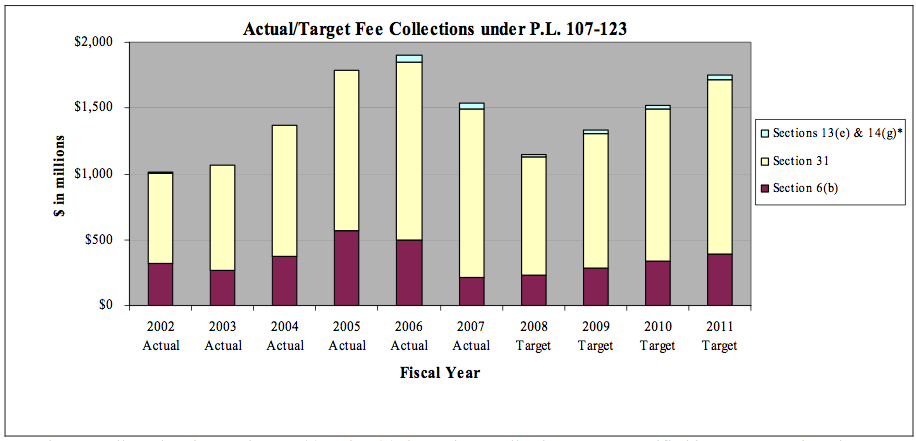
graphic via SEC
>
Sources:
Testimony Before the U.S. Senate Committee on Banking, Housing and Urban Affairs
by H. David Kotz
Inspector General
U.S. Securities and Exchange Commission
September 10, 2009
http://www.sec.gov/news/testimony/2009/ts091009hdk.htm
Written Testimony of
H. David Kotz Inspector General of the SEC PDF
Other Coverage:
SEC’s Watchdog Proposes 58 Improvements After Madoff
David Scheer
Bloomberg, Sept. 29 2009
http://www.bloomberg.com/apps/news?pid=20601103&sid=afWAC3PfVIhc
SEC Investigators Say Regulator Is ‘Dog Chasing Its Own Tail
Jesse Westbrook
Bloomberg, Sept. 30 2009
http://www.bloomberg.com/apps/news?pid=20601103&sid=agopC8.GGugM
SEC Watchdog Releases Post-Madoff Recommendations
Sarah N. Lynch
DOW JONES NEWSWIRES, September 29, 2009
http://online.wsj.com/article/BT-CO-20090929-711537.html
In Harsh Reports on S.E.C.’s Fraud Failures, a Watchdog Urges Sweeping Changes
ZACHERY KOUWE
NYT, September 29, 2009
http://www.nytimes.com/2009/09/30/business/30sec.html
SEC Inspector General Tells Agency What It Must Do To Catch Next Madoff
Frank Ahrens
WaPo/The Ticker, September 29, 2009
http://voices.washingtonpost.com/economy-watch/2009/09/inspector_general_tells_sec_ho.html



September 30th, 2009 at 7:35 am
Privatize it.
Sell it to individual investors with less than 5M in investable assets. They get to vote on the rules and regs. They get to elect the head. One- investor, One vote (It’s America.) Then we’ll see some new vigor aimed at private-jet romping CEOs and their frat-buddy boards.
~~~
BR: heh heh — anything to keep corrupt Congress out of it?
September 30th, 2009 at 7:54 am
Disband the SEC, turn the investigative responsibilities over to the FBI (who will be given funding to hire CPAs), and appoint Special Prosecutors to seek the harshest civil AND criminal penalties possible for those on the wrong side of the law. No deals will be made, no plea bargains, and no non-disclosure of the findings of the investigations (names will not be withheld to protect the guilty, and financial penalties include all of the ill-gotten gins, plus seizure of future income of any convicted party).
The penalties must outweigh any potential gains from the crime committed.
Before we do any of that, we need to remove the corporate shield (an artifact of Judicial law-making if there ever was one. Sarbanes-Oxley isn’t working).
___________
Why can’t we do the right thing any more?
September 30th, 2009 at 8:04 am
…it is not a an economic crisis/problem per se, as much as it is, more fundamentally, a moral crises – that is we “we can’t do the RIGHT thing anymore”
September 30th, 2009 at 8:13 am
If you are going to increase staffing you need to increase the sophistication of the investigators as was shown by the Markopolous reports re Madoff. The SEC is very good at investigating insider trading. Aside from that they are usually way behind.
September 30th, 2009 at 9:13 am
it depends. if we really want to have investors be able to actually make reasonable and informed investments, that aren’t subject to the powers that be on wall street, then you have have the SEC do the jobs it was created to do (you know have a free market kind if thing, not be a casino, or have the decks stacked against them, keep corporate crime down to a low level. on the plus side I suppose we haven’t heard about any corporation having hired thugs to kill any body or beat them up like in the old days)
. as it is we have the worst of all worlds. investors have no clue really wants going in the corporate world, and in reality have little control over those same corporations they have invested in. so they have changed the game to just try to make money on the buying and selling side since thats how little control they have . and the game we have is the same as the rest of the world, which it used to not be. we used to be the gold standard of investing (or at least much better than the rest!). and privatization wouldn’t help. without government powers (filing criminal complaints, enforcing regulations etc) you would end up in worse shape than now. and there would be a lot less money available to fund enforcement.
September 30th, 2009 at 9:22 am
The Office of the Inspector General has prioritized boots on the ground in pursuit of letter carriers walking too slowly and the like. Corporate fraud has been an oxymoron under our recent leadership. A change would be welcome and cost effective, but i”m not sure I can hold my breath that long.
September 30th, 2009 at 9:25 am
With all due respect, $1 billion should be adequate funding for a watchdog organization. Money and staffing should not be the problem. Money and staffing are simply excuses.
September 30th, 2009 at 9:25 am
I don’t expect to see a serious attempt at fixing the SEC for a while, if ever.
The “recovery” and the new health of banks comes from mark to fantasy and stimulus money, nothing else, if banks were really healthy, credit wouldn’t contract.
So right now the strategy seems to be “wait and see” and let the financiers do what they want to make it look rosey again, no restrictions, no rules.
And we’re supposed to trust that bunch.
To fix it, I’m with MA.
September 30th, 2009 at 9:40 am
Sorry. I have no sympathy for the SEC. They are corrupt.
Budget cuts and staffing issues are just an easy excuse, a smoke screen to hide their lack of integrity.
I’ve been dealing with budget constrains all my life, and when money is tight, one has to prioritize, it’s dead simple.
Pray tell me what the rationale was to go after Martha Steward instead of Bernie Maddof ?
September 30th, 2009 at 9:49 am
$$$$$$$$$$$$$$$$$$$$$$$$$$$$$$$$$$$$$$$$$$$$$$$$$$$$$$$$$$$$$$$$$$$$$$$
September 30th, 2009 at 9:50 am
Claiming corruption or lack of desire to do the grunt work are probably off the mark. Essentially this organization has been asked to basically NOT do its job. Measured in those terms it should get an A.
Its leaders have been picked based on their willingness to defy its charter and laissez faire approach to wall st.
September 30th, 2009 at 9:51 am
And politicians fixing things for the better? good luck
look at the public option, what a bunch of chicken shit bought out MFs.
September 30th, 2009 at 9:51 am
Like with the FBI’s 10 most wanted list, give cash rewards for uncovering ponzi schemes and corporate shenanigans. Make SEC employees eligible for this and they will be VERY motivated to protect us.
HCF
September 30th, 2009 at 10:13 am
I think we should look forward, not back, and only investigate low-level clerks who overstepped the bounds of thievery established by the corporate memos which no one can see, having been protected under the state secrecy privilege.
September 30th, 2009 at 10:21 am
HFC’s suggestion is a good one. Bureaucrats are generally motivated not to rock the boat. Money on the other hand always motivates. Give the regulators the same motivation as the regulatees (if that is a word)…….or as Bush would have said, “the perpertraders”……
September 30th, 2009 at 10:21 am
MA asks: “Why can’t we do the right thing anymore?”
This cultural decline has been years, decades, in the making. We are finally seeing that “labor” bear fruit.
September 30th, 2009 at 11:09 am
The SEC IS “fixed”, and it is working exactly the way that the industry wants it to work.
Bernie Madoff knew that, as does anyone who looks at the work that the SEC does. Madoff could not have even begun his little enterprise if there were a shred of regulatory oversight in the securities industry.
The fact that the market decline (not the SEC) has flushed out a cloud of locusts like Madoff is proof of that. But the swarm of Ponzi locusts is nothing compared to the giant thieving blood-sucking squids that dominate the markets these days.
September 30th, 2009 at 11:11 am
“Why can’t we do the right thing any more?”
Have we ever?? Ever since this country kicked into “hyper capitalism” in the late 1800’s there’s been nothing but corruption and huge disparity between rich and poor. You think markets are manipulated now, just think of the billions of dollars that were made in the early days of the market with absolutely no governance. The system has always been insanely corrupt.
September 30th, 2009 at 11:15 am
“To be blunt: I don’t think we are serious about it.”
Great posts/creative solutions by all (ex-SEC). SEC is WS lapdog. Waste of taxpayer $. Same with Fed (only worse). Why would the US want to keep these institutions going? They have both failed at their respective tasks. Some may say intentionally (tin foil hat removed). We all know private sector response to poor performance.
The proven system of checks and balances must apply to all branches/departments/agcys. of gov’t. Must have oversight (with oversight). This applies to health care reform, WS regulations, and toothpaste.
The Glass-Stegall Act worked pretty well until it was emasculated.
http://en.wikipedia.org/wiki/Glass-Steagall_Act
Emasculate \E*mas”cu*late\, v. t. [imp. & p. p. Emasculated;
p. pr. & vb. n. Emasculating.] [L. emasculare; e + masculus
male, masculine. See Male masculine.]
1. To deprive of virile or procreative power; to castrate
power; to castrate; to geld.
[1913 Webster]
2. To deprive of masculine vigor or spirit; to weaken; to
render effeminate; to vitiate by unmanly softness.
[1913 Webster]
The list of emasculated agcy’s is a mile long (“to infinity, and beyond”).
sharkbait
September 30th, 2009 at 11:46 am
Why not fund the SEC like the FDIC? Make all corporations contribute based on market cap. This way congress can no longer interfere in providing funding based on the specific party ideology.
September 30th, 2009 at 11:51 am
This came out a couple of weeks ago but it’s appropriate for this discussion:
http://www.washingtonpost.com/wp-dyn/content/article/2009/09/14/AR2009091401671.html
http://www.zerohedge.com/article/judge-rakoff-orders-trial-merrillbofa-settlement
September 30th, 2009 at 12:32 pm
Happy Wanker wrote @ 11:11 AM:
“’Why can’t we do the right thing any more?’
Have we ever?? Ever since this country kicked into “hyper capitalism” in the late 1800’s there’s been nothing but corruption and huge disparity between rich and poor. You think markets are manipulated now, just think of the billions of dollars that were made in the early days of the market with absolutely no governance. The system has always been insanely corrupt.”
______________________________________________________________
The Great CNBC Sucks’ reply:
Wanker, I have not been paying much attention to this blog lately, but through mumblings in the Ritholtz fantasy football league, I know you have continued to annoy the peeps. However, this is one of the best comments I have seen you make. Your apparent argument that “the system is f*cked, so make paper money off it anyway” reminds me of a great poster named centiare, who did not stay on Ritholtz long. Here is centiare doing the best thing anybody can do, agree with The Great CNBC Sucks:
http://www.ritholtz.com/blog/2009/04/blog-traffic-reading-complacent/#comment-166645
centiare’s basic argument was that the peeps on this blog are sentimentalists, who wanted to see the world and America as they hoped, not as they really are. I empathize with these peeps. It is a great abyss of despair that one experiences when coming to grips with the discovery that the whole economic system is fundamentally corrupt and therefore tenuous.
The Great CNBC Sucks remains almost completely retired, and will welcome Mark E. Hoffer to “fashion-forward hibernation” if he so chooses. My friend Bergsten has been kind enough to let me know what is happening on the Ritholtz blog. If any of you miss The Great CNBC Sucks, just follow me on Twitter (http://twitter.com/cnbcsucks), at which I will occassionally supply you with useful factoids such as “My problem with CNBC is not that it tries to trick you into buying stocks with attractive female anchors, but that they are flat-chested.” and “Why doesn’t Roger Federer have a hotter wife?”.
September 30th, 2009 at 12:40 pm
…you are all over it CNBCSucks
September 30th, 2009 at 12:42 pm
Forgive me for I am going to expound (once again).
I think this SEC discussion reveals one of the most significant divisions in the mind sets of liberals and conservatives and perhaps it can also serve as a lesson on how to present liberal ideas in a manner that will be, let me say, less objectionable to conservatives. (I have worked in the policy arena in both Democratic & Republican administrations and I do think I know a bit about what I am going to share.)
I have no expertise on the SEC, but that does not really matter because this is an issue of human nature and the effectiveness of using alternative approaches when trying to accomplish policy objectives.
Nearly everyone, conservative and liberal, agrees that something needs to be done to avoid another Madoff affair and another financial meltdown. Even Greenspan acknowledges that the forces of greed supercede any desired effort to self-regulate. One can probably liken it to the addictive force that compels one to take a drink or overeat. One knows better but cannot help oneself (or can rationalize) at the time.
So we need to do something about the SEC. What should we do?
One line of reasoning would be, “The SEC failed because they did not have adequate resources. If we provide the SEC with additional staff and funding, they will be able to better regulate the financial industry.”
This approach contains an underlying assumption that the issue is one of volume, quantity and not quality. It also assumes that the employees at the SEC are and will be highly motivated and focused on identifying, investigating and eliminating irregularities and fraudulent practices in the financial industry.
However from what I have read, the SEC has not demonstrated a significant degree of volume in rooting out bad apples. They have shown little capability at all to identify, investigate and eliminated bad practices, particularly with respect to significant and complex schemes. The Madoff case provides anecdotal evidence to this.
I can assure you that this is not because the employees of the SEC are lazy or incompetent although in any bureaucracy public or private this exists. On the contrary many, most are hard working and motivated.
But are they motivated to identify, investigate and prosecute those who engage in bad practices? – “to do the right thing” as Mannwich asks. The answer is that of course some individuals in any organization are. However many, most are not. Why? Because what is in it for them? What if they take the risk to investigate someone important and powerful and do not prevail? This could harm their careers, future promotional opportunities, the esteem with which they are held by their peers. There is simply too much personal risk and too little personal reward. Instead it is far more rational for them to do exactly what the procedures require. Cross all “t”s and dot all “i”s. Play it safe and your chances for a long a prosperous career will be greater.
Yes, but they are “public servants”, they “should” take these risks no matter what the consequences you might respond. To which I would ask, What if you had a family, a mortgage, a good job, a future career path, what would you do in these circumstances? Would you really forsake all that you have accomplished on a risky proposition against wealthy, connected and powerful opponents? Opponents who can and will cost you your job if you by chance slip up, no matter how good your intentions were?
My first point here is that more and bigger government is not necessarily the solution. We would simply be hiring more government workers who are not given the proper motivation.
Another point is that one should not blame government employees for the circumstances in which they must operate. For the most part they are not slackers. They are simply acting rationally given their circumstances. Yes, as a general rule the individuals who seek out public service employment tend to be more risk adverse – are willing to give up higher levels of income for the job security afforded by civil service protections. However many government employees work long and hard hours in dedication to their organization.
We simply must recognize there are inherent limitations to using governmental entities to solve our societal problems. The policy planners who develop new governmental programs will assume that the employees responsible for implementation them will share their zeal, enthusiasm and understanding of importance. Further they assume the programs will be implemented true to intentions without political influences or distortions. (I have done this myself folks. I know of what I speak.) Simply put, this only happens in the abstract world of ideas, not in the real world of personal survival and external influence. To think that it will change, that mankind might somehow start “doing the right thing” beginning tomorrow is not realistic.
Therefore how should we go about regulating the financial markets and for that matter implementing social policies in general?
I would suggest that we start by having a realistic understanding of what the various parties can and cannot do well. We have discovered that the financial industry cannot self regulate. We should understand that traditional government bureaucracies are by their nature not motivated to regulate well particularly when personal risk taking without reward is involved. Further we should accept that simply building a larger bureaucracy, one that will require yet more private-sector labor hours to respond to, will put our financial industry at a competitive disadvantage, stifle innovation, reduce productivity, etc.
Again, I am not an expert in financial regulation and as such I do not have any magic bullet solution although I do like the concepts of a bonus or a percent of proceeds reward system for those within the organization who do take risk chances in investigating wealthy and powerful adversaries. These are not as easy to administer as they sound, however not only do they provide a reward incentive, they also serve to validate the importance of the risk taking process. In other words, how are you going to fire the person who just got acknowledged financially and ceremoniously for outstanding service? If that same person makes a future misstep, they can point to their past accomplishments as justification for their risk taking behavior.
So how does this discussion help liberal causes? I suggest liberals need to think more realistically about the solutions. Find solutions that will achieve the objective while not creating waste, inefficiency or ineffective programs. You will discover that big government rarely is the answer, so find another way.
My favorite example is the Earned Income Tax Credit. It is efficient, it rewards the right people (those whose present level of skills and ability prevent them from providing for themselves and their families, it rewards the right personal motivations (self-responsibility, work ethic), it does not require a large governmental organization to implement or administer and it does not improperly skew the inputs in private sector resource allocation as would a higher minimum wage or a public job creation program.
It serves as an example of how social change can be best implemented with a minimum of adverse or unforeseen consequences.
I hope you will consider these perspectives.
Thanks for your time.
September 30th, 2009 at 12:54 pm
CNBCs-
dude- you won an game-
also- your trade offer went into my spam queue – so sent you my answer this morning- a week late- wouldn’t have mattered – but now have you flagged as acceptable and not spam-
say hey to Bergsten
September 30th, 2009 at 12:55 pm
The Great CNBC: An excellent post. Today’s market action is yet another glaring example of this.
BTW: Federer’s wife has been the topic of many conversations only to draw the logical conclusion.
September 30th, 2009 at 1:03 pm
I did not know, Harry. I have to read up on Federer’s wife then. Thanks.
WordPress handles URLs in comments crappily, so IF you desire, follow The Great CNBC Sucks on http://twitter.com/CNBCSucks
Back to retirement. I wish all of you the best until my next return…
September 30th, 2009 at 1:07 pm
Now it is working, but you have a “sara palin nude” and I click on her picture and nothing happens….What’s up with that…..
September 30th, 2009 at 1:20 pm
LOL, franklin420d. You are funny…more entertaining than franklin411.
The background of my Twitter account is a screenshot of the CNBC Sucks blog at the end of 2008. To access actual links, you have to go to my blog, which you get if you click my name.
Sorry, Ritholtz, you were saying something about the SEC…
September 30th, 2009 at 1:23 pm
I always wondered what compassionate conservatism was.
September 30th, 2009 at 1:28 pm
“Congress critters” are already interfering with the SEC doing its job because they don’t “fund the agency adequately, hire enough lawyers to prosecute the crimes and are (NOT) serious about corporate fraud, or violations of the SEC laws”. Their masters are very happy with them running interference and the job that they’re doing. Sometimes it’s not what you do but what you don’t do. Like the FED.
September 30th, 2009 at 1:29 pm
I’m joining you soon as well, CNBC Sucks. Great post. And, yes, great post, HarryWanker. I think it’s time for everyone to lay of the man. I know I will…..for now.
September 30th, 2009 at 1:39 pm
I was sued by the SEC for insider trading in 2000. I went to trial in 2005 and won a directed verdict – I was not required to present a defense – they defeated themselves. The nature of their accusation was such that I was able to counter-sue them (rare) and they quickly settled and paid me a substantial sum. (They accused me of using information to profit when profits occurred before the disclosure of the information that was to have enabled the profit. AKA time travel).
The SEC subpoened 500,000 pages of documents, took 90+ depositions, assigned 25 lawyers and dozens of staff, experts, accounts, and the case went through 5 layers of management including the commission itself. The case involved cooporation from NY, Philadelphia, Boston and San Francisco enforcement offices. With all this resource and money, the SEC only needs to show a preponderance of the evidence to win their case; that is, they need to show a 51% probability of guilt.
They were not overfunded – they tried to spend me into a settlement. They weren’t understaffed for me at least; they were understaffed for Bernie because of me in part. They were definitely motivated to bring cases and never to drop them. They clearly attempted to avoid chasing people who could fight back. Bring the high probability cases only mentality.
I was handsomely compensated by the SEC for my troubles, but most people just quietly cave in. The people who prosecuted me would never have the mettle to fight Bernie. When I went on the offensive, the middle layer scattered and I ended up litigating with their best.
If you look at the litigation section of their website, the majority of the serious cases are riding the coattails of a state’s attorney or US district attorney. The SEC does not do such work itself. If it requires courage and real work, criminal prosecutors do the work and take the risks.
They are not worthy of our respect. Cuomo and many of his kind are.
September 30th, 2009 at 2:36 pm
The SEC needs to be wiped out, along with the IRS and Federal Reserve. Ron Paul is right.
http://theburningplatform.com/economy/founding-fathers-of-our-new-country-1
September 30th, 2009 at 2:56 pm
This link is for Harry. I don’t think we are not going to see a V shaped recovery in the economy. But the V shaped chart in the “indices” is a whole different story.
http://finance.yahoo.com/tech-ticker/article/346483/America%27s-%22Very-Soggy%22-Outlook-Why-the-Recovery-Won%27t-Be-V-Shaped?tickers=^DJI,^GSPC,SPY,DIA,TLT,TBT,XLF&sec=topStories&pos=8&asset=&ccode=
September 30th, 2009 at 3:00 pm
The SEC has plenty of teeth!!!
We only have the best talent in football. Seriously, check the linebacker depth charts of any NFL team, and guaranteed you will find more SEC players than any other conference in the NCAA.
Oh, and guys like Herschel Walker, Jamaal Lewis, Peyton Manning, Percy Harvin… man, I could just keep going.
Oh, whats that? Wrong SEC? My bad.
I didnt know there was another SEC…
What the f*ck does the other SEC do anyways???
September 30th, 2009 at 3:01 pm
The market can run all it wants. It still won’t convinced me that the economy is recovering until I see actual evidence (no, not the markets) to the contrary.
September 30th, 2009 at 3:01 pm
@I-Man: LOL. Great points too!
September 30th, 2009 at 4:16 pm
HarryWanger Says:
The Great CNBC: An excellent post. Today’s market action is yet another glaring example of this.
BTW: Federer’s wife has been the topic of many conversations only to draw the logical conclusion.
I don’t remember you addressed the debt question, following your yesterday’s long post, about 51T total (private+gov) debt we are facing and more data and fact about your “energy, coal, technology” driven growth to pull ourselve out of this mess (quickly?).
Using stock market going high to pump more unwarranted optimism is not something really interesting, at least here.
September 30th, 2009 at 9:47 pm
masterofmydomain,
Thanks for sharing that personal tale. Unfortunate. But, very interesting.
September 30th, 2009 at 11:18 pm
@masterofmydomain
Good on you mate.
I remember a conversation between B.Clinton and Jim Simons about nuclear power a couple of years ago, not that it would put coal out of the picture for some assholes.
Keep digging.
October 1st, 2009 at 1:23 pm
I have been screaming at H.David Kotz for a long time now about his siding with anonymous fraudsters on sec.gov claiming everything from worthless penny stocks,(that the fraudulent ‘naked short selling’ claim of James Dale Davidson’s NAANSS or National Association Against Naked Short Selling first started with in 2002 and since 2005 REPLACED BY Patrick Byrne’s,et.al’s NCANS),to Novastar Financial and Northern Rock and finally Freddie Mac and Fannie acording to ex SEC Chair Chris ‘Naked Shorts’ Cox and his and David Kotz’s SEC were brought down by ‘naked short selling’!My first article-posts re Kotz and Christopher Cox’s ‘naked shorting’ lies and cover ups are hard to find now for some reason but are still on internet.
Ij ust wanted you to know he claims Fannie Mae and Freddie Mac were ‘naked shorted’ or ‘counterfeit’ to cover that massive fraud up as well.Will someone investigate, PLEASE !?
http://www.phillyimc.org/en/senator-carl-levinsarlen-specters-naked-short-fannie-mae-theory-vs-jfk-magic-bullet-assassination-th
Senator Carl Levin’s,Arlen Specter’s ‘Naked Short Fannie Mae Theory’ vs JFK ‘Magic Bullet’ Assassination Theory
SEC Inspector General H.David Kotz who these Senators treat with kid gloves as though he were a child prodigy for playing along with their and ex SEC Chair Chris Cox lie about Fannie Mae and Freddie Mac being ‘naked shorted’ when it is precisely those stocks that prove the claim of James Dale Davidson,Patrick Byrne,Senators Bob Bennett, Carl Levin,Arlen Specter, et.al. is a lie – if shares issued by Fannie Mae and Freddie Mac were ‘naked shorted’ meaning they were counterfeited according to the Senators and James Dale Davidson and Byrne,et.al.,then many shareholders would have complained of not receiving their dividends over the years.This never occured so the only question is are these Senators purposely aiding stock criminals or just mistaken and themselves manipulated to aid a mafia like stock fraud that thanks nothing of threatening the lives of those who criticise them whether they be journalisats are victims of their fraud such as myself.
October 1st, 2009 at 7:51 pm
[...] good friend and blogger extraordinaire Barry Ritholtz wrote such a compelling post yesterday about the SEC that I thought it was worth sharing with footnoted.org readers. Here it is [...]
October 2nd, 2009 at 3:59 pm
[...] Giving the SEC Teeth (Barry Ritholtz, The Big Picture) The Big Picture | September 30, 2009 How hard was it for the Inspector General of the U.S. Securities and Exchange Commission (SEC), H. David Kotz to find items to critique? I am sure the two reports outlining 58 steps to improve the agency’s enforcement and inspections units are perfectly adequate. But the question I want to pose is this: Do they address a decade of neglect? [...]
October 22nd, 2009 at 11:51 pm
Isn’t it silly, though, that it would take a budget of about $2,000,000,000 ($2 Billion) annually to keep tabs on corporate America? I mean, does it really cost this much to sign up with a few (free) databases, just a few (expensive) databases, and a team of investigators, or are we talking about a staff of 10,000, each paid about $100K per year, plus about 10,000 laptops, each costing about $100K? I mean, jesus, that’s a lot of money to not be doing a good job with oversight.
~~~
BR: Over the past 12 years, we gutted the SEC’s budget, and significantly reduced their staff.
How did that work out?
We have had major analyst, banking and accounting scandals, and 2 massive boom bust cycles.