
How Many Hours of Work Are Required to Purchase S&P?

Email this post Print this post
By Barry Ritholtz - September 10th, 2009, 12:34PM

Are stocks cheap or expensive? Are wages up or down?

The answer to the  above question is obviously a a function of both hourly wages and S&P prices.

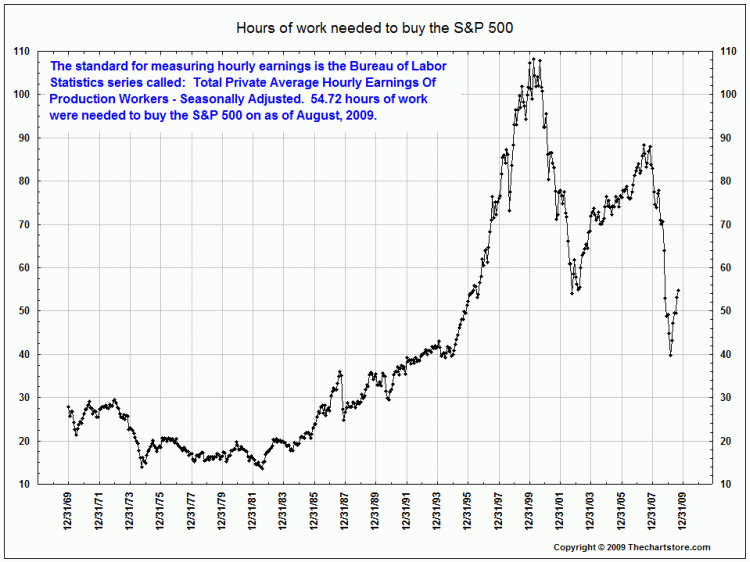
Note that in the early 1980s, you could by the SPX with under 20 hours of labor — Stocks were cheap then. In the late 1990s, it took more than 100 hours of labor to buy the SPX — Stocks were expensive then.

Now, it requires 54.72 hours of work — somewhere in the middle.

>

Hours of Labor Required to Purchase S&P500
9-4-09 Hours to buy S&P

>

Thanks to Ron Griess of The Chart Store for another fascinating chart.

83 Responses to “How Many Hours of Work Are Required to Purchase S&P?”

  1. leftback Says:

    Another way to look at P/E compression: 13 hours work to buy the S&P 500 in 1974 and 1982.
    4 times lower than today….

  2. nemo Says:

    Still very high by historical (pre-1995) standards.

    This time it’s different. . . .

  3. going broke Says:

    If you’re on CA unemployment receiving the maximum allowable, it would take 2.1 checks to purchase the S&P.

  4. call me ahab Says:

    a bubble still

  5. HarryWanger Says:

    So the market is fairly priced in other words. But when adding in the enthusiasm that is running rampant on the improving economic numbers, I am looking for 20% additional by EOY.

  6. call me ahab Says:

    troll

  7. E Says:

    “Total Private Average Hourly Earnings of Production Workers – Seasonally Adjusted”.

    Average, not median
    Production workers only, not the broader labor market
    Seasonally Adjusted

    Three strikes, that stat is out.

  8. flipspiceland Says:

    A mathematician, an accountant and an economist apply for the same job.
    The interviewer calls in the mathematician and asks “What do two plus two equal?” The mathematician replies “Four.” The interviewer asks “Four, exactly?” The mathematician looks at the interviewer incredulously and says “Yes, four, exactly.”

    Then the interviewer calls in the accountant and asks the same question “What do two plus two equal?” The accountant says “On average, four – give or take ten percent, but on average, four.”

    Then the interviewer calls in the economist and poses the same question “What do two plus two equal?” The economist gets up, locks the door, closes the shade, sits down next to the interviewer and says “What do you want it to equal?”

  9. call me ahab Says:

    Geithner Says Government Moving to Reduce Its Role in Markets

    http://www.bloomberg.com/apps/news?pid=20601087&sid=alupu1ynmkpI

    i don’t know wanger- what do you think?

    is uncle dumbass gettng out of the backstopping game?

  10. HarryWanger Says:

    ahab: That’s great news! Economy is getting stronger daily and government has no need to stay in the markets. That should make the indices fly now!

  11. leftback Says:

    Back in March, President Obama gave a VERY clear hand signal that it was time to buy stocks, which were cheap.
    This Geithner release could be the hand signal that it’s time to get out of the water.

    Have fun splashing around Harry, while it lasts. Just think about the strong Treasury auctions (you know, bonds).
    Wait a minute, is that a fin on Blankfein’s back? SHARK !!!

  12. Mannwich Says:

    I’m sure this will be viewed as “better than expected” by the markets or just completely ignored.

    http://www.calculatedriskblog.com/2009/09/census-bureau-real-median-household.html

    Less income is GOOD for the markets! Spin it like that….or, something……

  13. HarryWanger Says:

    leftback: This Geithner release is the signal to get in not out. A clear signal to average Joe that the economy is strong enough to not need government intervention. How could that not be good for the markets?

  14. Thor Says:

    Manny – what the article didn’t mention is that the government hasn’t changed how they calculate the poverty level in over 40 years.

  15. Mannwich Says:

    @Thor: So the real poverty level is probably even worse than they are reporting?

  16. IdahoSpud Says:

    This is an odd metric. While thought-provoking, I cannot decide whether it is useful or not.

    The recent tech and housing bubbles are quite evident on this chart, and it looks like the beginning of another bubble on the right side of the chart.

  17. Thor Says:

    Manny – Yes, I think that would be a fair assessment. NPR had a piece about the poverty rate this morning, many states are using their own calculations as the federal calculations make little sense in places like Boston, NYC, or San Francisco.

  18. leftback Says:

    “A clear signal to average Joe that the economy is strong enough to not need government intervention”

    Strong enough to generate at least $15-18/share for the S&P 500… who are you, anyway – Brian Wesbury?

  19. Mannwich Says:

    @leftback: Don’t waste your energy. That’s all I’m going to say. I learned that the hard way last night.

  20. Onlooker from Troy Says:

    It’s probably just another manifestation of the skew of wealth to the few. Those folks are the very large majority of the investor class and are just awash with money and so don’t see any problem with bidding up stocks to ridiculously rich valuations by historical standards (going back to ‘69 or so which is all this chart shows). It just doesn’t faze them because relative to their increasing share of income and wealth it’s no big deal. Heck, it even helps them because it prices out the rabble and gives them even more control.

    Interesting because I hadn’t linked those factors together like this before. And it helps to even better explain the rise in valuations in the bubble years. It’s also very disturbing, of course. Except for those who just want to ride the wave and don’t really care about the socioeconomic consequences to the whole of society. They’re happy as pigs in mud.

  21. Onlooker from Troy Says:

    Another good article by Dr. Housing Bubble re: the GD

    The Gospel of Economic Prosperity: Lessons from the Great Depression Part XVIII. Pretend and Spend and Success will Come.

    I put it on the other thread but don’t think anybody’s there anymore.

  22. DL Says:

    Thor @ 2:38

    A bottle of wiskey, and a cardboard box next to a steam grate in Manhattan. What more could one ask for?

  23. cvienne Says:

    @Wanger

    “I am looking for 20% additional by EOY”

    Screw that…Why wait for the rest of the year to make a stinkin 20% that you’ll have to pay taxes on?

    I’ll give you a freebie… Take the STEELERS tonight and lay the 6 points… That’s 100%, overnight…

  24. Andy T Says:

    Now, THAT is an interesting chart….thanks BR

  25. laughingAllTheWay Says:

    DL – I recommend tin foil lined cardboard boxes. It’s so cool to be able to get tin foil out of trash containers. It’s like people don’t even want to protect themselves anymore. So help yourself to their tin foil.

  26. mtc Says:

    change that to CEO bonus, and S&P is cheap.

  27. laughingAllTheWay Says:

    CV – better yet, Take Patriots minus the points for next Monday’s game. Should be a blowout.

  28. SecondLook Says:

    Perhaps, this might be a better way to look at it: Using the average hourly wage (this is the broadest number, including all workers), adjusted for inflation. The price of the S&P 500 is the close for that year

    1969: $18.25
    S&P 94.95
    Number of hours: 5.20

    1979: $18.75
    S&P 107.67
    Number of hours: 5.74

    1989: $16.5
    S&P 348.69
    Number of hours: 21.13

    1999: $16.8
    S&P 1,417.04
    Number of hours: 84.35

    2009: $18.66
    S&P 1,042
    Number of hours: 55.84

    At this moment, if you use the notion of comparing hourly wages to the stock market, it’s ten time more expensive than it was for the first 3 decades after the 2nd World War, and more than twice as costly as it was during the period from about 1985-1994.
    I think think the ratio demonstrates, acutely, the stagnation of wages per worker more than the value of the index.
    The numbers look better when you use average household income, but that is primarily due to the very large increase of 2+ wage earners per household since the early 1970’s.

    While we having fun with inflation adjusted numbers, these are the adjusted figures for the S&P 500 in terms of purchasing power

    1969: 521.27
    1979: 303.15
    1989: 596.28
    1999: 1830.99

    Fundamentally, the value of investments, of all capital, is in its purchasing power – what you can buy with it. Money, to all intents and purposes, is basically a medium of exchange.
    Therefore, ignoring the discounting effect of inflation over the years is a terrible error that we all too prone.

  29. wpeterson Says:

    IdahoSpud Says
    ‘This is an odd metric. While thought-provoking, I cannot decide whether it is useful or not. ‘

    I’ve just started reading the Wealth of Nations. Barry is channelling Adam Smith.

    “The real price of every thing, what every thing really costs to the man who wants to acquire it, is the toil and trouble of acquiring it. What every thing is really worth to the man who has acquired it, and who wants to dispose of it or exchange it for something else, is the toil and trouble which it can save to himself, and which it can impose upon other people.(Wealth of Nations Book 1, chapter V)”

    ~~~

    BR: EXACTLY !

  30. Mannwich Says:

    @laughing: I totally agree with that. The Bills are a mess. Of course, I’m a Pats fan, so I am biased, although I predict 38-10.

  31. cvienne Says:

    @laughingAllTheway

    agreed… I don’t like the loss of Richard Seymor… But I think the PATS are going to drop a 40 on the Bills…

  32. cvienne Says:

    …and yet the number of hours worked to hoe a bed for planting corn, tomatoes, potatoes, beans, & lettuce has stayed EXACTLY the same…

    REMARKABLE!

  33. HarryWanger Says:

    This is the perfect pace for this market to continue its run. Steady with .5-.6% rises. That bodes well now that all the resistance levels have been taken out on the indices.

  34. call me ahab Says:

    so . . .

    i am wondering the ramifications of tiny tim’s remarks today about USG retrenchment on support for the financial markets-

    a sign? an omen?

    harry wanker liked the idea- although reading the prose- it appears to be f411 in disguise-

    i am thinking it could be the wrong message to those expecting the full faith and credit of uncle dumbass to backstop their trades-

    observations?

  35. cvienne Says:

    @Wanger

    “That bodes well now that all the resistance levels have been taken out on the indices.”

    Au contrare… HEAVY RESISTANCE is just above at 1044 – 1054… Plus the 89 week ME (which is around 1070 as we speak…

    Keep in mind Harry… I’m ROOTING for those levels to be reached… So don’t think of this blog as sad permabears…

    I’m happy you’re making $$, my friend…

  36. HarryWanger Says:

    ahab: It’s a win-win for investors. The retrenchment is signaling that the economy is much stronger than anticipated. That’s a win. Also, the ability and money remains on the government sideline in case it is needed again. Also a win since it shows the government has more and is willing to use it when (probably never in my lifetime) needed.

  37. arbitrader Says:

    @SecondLook

    So you adjust wages for inflation but not the S&P? You don’t see a problem with this?

    Try running those numbers back to 1900, the gap will be even more stark. The farther back you go, the more stark will be the gap. Thats the way inflation works. If you adjust for inflation you have to adjust everything for inflation, not just wages.

  38. cvienne Says:

    @Wanger

    “It’s a win-win for investors.”

    Harry, I like you (because I like your cojones – not literally)…but you disappoint me with a statement like that…

    INWESTORS????? You can’t think that the money poured into equities over the past 6 months was for INVESTMENT purposes, do you?

    No, no, no, no… It’s just, well, because the NFL season was over, and March Madness was winding down… You know? the bookies close up shop for a few months so people play around with this stock market thingy…

    Time to get back to some REAL inwesting…

  39. HarryWanger Says:

    I like your sarcasm but Barry is reiterating what I have said for a long time, stocks are priced right at this level and the new frenzy of enthusiasm that is about to hit will continue to push this higher and higher. Certainly no catalyst to the downside on the economic front that I can see.

  40. cvienne Says:

    @arbitrader

    You make a good point… and keep it on thread as well…

    I had your idea in mind when I posted my (3:35) comment… I simply expressed it in a different manner…

    Bottom line: Things like INFLATION, wages, prices, are all money constructs (designed, I suppose, to give somebody something to do)…

    But if you take it all away… A human basically needs water, food, & warmth (in that order)…

    The COST of the labor to achieve those things is constant (varied only slightly by the cleverness of the ‘tools’ he applies to the task)…

    So the difference is:

    - a simple person only needs a few seeds, some dirt, (and some ‘tools’ to work the dirt to grow food to nourish himself)…

    Instead, we have created this thing called an ECONOMY… And as result, we hire ‘tools’ to explain to us how it should run (hoping we get a little food as the end result)…

  41. leftback Says:

    “Certainly no catalyst to the downside on the economic front that I can see.”

    That’s a true statement. The catalysts are there (insolvent banks, CRE meltdown) but most people can’t SEE them. For as long as they can be hidden behind the curtain this rally will continue. The bond market isn’t fooled.

  42. HarryWanger Says:

    leftback: I’m curious – Barry basically laid out the explanation for why stocks were fairly valued right now. What tells you otherwise?

  43. cvienne Says:

    @Harry

    When one hears the term “Stocks are priced for perfection”, that does not denote that they are perfectly priced…

    Instead, it suggests that they “could be worth this much” if the PERFECT scenario unfolds…

    I am a doubter that the PERFECT SCENARIO WILL UNFOLD… Therefore, the catalysts to the downside, while you may not see them, are your bogeyman…

  44. jturner Says:

    Thanks for the chart, very interesting.

  45. HarryWanger Says:

    cvienne: But catalysts to the upside are coming at us daily. Every number beats, whether corporate or economic. That will continue for quite some time until an equilibrium is reached. Where is that? My guess is about 20% higher from here since all data throughout the end of this year and early into 2010 is going to look great YOY.

  46. call me ahab Says:

    wanker says-

    “and the new frenzy of enthusiasm that is about to hit will continue to push this higher and higher. ”

    ok- this proves that this is a complete put on- you are saying the dumbest shit to get a rise- so you have someone to talk to-

    when i read that statement i literally laughed- it’s that damn funny

  47. cvienne Says:

    …actually, LB laid out some interesting scenarios (CRE, insolvent banks, etc.)…

    At this point, because the market is reaching CLEAR overvaluation levels, I’m waiting for something more benign…

    I think we’re getting close to a point that some VERY BIG WHALES are going to head for the exits… Guys who manage a lot of money, have been through this before, and know where the exits are…

    When they start leaving the party, a stampede will ensue…

    So it’s not like you’re going to wake up one day and see a shopping mall default on a loan (hell, “Tavern on the Green” in Central Park just filed for Chapter 11 today…wen’t unnoticed)… No… Instead, it’s when the smart guys say “that’s enough for me”…

    You don’t know that day (but you’ll READ about it 3 months later)…

  48. Mannwich Says:

    If we’re really and truly out of the woods here in such a short period of time after facing the worst crisis since The GD, then the O man and his staff deserve not only another term, but maybe another TWO terms and the label one of the “top 5 presidents of all-time”. I would LOVE for this to be the case, but I think I know better than this. Common sense and reality are no fun sometimes, actually, most times.

  49. emmanuel117 Says:

    Looks like a lot of liquidity in that chart.

  50. HarryWanger Says:

    Mannwich: I read some very interesting articles regarding the exaggeration of the crisis from political points of view. Bearing that in mind, that yes, there was a crisis but not nearly of the magnitude the media laid out, it shouldn’t come as any surprise that we’ve rebounded so quickly.

  51. EricTyson Says:

    “The key to making money in stocks is not to get scared out of them.” —Peter Lynch

  52. Thor Says:

    Ahab – I think you made another successful call – Wanger is F411.

  53. Stillaway Says:

    Give credit where credit is due. The Wanger 2% Dip Rule is still working.

    It doesn’t matter (for now) that the market is disconnected from the economic fundamentals. Corporations will strive to make money at whatever level of business exists by cutting costs, that is, layoffs and salary reductions for the proles, more offshoring, and eventually replacing cloth towels with paper ones in the executive washroom.This trick will work until unemployment cascades upward achieving the critical mass of Ultimate Consumer Implosion. At this point cost-cutting can’t keep pace with the decline in revenue and an Earnings Miss occurs (typically preceded by the completion of inside selling). The CEO resigns, deploys his/her golden parachute and drifts downward landing a C-level position in a totally unrelated industry or perhaps a community service position (Treasury Secretary, Ambassador to Sweden, etc.)

  54. CNBC Sucks Says:

    How many hours of work are required to purchase the S&P?

    Hopefully, more hours than are required for cvienne to approve my trade with franklin420d in the Ritholtz fantasy football league. cvienne, who is The Great CNBC Sucks’ opponent in Weak 1, is also the league’s commissioner and has sole power to approve / disappove trades.

    cvienne, if you don’t approve the trade soon, I am gonna raise a stink so powerful you will wish you roomed with a cadaver.

  55. Mannwich Says:

    @Harry: I might be inclined to agree with you to a certain extent, except for all of the downright awful data in housing, employment and CRE, among other things. I just can’t see how things have been “exaggerated” as you claim when the reality out there is indeed downright ugly. Unemployment at 10% (in reality about 16-17%) is not something to cavalierly dismiss, IMO.

  56. SecondLook Says:

    rbitrader Says:
    September 10th, 2009 at 4:08 pm

    @SecondLook

    So you adjust wages for inflation but not the S&P? You don’t see a problem with this?

    There you go, both sides adjusted for inflation.

    1969: $18.25
    S&P 521.27
    Number of hours: 28.56

    1979: $18.75
    S&P 303.15
    Number of hours: 16.17

    1989: $16.5
    S&P 596.28
    Number of hours: 36.14

    1999: $16.8
    S&P 1830.99
    Number of hours: 108.47

    2009: $18.66
    S&P 1,042
    Number of hours: 55.84

    The story stays basically the same. By that particular metric, the market is still far above it’s historical range.

    However, I wouldn’t put that much significance into the ratio, the vast majority of stock has never been bought by the “average” worker. Perhaps a more telling indicator would be the ratio of the average income of people in the top two income quintiles – those who do by and large buy stocks – to market prices.
    I suspect that looking at that would indicate the market really hasn’t risen that disproportionally to income over the decades.
    Hmmm, interesting thought: How much of the great bull market during 1982-1999 was due to the outsized income gains of the top 20% of the country…

  57. HarryWanger Says:

    Mannwich: I posted this a couple of weeks ago on another site regarding unemployment. I actually said, “I don’t want to sound cavalier about people losing their jobs but it is exactly what the economy needs.” Sucks for those who lost their jobs but now that businesses are functioning at rather optimal levels of productivity, it’s a win for the corporation and their investors.

  58. Mannwich Says:

    @Harry: How do unemployed people afford to buy products, particularly discretionary products that make our economy go.

  59. call me ahab Says:

    cnbc-

    your season’s over- give up now- with some dignity- please- why get kicked around for the next 6 months-

    and confirm what is already apparent :-)

  60. MRegan Says:

    http://trendandvalue.blogspot.com/2009/09/when-not-if.html

    Via IncaKolaNews…this guy (the chartist) is arguing for a downturn. Interesting chart.

  61. call me ahab Says:

    wanker411-

    you kill me- you are like a gift that keeps on giving

  62. HarryWanger Says:

    Mannwich: You are correct, they don’t buy as many discretionary products. But they don’t have to. Here’s the problem with the false assumption that the consumer drives the economy and unemployment will dampen that. As corporations laid off more workers, they became much more efficient – effectively eliminating fluff. Now for the same business to be profitable or start to grow again, the bar is much lower than when they carried such enormous overhead. Thus, if sales drop 15% but cost cutting brought a net gain of 10%, that’s a good thing.

  63. Mannwich Says:

    @Harry: OK, so companies can become more profitable cutting costs. At some point, top line growth must also return to justify their stock prices, no? Or does that not matter anymore all of a sudden?

  64. CNBC Sucks Says:

    ahab – somebody who has three quarterbacks on their fantasy football roster should not attempt to talk smack with The Great CNBC Sucks. Did someone explain to you that you cannot switch quarterbacks in the middle of a game?

    I am not even gonna go into how you still have Michael Crabtree on your roster.

    cvienne – APPROVE THE TRADE. Thanks.

  65. Onlooker from Troy Says:

    SecondLook
    “Hmmm, interesting thought: How much of the great bull market during 1982-1999 was due to the outsized income gains of the top 20% of the country…”

    Yep, I was musing that notion in my post above as well. Never really made the direct connection before, but it’s intriguing.

  66. Mannwich Says:

    @CNBC: LOL. Excellent point!

    On another note, so much for the “sidelines money” going into equities meme……

    http://www.ici.org/research/stats/flows/flows_09_09_09

  67. HarryWanger Says:

    Mannwich: Top line growth does return when you level out the field. That leveling is happening now (actually, mostly has happened already). If you sell less goods, which they will, but have brought their overhead down significantly, which they have, then top line growth occurs once that equilibrium is hit. So unemployment is not an issue until it becomes significantly higher, say 30% or more. Then businesses will have other worries at that point. But that isn’t happening and won’t. We may have lost some jobs and job growth will be slow but swift action both by the government and corporate America nipped that at a sustainable equilibrium setting up growth.

  68. call me ahab Says:

    cnbc-

    just needed someone for my bye week my friend- leinart is my insurance in case Warner gets hurt or- god forbid- falls apart-

    as i said before- he looked good in pre-season-

    re crabtree-

    “Just three days from their season opener Sunday at Arizona, he’s barely ever mentioned. He’s so far behind that his rookie season could be lost even if he does show up for practice and pull on his No. 15 jersey.’

    so yes i am concerned- but where else is he going to go?

  69. Thor Says:

    Harry – what do you do for a living?

  70. HarryWanger Says:

    Thor: I own a small trading/investment business with 5 partners.

  71. Simon Says:

    Someone has probably already said it but that chart assumes that you have a job s doesn’t it? I imagine that in a stimulus flooded safety net world wages are probably sticky on the way down, hence the above chart is very much a lagging indicator.

  72. CNBC Sucks Says:

    The commish is good, and The Great CNBC Sucks is an ass.

    My apologies to cvienne. I will never question your integrity again.

    Ritholtz – can you reallocate a few of my off-topic allowances to cvienne? I know you have a special reserve for me because Barry Wuzzy wuvs The Great CNBC Sucks.

  73. Thor Says:

    CNBC – I wish you’d stick around awhile this time

  74. call me ahab Says:

    “The Great CNBC Sucks is an ass.”

    will anyone challenge this statement?

    much akin to saying the sun rises in the east and sets in the west- or-

    autumn follows summer-

    self evident-

    however- i don’t want CNBC to think he isn’t wanted-

    we love you man

  75. CNBC Sucks Says:

    @ Thor — That is the sweetest thing anyone has ever said to me on this blog. From the man with biceps no less. Thank you.

    @ ahab – The thing about football is that the ball is shaped funny and stars get injured all the time. Regardless of how much I make affectionate fun of your roster, you just never know what will happen. In this regard, fantasy football is intellectually a superior endeavor compared to the stock market, where it is a foregone conclusion that the US government will do anything in its power to make sure the Dow Jones False Prophet Index will keep going up and up and up, no matter the ultimate consequences to the people or the nation’s future. In any case, The Great CNBC Sucks wuvs you all too.

    Just as long as you are…FASHION-FORWARD. ;)

  76. AmenRa Says:

    For those who like the magic charts. Monthly reversals are major trend changes when using TLB. This chart I’m linking to uses the S&P from 02/98 to today.

    It was trending up until 07/98. Reversed down 10/98. Not confirmed following month which closed higher (11/98). Started trending up 02/99. Stayed in trend until 10/00. Broke through reversal price in 01/01. Confirmed by a lower monthly close following month. Note: the market can take as long as it wants to confirm or negate a reversal. Started trending down 07/01. Stayed in trend until 09/03. Reversed up in 10/03. Started trending up 12/03. Stayed in trend until 04/06. Reversed down 08/06. Reversal negated with higher close in 09/06. Started trending up in 11/06. Stayed in trend until 12/07. Reversed down in 01/08. Started trending down in 05/08. Stayed in trend until 06/09. Reversed up in 07/09. If September closes higher then it will be trending up again. Current reversal price is a monthly close below 825.88.

    Chart here: S&P Monthly TLB by AmenRa

  77. franklin420d Says:

    Uncle Harry – On your assumption that some unemployment is good.

    In the late 80’s, early 90’s, I worked at a pharmacy, one of the ladies I worked with and myself worked our butts off, we offered superior customer service and innovated ideas the owner never thought of, as a consequence of our hard work the store grew leaps and bounds. After the pharmacist bought everything he ever wanted and more, he had no place to put his money, so he started hiring new employees, we went from 4 full time employees to 9 and production went down, I caught an employee stealing ($500) and told the owner, he did not care. The original lady and I got tired of how things were going and quit.

    My point is that excess money needs to go some where and after companies purchase everything they ever thought they needed, they will hire extra people, too many extra people and productivity declines and unethical behavior increases.

    Therefore I 100% agree with your assumption that some unemployment is good, but after we quit the store started a tail spin that it never recovered from and he eventually closed his store.

    But what is the equilibrium? And once it is crossed by hiring too many employees, what is the equilibrium number for returned productivity and was too many key jobs are lost can that equilibrium ever return to that business. I don’t ask you this question because I think you have the answer (You or no one can have those answers) I ask the question because those are just a few of the things that concern me.

    Further more you make the assertion that the crisis was manufactured in the first place.
    4:40pm “Mannwich: I read some very interesting articles regarding the exaggeration of the crisis from political points of view.”

    So doesn’t it also hold true that the recovery may be being exaggerated for political purposes?

    Anyway – I talked with your doctor today and he said it was ok to up your meds, so hopefully this will keep some of your more tourette like outbursts under control.
    And tell my little bro I miss him and when he comes back home to pick me up a bag of smokes.

  78. franklin420d Says:

    Uncle Harry – On your assumption that some unemployment is good.

    In the late 80’s, early 90’s, I worked at a store, one of the ladies I worked with and myself worked our butts off, we offered superior customer service and innovated ideas the owner never thought of, as a consequence of our hard work the store grew leaps and bounds. After the owner bought everything he ever wanted and more, he had no place to put his money, so he started hiring new employees, we went from 4 full time employees to 9 and production went down, I caught an employee stealing ($500) and told the owner, he did not care. The original lady and I got tired of how things were going and quit.

    My point is that excess money needs to go some where and after companies purchase everything they ever thought they needed, they will hire extra people, too many extra people and productivity declines and unethical behavior increases.

    Therefore I 100% agree with your assumption that some unemployment is good, but after we quit the store started a tail spin that it never recovered from and he eventually closed his store.

    But what is the equilibrium? And once it is crossed by hiring too many employees, what is the equilibrium number for returned productivity and was too many key jobs are lost can that equilibrium ever return to that business. I don’t ask you this question because I think you have the answer (You or no one can have those answers) I ask the question because those are just a few of the things that concern me.

    Further more you make the assertion that the crisis was manufactured in the first place.
    4:40pm “Mannwich: I read some very interesting articles regarding the exaggeration of the crisis from political points of view.”

    So doesn’t it also hold true that the recovery may be being exaggerated for political purposes?

    Anyway – I talked with your doctor today and he said it was ok to up your meds, so hopefully this will keep some of your more tourette like outbursts under control.
    And tell my little bro I miss him and when he comes back home to pick me up a bag of smokes.

  79. franklin420d Says:

    FYI – farmacy with a ph is a filtered word.

  80. AmenRa Says:

    As the dollar turns: USD Monthly TLB by AmenRa

    Not looking good for the greenback.

  81. franklin420d Says:

    @ CNBC sucks “The Great CNBC Sucks is an ass.”

    Hey we all have to be good at something :)

  82. Wes Schott Says:

    @amen -

    that rhythm looks ominous

    so, does that mean it is not?, LB?, Diogenes?

    $=toast, unless all credit/debt collapses

  83. constantnormal Says:

    Funny, the assumptions involved here … that the value of labor is the same in each of the periods, that the value of the S&P is the same … and that only the willingness of people to pay more/less of their labor to purchase the S&P is what has changed.

    There are more degrees of freedom here than there are variables. It’s all nonsense.