
Yet Another Bailout: Housing’s Hair of the Dog

Email this post Print this post
By Barry Ritholtz - September 8th, 2009, 11:13AM

One of the arguments I keep making is that the folks pushing “Less Bad = Good” are ignoring the impact of Uncle Sam’s largesse.

Let’s look at how much the U.S. government is pushing a housing recovery via a hair of the dog.

As the WSJ reported last week, the number of loans backed by the FHA has soared, and “its market share reached 23% in the second quarter, up from less than 3% in 2006, according to Inside Mortgage Finance.”

Even worse, the FHA is now insuring mortgages with as little as 3.5% down. Add in the $8,000  first time buyer tax credit, and you have all the makings of a government sponsored boomlet.

The downside?

Rising delinquencies, for one thing. The FHA delinquency rate has soared. The Journal noted that “At the end of June, some 7.8% of FHA-backed loans were 90 days late or more, or in foreclosure, according to the Mortgage Bankers Association, up from 5.4% a year ago.”

Then there is this WSJ article:

Before the boom, the FHA wasn’t a big player in the housing business because it didn’t follow private lenders in loosening its standards. Borrowers had to fully document incomes and insured loans were capped at $362,000. Congress increased those limits last year to as high as $729,750 in the most expensive markets. In August, the FHA and the U.S. Department of Veterans Affairs backed 40% of loans for all home sales.

Oh, and the FHA reserves are being seriously depleted. Then there is the little issue of the (not so) green shoots. When the money runs out, so too will much of the economic bump.

So the cure for too much easy credit going to unqualified people with too little skin in the game is more easy credit going to (according to delinquency rates) unqualified people who have too little skin in the game.

Kinda like drinking yourself sober.

Once again, the taxpayer is the one buying drinks for everyone else who should at this point be stone cold sober.

>
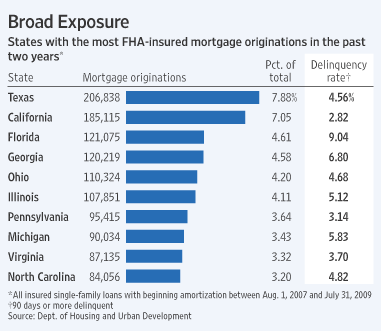
FHA loans 20090904

courtesy of WSJ

>

Sources:
Behind FHA Strains, a Push to Lift Housing
NICK TIMIRAOS
WSJ, SEPTEMBER 5, 2009

http://online.wsj.com/article/SB125211204270688031.html

MBA Reports Government-Insd Share of Mortgage Apps Highest Since 1990, Now at 36%
Mortgage Bankers Association , July 9, 2009

http://www.mortgagebankers.org/NewsandMedia/PressCenter/69541.htm

Loan Losses Spark Concern Over FHA
NICK TIMIRAOS and DEBORAH SOLOMON
WSJ, SEPTEMBER 4, 2009

http://online.wsj.com/article/SB125202440174685297.html

FHA Likely To Be The Next Shoe To Drop
John Burns Real Estate Consulting, September 2009

http://www.realestateconsulting.com/Newsletters.aspx?quicklaunch=true&newsletter=Strategic/strategic200909

79 Responses to “Yet Another Bailout: Housing’s Hair of the Dog”

  1. km4 Says:

    As *structural unemployment becomes worse the more the U.S. government pushes a housing recovery with easy terms like for who – the 80% that get avg of $33K/yr ? The gov is acting like a drug pusher.

    *Structural” is a polite way of saying there won’t be any jobs for the long-term unemployed this year, next year, or the year after that.

    Of the roughly 130 million jobs in the U.S., only 20%, or 26 million, pay more than $60,000 a year. The other 80% pay an average of $33,000. That ratio is not a good foundation for a strong middle class and a prosperous society.

  2. Marcus Aurelius Says:

    The FedGov is panicking, and who could blame them? To return to my airborne car analogy, it doesn’t matter what they do at this point, the end result will be impact with the ground (reality). Go ahead — floor the accelerator and pump the break at the same time, steer left and right, downshift, upshift, and slam it into reverse, and you can even use the turn signals and wipers (if all else fails, they can always take a big hit off of their almost-empty bottle of “kool aid”). I don’t begrudge TPTBs reaction to our situation. Desperate times call for desperate measures.

    OT and aside: (R) governed states seem to be over represented on the list of the largest numbers of FHA originations/delinquencies. So much for Texas secession.

  3. leftback Says:

    UFB. It’s almost as though the government were totally controlled by banks, homebuilders and real estate brokers.
    The carnies are in control. All the fun of the fair.

  4. Housing issues not behind us « lou whiteman is wrong Says:

    [...] issues not behind us Posted on September 8, 2009 by Lou Barry Ritholtz says the government-induced housing recovery is “kinda like drinking yourself sober.” His post is the case for why the worst might not be [...]

  5. BSNEATH Says:

    Of all of the stupid things that our government is doing with future taxpayer dollars, lets just say that keeping families in their homes is perhaps one of the “least stupid”.

    It beats the hell out of buying toxic and worthless assets in order to prop up bank balance sheets which in turn permits bonus-as-usual largess.

    Why do we criticize anything that helps out main street but turn a blind eye to massive bailouts of Wall Street?

    More importantly, why are we not madder than hell and doing something about it?

  6. Pat G. Says:

    It is apparent that the USG is not taking away the punchbowl anytime soon. In fact, this is an example of them expanding it. The other G20 countries will follow the USG’s lead and their currencies will suffer the same fate that the USD is experiencing now, in the end. At the G20 this weekend, most wanted to rain in excessive bonuses. Timmy wasn’t too fond of that idea and instead insisted that the G20 needed to have their banks increase their reserve requirements. That is all about shoring up excess liquidity in order to prevent it from leaking into their economies and causing inflation. The USG’s priorities are all backward. This is the reason commodities are on a tear. Just about everyone of them is a hedge against currencies and/or inflation.

  7. Onlooker from Troy Says:

    LB

    Indeed, they’re selling us down the river for the crooks who got us here. (plus many other factors, I know, save the replies in that vein)

    What it all comes down to is cowardice; on the part of politicians and much of the population. We’ve been afraid to deal with reality for so long that we’ve lost control of everything. The fork in the road is so far back, and our current track is getting further and further away from where we could and should be. There’s no easy way to get there now but continuing down this road sure won’t do it.

  8. FrancoisT Says:

    Can you smell the fear oozing out of the financial and political elites?
    They look so powerful, so out of reach.

    What these FHA numbers tell me, is that they’ll do whatever it takes to maintain a semblance of “return to normalcy”. In reality, there are so many things that must change:

    1) The financial sector must shrink dramatically
    2) The whole regulatory paradigm should be turned on its head. No more playing catch-up with the financial innovators.
    2a) FCPA need to become law.
    3) Campaign finance should be public only
    4) The housing sector allowed to bottom out without reckless intervention from the govermin.
    5) Basic research up and running again, without “translational” mandates.
    6) Real health care reform implemented (Yes! That include cost controls.)
    7) Complete overhaul of the primary and secondary education system, which still function as a 18th century institution.
    8) Strip corporations of their “personhood” status.
    9) Revisit tort reform; if you’re a small biz, try to sue a big competitor that illegally screwed you…good luck!
    10) Fair doctrine reinstated.
    11) Audit then abolish the Fed. Replace with no banks with privileged seats at the table or let the market dictate interest rates.
    12) Incentives to green the whole economy. You want to create jobs and a sustainable economy or not?

    J’ai dit!

  9. FrancoisT Says:

    Forgot an item in my last post.
    13) One ice cream for every kid each Sunday! ;-)

  10. DeDude Says:

    Letting everything just collapse is not an option in the real world where the loss of a job in a dead market means loss of everything you own and worked hard for the past 20 years. I know that for you thereticians with you’re a$$ safely out of the water, the “let it all collapse” hypothesis sounds tempting – even if reality has proven that the deeper these self-reinforcing cycles fall the longer it takes to recover. The vultures, sitting in the trees waiting to pick up the assets (that someone worked 20 years to accumulate) for pennies on the dollar, may not like it, however, it is the job of government to blunt the falls and smoothen the path of the economy.

  11. Mannwich Says:

    @DeDude: Here we go again with the false arguments. Can we please stop the “letting everything collapse” meme? Please? Hardly anyone at TBP is advocating that. Please just stop it. Please……..

  12. call me ahab Says:

    BR says-

    “Even worse, the FHA is now insuring mortgages with as little as 3.5% down”

    that has always been the case Barry- in fact- until recently- it was a 3% down statutory requirement- and full documentation of income has always been required-

    what has occurred though- is- that- FHA loan limits have been incresed to $729,705- as has Freddie and Fannie-

    the difference being- that with Freddie and Fannie- w/ less that 20% down- private mortage insurace is required- and those companies have tightened to the point where it is difficult to get mortgage insurance- thus-

    FHA- which is self insured-

    the historical loan limits have been considerably less than even the standard Freddie/Fannie limits of $417,000- thus the stark data point of 3% for 2006-

    these expanded limits are supposedly temporary- and set to expire this year- but we will see what happens- not sure the private jumbo markets are ready to expand lending

  13. franklin420d Says:

    Whooaaa BR – I am liking this drink myself sober idea – Is that really possible? Cuz I know pa tried.

    Now just let Ben B. get back behind the wheel of the housing market and AWAY we go.

    Yea, this is going to be one hella good ride.

    Hey, I am running to the store to stock up on beers, anyone what one?

  14. DeDude Says:

    Mannwich; if the government did not intervene in the current mortgage mess there would be no way that all those loans would be given, and the housing market would collapse. We can argue how much and how little intervention is needed for how long to avoid a certain level of collapse, but if the only game in town leaves town then there is no game anymore, and that is a fact.

  15. BSNEATH Says:

    Good comment DD.

    There are too many dogmatics at both ends of the spectrum.

    There are real people out in society who are getting pummeled and losing everything they and their families have. To advocate absolutist “tough love” in today’s environment would not only further cripple the foundations of our economy (aka jobs, homeownership, small businesses, etc.) but as you point out, would also permit the vultures to swoop once again.

  16. Mannwich Says:

    @DeDude: I’m not against intervention, but am against the wrong intervention. Please try to make that distinction in your arguments.

  17. Effective Demand Says:

    Low downpayment in high cost areas doesn’t make any sense. They used to have low downpayment loans for low cost areas because your chance for future income increase was high and future income decrease is low. But in high cost areas your chance for lower income is high and higher income is low. Yet the two type of loans are underwritten the same.

    The other issue is DTI ratios. Currently maxed out at 31/43 (which is still insane) for manual underwrites but with automated underwriting and compensating factors I see LO talking about approves at 60% DTI. Meaning the borrowers monthly debt nut is 60% of gross and they give them the loan because mummy and daddy kicked in 5k for an extra downpayment. Underwriting is far too lose, they push debt ratios and consider all sorts of non-standard non-W2 things as income.

    The only thing FHA has going for it is the up front mortgage premium and monthly premiums. That will limit the losses a bit but it will still get ugly.

  18. Mannwich Says:

    @DeDude: And you are wrong – - there are plenty of “games” left in town. That’s all our “economy” seems to have left to keep things going, or keep up appearances. Wall Street is playing and winning them at all our expense.

  19. Calvin Jones and the 13th Apostle Says:

    John Fogerty better be warming up his guitar.

  20. DeDude Says:

    Mannwich; thats OK but I don’t see more wrong with the above intervention than with not doing anything. If you have an alternative that will provide the same level of support for people in trouble then I am willing to listen. If the people complaining about the current defense against market forces attack on our country, have a better strategy I am all ears. But all I see on this site is screaming about the current defense without any realistic alternatives being presented.

  21. DL Says:

    Massive unfunded liabilities by the Federal government: bullish for gold.

  22. Mannwich Says:

    @DeDude: I would much rather we bail out homeowners, specifically the people who played no part in this mess. I’m with you there, but going back to 3.5% down on homes that are still too expensive in relation to incomes is not a good idea in my mind. It’s provides artificial price support and will just keep things in a zombie-like state. Sooner or later, the housing market will need to come down to prices that reflect the ability of people to actually afford them. We’re just dragging out the inevitable. These recent bag-holders will find out soon enough.

  23. DeDude Says:

    Mannwich; OK so where do I go to get a home loan if I have about 5% for the down-payment and can afford a rate of about 5-6%. My income for that loan is perfectly good and my credit score is also excellent. If you are saying that I shouldn’t get that loan you are also saying that the housing market should be allowed to collapse.

  24. constantnormal Says:

    Apparently, the only thing that will bring this party to an end is for the frat house economy to burn to the ground.

    Only then will the sheeple not accept the nonsense handed them by their elected buffoons and demand changes in the way we do business. ‘Cause only when the sheeple have nothing left to lose will they turn away from embracing the mirage of the past bubbles.

    There’s still of lot of destruction remaining before enough anger is generated … party on!

  25. DeDude Says:

    The reason for the defaults are not that the homes are to expensive. It is that people still lose their jobs (now at a higher rate than ever) and a lot of people go bankrupt with medical problems because of our screwed up health insurance system (where people end up losing coverage when they need it most).

  26. call me ahab Says:

    dedude-

    well- as far as the USG and the mortgage market- we do see how well Freddie and Fannie did- right? Costing hundreds of billions of $ in taxpayer money to keep afloat-

    not sure FHA will fare much better- however- there needs to be an entity that allows mortgage borrowing to occur- so i understand the reasoning-

    but what of the Fed policy that creates money to buy MBS to drive down mortage rates-

    should the USG be behind subsidizing rates to spur demand of an overbuilt commodity?

    is that good public policy?

  27. Thor Says:

    Ahab – you took the words right out of my mouth. Also, housing prices in many market are half what they were at the peak. The total “bad debt” in mortgages isn’t necessarily being accumulated at the same levels they were 4 years ago.

  28. constantnormal Says:

    @DeDude 12:30 pm

    “… be allowed to collapse.”

    I think you misunderestimate the situation. The housing market IS collapsing.

    http://www.businessinsider.com/chart-of-the-day-xxxx-2009-8

    The housing market will be contracting on a valuation basis for several years to come, given the overhang of unsold inventory (which is being increased daily, as you can see). I recommend avoiding house purchases until the valuations have stopped falling, as it’s just not smart to borrow money to buy a depreciating asset.

  29. Thor Says:

    Dedude – I’m not sure your argument that home are still too expensive holds much water outside of the hyper inflated markets. You obviously don’t live in NYC, SF, or LA.

  30. constantnormal Says:

    @Thor — I live in the heart of the Ohio Valley, next door to one of the pricer zip codes (so the homes in my neighborhood are much cheaper than the expensive-but-similar homes a mile away) in the state, and I found out yesterday a sale price on a neighbor’s house that shocked me. And I had already put in place in my spreadsheet of financial assets a 30% slide in my home’s valuation, spread out between the end of 2007 and the end of 2010.

    This was a home that initially sold (circa 1980) for $195K, and was resold over the intervening years for upwards of $230K. A very nice 2 story 4 bdrm 3 bath of (guesstimated) ~3000 sq ft, and a heavily wooded lot of about a third of an acre (stop laughing, you farm-folks). After 2 years on the market, it sold for $169K.

    I was in Austin over the summer, and looked at homes half the size of this one that were being offered for a LOT more.

    You don’t have to be in NYC, SF, or LA to see significant price reductions. The asset destruction is still on-going.

  31. DeDude Says:

    Fannie and Freddie are providing loans for people who have everything needed to responsibly own a home (including the current income to make the loan payments), and also have a 20% downpayment. FHA is doing the same, except that they will allow loans to people who have everything needed but only have a 3.5% downpayment. Nobody is giving out options ARM or lier loans or any of those other products that were designed to suck money and dreams out of hardworking people with minimal financial sophistication.

    The default rates on these responsibly given loans are increasing because the economy is tanking and the type of job and medical emergencies that always sink a certain amount of responsibly given loans are going up.

    Fannie and Freddie are dealing with the legacy of having been a privately owned for profit entity that were forced to take undue risks to keep up with their competitors. Had they been non-profit like FHA they would have done like FHA during the boom years; remained responsible in their practices and allowed their marked share to be reduced. The problem was that we allowed them to become a government sponsored playground for private profiteering – so government ended up with a huge bill. Unfortunately we have still not fixed that, they are still a private for-profit company even though government is the majority shareholder.

    The USG does not have a choice between the good and the bad, it’s a choice between the bad and the even worse. So they do have to hold their hand somewhat under the housing market for some time. If it doesn’t find its own feet soon they may have to let it sink further over the next few years, but they cannot allow a panic or drastic fall, because the collateral damage of letting it fall quickly (a collapse) is not acceptable to the regular people who will be hurt.

  32. Mannwich Says:

    @DeDude: Under few circumstances that I am aware of is 3% down a “responsible” thing to do. Sorry. Call me “old fashioned”, I guess.

  33. The Curmudgeon Says:

    @Ahab:

    to your excellent observations, add this one:

    Anyone in the residential real estate market knows the FHA for what it is–the US government’s subprime mortgage company. Their whole schtick is to underwrite the houses, not the mortgagors, who often have lousy credit and anyways have no skin in the game.

    The reason the FHA could step in so quickly and expand its role in the market is that virtually all of the subprime mortgage companies went kaput.

    The FHA is again taking bets on the houses, not the mortgagor’s ability to repay. With down payment assistance programs, which were recently tabled, the mortgagor’s often had only 1.5% skin in the game. Even at 3.5%, the mortgagors really only have to pay closing costs.

    The expansion of FHA lending is just doing more of the same as has been happening since Sep of 2008–the federal government collectively assuming individual risks. This won’t end any better than before.

  34. pmorrisonfl Says:

    @DeDude
    > The reason for the defaults are not that the homes are to expensive.

    While your other reasons are certainly true, that doesn’t mean homes are not too expensive. I’ll trundle out an old example refreshed, of a townhouse community I once lived in here in South Florida.
    Built in 1999, sold for 100K at the time
    I bought in 2001 for 140K, the neighbors thought I was crazy.
    Sold in 2005 at 310K
    Currently selling at ~80K

    While down substantially from 2005, did this place really gain 80% in value over the last decade? And did people’s incomes really grow 80% to support a mortgage on such a plce (ok, say incomes grew ~50%, since interest rates are lower now… it’s still not flying).

    While it looks like low-end areas are returning to sanity, it still looks to me like the mid- and high- ends have declines to come in this bubble area.

  35. pmorrisonfl Says:

    Oops: I meant 180K, not 80K

  36. DeDude Says:

    Ahab; the current fed policy of purchasing F&F bonds is simply a substitute for the more appropriate policy of direct government purchase of that paper fianced by selling treasuries. It is apparently impossible to get past the screaming idiots of our idiocracy and explain the difference between spending and being a loan conduit. So here we are with a more risky approach to allow individual people to get loans at a rate that is within a few hundred basis points of the rate “we the people” can get. The potential cost is a huge bargain for essentially preventing the great ressesion from becoming a great depression.

  37. constantnormal Says:

    @DeDude — I don’t think people here are cheerleading for the economy to fail, only for a return to some semblance of rationality in our approach to running the economy. But it appears that it will take a complete failure for that to occur.

    FrancoisT (12:10 pm) has an excellent list of things that need to be done. Do you really think that anything like that could happen without a total collapse? People will not look away from the pleasant past and comfort of previous bubbles and the Powers-That-Be are not going to do anything to upset their lobbyist backers.

    The only way I can see to change this is to separate the lobbyists from their money, which will separate them from the politicians. And the only way to separate the lobbyists from their money is for the corporations employing then to go bust. It’s going to take a lot for that to happen, because they are able to command the resources of the federal government and force it to borrow astronomical sums in the taxpayers’ name to keep them afloat.

    Eventually, the taxpayers are bankrupted, and nobody will loan them any more money (we’re very close to that now). But even that is not the end, because the Fed will print money and crash the dollar instead of disappointing our lobbyist overlords.

    So while I do not want things to collapse, I want them to continue down the road we are on even less, as that leads to a longer-lasting collapse.

    It’s kinda like this — say you had a flesh-eating bacteria on your leg , would you opt for the peach pit therapy (ref to the late Steve McQueen, or Steve Jobs’ fling at using a macrobiotic diet to deal with his liver cancer) or have the leg amputated? Nobody wants to lose their leg, but a sane individual would not hesitate long in making that choice. But there are lots of people (McQueen, Jobs, plenty of others) who are too focused on the past to make an objective assessment about their present and future.

    Focus on the disease, and the cure will become obvious. And it’s not being able to buy a house with 5% down and a 5% loan. 5% down is 20-to-1 leverage. If there were any reasonable chance of the asset declining by 5% or more, one would be a fool to wish for such an “opportunity”. I’m not calling names here, I’m just sayin’.

    The past is gone. Don’t wish for it back, as it was based on false promises, lies and deceit. Wish instead for a stable and growing-more-prosperous future. How we’re gonna get there is the problem. We need to call the Ghostbusters and have them cross the particle streams in Washington D.C. and on Wall Street. Send all those zombie banksters and zombie politicians to another universe.

    But that’s fantasyland too. The best we can do is hope that their money is taken away. And now we’re back to the amputation metaphor.

  38. karen Says:

    The flip side for a bit of eye-rolling humour: “The Self-Employment Catch-22, For freelance workers, buying a house just got that much harder.”

    http://nymag.com/realestate/realestatecolumn/58832/

  39. constantnormal Says:

    Really people — stop talking about 5% down and 3% down, and start referring to buying homes using 33:1 and 20:1 leverage.

    X% down is a salesman’s trick to fool the suckers, forcing them to focus on the amount they are paying in the here-and-now instead of on the financial risk they are assuming.

    The proper way to address that is to also look at the total amount of interest that will be paid, and then consider the risk of the mortgage going under water, and losing the home and all that the homeowner has put into it, at the next economic downturn.

    Rational buyers will blink a couple of times and start bargaining differently.

    The rest — well, there’s an old saying about people and their money …

  40. constantnormal Says:

    I transposed the leverage and rates — I presume you are all smart enough to know what I meant there.

    5% = 20:1
    3% = 33:1
    2% = 50:1
    0% down = simply nuts

  41. Thor Says:

    constant – sorry, I misspoke. I meant to say that the housing stock in SF, NYC, and LA are all still OVER priced. Prices in these markets have fallen a lot – but looking at the big picture, I don’t know many people who would say homes in these markets are anywhere near affordable for the average Joe.

    Your story about your neighbor sounds a lot like my neighborhood. I’ve seen four homes almost identical to mine sell in my small complex over the last two years. I stopped looking at the sales price a year ago :-)

  42. Mannwich Says:

    The higher-end is still way overpriced everywhere in this country. There simply aren’t enough high incomes to support all of these high end homes. The wealthy can hang onto their illusions much longer and think they’re going to get their asking price. Eventually they’ll start cutting prices in a big way when the realization sets in that they have no choice. Of course, then all prices in the middle and lower tiers will then go down again as well.

  43. DeDude Says:

    Mannwich; the 3% worked perfectly well for FHA until recently, so the 3.5% used currently is not that bad in historic perspective. If the income is there to make monthly payments, then the size of the equity cushion is not important. The size of the equity cushion is only important when the owner or mortgage holder is forced to sell the property. They will lose some extra money by using 3.5% rather than 20%, but that is the choice between bad (increased loss) and even worse (collateral damage from a “nobody can purchase a house” situation)

  44. Mannwich Says:

    @DeDude: That’s because it wasn’t widely used until now. I will admit that not all FHA’s were/are bad. I know some folks who initially got FHA’s a long time ago and they’re still in their homes and paying on time, but one of them is a doctor. However, it’s now become the new subprime tool for many who probably shouldn’t be buying a home for $700K+ because their incomes really don’t support it. because all those other idiotic loans are no longer available. It’s the new subprime and is thus being used in lieu of that, and used irresponsibly in many cases, I might add.

  45. DeDude Says:

    Pmorrison, and others;

    I should have said: “The reason for the defaults are not that the homes are to expensive RELATIVE TO THEIR INCOME”

    I would certainly agree that the absolute price levels in some areas are to high by a number of reasonable yardsticks. However, it is not a problem for the lender as long as the owner can make the monthly payment.

  46. Vilgrad Says:

    We’ve lived in Beverly Hills for three decades. It’s time to move back to Mayberry.

    http://theburningplatform.com/economy/living-in-beverly-hills-2

  47. Sloanslake Says:

    Barry:

    I love you 99% of the time, but you are off on FHA. Although FHA has been more lenient in underwriting requirements than conforming (Fannie / Freddie) for the 13 years I’ve been in mortgages, it has always required full document loans with (generally) fair credit scores and (comparatively) reasonable debt to income ratios.

    They have always (during this time period) had low down payments (3% until last year) and lesser FICO requirements (effectively 620-660 today) for employed, full document borrowers. FHA does not provide interest only nor neg am loans, nor does it allow liar loans, non-owner occs, 2nd homes, 125% seconds, 100% NINJA HELOCs, or any of the list of the tragic financial innovations of the last decade.

    Hate FHA if you like, but they (and their supporting lenders) have RAISED standards continually over this period of time, NOT lowered them.

    Perhaps you might wish to have FHA loans require an even greater tightening that that already shown- fine, if so, please enjoy your depression. FHA IS mortgage finance in much of the US today. Very few home buyers (and near 0% FTHB) can satisfy conforming loan requirements. If you wish to guarantee another 20-50% leg down in median home prices, please raise FHA standards to 20% down with 740 credit. Few will buy, fewer will have equity to sell. Hand them all over to the banks, HUD and the FDIC. Let the fed or states own all housing (like Scotland)!

    I counsel 5-6 would be home buyers a day (I am an attorney as well as own a mortgage company) and I relay that 20-25% of the would be buyer can today qualify under these present FHA standards. Perhaps 85% could qualify under some mortgage type 3 years ago (itself obviously too broad). These people have jobs, and want owner occupied properties with fixed rate mortgages, but they lack 20% down payments and or 740 fico scores. It is not today (at least in Denver) a factor of excessive home valuations (we are within 3-3.5% median income to median home value) nor is it a factor of excess debt (my average FHA client has similar debt to income ratio to my conforming client). Should only the rich today own homes?

    Sorry, rich posters, it will even effect your luxury homes as the entire realty food chain (from renter to first time home buyers to move up to luxury to empty nesters) are dislocated by these drastically increased mortgage standards. Let them eat cake?

    Enjoy riding your own home values down…

  48. DeDude Says:

    Constantnormal; I am certainly not against return to rationality or normality in ares of economics or spending. What I am against is to use the plan of just stopping all interventions cold turkey, because some clowns have a vision (they sure as hell don’t have any data to back it up), that if we just stop intervening then things may get bad – but then magically they will get good again all by themselves. We tried that kind of “imagination economics” with Reagans trickle down BS and a lot of people are still hurting. This time it is a lot more serious and a lot more people will get seriously hurt if we again abandon fact-based decision-making.

  49. call me ahab Says:

    dedude says-

    “The size of the equity cushion is only important when the owner or mortgage holder is forced to sell the property. They will lose some extra money by using 3.5% rather than 20%, but that is the choice between bad (increased loss) and even worse (collateral damage from a “nobody can purchase a house” situation)”

    so . . . uh . . .when these folks sell . . .who loses this EXTRA MONEY dedude- who comes to the table to cover the loss? assuming the borrowers have no money- which is very likely- because they could only scrape together 3.5% initially- and that was before the home puchase and the mortgage and all the costs associated with home ownership-

    how do they sell dedude? answer- they don’t- they are foreclosed

  50. DeDude Says:

    Constantnormal; for most people it is not and should not be an investment – it’s a home. The focus is rightfully, what will it take to get me in there and what will it take for me to stay there. Within those parameters I would wish that more people would follow the old rule of having a 6 month of expenses cash reserve (that’s sort of embedded in the “to stay there” question).

  51. pmorrisonfl Says:

    @DeDude “The reason for the defaults are not that the homes are to expensive RELATIVE TO THEIR INCOME”

    You’ve highlighted our disagreement; I claim that it appears to me in my bubble area for mid- and high-priced homes that anyone who bought after about the year 2000 paid too much for their houses relative to their incomes. There may be cases where people will continue to pay extra, supporting your point. But I believe defaults will continue to happen specifically because there are people who bought more mortgage than their incomes will allow, despite the govt’s best efforts to prevent that.

  52. call me ahab Says:

    dedude-

    and you question the markets- do you remember econ- basic stuff- but maybe you never took it in college but here is how it works-

    if there is an over-supply of something- prices go down- when prices go down- demand increases-

    and a floor for the price of the commodity is established when enough demand causes the price to increase-

    by subsidizing rates and providing incentives to purchase- you interfere with this process-

    but from you posts i understand you have more of a politcal motivation for your thoughts than a purely economic one

  53. constantnormal Says:

    @DeDude 1:34 pm

    I’ll try one last time to make my pitch. For most Americans (most people in ANY nation), a home is going to be the most expensive purchase they ever make. By forcing a 20% down policy, the lending regulators would be limiting the leverage to 5:1, so that if there ever happened to be widespread economic dislocations, or imbalances between the supply and demand of homes, the homeowners would not be forced out of their homes by a short-term economic disruption in their personal finances (job loss), and even if they were, they would still be able to retain some of the equity in their homes when they were forced to sell.

    OTOH, if one allows homeowners to become over-leveraged on their homes, and ESPECIALLY in an environment of widely-separated supply and demand (with supply overshadowing demand, just as it is now), then one is inviting homeowners to be trapped in an underwater mortgage, losing AT A MINIMUM all the equity they have poured into their home along with the home itself. THAT is the choice you are arguing for.

    Foreclosures do not need ARMs or fancy loans to happen. The largest category of foreclosures on the ascendency (I believe, somebody check me on this) is in 30-year fixed mortgages, where the value of the home has fallen below the loan balance, and the homeowner suffers a reduction in income. Note that by “reduction in income” I do not mean only job loss — it could be a reduction in pay, medical emergency, loss of one of a 2-earner household’s jobs, … there are many things that fall into the “reduction in income” category. There need not be a reduction in income at all — just have the homeowner’s employer move him to another state without buying out his mortgage.

    My first home I bought with a 30% down payment, in order to assume a 6.75% FHA loan (which was a miraculous thing to come by in the late 1970s). It was a modestly-priced home and both my wife and I busted our buns to amass the 30% down by the closing. But no matter what happened to our incomes or the property values around us, we were very unlikely to take a total loss on the property, with a 30% cushion AND a trivial house payment due to the 6.75% loan (we made 4 payments a month and paid it off in about 5 years). Yeah, it wasn’t a McMansion, but it was all ours. We more than doubled our money on it when we sold it and built our next home. That was the down payment for the next home.

    You seem to want your cupcake handed to you on a silver platter. All I want is for your lender to try and make sure that I will not be bailing him out because he is stuck with your foreclosed home and with the market value below the balance of the loan.

  54. DeDude Says:

    Mannwich; the FHA is not giving the kind of option ARM and lier loans that were previously given in the subprime market. Those are simply not available. What they are replacing is the disappearance of a private market for loans in a much lower risk class. If you want documentation for that you can look up the default rates for default curves for current FHA vs. private subprime (and remember FHA would be expected to have HIGHER early default rates because they are giving loans in a 10% unemployment not a 5% unemployment economy).

  55. HCF Says:

    @DeDude:

    > for most people it is not and should not be an investment – it’s a home.

    What defines a home is a family regularly living in it. Whether it’s bought or rented is irrelevant. Government should have ZERO intervention in the buying or selling of HOUSES. In my opinion, Fannie/Freddie and FHA should not exist. The subsidies in the system enable the price of housing to skyrocket without the intrinsic utility of the house changing whatsoever. When one buys a consumable item, like a sweater at the Gap, one always wants the cheapest price possible on it (assuming quality is constant). Somehow, houses have become this weird hybrid investment/consumable that most consumers root for to go up in price. Very few people cheer when their gasoline, bread, or beer increase in price.

    Since I view housing mostly as a consumable item, I support anything that will drive their price down to something that is truly more affordable for the average American.

    HCF

  56. Mannwich Says:

    @DeDude: Stay tuned and watch the wave of FHA defaults continue to increase. Grab a chair and some popcorn though. Could take a while to play out.

  57. DeDude Says:

    Ahab; in todays market homeowners are not selling unless they are absolutely forced to do it. So as long as their income at the time of purchase is adequate (yes including for maintaining the home), only the employment/medical emergencies will get them into a forced sale.

  58. call me ahab Says:

    HCF says-

    “Government should have ZERO intervention in the buying or selling of HOUSES . . .I support anything that will drive their price down to something that is truly more affordable for the average American.”

    exactly- as long as by “anything” you mean market forces

  59. dougc Says:

    Before you go balistic, I had a VA loan in 1980 and put $1 down. The differece is that you could only borrow 2 X your salary.

  60. Novemberrain Says:

    Fannie and Freddie have already gotten their bailouts, and now the third leg of the federal government’s affordable home ownership fetish might need more money too: the Federal Housing Administration.
    The FHA insures loans for first-time homebuyers, and its obligations could be staggering. The FHA insures loans with down payments as low 3.5%, but given the number of buyers who have wrapped closing costs into their mortgages in recent years, the true loan-to-value ratios may have been even higher.
    Here’s the worst part: “As the housing market has tanked and default rates have soared, the FHA’s market share has gone from 2% in 2006 to 30% in the fourth quarter of 2008. If the federal government doesn’t pump more money into the FHA to keep it solvent and lending, the mortgage market will become even more illiquid and home prices will tank as the number of people who can get financing tumbles. There really is no alternative to keeping the FHA viable.”

    Read More: http://www.housingnewslive.com

  61. DeDude Says:

    Pmorrison; it appears that our differences are coming down to a misunderstanding about what reference timeline we are talking about. I agree that up until the crash loans were given that were way to expensive for peoples income. What I am talking about as not being to expensive relative to income is the currently available FHA loans.

  62. call me ahab Says:

    OT- BR will probably delete-

    “A top senator is calling for fines of up to $3,800 on families who fail to get medical insurance after a health care overhaul goes into effect.”

    great idea [snark]- let’s just empower the insurance companies more- and even better- layers upon layers of IRS involvement-

    what a fucking joke- this whole health care debate has been won- by the insurance companies-

    better to do nothing at this point

  63. DeDude Says:

    Ahab; what I question is the “let the free market destroy whoever the hell it wants to destroys” BS from the Chicago school. Its not enough to go to college, you also need to get out of town ;-) I know he was the one “who’s name cannot be spoken” but look up Keynes and learn some of the econ basic stuff from the real world.

  64. HCF Says:

    @ ahab:
    >exactly- as long as by “anything” you mean market forces

    Yes, I mean the government should neither encourage nor discourage the purchasing of houses or other real estate. Affordable housing to me is when a family can buy or rent a house/apt/condo/etc. without leveraging to the hilt. The only justification I can see for ANY government intervention in housing is to prevent mass homelessness. Hard working people should not have to be homeless. On the other hand, they don’t need to own a home either… Renting should be fine for the majority of the populace (and yes, I am a renter!).

    HCF

  65. constantnormal Says:

    @DeDude 1:59 pm

    I have no desire to end the interventions — I just want them applied differently, at the bottom of the economic pyramid rather than the top. I want rules to prohibit insane behavior on the part of the financial industry — first and foremost, limits imposed on the amount of leverage they are allowed to have, with bankruptcy eliminating those that are over the line. Jail terms would be nice, to bring about some sense of moral hazard, but one can’t really punish people for living within the law, even if they DID bribe the government to change the laws to allow insane behavior on the part of the finance industry. But I can wish (so long as I distinguish between fantasy and reality). I have a lengthy list of other restrictions that ought to be imposed on the financial industry, such as the orderly winding down of the CDS marketplace, with an immediate halt to the writing of new CDS contracts.

    I would have really preferred to see the hundreds of billions (trillions? who can keep up?) poured into the taxpayers, by suspending personal income taxes for 2008 instead of into the banksters, and additional money being used to bail out the collateral damage victims of the financial industry’s frauds (CDOs with fraudulent ratings), such as municipalities, pension funds, insurance companies, etc. And I also favored forced-by-law restructuring of ARMs (which in hindsight appears would have been insufficient), converting them to fixed rate mortgages of vastly longer terms (100 yrs or more if necessary), and splitting any losses in the process between teh lender and borrower.

    But recognize that when we do stop pouring taxpayer debt onto the financial industry (and we WILL stop at some point, because the taxpayer will not be credit-worthy), there WILL be a massive collapse, because the financial industry is DEAD/kaput/busted and once you take away the transfusion of taxpayer money, the most rotted corpses (Citi, Freddie, Fannie, AIG) will immediately collapse into puddles of red ink, and all their tentacles that extend throughout the rest of the financial industry (CDS, mainly, but also bonds and preferred stock) will bring down even more of them.

    All that is happening by our current actions is that we are digging our national grave deeper, and the villains are amassing huge amounts of ridiculous compensation, probably direct-deposited into Swiss bank accounts. We will get a hard landing, all that has happened thus far is that it has been postponed, while depleting the resources necessary for the nation to recover. Do not be fooled into thinking that the stock market reflects the economy. Maybe in a free and transparent market it might, but we have not lived in that world for many decades.

  66. call me ahab Says:

    hcf-

    you and i are on the same page

  67. Blurtman Says:

    A lot of folks with little skin in the game are buying a call option on “their” home. If it finishes out of the money, they walk away. If it appreciates, they re-fi or HELOC the winnings.

  68. HCF Says:

    @DeDude:

    What free market? Housing? Banking? Agriculture? Energy? Medicine?

    We merely have the illusion of a free market, which is truly run for the benefit of those in charge. A true, working free market would have limited regulation, but STRICT ENFORCEMENT of those few regulations. Obviously, the latter part of that statement is what we have been lacking.

    HCF

  69. constantnormal Says:

    @dougc 2:14 pm

    “I had a VA loan in 1980 and put $1 down. The difference is that you could only borrow 2 X your salary.”

    1980? What was the rate you were paying on that “government subsidized loan”, if I may be so bold as to inquire. And the term. It might open the eyes of some of the younger readers.

  70. batmando Says:

    @ HCF at 2:39 pm

    BINGO! the absolute “moral hazard” essence of how we have arrived at the current state of affairs:
    “…STRICT ENFORCEMENT of those few regulations. Obviously, the latter part of that statement is what we have been lacking.”

  71. batmando Says:

    Congress can legislate the most draconian of new regulatory schemes, but without the political will to enforce, the effect will be nil…, bupkis.

  72. call me ahab Says:

    blurtman-

    good one

  73. HCF Says:

    @batmando:

    Finally, someone else who agrees that few rules, but strict regulation are not incompatible! I’m all for legalizing most if not all drugs, but I’m also for vigorous prosecution of robbery, rape, and murder….

    HCF

  74. DeDude Says:

    Constantnormal; I do not disagree with you that what you say makes sense for the long-term macroeconomics picture. However, in a crisis situation that takes second place to the short-term getting out of the crisis plans. Just the same way that government has to deal with its large debt and unfunded liabilities at some point. However to increase taxes and curb spending in the middle of a severe ressesion would be absolutely idiotic and destructive.

    The fact is that about 10-15% of the FHA loans will default. The remaining 85-90% will not default. The size of the downpayment will not change that default rate because people will default on monthly payments for lack of income not for lack of equity. The downpayment only influcence the exact size of the loss to FHA, and yes it will be bigger with 3.5% rather than 20% downpayments. However, if you increase the downpayment to 20% then it is not just the 10 % defaulting but also the 90% not defaulting that will be chased out of the housing market. So I contend that the damage to the economy (and government tax-income and people and etc.) from shutting down that segment of housing loans is bigger than the damage to government from taking a somewhat higher loss on the defaulting loans. The damage of a free-faling economy makes everthing else look like peanuts.

    And yes the new homeowners could end up under water if housing prices were to fall further. However, the current mortgage holders would be even further under water if the new homeowners were not there to support prices with their purchases. So the overall “underwatering” gets less with any intervention that supports house prices.

    And by the way I am not asking for this for my self, but for my country. I purchased my first and only home on a 15-year loan that was payed completely in about 8 years and I have never had a loan on it since (exept for a line of credit as an emergency back-up).

    I agree with your 2:33 post, however the intervention in housing is actually most of all bailing out the little guy. I am not against the idea of moving debt from regular peoples balance sheet to government balance sheet by giving taxcuts to the low end. However politically the idea of higher numbers on government debt, is apparently not received well, not even by those who benefit (look at current redneck rallies all over the country). And moving around debt from one balance sheet to another is not going to increase aggregate demand – needed to stop depression and end ressesion. I actually think that over 90% of the pouring taxpayer money into the financials has already been done. My guess is that anybody that comes for more at this time, is a lot more likely to be taken down, (since massive panic is no longer a risk, even if they took down Citi).

  75. Pete from CA Says:

    “The damage of a free-faling economy makes everthing else look like peanuts. [..] So the overall “underwatering” gets less with any intervention that supports house prices.”

    DeDude, has it occurred to you what a tragedy it is that our economy is being propped up by housing prices? What would you say to people who could buy a home with 20% down if only the prices came down to reasonable levels?

  76. Gov Down Payment + Gov Loan = More Defaults « Gop3.com: The Triumvirate Says:

    [...] is some great commentary on the issue from The Big Picture financial blog: “Let’s look at how much the U.S. government is pushing a housing recovery [...]

  77. leftback Says:

    I’ve said this before and I will say it again. This is NOT a housing crisis. The crisis was the boom that has ended. For years, a house was a place in which to live, and not an investment.

    A fall in home prices is our salvation. We are not seeing home prices to go to zero, just returning to the baseline where they began the 1990s, when they began to disconnect from salaries and from reality. Those who can pay their mortgage will pay and those who can’t will rent. This is not a crisis. We are being blinded by the banks. Cheaper home prices will lead to increased disposable income and stimulate more productive industries than the parasitic real estate industry that has sucked America dry for two decades.

  78. DeDude Says:

    Pete; I would say to them that if they already have put together 16% it can’t be that hard to get up to 20%. If they had some absurd idea that reasonable levels are a drop of another 40%, I would tell them to get real and look at historic price levels (Shiller index is great). Perhaps the best advice I could give is to find a smaller house that is priced such that their current savings is 20% of the price. I purchased much less house than I could afford (according to a very disappointed RE agent), and I have never regretted that decision.

  79. Straight Talk About Mortgages and Real Estate : More signs that FHA is in trouble…… Says:

    [...] Yet Another Bailout: Housing’s Hair of the Dog | The Big Picture As the WSJ reported last week, the number of loans backed by the FHA has soared, and “its market share reached 23% in the second quarter, up from less than 3% in 2006, according to Inside Mortgage Finance.” [...]