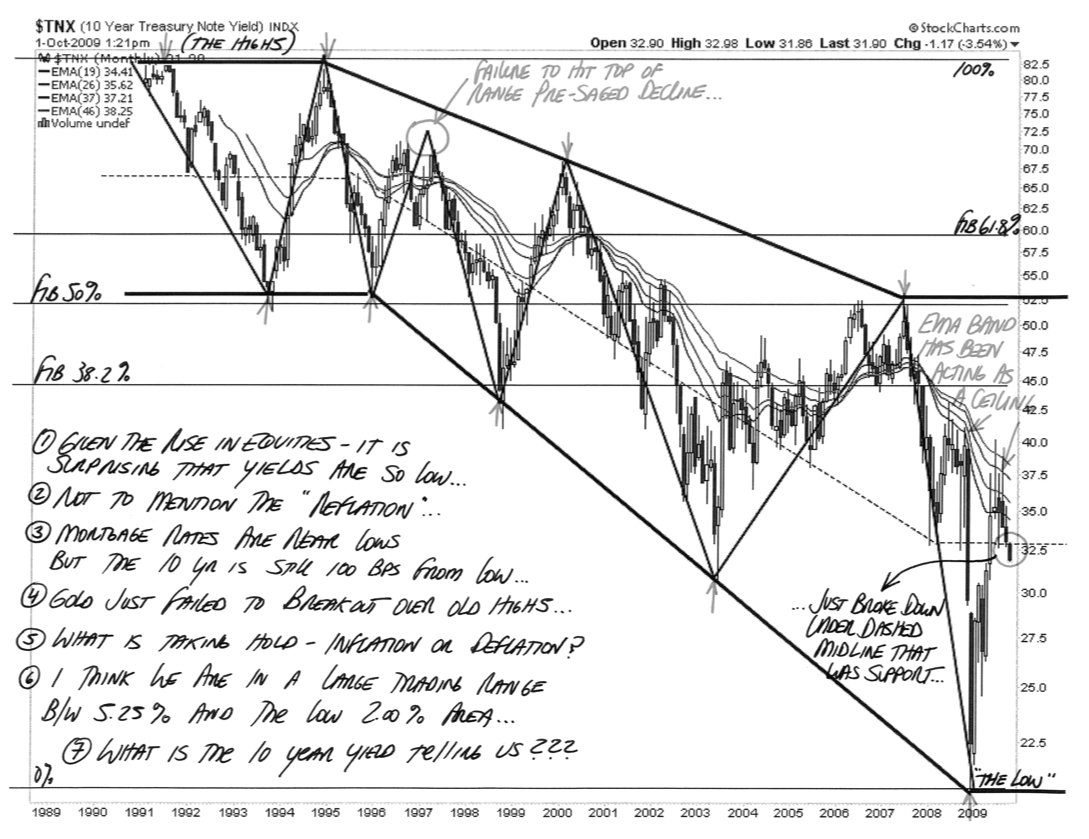
The 10-year is telling us that we have know idea what it’s supposed to be telling us. We know there will likely be high inflation later on, but when? And how long will deflation last? This is no time to be an “investor.” If you’re not a trader, you may as well stay in cash — or at least pay someone good money to manage the non-cash assets that you DO have.
We just got off the bus in crazytown, folks — it’s like you were on the phone with car guys, like, half an hour ago — and you probably wrote these people off as idiots, years ago! And either this is some kind of sick joke and like 90% of you gets it, but I. Don’t. Know. I’m gonna go with “crazy,” Dennis.
reply
———–
You know, sometimes I sit here and am just gassed out amazed that easy questions confuse professionals who could easily sell themselves as knowing more about this kind of stuff than I know. This question is indicative of genuine dumbassery.
The 10 year is being bought down by the Fed via quantitative easing. This isn’t my fantasy. It’s in the news. They aren’t trying to hide it. Fed printing presses are flooding the world with cash that is being used directly and indirectly to by UST debt. Basic textbook theory says that this causes rates to lower. It appears to work.
What nobody knows is what will happen when quantitative easing ends. The $300b of Fed injections is nearly spent and has about 1 or 2 shots of life left. Rumors of Fed quid pro quo occur when the Fed buys agencies from foreign governments and they use the cash to buy UST debt. This program will end around March 31 when they run out of cash for agency purchases.
Will markets fall when the cash stops being pumped in? Or will HFT set a floor and keep it in a range, waiting for sucker money to place a bet? This market is a little different in that there were few real buyers, so this means there will be few real sellers. In truth, what happens will be new and will be one for the text books. I still expect a mean reversion back to S&P 800ish, but the timing is unclear because of the manipulation of the markets over the past 6 months. Low volume allows the market to be hyped up more easily than high volume. On balance, the pump should return on low volume days, and this might be a floor setting action.
Don’t you people follow the news or do you just look at magic charts and think they tell you all you need to know? Really, this is stupid shit.
As far as the 10 year after QE ends, that is a crap shoot. If a real economy it should rise because of the inflationary aspects of the huge pump going on now. In a deflationary economy, it will fall and stay low. I’m guessing we will see a liquidity trap and deflation, like Japan of recent history. There’s no pent up demand or desire for recreational credit, so where’s the growth going to come from? My ass?
BTW…i dont beleive in right or wrong……i am not a idealist. I am just trying to make a best guess about what is happening….and what is the path of least resistance….and beneficial to the people who have debt of 60 trillion.
(i repeat again…i have no position…i am not dependent on market to make money…i enough saving to last me 10 years….no debt, which makes me loser in this game of reflation)
All dumbassery aside I don’t think all of the 10 year market action can be chalked up to the Fed…
According to the FOMC statement of March 18, 2009:
“Moreover, to help improve conditions in private credit markets, the Committee decided to purchase up to $300 billion of longer-term Treasury securities over the next six months.”
On March 18, 2009, before the QE announcement, the TNX opened at 3.00%. That day it closed at ~2.50%. By June 11, 2009, the TNX hit 4.00%. That’s with the bond market knowing that the $300B in purchases were still out there. Now we are back to 3.20%…
All dumbassery aside I don’t think all of the 10 year market action can be chalked up to the Fed…
reply:
———
No, there’s at least two big programs out there. The $300 billion one that is nearly used up, and the one where agencies and similar are being purchased. The latter one is for over $1trillion and is only 2/3 used up. It was recently extended to the end of Q1 2010 for expiration. It’s just a print job. ZH exposed the foreign govt connection a couple months ago, effectively doing agency for UST swaps. ZH documented massive growth in the custodial account of UST debt that corresponds to agency purchases and printed money.
Yes! But not at the same time. Did you bail on your equity positions after the morning drop under 9500? BTW, y’all should check out this Gustav LeBon book. It’s interesting…
I have a question – there’s all this talk about how much money the fed has been injecting into the economy. How is this offset (if at all) by all the money disappearing from the economy? What happened to the trillions we’ve lost in the housing market? How about the trillions lost in bad loans? Stock Market losses from last year? If we’ve collectively lost so much money over the last few years, is the money the fed is pumping into the economy anywhere near enough to make up for the losses?
Fans of the “inflation is inevitable camp” often forget that the velocity of money has decreased significantly. Just think of all the mortgage securitization / CLO’s that was going on. If a bank now needs to hold on to the mortgages they write (if any) – how many times can they lend the same money over the average life time of a mortgage? Once. Compared to multiple times a year – that’s a significant drag on velocity. So if M1/2 etc go up, but velocity comes down in same magnitude -> net effect zero. http://en.wikipedia.org/wiki/File:M1VelocityEMratioUS052009.png
The additional debt will have to be paid back one day (as long as there is political consens that ever increasing debt finally leads to self-destruction), probably via higher taxes (which puts breaks on consumption, hence anti-inflationary). John Mauldin has written about this at length. http://www.frontlinethoughts.com/index.asp
In December 2008 the April 2010 TIPS were pricing in a deflation of 7% over 15 months. That would have been a disaster (TIPS are redeemded at par, but if an older one is trading far above par, and you have deflation, your principal can shrink, hence those TIPS were trading below par). Even over 10 years the difference between TIPS and Treasury bond yields was close to zero. See http://www.marketoracle.co.uk/Article7970.html
At least now we have moved away from such a doomsday scenario (zero inflation until spring 2011, going up to 1% by 2014 and ca 2% by 2019). Of course the TIPS-Treasury yield spread has no predictive value – it’s just what the market currently prices in.
So noted. Once “all” of the planned QE incl. the agency stuff is spent, it seems up is the only way these rates can go…
reply:
———–
That’s the million dollar question. Inflation or deflation. Or both.
The Fed is duplicitous in that it only defines inflation in terms of CPI and Philips Curve logic.
It ignores asset bubbles intentionally and feels justified in doing so. It’s ‘exploring’ how to recognize and deal with them but isn’t hopeful of success, or so it says. I believe they will fail because they have no will to succeed and asset bubbles are a tool in their chest.
It appears to ignore the value of the dollar. The falling dollar is a pure reaction to the printing press. It’s just not on the radar and probably never will be.
So we will see a falling dollar, which isn’t inflation as the Fed defines it. We will see periodic asset bubbles, which are really a tool of monetary policy and not inflation, according to the Fed. .
Deflation corresponds to how people live in real life. No demand + excess capacity + oversupply in some things = lower prices. No demand for credit = low rates, cash is king, and high savings rates. Like Japan, the US carry trade will emerge and Africa will start being developed so they can be exploited as the last market on Earth.
Then,wait for China to explode. They’re just starting their bubble.
Isn’t it strange that the “norm” now in everything we do is simply gaming what the Fed’s plans are, and its consequences? I mean, that’s the only ballgame in town now. A year ago, this would have been thought to be bizarre, but now it’s the new “normal”.
I have a question – there’s all this talk about how much money the fed has been injecting into the economy. … What happened to the trillions we’ve lost in the housing market? How about the trillions lost in bad loans? Stock Market losses from last year?
reply:
——–
The Money Supply is actually Money x Velocity. Velocity loosely corresponds to a demand for cash. Lots of Cash and little Velocity creates a Liquidity Trap. Money without velocity is relatively useless. The Fed is hoping to offset lower velocity by making oceans of cash available. HFT and oil traders are taking them up on it. Not many others are.
So, to answer your question, a lot of the cash evaporated because velocity evaporated.
Speaking of a “flight to quality,” LQD just barely bounced off the 50-day EMA, which appears to be sloping downward now. This line had been sloping upward since April 9, which was the last time the daily price closed below it. A break in this trend could possibly “lead the indices lower,” to coin a phrase.
LQD looks like shit, but it will bounce early next week before the downtrend recommences. LB thinks the long bonds will back off a bit before the auctions of 10s and 30s next week. You know why, if you think about it.
So I just posted about the last-minute action in JNK and apparently used a “forbidden word,” as my post was disappeared forever. Good thing spammers don’t know how to deliberately misspell, eh, Mr. R1+h0ltzz?
Anyway, as lb said, the trend in LQD is still just barely intact. JNK traced out a bear flag and seemed to hit major resistance at the 20 EMA on the 30 min chart, but then blasted right through in the final minute of trading. It’s enough to give one the impression that the entire market is still some kind of *unmentionable gaming institution*.
Money is like manure. You have to spread it around or it smells. ~J. Paul Getty
According to the CFTC weekly data for the week ended Tuesday, net shorts in the euro fell by 38% from last week's record high and are now at a 6 week low. Net shorts in the pound moved up a touch to just shy of its record high. Net longs in the Australian$ rose to the most since May '08 and net longs in the Canadian$ rose to the highest since Nov '07. Gold new longs fell to a 4 week low. Net longs in crude rose 14% and are just 12k contracts from a record high dating back to...
October 2nd, 2009 at 1:08 pm
The 10-year is telling us that we have know idea what it’s supposed to be telling us. We know there will likely be high inflation later on, but when? And how long will deflation last? This is no time to be an “investor.” If you’re not a trader, you may as well stay in cash — or at least pay someone good money to manage the non-cash assets that you DO have.
We just got off the bus in crazytown, folks — it’s like you were on the phone with car guys, like, half an hour ago — and you probably wrote these people off as idiots, years ago! And either this is some kind of sick joke and like 90% of you gets it, but I. Don’t. Know. I’m gonna go with “crazy,” Dennis.
October 2nd, 2009 at 1:19 pm
Mr Chart asked:
What is the 10 year telling us?
reply
———–
You know, sometimes I sit here and am just gassed out amazed that easy questions confuse professionals who could easily sell themselves as knowing more about this kind of stuff than I know. This question is indicative of genuine dumbassery.
The 10 year is being bought down by the Fed via quantitative easing. This isn’t my fantasy. It’s in the news. They aren’t trying to hide it. Fed printing presses are flooding the world with cash that is being used directly and indirectly to by UST debt. Basic textbook theory says that this causes rates to lower. It appears to work.
What nobody knows is what will happen when quantitative easing ends. The $300b of Fed injections is nearly spent and has about 1 or 2 shots of life left. Rumors of Fed quid pro quo occur when the Fed buys agencies from foreign governments and they use the cash to buy UST debt. This program will end around March 31 when they run out of cash for agency purchases.
Will markets fall when the cash stops being pumped in? Or will HFT set a floor and keep it in a range, waiting for sucker money to place a bet? This market is a little different in that there were few real buyers, so this means there will be few real sellers. In truth, what happens will be new and will be one for the text books. I still expect a mean reversion back to S&P 800ish, but the timing is unclear because of the manipulation of the markets over the past 6 months. Low volume allows the market to be hyped up more easily than high volume. On balance, the pump should return on low volume days, and this might be a floor setting action.
Don’t you people follow the news or do you just look at magic charts and think they tell you all you need to know? Really, this is stupid shit.
As far as the 10 year after QE ends, that is a crap shoot. If a real economy it should rise because of the inflationary aspects of the huge pump going on now. In a deflationary economy, it will fall and stay low. I’m guessing we will see a liquidity trap and deflation, like Japan of recent history. There’s no pent up demand or desire for recreational credit, so where’s the growth going to come from? My ass?
October 2nd, 2009 at 1:23 pm
Deflation, baby, deflation!
October 2nd, 2009 at 1:31 pm
D-TRAIN, baby. Flight to Quality. Liquidity trap. Pull up a chair, this one is just getting started…….
BARRY, this is excellent, you are really on your game today, hitting all of the important issues. Great posts.
October 2nd, 2009 at 1:43 pm
will it surprise you guys a lot if the hiring related to stimulus spending is as much as 1 million direct…and another million secondary/indirect.
and will it be more surprising if Gov gives more money to all the entities in form of budget…so that they can increase spending/hiring?
and how about second stimulus bill if things go bad, will that be a surprise?
Deflation is the king right now….but the Gov is working on reflation and dont underestimate the printing press.
QE can go on much longer…..if economic growth/specualtion does not send the commodities sky high.
October 2nd, 2009 at 1:46 pm
BTW…i dont beleive in right or wrong……i am not a idealist. I am just trying to make a best guess about what is happening….and what is the path of least resistance….and beneficial to the people who have debt of 60 trillion.
(i repeat again…i have no position…i am not dependent on market to make money…i enough saving to last me 10 years….no debt, which makes me loser in this game of reflation)
October 2nd, 2009 at 1:46 pm
@ deadhobo
All dumbassery aside I don’t think all of the 10 year market action can be chalked up to the Fed…
According to the FOMC statement of March 18, 2009:
“Moreover, to help improve conditions in private credit markets, the Committee decided to purchase up to $300 billion of longer-term Treasury securities over the next six months.”
On March 18, 2009, before the QE announcement, the TNX opened at 3.00%. That day it closed at ~2.50%. By June 11, 2009, the TNX hit 4.00%. That’s with the bond market knowing that the $300B in purchases were still out there. Now we are back to 3.20%…
October 2nd, 2009 at 1:53 pm
Good chart. From that I can extrapolate that the market is going up or down.
October 2nd, 2009 at 1:57 pm
SINGER Says:
October 2nd, 2009 at 1:46 pm
@ deadhobo
All dumbassery aside I don’t think all of the 10 year market action can be chalked up to the Fed…
reply:
———
No, there’s at least two big programs out there. The $300 billion one that is nearly used up, and the one where agencies and similar are being purchased. The latter one is for over $1trillion and is only 2/3 used up. It was recently extended to the end of Q1 2010 for expiration. It’s just a print job. ZH exposed the foreign govt connection a couple months ago, effectively doing agency for UST swaps. ZH documented massive growth in the custodial account of UST debt that corresponds to agency purchases and printed money.
October 2nd, 2009 at 1:57 pm
@HW
Yes! But not at the same time. Did you bail on your equity positions after the morning drop under 9500? BTW, y’all should check out this Gustav LeBon book. It’s interesting…
http://socserv.mcmaster.ca/econ/ugcm/3ll3/lebon/Crowds.pdf
October 2nd, 2009 at 2:01 pm
@ Dead Hobo
So noted. Once “all” of the planned QE incl. the agency stuff is spent, it seems up is the only way these rates can go…
October 2nd, 2009 at 2:04 pm
I have a question – there’s all this talk about how much money the fed has been injecting into the economy. How is this offset (if at all) by all the money disappearing from the economy? What happened to the trillions we’ve lost in the housing market? How about the trillions lost in bad loans? Stock Market losses from last year? If we’ve collectively lost so much money over the last few years, is the money the fed is pumping into the economy anywhere near enough to make up for the losses?
October 2nd, 2009 at 2:06 pm
@Thor: two words: Not likely. That money is going to “money heaven” and that equals deflation.
October 2nd, 2009 at 2:07 pm
Fans of the “inflation is inevitable camp” often forget that the velocity of money has decreased significantly. Just think of all the mortgage securitization / CLO’s that was going on. If a bank now needs to hold on to the mortgages they write (if any) – how many times can they lend the same money over the average life time of a mortgage? Once. Compared to multiple times a year – that’s a significant drag on velocity. So if M1/2 etc go up, but velocity comes down in same magnitude -> net effect zero.
http://en.wikipedia.org/wiki/File:M1VelocityEMratioUS052009.png
The additional debt will have to be paid back one day (as long as there is political consens that ever increasing debt finally leads to self-destruction), probably via higher taxes (which puts breaks on consumption, hence anti-inflationary). John Mauldin has written about this at length. http://www.frontlinethoughts.com/index.asp
In December 2008 the April 2010 TIPS were pricing in a deflation of 7% over 15 months. That would have been a disaster (TIPS are redeemded at par, but if an older one is trading far above par, and you have deflation, your principal can shrink, hence those TIPS were trading below par). Even over 10 years the difference between TIPS and Treasury bond yields was close to zero. See http://www.marketoracle.co.uk/Article7970.html
At least now we have moved away from such a doomsday scenario (zero inflation until spring 2011, going up to 1% by 2014 and ca 2% by 2019). Of course the TIPS-Treasury yield spread has no predictive value – it’s just what the market currently prices in.
Further reading here: http://seekingalpha.com/article/118363-tips-on-tips-treasury-inflation-protected-securities
October 2nd, 2009 at 2:13 pm
SINGER Says:
October 2nd, 2009 at 2:01 pm
So noted. Once “all” of the planned QE incl. the agency stuff is spent, it seems up is the only way these rates can go…
reply:
———–
That’s the million dollar question. Inflation or deflation. Or both.
The Fed is duplicitous in that it only defines inflation in terms of CPI and Philips Curve logic.
It ignores asset bubbles intentionally and feels justified in doing so. It’s ‘exploring’ how to recognize and deal with them but isn’t hopeful of success, or so it says. I believe they will fail because they have no will to succeed and asset bubbles are a tool in their chest.
It appears to ignore the value of the dollar. The falling dollar is a pure reaction to the printing press. It’s just not on the radar and probably never will be.
So we will see a falling dollar, which isn’t inflation as the Fed defines it. We will see periodic asset bubbles, which are really a tool of monetary policy and not inflation, according to the Fed. .
Deflation corresponds to how people live in real life. No demand + excess capacity + oversupply in some things = lower prices. No demand for credit = low rates, cash is king, and high savings rates. Like Japan, the US carry trade will emerge and Africa will start being developed so they can be exploited as the last market on Earth.
Then,wait for China to explode. They’re just starting their bubble.
October 2nd, 2009 at 2:15 pm
Isn’t it strange that the “norm” now in everything we do is simply gaming what the Fed’s plans are, and its consequences? I mean, that’s the only ballgame in town now. A year ago, this would have been thought to be bizarre, but now it’s the new “normal”.
October 2nd, 2009 at 2:23 pm
Thor Says:
October 2nd, 2009 at 2:04 pm
I have a question – there’s all this talk about how much money the fed has been injecting into the economy. … What happened to the trillions we’ve lost in the housing market? How about the trillions lost in bad loans? Stock Market losses from last year?
reply:
——–
The Money Supply is actually Money x Velocity. Velocity loosely corresponds to a demand for cash. Lots of Cash and little Velocity creates a Liquidity Trap. Money without velocity is relatively useless. The Fed is hoping to offset lower velocity by making oceans of cash available. HFT and oil traders are taking them up on it. Not many others are.
So, to answer your question, a lot of the cash evaporated because velocity evaporated.
October 2nd, 2009 at 2:40 pm
Its telling you to duck and cover people…
Especially you of the “long” persuasion.
October 2nd, 2009 at 2:50 pm
David, thanks for the great charts and explanations. Much appreciated.
October 2nd, 2009 at 2:59 pm
Speaking of a “flight to quality,” LQD just barely bounced off the 50-day EMA, which appears to be sloping downward now. This line had been sloping upward since April 9, which was the last time the daily price closed below it. A break in this trend could possibly “lead the indices lower,” to coin a phrase.
October 2nd, 2009 at 3:06 pm
@ SEAchill:
Yeah, stick a fork in the LQD bro… High volume on a pullback to the 50 d EMA is NOT what longs want to see in this tape.
It was an amazing uptrend. But look out below…
More importantly, what does LQD say about SPY???
October 2nd, 2009 at 4:16 pm
LQD looks like shit, but it will bounce early next week before the downtrend recommences. LB thinks the long bonds will back off a bit before the auctions of 10s and 30s next week. You know why, if you think about it.
October 2nd, 2009 at 4:24 pm
So I just posted about the last-minute action in JNK and apparently used a “forbidden word,” as my post was disappeared forever. Good thing spammers don’t know how to deliberately misspell, eh, Mr. R1+h0ltzz?
Anyway, as lb said, the trend in LQD is still just barely intact. JNK traced out a bear flag and seemed to hit major resistance at the 20 EMA on the 30 min chart, but then blasted right through in the final minute of trading. It’s enough to give one the impression that the entire market is still some kind of *unmentionable gaming institution*.