
Comparing Rallies: 2009 vs 1974-75 vs 1938-39

Email this post Print this post
By Barry Ritholtz - October 21st, 2009, 9:00AM

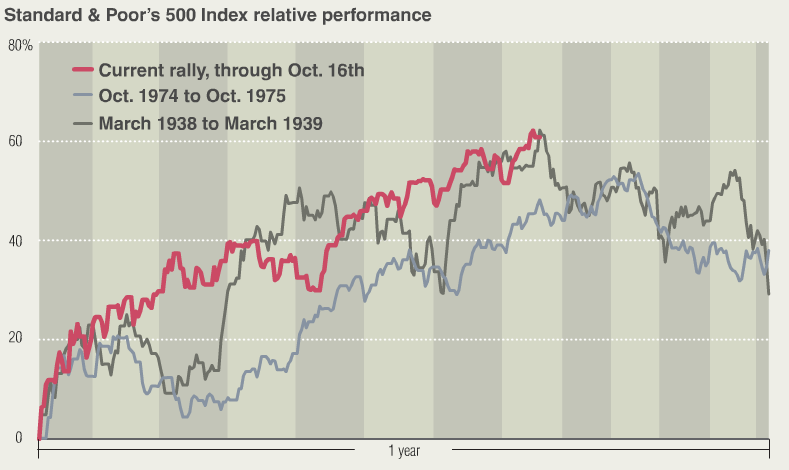
Predictions that U.S. stocks would decline in September and October weren’t wrong, just early, says Mary Ann Bartels, an analyst at Bank of America Corp. The CHART OF THE DAY shows how the Standard & Poor’s 500 Index’s surge from its 12-year low on March 9 compares with rebounds from troughs in March 1938 and October 1974. Using the earlier rallies as a guide suggests the “seasonal weakness” that stocks often suffer in September and October will occur in November, December and January instead, she wrote.

>
SPX Seasonal Drop

courtesy of Bloomberg

>

The 1930s advance appears in the chart’s top panel and the 1970s surge is in the bottom panel. In both cases, the S&P 500 fell more than 10 percent from its peak after the rally ended, surpassing a commonly used threshold for a stock correction.

>

Source:
Seasonal Drop in U.S. Stocks May Just Be Delayed: Chart of Day
David Wilson
Bloomberg, Oct. 19 2009

http://www.bloomberg.com/apps/news?pid=20601109&sid=aEWacWSz6VOs

Comments

Please use the comments to demonstrate your own ignorance, unfamiliarity with empirical data, ability to repeat discredited memes, and lack of respect for scientific knowledge. Also, be sure to create straw men and argue against things I have neither said nor even implied. Any irrelevancies you can mention will also be appreciated. Lastly, kindly forgo all civility in your discourse . . . you are, after all, anonymous.

53 Responses to “Comparing Rallies: 2009 vs 1974-75 vs 1938-39”

  1. HCF Says:

    A bit off topic, but this is bugging the hell out of me…
    “Extend and Expand the Homebuyer Tax Credit”:
    http://takeaction.realtoractioncenter.com/campaign/hbtc?qp_source=dotorg&LID=RONav0019

    Because what this country really needs is ANOTHER boondoggle to undeserving recipients…

    HCF

  2. call me ahab Says:

    HCF-

    i posted a quote from the Sec of HUD yesterday- that indicated the Obama admin is not necessarily on board / an extension due to the cost-

    we will see-

    the NAR, home builders and the MBA are all out their lobbying i’m sure- telling congress the world will end if the credits are not extended/expanded-

    let’s see if the Obama admin has the fortitude to disagree

  3. SINGER Says:

    “The 1930s advance appears in the chart’s top panel and the 1970s surge is in the bottom panel. In both cases, the S&P 500 fell more than 10 percent from its peak after the rally ended, surpassing a commonly used threshold for a stock correction.”

    Considering the indices are up 60%+ and individual names are up 100%-400% since the Oct-Mar low timeframe, would it be strange and/or significant that a <10% decline should occur…

    Plus, is 10% a commonly used threshold for corrections? As per experience, you often have an advance followed by a correction that wipes out almost all of the first move, only to begin going higher…

  4. HCF Says:

    @ahab:

    We can only hope that the Obama administration has finally grown a backbone to stand up to special interests like the NAR and NAHB… I doubt it… In all likeliness, members of both parties will advocate and pass this fiscally irresponsible boondoggle to keep homeowners in indebted servitude to the banks. The only true benefit to society is if housing corrects to a fair and affordable price (which of course, it would without all the subsidies, tax credits, and artificially low interest rates).

    HCF

  5. some_guy_in_a_cube Says:

    “Predictions that U.S. stocks would decline in September and October weren’t wrong, just early, says Mary Ann Bartels, an analyst at Bank of America Corp.”

    And all that money you lost following those predictions weren’t really losses, just “character builders”.

  6. Mannwich Says:

    @some: LOL. I had similar thoughts. Early and big = wrong.

  7. Bruce in Tn Says:

    http://finance.yahoo.com/news/Bailout-watchdog-expects-much-apf-1966132592.html?x=0&sec=topStories&pos=2&asset=&ccode=

    Bailout watchdog expects much to remain unrefunded

    “Just as the Obama administration prepares to announce a new TARP-like program for small community banks, Inspector General Neil Barofsky said he believes that “it’s unrealistic to think we’re going to get all of that money back.”

    …Uh oh. You mean the taxpayer may wind up with a moth hole in his wallet? Why didn’t someone explain this to me? What’s that? Now you say their is no Santa Claus? No pot ‘o gold at the end of every rainbow?

    No, it is not “extend and pretend”. It is ” pretend and then don’t”………..

  8. Marcus Aurelius Says:

    ahab and HCF:

    The O administration’s recent vocal push back on the banking industry got me thinking that there’s a small chance the game is being played one step ahead of what we’re seeing. Having given the banks everything they asked for as an incoming admin facing crisis (relying on the advice of the playa’s involved, at that), and having been swindled in the deal, they could now push for regulation beyond anything they might have achieved without the $1T (?) “good faith” effort having been put forth. A populist response to the blatant double dealing by the banks would result in huge political support.

    OTOH, and probably more realistically, there’s nothing to stop them from maintaining the status quo.

  9. chris steinbach Says:

    I am betting the rally will continue simply because so many are saying it won’t. The only thing about the stock market that is predictable is that it will confound the majority of people. But, I am hedging my bet by restricting my investments to tech, since tech has the most legs. The internet has become very disruptive to existing business models and the economy is nowhere near finished reorganizing around this new paradigm. The recovery will result in more reorganization, which will cause tech to lead everything else.

  10. Thor Says:

    Chris – I agree. Have said before that I wouldn’t be surprised if it went well beyond what anyone is predicting. Not because of any underlying health in the economy, or the companies traded in the stock market, but because it can. We should never underestimate the power of greed.

  11. HCF Says:

    @Thor:

    Agreed completely with you… I am still bearish as hell for fundamental reasons, but have made my portfolio more long because I have seen breakouts in various charts. Does it make sense to me? Hell no… But I do have to admit that I’ve looked like an idiot most of the year compared to a “genius” like Harry Wanger.

    I guess it comes down to two factors:
    1) Separating the market from economy (clearly two different beasts)
    2) Separating process from results (a bullish/bearish idiot is like a broken clock – correct once in awhile, but only by coincidence)

    I think the govt. has pumped enough electricity into this dead body to make it stand up and dance. Might as well enjoy the fun until smoke starts coming out!

    HCF

  12. HarryWanger Says:

    11,500 area seems to be where DJIA is heading as I’ve been stating for some time. However, I’m keeping my finger on the trigger. To be honest, I stand to make more money than I ever have in my life if this market can maintain and go higher through Nov. 20. Once that happens a re-evaluation of targets on the indices will dictate the next move. If the trend is in tact, then 11,500. If it’s breaking down by then I could see a sizable pullback moving into the EOY with profits being locked in across the board.

  13. HarryWanger Says:

    From MW: “WASHINGTON (MarketWatch) — Federal Reserve Chairman Ben Bernanke contends that legislation to accelerate the effective date of credit card reform legislation would have a detrimental impact on small credit card issuers, according to excerpts from a letter to a key lawmaker released Wednesday.”

    Doesn’t that sound eerily familiar to the OTC story on Frontline last night? Regulation would jeopardize the economy they said. Hmmm…

  14. bsneath Says:

    Just to be a bit contrarian, let me pose the following:

    In the long run, is it better for the Federal Reserve and Treasury to acquire & write off hundreds of billions in toxic mortgage securities? or to pay tens of billions to encourage first timers to buy homes?

    Perhaps the second alternate is the lessor of two evils since we are going to have to chose one or the other or some of each whether we like it or not.

    I know that many are opposed to housing tax credits because of inherent unfairness and because the real cost per new home buyer is quite high. I suggest that this is not looking at “the big picture” (sorry BR). Currently we have a very large oversupply of available housing stock. Much greater than existing demand. If we do not increase demand, we risk housing prices over shooting far below fair value. While this is great if one is currently in the market or wants to speculate, it could be disastrous in an already severely weakened and very sick economy.

    Housing demand is shrinking fast as strapped families sell of second homes (bankers excluded of course), young adults delay home purchases and stay with their parents (got three of these at the moment) and existing homeowners are forced into foreclosure and are thus out of the homeownership pool for a number of years due to bad credit (yes I know many of them never should have been homeowners, but many others should have, but were not financially astute when bribed with HELOC candy or who have lost their jobs and couldn’t sell in time.

    In fact what we should be doing in opening up the floodgates to well educated or highly capitalized immigrants in order to increase housing and general consumption demand. Perhaps targeted to professions and investments in alternative energy, storage, medical technology, etc. to make it more politically acceptable. (Just no more investment bankers please!)

    Bottom line is we should be thinking about how to stimulate housing demand. Even if the program is not totally efficient, it beats the alternatives of huge bank-incurred foreclosure costs, further home valuation declines, TARP write downs etc. etc.

    So, should we directly bail out the banks (knowing that we are buying bad paper), or wouldn’t it be better to indirectly bail them out by helping out main street, allowing more people to own homes and in the process reducing the total amount of toxic assets as a higher percentage of the bad mortgages get reworked into good ones? You know you are going to be paying for this one way or the other.

    Perhaps housing credits should be limited to existing structures and not new homes to work through the oversupply.

  15. M Says:

    I suppose if you noodle around long enough you can find charts that rationalize being wrong. Looking at the DOW for the pre-war period (there was no s&p 500) and squinting really hard and trying to be generous I still think she’s blowing smoke. First, I don’t see the pattern she’s seeing and second I don’t see why those periods should be particularly relevant to today’s.

  16. Comparing 1974-75 and 1938-39 vs 2009 | The Big Picture Says:

    [...] This morning on Bloomberg Radio, I discussed prior market rallies with Jim Bianco, namely  the 1937-38 and 1973-74 moves (including this Bloomberg chart). [...]

  17. leftback Says:

    Hard to say that you can learn anything from these comparisons, 1938 was leading into a period of major political instability and WW2 and the 70s were different in many ways from the intervention-driven market of today.

  18. HCF Says:

    @bsneath:

    Perhaps we should remove any credits and subsidies related to housing? Housing prices would fall A LOT, and plenty of people would be able to afford and buy houses. If your hope is to keep housing at artificially high and ultimately unaffordable prices, then we should continue the current practices or even expand them.

    The philosophical question is this: Do you crush the overleveraged current home-”owner” (actually, debtor) or do you crush future generations of the young who will have to work much harder and save much more/longer or overleverage themselves just to buy something…

    HCF

  19. ben22 Says:

    Where’s the 1929 and on comparison? After all, it’s the only time you had the credit run-up similar, certainly not on the other dates shown here.

  20. ben22 Says:

    Chris Steinbach,

    Who is saying the rally won’t last? Outside of a handful of people why do people continue to claim this? The largest MM’s, such as WB, Ron Baron, Bob Doll, etc etc are hardly saying this is going to end. Is it because of blog comments? Where are people getting this, it certainly isn’t from sentiment indicators like the DSI.

  21. HarryWanger Says:

    leftback, M: I agree. That’s my problem I have when people try to compare completely different events. The world is vastly different from the 70′s and not even relevant to the ’30′s. We now have a world where India, China, South America, that were virtually nonexistent 20 years ago as far as consumption goes, are major factors. How anyone can even try to compare our most recent event with any of those others is outrageous.

    The little recession of 2001 is somewhat more relevant and basically the set up for what we’re going through now. That was the appetizer of this ugly feast.

  22. call me ahab Says:

    lb-

    you bring up a good point- hadn’t really thought about it before- but industries were getting battered in the 70′s- i know there was a bailout of Chrysler- unprecedented- but- for the most part- the government and the Fed weren’t all in the markets either-

    i am thinking it is this whole stimulus mentality- Bush’s- “go out and buy something” advice- that is where our trouble stems from-

    it’s all about getting the credit fueled consumption model back on track-

    no matter that a new “set of rules” needs to be created- sustainability and moderation

  23. Mannwich Says:

    Is this what a “mini economic boom” looks like? If so, I gotta get me some of that.

    http://www.calculatedriskblog.com/2009/10/states-report-widespread-job-losses-in.html

    We’re in a not so “mini” market and commodities bubble, but “economic boom”? Hardly.

  24. HarryWanger Says:

    Mannwich: Yes, I saw that. Looks grim. It is a mini economic boom but as I’ve said in the past, it’s due to simple economics. Stimulus, lower dollar, etc. are solely responsible for the “boom”. At some point jobs and output/manufacturing have to keep pace with that or we’re right back to where se started. When will that happen? 2 years? 5 years? Some say 15 years. Hard to even imagine when that will be right now.

  25. Bruce in Tn Says:

    Some of you fellows disappoint me a little here. You seem to be responding to Harry Wanger as though he has sense. Of course he’s an idiot, probably 20 years old and flips hamburgers. Guys, debt is debt. You are trying to reflate a debt bubble with more debt. What seems to have made all the rational investors glum is that markets and economies cannot precisely be timed. If they could, we all be as rich as Buffett, without his obvious shortcomings.

    http://www.nytimes.com/2009/10/21/business/global/21yen.html

    Rising Debt a Threat to Japanese Economy

    “TOKYO — How much debt can an industrialized country carry before the nation’s economy and its currency bow, then break?

    The question looms large in the United States, as a surging budget deficit pushes government debt to nearly 98 percent of the gross domestic product. But it looms even larger in Japan.

    Here, years of stimulus spending on expensive dams and roads have inflated the country’s gross public debt to twice the size of its $5 trillion economy — by far the highest debt-to-G.D.P. ratio in recent memory. ”

    …Guys, even a fool sounds like he knows something the rest of us don’t during bull market blips. The Wangers of the world are like the old saw about the trading community. “I know bold traders, and I know old traders, but I don’t know any old bold traders…”

    Yes, I bought stock too, with stops, as I imagine most of us have done during the dollar hollowing out process that is going on here. But the posters in the room have rightfully looked at the overall economic picture ahead for the United States and it isn’t pretty. You are giving the Wangers of the world way too much credit, he may be a happy idiot here, but he’s still an idiot. You think if he was 75 and retired he’d still sound this way? Of course not. He’d be retired for 10 years and be sleeping under a bridge since he’s long ago have lost his retirement money.

    Just go with the flow. The Keynesians still don’ t have a way to remove debt without an endgame, and that is the weakness of that particular economic theory. When we wake up tomorrow we will still be further in debt than we are today. If the government thinks monetizing debt will work, we are all doomed…..

  26. Thor Says:

    Am I the only one who thinks it’s odd that HW doesn’t seem to catch when he’s being mocked or made fun of?

  27. Bruce in Tn Says:

    Thor:

    I suspect Harry is someone who actually invests and is having fun with the room. But don’t let the needling get us down. Whoever he is, when rates go up, and liquidity dries up, the market downturn will produce a notable absence. Most of us are reading the tea leaves correctly. And I understand why stocks, with a higher risk, are what investors are being forced into. But zero per cent interest rates are not a natural phenomenon, and we seem to forget that Greenspan, with his 1 per cent decision produced much of what happened here this time…

    Life will be ok…

  28. bsneath Says:

    I read every one of HW’s postings here and they all are sensible comments/opinions. You can agree to disagree or you can mock, call names and reveal your true character (or lack thereof).

  29. Bruce in Tn Says:

    bsneath:

    Does that include the “you are a pockmarked fool” comments from yesterday from HW?

  30. HarryWanger Says:

    Bruce: Actually I’m 47, own a small business based in Mpls, live in Seattle, travel frequently for my work. You are correct about debt. It’s a matter of how far can it take us until actual production and job creation catches up. Our mini economic boom is just that – driven by stimulus, debt, weakened dollar, etc. Economics 101. What happens down the line? Judging by the fact that we saw virtually no job creation in this decade it’s akin to trying to bail water out of a boat with a bucket. That’ll work for a while until the hole gets bigger, the water rushes in faster and the bucket isn’t big enough. Gotta patch the hole. That’s not being addressed as of this time.

  31. HCF Says:

    @bsneath:

    My issue with HW is never his position or opinion, per se, but rather the way he arrives at it. He typically cheerleads whenever any “better than expected” data comes out and point out how awesome and smart his investments are. I wouldn’t put him in the camp of rational, well-reasoned, un-conflicted thought.

    I believe the majority of people here are very tolerant of differing opinions, so long as it is well reasoned and argued.

    HCF

  32. Bruce in Tn Says:

    HarryWanger Says:

    October 20th, 2009 at 6:34 pm
    ahab: You stated: “creepy strange- why do you give your advice so freely? as if anyone cares- which no-one does-” Yet everyone cares about your advice.

    Let’s see what’s weirder, complaining/whining constantly about the economy/earnings, etc., etc., etc.? Or, making money off what is clearly a mini economic boom we’re in the beginning phases of.

    What’s weirder, complaining about your leaders in the country and sticking your head in the sand playing fantasy football or actually trying to support the capitalism that has made this country’s standard of living infinitely better than just about anywhere in the world?

    Yes and my professors who awarded me a Masters Degree in Business from one of the most prominent universities in the country would laugh in your pock marked, stupid ass junior college face!

    ….Yesterday’s comment from the brilliant HW…

    …maybe bsneath he is your cup of tea…

  33. Bruce in Tn Says:

    As a final note, I think you will find that in the start of 09, I thought we’d be at 100% debt/gdp by the end of the year. If you are reading Lefty, although we didn’t wager on it, I think you owe me a burger. See the above article about Japan…

  34. ben22 Says:

    “Our mini economic boom is just that – driven by stimulus, debt, weakened dollar, etc. Economics 101.”

    lol, yeah, how’s that worked out the last 20 years, and let me clarify, I’m not talking about what it did for the stock market but the economy. Economics 101 has been proven wrong. The FACTS are, the economy was worse from 75-99 than it was during the 40′s to 60′s bull.

    As for comaprisons not being valid because “it was a different time” or “the world is different now”

    Tell me, how different are human emotions and reactions, and please document proof of that difference for me.

    The economic reality of 75-99 compares quite well with 1920′s imo.

  35. bsneath Says:

    HCF Says:
    October 21st, 2009 at 11:59 am

    @bsneath:

    “Perhaps we should remove any credits and subsidies related to housing? Housing prices would fall A LOT, and plenty of people would be able to afford and buy houses. ”

    HCF, I hear you and under normal recessionary circumstances, I could not agree more. However what we have today is a black swan event, a Minsky Moment, a depression that the Federal Reserve and the Treasury are desperately trying to contain. Whether or not they succeed, time will tell.

    So with respect to housing, I simply do not think that our economy could withstand the collateral damage if housing prices were allowed to fall a lot. I suspect that literally trillions more would be thrown into the banking system, millions more would be thrown out of a job and the permanent damage to our already crippled economy would be severe. If nothing else, it is simply a risk that we cannot be taking in the current environment.

    You can place the onus on the investment banks once again for the need to take these seemingly irrational and inefficient steps. We are unfortunately in a position of attempting to determine which approach will tax our children’s incomes less and preserve our nation’s wealth the most. I continue to think it is by fixing the problems through main street rather than buying crap directly from the banks.

    It is also why there must be true banking reform and not just bandages and appearances.

    Separate commercial banks and investment banks
    Break up large institutions into not-to-big-to-fail smaller entities
    Gradually restore capital ratios of no less than 12 to 1
    Allow the Federal Reserve to use reserve ratios as well as interest rates as monetary tools
    Regulate derivatives and eliminate those that are counter productive (ie GS betting against Subprime)
    Regulate hedge funds
    Strengthen and enforce insider information laws
    Regulate HFT
    Enact real campaign & lobbyist reform
    Vote for candidates who promise to look after the interest of the general public rather than those of the wealthy and powerful (that way perhaps a couple of them might actually be honest people)

  36. bsneath Says:

    no more than 12 to 1

  37. Bruce in Tn Says:

    Harry,

    I will give you some benefit of the doubt. You, if you are interested, will catch more flies with honey than you will with vinegar. Some of us have been at this a long time. We might have been born at night, but it wasn’t last night, as they say.

  38. HarryWanger Says:

    ben22: You are correct. It hasn’t worked out well in the last 20 years for the economy. We’ve had no job creation in a decade with nothing in sight. Actually I think there was true prosperity in this country in the early 1900′s, economically speaking. Everything after the GD has been total bullshit. It took a major war to spur the economy and there was a major “boom”. But it was all manufactured. So what happens? War is over, people are excited, babies “boom”, housing, infrastructure, on and on. There’s demand, savings, exports but that’s really only short-lived, in an historical sense.

    Now the manufactured “booms” happen in quicker succession: internet, housing, commodities, etc. They have to or we’d be dead in the water right now. Instead another manufactured “boom” keeps the boat afloat for awhile. But this one won’t last long either. It can’t. Economics 101.

  39. HCF Says:

    @bsneath:

    I disagree with you that the housing meltdown was a black swan event. To paraphrase Nassim Taleb:
    “Thanksgiving is a black swan for the turkey, but not for the butcher”

    I saw it coming, many people on this forum saw it coming, Taleb saw it coming, Robert Shiller saw it, etc. The problem was that most policymakers in charge did not see it, and not only didn’t do anything about, but exacerbated the problem. As it stands, we have massive overinvestment in the real estate sector. Without correction of prices, the moral hazard continues, and everything stays the same. Yes, it would hurt a lot of people, which is unfortunate. However, it is a necessary structural change in the economy that would not occur without the financial crisis forcing us to. In the long term, it is cheapest to allow the market to clear and for resources to be deployed to more valuable investments.

    HCF

  40. call me ahab Says:

    bsneath-

    you are a good man for sticking up for ‘ol Harry- but remember-

    he is just a buffoon looking for an audience- maybe he is looking for friends- he has no idea what he is talking about- and my guess is he has an economics and history books in front of him to reference when people question his comments-

    bruce-

    that comment by HW was actually pretty funny- but I think he was serious-

    gave me a good laugh though

  41. Bruce in Tn Says:

    agree HCF.

  42. Rikky Says:

    Hey Wanger you should change the g to k to reflect your true self.

  43. bsneath Says:

    HCF

    Regardless of who saw it coming, it was allowed to perpetuate even after the dangers were becoming ever more apparent.

    What galls me is the response of the “smart” investment bankers. Once Goldman Sachs became aware that subprime mortgages would have devastating effects, did they immediately call there ex-employees through out government and warn them of the potential devastation? Shit no. They loaded up on derivatives to profit off of the collapse, thereby magnifying the damage done.

    Our Masters of the Universe, Capitalists-in-Charge have demeaned there stature from being the self-regulators to becoming seekers of the “bigger fool” to screw over.

  44. Bruce in Tn Says:

    “Vote for candidates who promise to look after the interest of the general public rather than those of the wealthy and powerful (that way perhaps a couple of them might actually be honest people)”…..

    Well, I think 100% of candidates do that….somehow it just doesn’t QUITE work out sometimes…

  45. bsneath Says:

    Damn – bad gram twice…. i before e except after…

  46. Rikky Says:

    >>So with respect to housing, I simply do not think that our economy could withstand the collateral damage if housing prices were allowed to fall a lot. I suspect that literally trillions more would be thrown into the banking system, millions more would be thrown out of a job and the permanent damage to our already crippled economy would be severe. If nothing else, it is simply a risk that we cannot be taking in the current environment.

    bsneath, there are more ways to skin a cat if you’re worried about such an outcome. how about direct assistance to at risk homeowners without the intermediaries? if you threw a few hundred billion at this segment this would flow right into the real economy and keep many more people in their homes than would otherwise. fair? absolutely not, but none of the programs to address the crisis is outright fair. if i had to choose the lesser of evils i’d rather give my fellow americans a direct subsidy than the snake oil vampiric banks who whisper sweet nothings of using their bailouts to help the common man all the while sticking the knife in deeper.

  47. Bruce in Tn Says:

    And if you are comparing economic ideas as to how best to solve this, I still would vote for a temporary tax decrease, for all, rather than giveaway plans. Taxes could go back up, but for now this would put money (less spending on taxes) back in the pocket of the consumer. The distortions of government largess on certain large institutions would not have occured and the increasing of the national debt, which would occur under either solution, would not require more funding in the future under larger, more costly government plans.

    Here we spend the money for IB’s (remember Elizabeth Warren has opined this was a mistake) but have so far failed to help the little fellow. I do mean help, not gimmick him into more debt for a home he still can’t afford, more taxes to bail out bankrupt Fannie and Freddie, and the FHA….”saved” tax money would be spent by the consumer as he or she needed it, not by government decision. That would, by practical definition, make it most beneficial to John Q. Public….

  48. HarryWanger Says:

    Bruce: “Help for the little fellow” can only come through jobs IMO. I don’t see where those are going to come from. I agree that tax breaks are better than other giveaway plans but unfortunately with the deficits facing the country and states, tax breaks are seemingly impossible at this time.

  49. HCF Says:

    @bsneath:
    > Once Goldman Sachs became aware that subprime mortgages would have devastating effects, did they immediately call there ex-employees through out government and warn them of the potential devastation? Shit no.

    I’m not one to usually one to defend the vampire squid called Goldman Sachs, but to be completely fair, they are a corporation run for the benefit of its partners and shareholders. They have no moral obligation whatsoever to warn policymakers and ex-Goldmanites in government, etc. With that said, by amplifying the problem, they should not have been bailed out via AIG, TARP, discount window, re-incorporating as a commercial bank, etc.

    In other words, you should be free to do as you wish (within legal boundries), but you are should also be free to be taken down by the shitstorm of your own doing. Wouldn’t the best punishment for poorly run banks be to go bankrupt? Instead, their “punishment” has been trillions in asset guarantees, free money at the discount window, and sham-tastic “stress tests” to artificially boost confidence in the markets. This is socialism for the rich!

    HCF

  50. Bruce in Tn Says:

    Harry,

    I agree that now that we’ve stepped in it, we have to put up with the smell. I think my point is really rather that tax cuts, for all, temporary in nature, would have been a better solution for the new administration. Even though I am not a fan of his because of the problems I think we’ll face with a bigger more intrusive government, I will say that he stepped into a helluva mess…

  51. HarryWanger Says:

    Bruce: Tax cut would have been a much better stimulus IMO right out of the gate. Regarding Obama, yes he stepped into an unbelievable mess: economy, wars, etc. The other guys, they’ve been around through it all: Bernanke, Summers, Geithner – they have no excuse whatsoever.

  52. bsneath Says:

    HCF They have no moral obligation whatsoever to warn policymakers and ex-Goldmanites in government, etc.

    Understand. However they sold Congress,the WH and Greenspan on the concept that they could leverage to the hilt and did not need regulation of the derivatives market because they would self-regulate. Shorting a catastrophic event is not, in my opinion, self regulation. OK, maybe they didn’t need to go to DC, but they certainly needed to self-regulate and they did not. ergo here we are today, screwed.

  53. DiggidyDan Says:

    Holy crap, ole HW is actually putting up real reasons instead of the “beat guidance and analyst predictions, and indices” b.s.

80 queries. 0.406 seconds.