
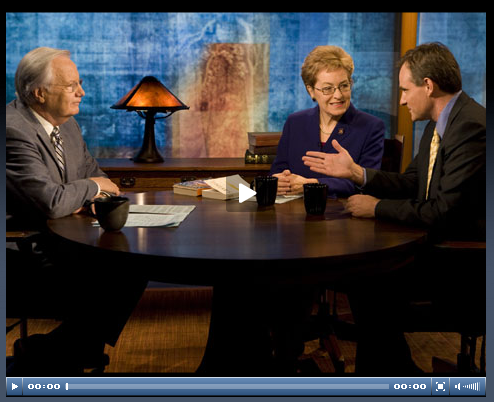
Just over a year after economic calamity brought promises of reform from Washington, has Wall Street really changed? Former International Monetary Fund chief economist Simon Johnson and US Rep. Marcy Kaptur (D-OH) report on the state of the economy.
>
click for video
In Michael Moore’s new film Capitalism: A Love Story, Congresswoman Kaptur says there has been a financial coup d’etat, and that Wall Street – rather than Congress – is in charge.
Hat tip Washington’s blog
October 9, 2009
BILL MOYERS: Welcome to the JOURNAL.
I sat in a theater packed with passionate moviegoers, every one of them seemingly aghast at the Wall Street skullduggery exposed by Michael Moore in his latest film. It’s called ‘Capitalism: A Love Story.’ Here’s an excerpt:
MICHAEL MOORE: We’re here to get the money back for the American People. Do you think it’s too harsh to call what has happened here a coup d’état? A financial coup d’état?
MARCY KAPTUR: That’s, no. Because I think that’s what’s happened. Um, a financial coup d’état?
MICHAEL MOORE: Yeah.
MARCY KAPTUR: I could agree with that. I could agree with that. Because the people here really aren’t in charge. Wall Street is in charge.
BILL MOYERS: That’s the progressive Representative from Ohio, Marcy Kaptur, she’s with me now. She has a Masters from the University of Michigan, did graduate study at M.I.T. and still lives in the same house in the Toledo working class neighborhood where she grew up.
She’s in her 14th term in Congress, the longest-serving Democratic woman in the history of the House, and she’s an outspoken financial watchdog on three important Committees: Appropriations, Budget and Oversight and Government Reform.
Also with me is a familiar face to viewers of this broadcast. Simon Johnson is the former Chief Economist at the International Monetary Fund. He now teaches Global Economics and Management at M.I.T.’s Sloan School of Management. He’s one of the founders of the website Baselinescenario.com. I check it out daily for Simon’s take on the economic and financial crisis.
It’s been a year since the great collapse and both my guests are well equipped to assess what’s happened since then. Welcome to you both.
MARCY KAPTUR: Thank you.
BILL MOYERS: Let’s look at this story that I just read from the Associated Press this week about how Treasury Secretary Geithner is on the phone several times a day with a select group of very powerful Wall Street bankers, especially Citigroup, J.P. Morgan, Goldman Sachs. He will talk to them when Members of Congress have to leave a message on the answering machine. And these are the bankers who helped bring on this calamity and who are now benefiting from it. What does that say to you?
MARCY KAPTUR: That says to me that Wall Street and Washington is a circuit. And because Mr.Geithner headed the New York Fed that that historic relationship, unfortunately, continues. And it gives them special access and special power to influence policy.
SIMON JOHNSON: Well, I think it really tells you how the system works. The system is based on access and is based on what on Wall Street shaping Washington’s view of what’s important.
It’s the people who are very close to Mr. Geithner before when he was the head of the New York Fed. Before he became Treasury Secretary. These people have unparalleled access. And in a crisis, when everything is up for grabs, you don’t know what’s going on, the people who will take your phone calls, right, in government and people who are going to be standing in the oval office, making the key decisions. That’s the heart of the system. That’s the heart of how you get your agenda through, by changing their worldview.
MARCY KAPTUR: And they also move people. In other words, Mr. Geithner came from the New York Fed, he came from Wall Street, and he becomes Secretary of the Treasury. His predecessor, Mr. Paulson, came from Goldman Sachs, and he becomes Secretary of Treasury. You can go back decades, and you will see that there’s this revolving door between Wall Street and Washington. And I recently asked Chairman Bernanke of the Federal Reserve, ‘Let me ask you a question. Would you be willing to consider a reform where the Cleveland Fed would have equal power to the New York Fed, in terms of how the Fed is run?’ And his answer was, ‘No.’
BILL MOYERS: And why did you ask that question?
MARCY KAPTUR: Because I think we need to democratize the Fed. I think that my region of the country, which is suffering so heavily from these decisions that were made by Wall Street and Washington, we need to have voice. And our bankers, who didn’t do the bad things, our community bankers, who are having to pay higher fees shouldn’t be treated this way. Why should the people who did it right be penalized for those that did it wrong?
SIMON JOHNSON: Remember Wall Street convinced us that trading derivatives without any regulation, that all these kind of crazy housing loans, which are very dangerous for consumers. That all of this was sensible. All of this was a good way to sustain growth. That was wrong. That wasn’t it. That wasn’t that’s not the end of the story. In the crisis, when things got bad, they also convinced the key people in Washington that they, the bankers, the big bankers, the Wall Street bankers, who are really responsible for all of these problems, they should be saved. Not just their banks, but they individually and should be saved. Their jobs, their pensions, all their perks. It’s an extraordinary moment.
BILL MOYERS: You asked on your blog, just this week, a question I want to put to you now, and to both of you. You asked, ‘Does this crisis reflect something about the disproportionate influence of a few incompetent investment bankers or a deeper breakdown of capitalism?” What’s your answer to your own question?
SIMON JOHNSON: Well, definitely, this disproportionate influence of some fairly incompetent bankers, that’s for sure. That’s what we’re seeing today. That’s what we’ve seen over the past few months. I think on the issue on the issue of capitalism, we have to take this very seriously. To me, at least, the financial part of our capitalism is very seriously broken.
SIMON JOHNSON: They persuaded us to allow them to take incredible risks. And then they pushed all the downside, all those losses onto us, the taxpayer, at the same time as really hammering hard all the people who were duped, essentially, into taking out loans. People lost their houses. It’s an absolute tragedy. This combination cannot go on. And yet, the opportunity for real reform has already passed. And there is not going to be not only is there not going to be change, but I’ll go further. I’ll say it’s going to be worse, what comes out of this, in terms of the financial system, its power, and what it can get away with.
BILL MOYERS: Why?
SIMON JOHNSON: That’s the.
BILL MOYERS: Why is it going to how is it going to be worse?
SIMON JOHNSON: Well, there’s four we used to have a dozen or so substantial big banks, now we’re down to four. Now we’re down to four big banks that have a lot more market power and a lot more political power. They make the campaign contributions. They shape agendas in ways that are that are really quite scary. If you look, for example, at derivatives. And the debate on whether or not derivatives should be regulated in a sensible manner. And at this point, actually, the Obama Administration has is leaning in a better direction. But the big financial players are absolutely against any kind of sensible regulation. And I think they’re going to win.
MARCY KAPTUR: Let me give you a reality from ground zero in Toledo, Ohio. Our foreclosures have gone up 94 percent. A few months ago, I met with our realtors. And I said, ‘What should I know?’ They said, ‘Well, first of all, you should know the worst companies that are doing this to us.’
MARCY KAPTUR: I said, ‘Well, give me the top one.’ They said, ‘J.P. Morgan Chase.’ I went back to Washington that night. And one of my colleagues said, ‘You want to come to dinner?’ I said, ‘Well, what is it?’ He said, ‘Well, it’s a meeting with Jamie Dimon, the head of J.P. Morgan Chase.’ I said, ‘Wow, yes. I really do.’ So, I go to this meeting in a fancy hotel, fancy dinner, and everyone is complimenting him. I mean, it was just like a love fest.
MARCY KAPTUR: They finally got to me, and my point to ask a question. I said, ‘Well, I don’t want to speak out of turn here, Mr. Dimon.’ I said, ‘But your company is the largest forecloser in my district. And our Realtors just said to me this morning that your people don’t return phone calls.’ I said, ‘We can’t do work outs.’ And he looked at me, he said, ‘Do you know that I talk to your Governor all the time?’ He said, ‘Our company employs 10,000 people in Ohio.’
MARCY KAPTUR: And I’m thinking, ‘What is that? A threat?’ And he said, ‘I speak to the Mayor of Columbus.’ I said, ‘Why don’t you come further north?’ I said, ‘Toledo, Cleveland, where the foreclosures are just skyrocketing.’ He said, ‘Well, we’ll have someone call you.’ And he gave me a card. And they never did. For two weeks, we tried to reach them. And finally, I was on a national news show. And I told this story. They called within ten minutes. And they said, ‘Oh, we’ll work with you. We’ll try to do some workouts in your area.’
We planned the first one after working with them for weeks and weeks and weeks. Their people never showed up. And it was a Friday. Our people had taken off work. They’d driven from all these locations to come. We kept calling J.P. Morgan Chase saying, ‘Where’s your person? Where’s your person?’ And they finally sent somebody down from Detroit by 3:00 in the afternoon. But out people had been waiting all morning and a lot of people that’s how they treat our people.
BILL MOYERS: You did a remarkable thing on the floor of the House recently. And I want to show my audience a clip of a speech in which you urge people to break the law.
MARCY KAPTUR: So why should any American citizen be kicked out of their homes in this cold weather? In Ohio it is going to be 10 or 20 below zero. Don’t leave your home. Because you know what? When those companies say they have your mortgage, unless you have a lawyer that can put his or her finger on that mortgage, you don’t have that mortgage, and you are going to find they can’t find the paper up there on Wall Street. So I say to the American people, you be squatters in your own homes. Don’t you leave. In Ohio and Michigan and Indiana and Illinois and all these other places our people are being treated like chattel, and this Congress is stymied.
BILL MOYERS: Wow. You are urging them to resist the law when the Sheriff shows up to throw them out of their home.
MARCY KAPTUR: I’m saying that they deserve justice, too. And that the scales of justice in front of the Supreme Court are supposed to be balanced, and they’re not. And that possession is 90 percent of the law. And that you have legal rights, as a home owner. You have a right to legal representation. You have a right before the judge to have the mortgage note produced by whomever in the system has it. Judge Boyko of Cleveland threw out six cases, because when the foreclosures came up, the financial institutions couldn’t produce the note. Our people deserve their day in court.
BILL MOYERS: What’s your explanation as an economist. And a student of this financial system as to why the banks are taking so long to help the homeowners when Congress has allocated funds for that purpose?
SIMON JOHNSON: I’m afraid that it’s pretty obvious and it’s very tragic. That they have no interest in helping the homeowners. They make money with what they’re doing. Bill, they’ll expected a lot of these mortgages they made to default, okay? It was in their models. A high default rate. Now, they didn’t expect house prices to come down so much. That’s where they got their losses. But they absolutely made these loans expecting they would have to foreclose on people. And figuring they would make money on that.
SIMON JOHNSON: These are very smart, very profit-oriented people. I can assure you, if there was money in it for them. They would be negotiating you know, very various kinds of re-schedulings of these loans. They don’t want to do it. They it’s not in their interest. It’s not where the money is. Follow the money. The money is where Jamie Dimon says it is. Jamie Dimon says, ‘You ain’t seen nothing yet,’ in terms of his lobby in Washington. He’s on the record as saying, he’s this is his big initiative right now.
BILL MOYERS: To?
SIMON JOHNSON: To spend more time in Washington, more time cultivating all those relationships on Capital Hill and in the executive branch. And you know what else Jamie Dimon said to his shareholders? To his shareholders meeting this year, he said, with regard to 2008, the year of what we regard as the greatest financial crisis, an absolute human tragedy. He said, Jamie Dimon said to his shareholders, ‘This was perhaps our best year ever.’
MARCY KAPTUR: Think about what these banks have done. They have taken very imprudent behavior, irresponsible. They have really gambled, all right? And in many cases, been involved in fraudulent activity. And then when they lost, they shifted their losses to the taxpayer. So, if you look at an instrumentality like the F.H.A., the Federal Housing Administration. They used to insure one of every 50 mortgages in the country. Now it’s one out of four.
MARCY KAPTUR: Because what they’re doing is they’re taking their mistakes and they’re dumping them on the taxpayer. So, you and I, and the long term debt of our country and our children and grandchildren. It’s all at risk because of their behavior. We aren’t reigning them in. The laws of Congress passed last year in terms of housing, were hollow. Were hollow.
MARCY KAPTUR: Foreclosures in my area have gone up 94 percent. And we know the basic rules of economics. Housing leads us to recovery. Housing was the precipitating factor in this economic downturn. Unless you dealing with the housing sector, you aren’t going to have growth in this economy
BILL MOYERS: You’re both saying the financial world, the banks in particular, are putting their interests above anybody else’s interest. And they’ve got the power in the executive branch, and the Congress to back up their demands, right?
SIMON JOHNSON: This is capitalism, Bill. That’s what they’re supposed to do. They represent their shareholders, they’re appointed by the board of directors to make money for their shareholders. And the way they think that they can best make money is to shape the regulatory rules around housing around derivatives, around all everything we used to have that kept the financial sector under control. Has all been, you know, washed away, one way or another, by their efforts, right? They make money in the boom, that way. And when and when bad things happen, they shove all the downside onto the taxpayer. That’s what they’re doing their job.
MARCY KAPTUR: It’s socialism for the big banks. Because they’ve basically taken their mistakes and they’ve put it on the taxpayer. That’s the government. That’s socialism. That isn’t capitalism.
SIMON JOHNSON: Well people some people call that lemon socialism. So, when it turns out to be a lemon, it’s you it’s yours, the taxpayer. When it turns out to be good, it’s mine, I’m Wall Street.
BILL MOYERS: Why have we not had the reform that we all knew was being was needed and being demanded a year ago?
SIMON JOHNSON: I think the opportunity the short term opportunity was missed. There was an opportunity that the Obama Administration had. President Obama campaigned on a message of change. I voted for him. I supported him. And I believed in this message. And I thought that the time for change, for the financial sector, was absolutely upon us. This was abundantly apparent by the inauguration in January of this year.
SIMON JOHNSON: And Rahm Emanuel, the President’s Chief of Staff has a saying. He’s widely known for saying, ‘Never let a good crisis go to waste’. Well, the crisis is over, Bill. The crisis in the financial sector, not for people who own homes, but the crisis for the big banks is substantially over. And it was completely wasted. The Administration refused to break the power of the big banks, when they had the opportunity, earlier this year. And the regulatory reforms they are now pursuing will turn out to be, in my opinion, and I do follow this day to day, you know. These reforms will turn out to be essentially meaningless.
MARCY KAPTUR: When Lincoln ran into trouble, during the Civil War, he got new generals. He brought in Grant. I hope that President Obama will bring in some new generals on the financial front.
BILL MOYERS: Should Geithner be fired? And Summers be fired?
MARCY KAPTUR: I don’t think that any individuals who had their hands on creating this mess should be in charge of cleaning it up. I honestly don’t think they’re capable of it.
BILL MOYERS: Let me show you an excerpt from the speech President Obama made on Wall Street last month, September. Here is the challenge he laid down to the bankers.
PRESIDENT OBAMA: We will not go back to the days of reckless behavior and unchecked excess at the heart of this crisis, where too many were motivated only by the appetite for quick kills and bloated bonuses. Those on Wall Street cannot resume taking risks without regard for consequences, and expect that next time, American taxpayers will be there to break their fall.
BILL MOYERS: A reality check. Not one CEO of a Wall Street bank was there to hear the President. What do you make of that?
SIMON JOHNSON: Arrogance. Because they have no fear for the government anymore. They have no respect for the President, which I find absolutely extraordinary and shocking. All right? And I think they have no not an ounce of gratitude to the American people, who saved them, their jobs, and the way they run the world.
BILL MOYERS: In the scheme of things, it is the Congress, and the government that’s supposed to stand up to the powerful, organized interests, for the people in Toledo, who can’t come to Washington. Who are working or trying to keep their homes or trying to pay their health bills. What’s happened to our government?
MARCY KAPTUR: Congress has really shut down. I’m disappointed in both chambers, because wouldn’t you think, with the largest financial crisis in American history, in the largest transfer of wealth from the American people to the biggest banks in this country, that every committee of Congress would be involved in hearings, that this would be on the news, that people would be engaged in this. What we’re seeing is– tangential hearings on very arcane aspects of financial reform. For example, now we’re going to have a consumer protection agency to help the poor consumer, who doesn’t understand all of this, rather than hearings on the fundamental new architecture of reforming the American financial system, so that we have prudent lending, capital accumulation at the local level again; that we encourage savings and limit debt by the American people. Our country needs this. Those aren’t the hearings that are happening.
If you want a marker at the Federal level of how serious we are to get justice out of this financial crisis, look at the F.B.I. Look at the number of people who are really prosecuting and investigation mortgage fraud and securities fraud. It is so small
I’ve been one of the Members of Congress trying to increase by ten times the agents to get at the justice issues for the American people. For companies that have been hurt. For shareholders that have been hurt. Our government isn’t doing it. That it’s very easy to look at the budget of the F.B.I. in mortgage fraud and securities fraud and say, ‘How serious is the government?’ And until those numbers increase, we will not begin to get justice.
BILL MOYERS: If we can’t get reform out of this calamity, when can we get it then, given the realities you have both described?
SIMON JOHNSON: That’s the worry, Bill, right? And I’m very serious. I’m very serious about this. Which is, you know, does it take- we have elements of the Great Depression now, in terms of the impact on people, okay? I mean, people losing their jobs, their homes, their health insurance.
BILL MOYERS: Even though Wall Street says, ‘Well, we’re past the crisis now. Profits at the banks are up. And Wall Street- and the stock market is stirring.’
SIMON JOHNSON: We’re out of the financial part of the crisis, we’re not out of the human part of the crisis.
MARCY KAPTUR: And we’re not out of the housing crisis. The President ought to take these empty units and require his Administration to broker rental agreements with families, so they’re not kicked out. Property values are dropping, all over the country, sometimes by as much as 25 percent. You can do a 30 year mortgage, even a 40 year mortgage, where people have a job or even unemployment benefits, if they’re going to get them for another year. Well, my goodness, you can keep them in their home. Empty units do no one any good.
Let me tell you what happened in- where I live in Toledo, Ohio. The house next to me was foreclosed. And so, I called, the other day, a little plaque appeared on the door of this house. And it said, ‘$500 down, $300 a month rent.’ I said, ‘What is that, a land contract deal? What’s going on there?’ So I called the number. I get a repossession dealer in South Carolina. I said, ‘Hello sir, what’s your name?’ ‘Johnny,’ or something. I said, ‘And what’s your address?’ He gave me a P.O. Box number. I said, ‘Now listen,’ I said, ‘Your property is bringing down the value of our property because you’re on our heels.’ ‘Lady, I get these things from the bank.’ And he said, ‘You know, we try to unload ’em. What are you going to offer me?’ This is what he’s saying to me over the telephone. I don’t think a single one of my neighbors knows that that home is now in possession of a group in South Carolina that could care less about it.
SIMON JOHNSON: Just to reinforce this point. Fanny Mae and Freddie Mac are now government agencies. Okay? They not only hold a lot of mortgages that are in default or close to default. They’re also responsible for enormous amount of the new loans- that are being originated anywhere in the country, actually. They work for the President. The kinds of proposals that Congresswoman Kaptur’s put in forth are entirely reasonable. And can be implemented by the executive branch, hopefully with Congress on board, certainly at the urging of certain members of Congress, obviously. But they can do it.
BILL MOYERS: So Simon, go ahead- you were saying- what is it that scares you? You’re worried?
SIMON JOHNSON: Another Great Depression. Right? If you don’t fix the financial system, Bill. If you allow them to have the same attitude. If you- if you actually allow them to increase their economic power, their ability to take risk, and their belief that they can shove the losses onto the government. And that’s why they didn’t show up to President Obama’s speech on Wall Street.
BILL MOYERS: Why don’t they respect him?
SIMON JOHNSON: Because they think that the next time they won’t even have to ask. They’ll just be given the bailout that they want.
MARCY KAPTUR: Right. That’s been their history. Their bed is feathered. When they messed up during the 1980s, they put their bill through the savings and loans crisis on the American people. $140 billion.
BILL MOYERS: And we’re still paying that off, by the way. I think the last payment will be made in 2013.
MARCY KAPTUR: Very good. Most people don’t even know that.
BILL MOYERS: Well, I covered that.
MARCY KAPTUR: But that, you know, it opened the flood gates. They go, ‘Oh, we can get away with $140 billion?’ This time how many trillions have they gotten away with? Plus all the deregulatory actions that were taken during the 1990s. I remember when they came to the Congress, when Newt Gingrich became Speaker of the House. And they came down to the Banking, Finance, and Urban Affairs Committee, and they took the name off the door. And they changed it to Financial Services. And people began to see that they had money in the bank, and they charged them a fee to cash their own check on their own money. And then fees went up for everything. And the ordinary consumer found, ‘Hey, it’s not so smart to have a savings account, because it costs me more money if I have under $10,000 in the bank, they charge me all this money on my own money.’ They got exactly what they wanted. And so, then all the abuses and the irresponsible and imprudent behavior of the 1990s that led to this, nobody did anything. They just kept opening more floodgates to them. And then with the removal of Glass-Steagall in 1999, which I-
BILL MOYERS: That was the rule that kept the investment banks from being owned by banks, right?
MARCY KAPTUR: It’s about separating banking and commerce.
BILL MOYERS: Right.
MARCY KAPTUR: They said as a country, you know, banks have extraordinary power. They have the power to create money. And decide how much that is worth. They have extraordinary power. And we used to have capital ratios. We need to get back to them. Ten to one. For every dollar in your bank, you can lend ten. You know what J.P. Morgan did? A hundred to one. And then with derivatives, who knows how much? Glass-Steagall separated banking from commerce, so that we didn’t have these institutions getting too big, getting into too many things. And we just gave them total abandon. And they took it.
SIMON JOHNSON: Well, the final end of the last vestige of Glass-Steagall came in just now in August. Unnoted, but I think very significant. Goldman Sachs, you remember, was an investment bank, a securities company. Not allowed to be a commercial bank; didn’t have access to the Federal Reserve and this ability to tap into the money supply of the country. Until September of last year, when the crisis broke, they were allowed a very short notice to convert to being a bank holding company. This was what saved Goldman Sachs in my opinion. Also Morgan Stanley. Which meant they could stay in the securities business. And they could also have access to the Federal Reserve. In August, just now, they converted to what’s called a financial holding company. That may seem like a technical detail to you, but this means they can borrow from the Fed, at essentially zero interest rate now.
They can invest in, I mean, as far as we can see, from the outside, looking at their portfolio, anything they want, including, you’re going to love this one, they just bought some stock, big chunk of stock in a Chinese automotive company. Okay? So, that’s your money, that’s your Federal Reserve, financing a highly speculative investment. And if it goes well, they get the upside. And if it goes badly, that’s another one for us.
BILL MOYERS: Well, and this is what we were talking about earlier, the system. I mean, President Clinton’s Secretary of Treasury, Robert Rubin helps eliminate Glass-Steagall. And then leaves the government and goes to work for? Citicorp?
SIMON JOHNSON: Well Rubin’s a fascinating character. He ran Goldman Sachs, he went into the Clinton White House, then he became Secretary of the Treasury, and it was on his watch that, first of all, Glass-Steagall began to really seriously crumble, and then it was completely swept away- replaced, abolished, really. And then, of course, Rubin goes on after he leaves Treasury, to be the senior guru type figure at Citigroup. And Citigroup is absolutely epicenter of everything that’s gone wrong with our financial system.
BILL MOYERS: And wasn’t it Robert Rubin the mentor, the guru to both Tim Geithner and Larry Summers?
SIMON JOHNSON: Absolutely. Both Geithner and Summers advanced to senior positions in the Treasury under Rubin was instrumental in bringing Larry Summers to be President of Harvard, after the Clinton Administration. And according to published new report, he was absolutely key person in making sure that Tim Geithner first went to a senior job at the IMF, and then became President of the New York Fed. And there are unconfirmed reports that Robert Rubin was an essential advisor to then candidate Obama in fall of last year, with regard to who he should bring on board as the leadership team on the economic side.
MARCY KAPTUR: And you know, looking at it from the heartland, when I look at Wall Street and all their connections into Washington, and I’ve been at it a while now, it’s very disheartening to me, because I know they don’t care about us out there. We’re flyover country for them. And they’re just out to make money.
And I have seen people that I worked with in the Carter White House, who were associated what the bond industry of Wall Street, use their access and create for themselves a money path that today has led them to head organizations like Black Rock, and get private contracts with the Federal Reserve. The over $2 trillion, we don’t know how much that the Federal Reserve has extended at this point.
BILL MOYERS: And Black Rock is?
MARCY KAPTUR: Black Rock is an institution that has gotten the major contract of the Federal Reserve to do the mortgage workouts. And my question is, the very people involved in Black Rock, who’ve gotten these confidential contracts with the Federal Reserve, they were involved on Wall Street in creating the instruments in the first place. So how do we know that they are not covering up their own crime?
BILL MOYERS: So, Simon, what happens now? If we’re going to avert a depression and the next calamity, what needs to be done?
SIMON JOHNSON: Well, I think you have to keep at it, Bill. I mean, that’s the lesson from previous generations of Americans, who have really confronted entrenched power like this. You have to keep at it. And you mustn’t be satisfied. When the Administration says, ‘Okay, we fixed it. Don’t worry. We did some technical tweaking on capital requirements, for example, in the banks.’ You have to say, ‘No, that’s not true. Let’s look at what’s happening, let’s follow it through.’
The muckrakers of today are absolutely essential, I think, to really pushing these banks. And revealing what they’re doing. And by the way, Bill, it’s going to I think it’s going to be a long haul. I think that the economy will start to recover. We’ll get some jobs back. It’s going to be very painful for a lot of people. But other people’s attention is going to drift. It’s a three, five, seven, maybe twelve year cycle. But when it comes back, it will come back with a vengeance. And it will be even, I think, even more devastating, in all likelihood, than what we just saw.
BILL MOYERS: How do we get Congress back? How do we get Congress to do what it’s supposed to do? Oversight. Real reform. Challenge the powers that be.
MARCY KAPTUR: We have to take the money out. We have to get rid of the constant fundraising that happens inside the Congress. Before political parties used to raise money; now individual members are raising money through the DCCC and the RCCC. It is absolutely corrupt. It’s good people.
BILL MOYERS: Those are the fundraising groups both parties-
MARCY KAPTUR: Parties.
BILL MOYERS: In the Congress.
MARCY KAPTUR: And then people wonder, ‘Well, why doesn’t Congress get along?’ Because they are made into arch enemies by the type of fundraising system that is embedded in the very guts of the institution. So, you’ve got to clean that out. But meanwhile, we need to get hired over at the justice department, 1,000 agents, in mortgage fraud and in securities fraud. Then, I pray, that the leadership of both chambers will do the kind of robust hearings that the nation deserves to rout out those who did wrong and to change the fundamental financial architecture of this country. And then the President needs to get his top housing advisors in the room with him. And they need to meet all weekend. And they need to get their arms around this housing market, in order to stem the rising foreclosures. We haven’t stopped the bleeding out there.
BILL MOYERS: Does President Obama get it?
MARCY KAPTUR: I don’t think President Obama has the right people around him. The poor man inherited a total mess, globally and domestically. I think some of the people that he trusted haven’t delivered. I urge him to get new generals. It’s time.
SIMON JOHNSON: Louis the Fourteenth of France, a very powerful monarch, was famous for having many bad things, you know, happen under his rule. And people would always say, ‘If only Louis the Fourteenth knew. I’m sure he doesn’t know. If we could just tell him, he’d sort it out.’ You know. I’m skeptical.
BILL MOYERS: Simon Johnson, Congresswoman Kaptur, thank you both very much for this interesting discussion.
MARCY KAPTUR: Thank you.
SIMON JOHNSON: Thank you.

What's been said:
Discussions found on the web: