
Securitized Loans Are 5X More Likely to Be Delinquent
Here is an interesting data point you may have missed: A study found that securitized mortgages were five times as likely to be delinquent as mortgages that were not resold to securitizers.
Kinda makes you think that the banks that planned on keeping their mortgages had different lending standards than those that knew the paper would be off their hands soon. (Approximately one in eight homeowners have had their mortgages securitized). I do not recall the data source, but sub-prime mortgages are also much more likely to be securitized than prime mortgages are.
The graphic from Pro-Publica is probably the best explanation I have seen on the securitization process yet:
>
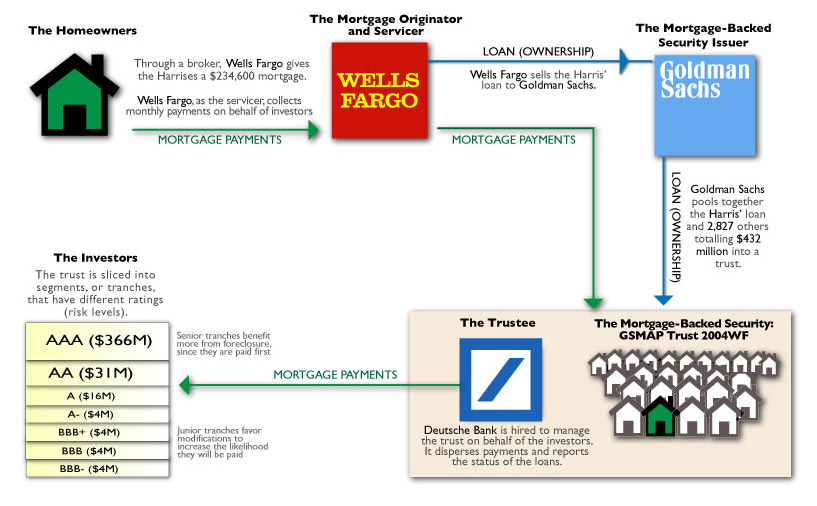
Hat tip Paris-SF
>
Sources:
Bundled Mortgages Pose Problems for Housing Program
Karen Weise
ProPublica – August 6, 2009
http://www.propublica.org/ion/bailout/item/making-home-affordable-loan-modifications-denied-806
Bundled loans stall modification plan
Marketplace, August 6, 2009
http://marketplace.publicradio.org/display/web/2009/08/06/pm-loan-mods/



October 19th, 2009 at 6:10 am
Subprime Debacle Traps Even Very Credit-Worthy
http://online.wsj.com/article/SB119662974358911035.html
An analysis for The Wall Street Journal of more than $2.5 trillion in subprime loans made since 2000 shows that as the number of subprime loans mushroomed, an increasing proportion of them went to people with credit scores high enough to often qualify for conventional loans with far better terms. In 2005, the peak year of the subprime boom, the study says that borrowers with such credit scores got more than half — 55% — of all subprime mortgages that were ultimately packaged into securities for sale to investors, as most subprime loans are.
The study by First American LoanPerformance, a San Francisco research firm, says the proportion rose even higher by the end of 2006, to 61%. The figure was just 41% in 2000, according to the study. Even a significant number of borrowers with top-notch credit signed up for expensive subprime loans, the firm’s analysis found.
October 19th, 2009 at 11:35 am
It is almost a given that those who give loans that they would have to each the losses on themselves are a lot more careful than those who quickly take a fee and ship the risk downstream.
October 19th, 2009 at 11:45 am
And who exactly is suprised by this? The game of hot securitized potato only encouraged more reckless lending because as long as you could fob it off on someone else before it blew up, you’d be fine. Sounds a lot like many things in today’s economy.
October 19th, 2009 at 12:19 pm
good credit does not mean great credit, most likely they desired lowest payment possible, and had a few nicks and dings that were easily fudged, like real income, net worth, etc………..alot of it is simply, go to xyz they will get you approved, the realators knew who were lax, and who would provide easy comps
October 19th, 2009 at 12:25 pm
Same story with qualified borrowers getting jumbo loans in California, for sure. People chasing bubble markets are “on margin” more often than not. I’m sure there was a lot of this in the Manhattan condo market as well.
October 19th, 2009 at 12:29 pm
The thing is, we may not be seeing as much securitization of mortgages as before, but now it’s Fannie/Freddie and the FHA who are on the hook, meaning we the taxpayer will be on the hook if/when these new loans to the latest group of knife-catchers/bagowners, I mean homeowners goes south.
October 19th, 2009 at 12:41 pm
Speaking of “hot potatoes”:
http://www.zerohedge.com/article/aig-casino-hot-potato-darling-806-monthly-turnover-ratio
October 19th, 2009 at 12:46 pm
Kudos to all who made the SPX 1100 call, ben22 among them. BR too, I expect. Will be interesting to see if the ceiling for dollar carry is EUR:USD 1.50 or 1.60.
October 19th, 2009 at 12:59 pm
Einhorn bets on major currency collapse..me too
http://www.marketwatch.com/story/einhorn-bets-on-major-currency-collapse-2009-10-19
October 19th, 2009 at 1:01 pm
@lb yes my s&P 1100 call reached today. I think markets will take a pause here. But whether we will see a deep correction after that is anyone’s guess.
October 19th, 2009 at 1:23 pm
http://www.marketfolly.com/2009/09/hugh-hendrys-eclectica-fund-august.html
Einhorn’s strategy seems aligned with comments Hendry made in Eclectica’s Aug. missive- specifically under the subheading “Investment Strategy”.
October 19th, 2009 at 1:32 pm
More Hendry from 10-16-09
https://self-evident.org/?p=691
October 19th, 2009 at 1:43 pm
Fortunately securitization spread the risk around, so the system as a whole was a lot safer.
Right?
October 19th, 2009 at 1:49 pm
If by “securitized” you mean funded by entities other than those originating the loans, then the proportion of securitized loans is well above one in eight. About now, try nine in ten, which is about how many loans done today whose funding comes from the gse fed conservatorships, and the fed government itself, in the form of our very own subprime mortgage securitizer, Ginnie Mae and the FHA.
As Mannwhich observed, we’re all on the hook for these loans now, most of which would have been further “securitized” and sold on to the Chinese, et al, in the form of bonds sold by the gse’s. At least those that weren’t monetized in a purchase by the fed.
October 19th, 2009 at 2:19 pm
duh.
October 19th, 2009 at 2:57 pm
I have seen lots of diagrams, articles, podcasts, etc., explaining the securitization process. Anybody who wants to understand it, at least on the surface, from the outside, can find an explanation to suit his level of financial knowledge.
Here’s what I have not seen: a diagram similar to the one above, that also has an annotation regarding the payments and profits extracted by each party at each step.
I think that would go a long way towards helping understand how so many people could be involved in what many knew to be a flawed or even fraudulent process. I know the numbers may vary, but perhaps example of the fees paid for an ‘average’ securitized mortgage bond from start to finish would be eye-opening. This would include fees paid to rating agencies, RE appraisers, originating banks, bond salesman, etc. Hell, even mortgage spammers fit in this food chain somewhere and extract some amount.
October 19th, 2009 at 3:00 pm
ManhattanGuy = ben22? I forgot whether you announced that.
Kudos to you, though, for a great call.
October 19th, 2009 at 3:12 pm
duh, indeed.
@Mannwhich and @curmudgeon: yours is the best point yet. The strategy of the players in the securitization chain was to lob the hot potato to someone else, anyone else. Now the mortgage industry has lobbed it to the government, who will lob it to the taxpayers.
The question is whether the lob from the mortgage industry to the gov’t at FMV. To the extent it is not the banks will receive yet another subsidy.
I’m still waiting for some brilliant economist/journalist/commentator to calculate all the subsidies that the banks have received from us.
October 19th, 2009 at 3:15 pm
@Marc P: And the taxpayers in the lower and middle classes (only the “little people” pay taxes) are largely broke, so who will we “lob” it too? The Chinese?
My earlier prediction of quiet tax and debt rebellions coming to a town near all of us has not changed one bit. If anything, it’s strengthening.
October 19th, 2009 at 3:25 pm
@Marc P:
It goes w/ being TBTF. At some point the subsidies are seamless and Marx wins.
October 20th, 2009 at 7:32 am
[...] Banks securitized the glop and kept the good stuff A study found that securitized mortgages were five times as likely to be delinquent as mortgages that were not resold to securitizers. In other words, banks held the good stuff and sold the glop to be securitized. Thus, they knew exactly what they were doing [...]
October 20th, 2009 at 10:08 am
[...] Ritholz points to a study finding that “securitized mortgages were five times as likely to be delinquent as mortgages that were not resold to [...]
October 20th, 2009 at 10:51 am
Who cares about delinquencies? Losses don’t count towards operating earnings and they eventually get socialized by the government.