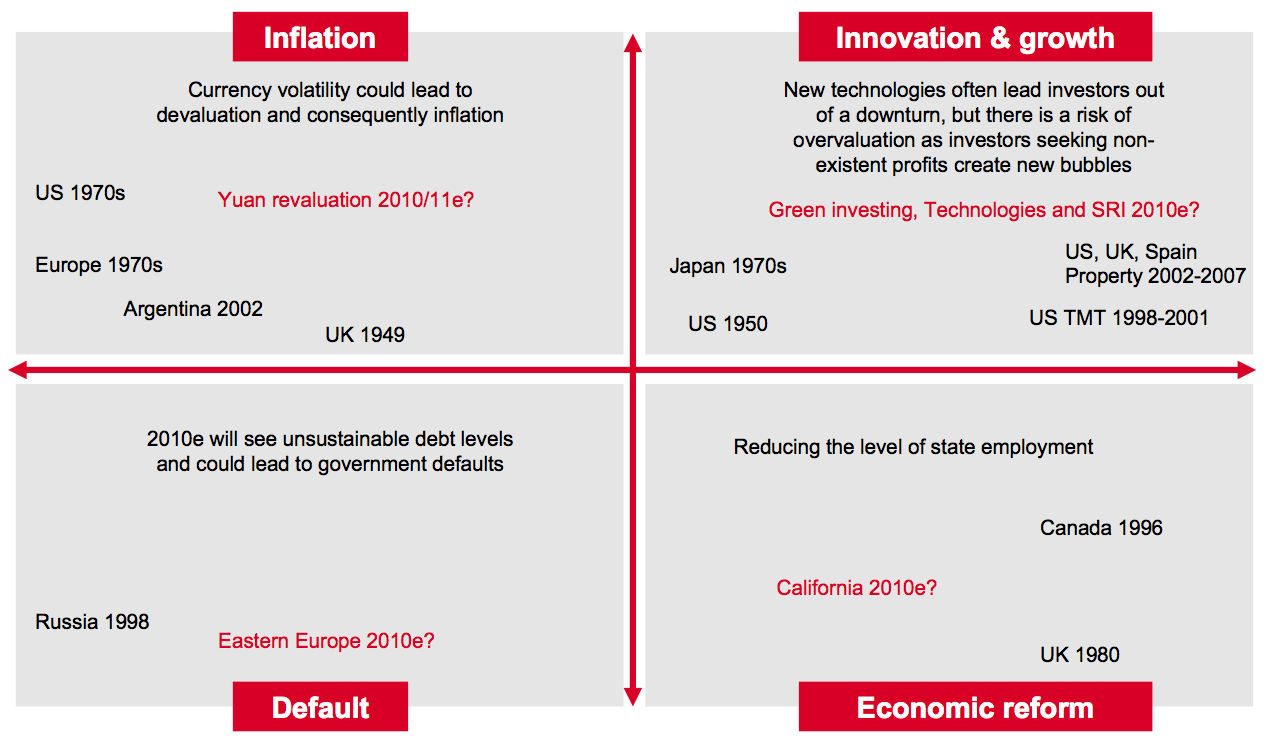
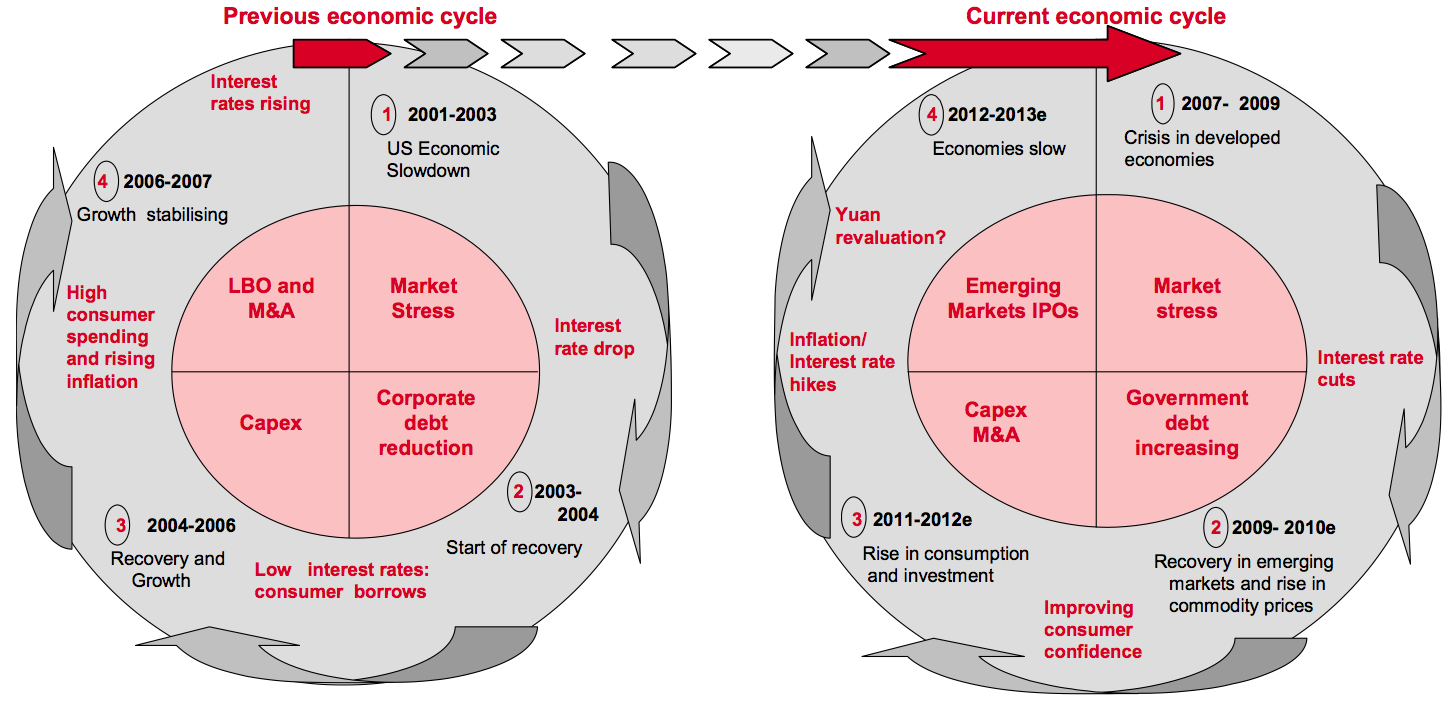
SG: Worst case debt scenario
Daniel Fermon of Société Générale produces some of the more unusual market research and especially charts and graphs.
What I have seen of them is frequently intriguing, and oddly thought provoking. I can stare them them for long periods of time while trying to suss out just what they mean — sometimes with only modest degrees of success.
Still, they are strangely appealing, fully of symmetry and grace. I find them oddly beautiful:
>
click for ginormous graph
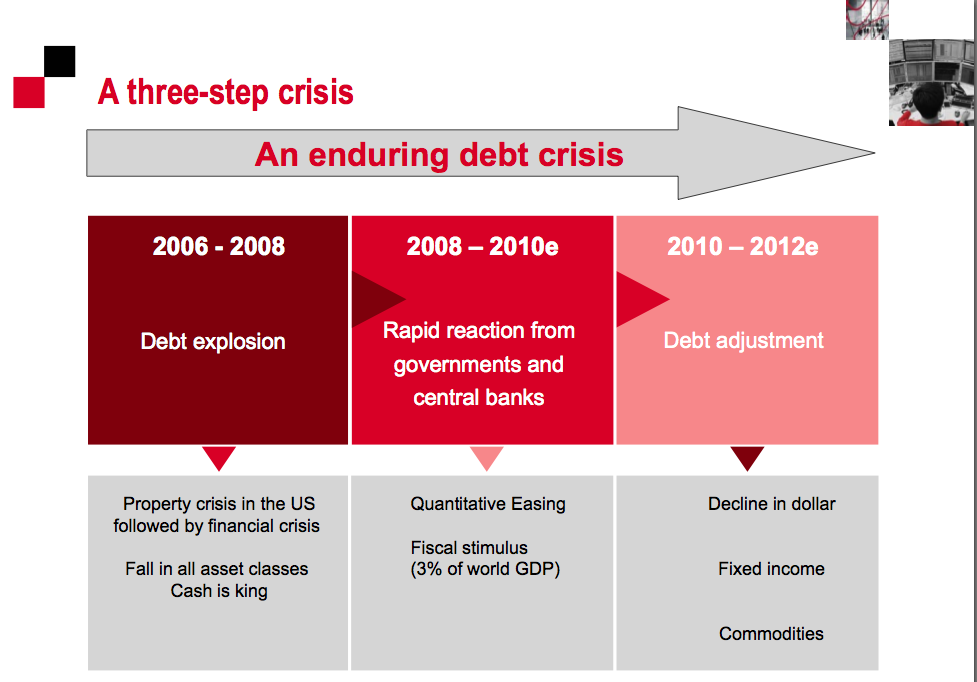
Source:SG Cross Asset Research
>
click for ginormous graph
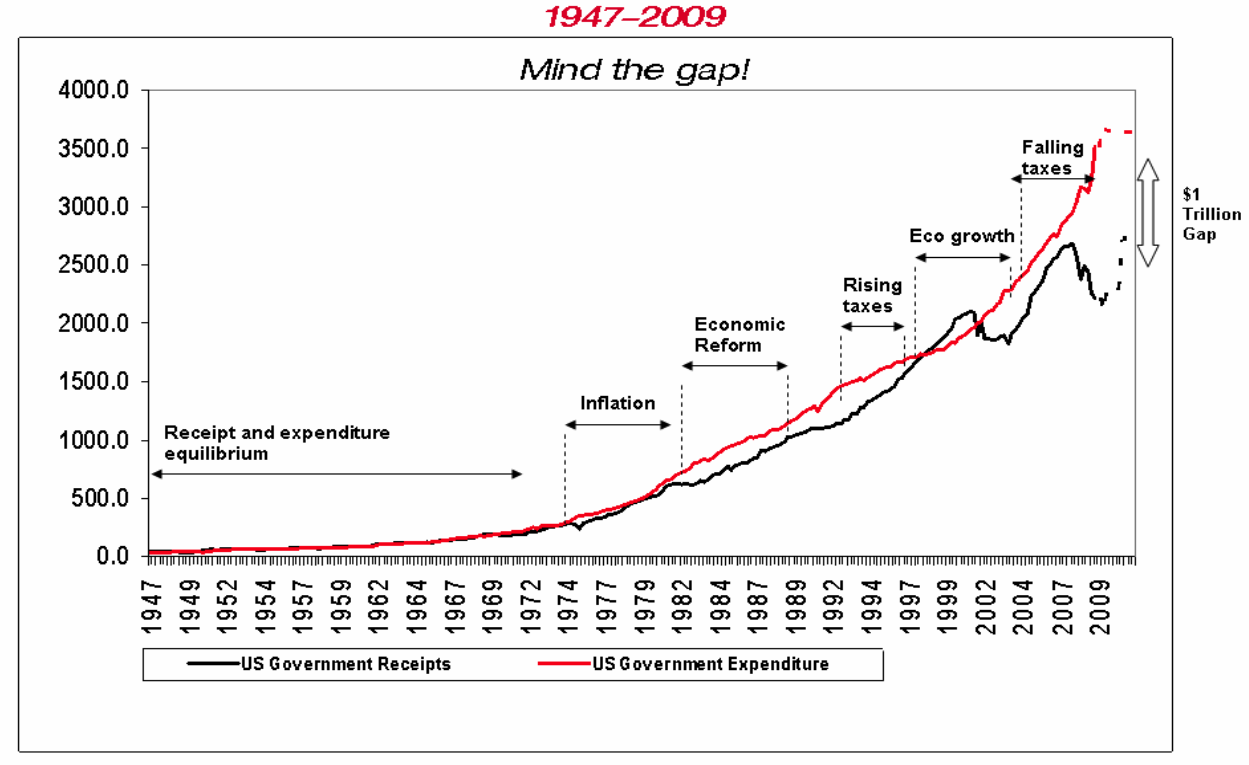
Source: Congressional Budget Office, SG Cross Asset Research
>
>
Source:
Worst case debt scenario
Protecting yourself against economic collapse: Hope for the best, be prepared for the worst
Daniel Fermon
SG Cross Asset Research,
Société Générale, 13 October 2009



Tweet
Facebook
Reddit
Digg this!


October 18th, 2009 at 12:05 pm
How about “most likely scenario”.
Excellent graphics.
October 18th, 2009 at 12:49 pm
Ahah. I love my employer. This graph really is “smooth”.
Seems like being long on commodities is a good play if “worst case scenario” happens.
Unfortunately, I can’t see any alternative scenario…
October 18th, 2009 at 1:45 pm
Mr. Ritholtz,
Excellent information. Receipts and expenditures is a good tool. It is unbiased. Unlike indexes that substitute failures (GM) for new winners and apply a weighting, it is a much better representation of what is really happening.
You should develop the Ritholtz index an index that utilizes unbiased data like receipts and expenitures to show what is actually happening in the economy.
October 18th, 2009 at 2:46 pm
The graph “Mind the gap!” (federal revenues vs expenditures, 1947-2009) needs to be on a log scale to be visually meaningful over so large an expanse of time and dollar depreciation. Better still, remove the income and expeditures tied to Medicare and Social Security, which unnecessarily distort picture. For one thing, if you remove those two retirement items, the Clinton “surplus” would turn into a mirage.
October 18th, 2009 at 3:11 pm
those are nice charts, though, the ‘comments’, for them, seem to be missing..
usually, a powerpoint slide, or similiar, has ‘explanatory’-prose to go with them..would these?
other than that, this: “Protecting yourself against economic collapse: Hope for the best, be prepared for the worst”, has to be the best advice one can follow.
~~
and, this, another slice of how the Game gets played: “…facing an overwhelming resource mismatch with the financial businesses. These businesses are deploying armies of lobbyists on Capitol Hill and hosting hundreds of campaign cash parties.
In an excellent article in the New York Times, regular columnist Joe Nocera, asks the question–”Have the Banks No Shame?” He starts his reply by quoting Simon Johnson, a former economist with the International Monetary Fund: “They can’t pay what they owe!” he began angrily. Then he paused, collected his thoughts and started over: “Tim Geithner saved them on terms extremely favorable to the banks…What gets me is that the banks have continued to oppose consumer protection. How can they be opposed to consumer protection as defined by a man who is the most favorable Treasury secretary they have had in a generation…It is unconscionable.”
Well said, but not enough. As long as the top banking bosses get their huge bonuses and their mismanaged, corrupted banks get their taxpayer bailouts, because they are too big to fail, they will continue pushing their devastating greed with impunity.
The issue is not only shame. The issue is guilt and for that, prosecution, conviction and incarceration are the remedies. That is the only prospect that sobers up the corporate crooks.
Adequate prosecution budgets, tougher corporate criminal laws and a government going for law and order–none of these are in any legislative proposals or in the hearts and minds of our Washington representatives.
So, sovereign citizens everywhere, if you don’t organize to have the say, you’ll continue to pay, pay and pay. Time to make apathy boring!.” By Ralph Nader
http://www.informationclearinghouse.info/article23738.htm#
October 18th, 2009 at 3:25 pm
@Mark E Hoffer Says: “…they will continue pushing their devastating greed with impunity”
I am pleasantly surprised by the increasing number of well respected economists and others who are reaching similar conclusions and speaking out about the wrongs of financial industry.
October 18th, 2009 at 3:53 pm
Greenspan, the libertarian of finance, is on board. He recommends that the big banks need to be split up. Let’s start with Goldman Sachs. They can keep their investment banking advisory functions but should off load their trading operations.
October 18th, 2009 at 4:20 pm
…and in the Daily News the caption read… “Latest Wall St. bonuses are simply obscene”
http://www.nydailynews.com/opinions/2009/10/18/2009-10-18_latest_wall_st_bonuses_are_simply_obscene.html
October 18th, 2009 at 7:35 pm
Give the TBTF banks a short time frame to pay back or they get broken up liquidated to pay back the US. Meanwhile another foreclosure surge will kick off another financial crisis and the breakups will yield to another round of bailouts!
October 18th, 2009 at 8:08 pm
so are we buying asian equities on any pullback?
October 18th, 2009 at 10:21 pm
[...] Here’s one for the next time you have to endure a “Real American” waxing about old mother Reagan. Note that in the golden years of American capitalism, when the top federal tax bracket was hovering around 90%, the federal government paid its bills. Via Barry Ritholtz. [...]
October 19th, 2009 at 12:43 pm
[...] You could take issue with the chart above, as the worst case deficit projections come from the Heritage Organization, a conservative group opposed to Obama. But Société Générale came up with a similar analysis, concluding that we will quickly have a Trillion Dollar Gap with no clear way to fill it. See chart, courtesy The Big Picture. [...]
October 19th, 2009 at 5:57 pm
These charts are exhibits of highly effective scenario planning originaly developed by Royal Dutch Shell (Peter Schwartz). They were and are used to develop “potential” scenarios and how these may play out in the longer view. The key is to input “realistic” parameters on the four axis’ otherewise they are useless. They are nice charts.
October 21st, 2009 at 4:02 pm
[...] SG: Worst case debt scenario | The Big Picture (tags: FW debt USA) [...]
November 20th, 2009 at 8:26 pm
wow. i caught this report (on daily telegraph of all places) late!
the kicker is that tax gap graph (figure 2nd from top).
We can thank our Gormint for opening up the red gaps in 2003 (the Same year CHina REALLY STARTED to kick up it’s accumulation of US treasuries in HIGH GEAR…running HUGER surpluses; also the same year of Iraq war v2.0) and another fall off due to recession near end 2008.
SO looking at Fermon’s 2nd Graph: gap is $1TRN. we can’t raise taxes NOW because our OWN bankers (the blond/blueeyed Wall Streeters) have done us in [and suitably given themselves bonuses for this]. WE can’t cut spending cause we have 2 war’s baking in the oven plus appetite for more. tick tock tick tock…..the world doesn’t WANT hot flow of $$s anymore (even developing nations which we fashionably call superpowers have “capital” controls : as in “$ not accepted here”.) And what is our Gormint doing?
THE MATH: to close this gap:
*assume tax receipts are 20% of GDP.
*assume current GDP is $14trn.
==> extra tax receipt of $1trn at current rates requires extra GDP of $5trn.
==> $5trn on $14trn implies a growth of GDP by 35% (!) (NOT BLOODY LIKELY)
* assume this $1trn gap grows at 10yr Treasury rate of 4%
==>if our GDP doesn’t grow >4%; our $1trn “gap” only gets bigger
==>………..the repo man will knock on our doors (and he speaks mandarin).
November 20th, 2009 at 8:31 pm
PS. (anticipating all the supply siders or whatever tehy call themselves these days; if anyone responds at all this late :(
NO u can’t say it’s only $$s we can print as many as we like!!! that is NOT the way we run things. that is what someone in elementary school below grade 6 might say. EVENTUALLY it requires foreign money to support the $ ! When the $ starts to tank and Fed don’t want it to…they will have to call on foreign ccy to raise it……reserve ccy status won’t hack it. It will all come back…..like what they call “blow back”.