
Strategic Non-Foreclosure
This morning, we discussed Strategic Mortgage Default. This afternoon, let’s look at Strategic Non-Foreclosure.
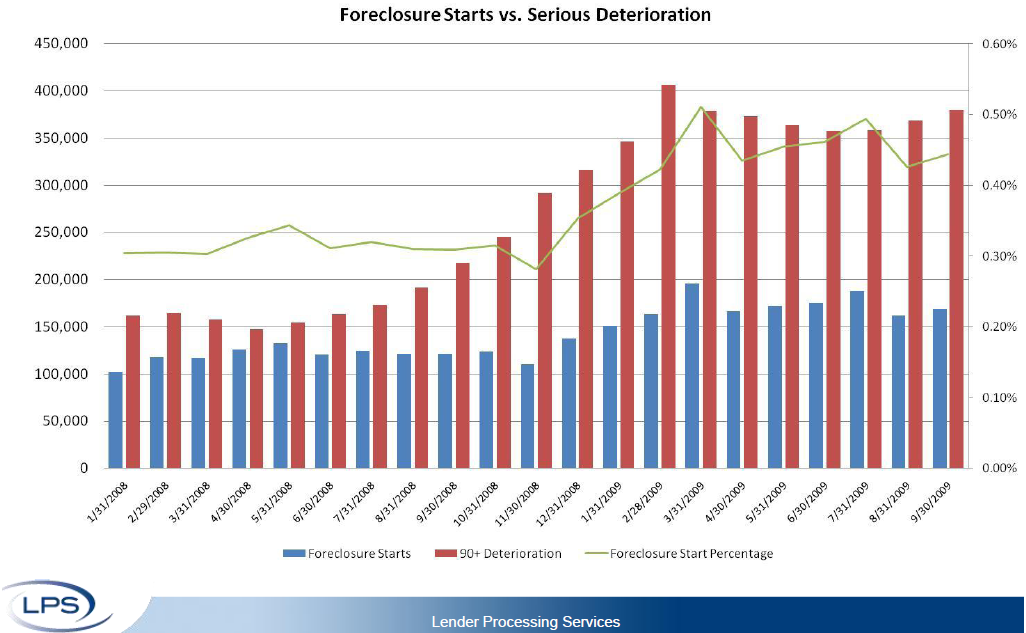
Data via LPS‘ Monthly Mortgage Monitor shows a growing disparity between delinquencies and foreclosure starts. In other words, as more people fall behind on their mortgages, banks are becoming increasingly leery of putting them into foreclosure.
LPS calls this “Shadow Foreclosure Inventory” – The number of loans deteriorating further into delinquent status is more than twice the volume of foreclosure starts.
Why would they wait? Some of it is voluntary foreclosure abatement, some mortgage mod delays. Yet the chart below implies something beyond that. Perhaps its strategic.
Consider: The bank may have other (more expensive?) local properties that would be effected by a foreclosure. They may be waiting for a more advantageous time of year to put the homes up for sale. But I suspect the biggest reason are costs: Until foreclosure, the nominal owner remains liable for all state, real estate and local school taxes. Plus, some localities require regular maintenance (mow yard, clean street, shovel sidewalk, etc.)
Hence, not foreclosing not only gives the owner time to get current, but may also prevent the bank from accruing expenses . . .
Here is LPS chart:
>
click for larger graph
Data as of September 30, 2009 Month-end
>
As Annaly Salvos notes:
“As the graph illustrates, delinquencies are rising, but foreclosure starts are not. As of September 2009, 90+deterioration more than doubled actual foreclosure starts. LPS has dubbed this “shadow foreclosure inventory.” Higher unemployment begets delinquencies and defaults, but foreclosures aren’t flowing through due to modification efforts and various moratoria. Depending on the success of programs like HAMP, more than a few of these loans are still destined for foreclosure.”
Good stuff.
>
Hat tip Scott F!
Sources:
September 2009 Mortgage Performance Observations
LPS Mortgage Monitor, October 15, 2009
http://www.lpsvcs.com/NewsRoom/IndustryData/Documents/10-2009%20Mortgage%20Monitor/LPS%20Mortgage%20Monitor%20Sep09.pdf
Who Knows What Evil Lurks In The Hearts of Men?
Annaly Salvos
October 27th, 2009
http://www.annaly.com/blog/?p=659



October 28th, 2009 at 12:20 pm
i’ve been commenting on this for months, number one, the government gave banks a moratorium, don’t we will try and save the world, number two, not enough buyers, processors of paper work, plus, if they took them down they would be so insolvement it would not be funny
there are 3 types of buyers of foreclosure, big companies that can buy 700 at a shot, local guys who buy 40-50 a clip across the country, and individuals
the middle guys are shut out waiting, all of there contacts tell them there files grow yet they are not foreclosing
they are in fact propping up the market by controlling it by not foreclosing and tax credit buyers
they anticipate the largest number will come starting in early summer of 2010, why, unemployment benefits are done and run out, plus, the resets on arms are starting right now, notices going out, so how long can u last when u get jacked up, so jan/feb/march anticipation is for delinquencies to march up
they need prices to stay up, plus go up, plus employment which will not happen till middle of 2010
it’s a game of chicken, how long can u keep rates low, well as ben says for forseeable future,
October 28th, 2009 at 12:48 pm
I had heard that for securitized mortgages, in many cases the banks as servicers have the right to make advances to the trust to keep mortgages and bondholders current between default and foreclosure. All of the servicing advances prime the first mortgages and carry significantly above market rates. Under those circumstances, the defaulted mortgage would have more value than the foreclosed properties to the servicer, as it is a fee generating opportunity and provides super senior lending opportunities (funded in many cases with TARP money) at rates higher than they can get lending to prime customers. Securitization is a necessary ingredient for providing systemic liquidity, but under the current circumstances seems to have created a cascade of self serving and perverse incentives.
October 28th, 2009 at 12:55 pm
OT:
torrie,
don’t get me wrong, my clerical skillz leave much to be desired, though, you may care to check out:
http://www.dailywritingtips.com/there-their-theyre/
http://www.better-english.com/easier/theyre.htm
~~
to the post:
the beautiful thing, with these strategic ‘non-Foreclosures’, is that they let yahoos like Yun crow about ‘low-levels’ of ‘inventory’..
“lowest level since Nov. ‘82″, IIRC..
October 28th, 2009 at 12:56 pm
“But I suspect the biggest reason are costs: Until foreclosure, the nominal owner remains liable for all state, real estate and local school taxes. Plus, some localities require regular maintenance (mow yard, clean street, shovel sidewalk, etc.)”
This is generally true. I say this as someone that has represented banks interests in foreclosure. Besides delaying costs, banks are worried about the debtor filing bankruptcy. The last thing they want to do is spend money getting taxes current only to have the debtor file bankruptcy. At best, the bankruptcy delays foreclosure (depending on the state, this can be from a few months to years) and the bank has money tied up until it can get the property out of bankruptcy court. At worst, the bankruptcy court agrees to let the debtor do a sale of the property through the bankruptcy court and pay the bank back proceeds from the sale. The bank is then left arguing over and trying to recover not just the debt, but amounts paid for real estate taxes and other expenses.
So it is generally true that banks like to defer the cost of putting money into the property until post-foreclosure. With that being said, it is not always such a clear cut decision. The banks may not be liable for the property taxes, but the property tax lien does prime their lien and attaches to the property. If the bank waits too long, the taxing authority may initiate foreclosure proceedings of its own forcing the bank to step up and pay the taxes before foreclosure. In states that use judicial foreclosure with a lengthy process, this is not an unlikely event. Keep in mind the property taxes are not a free ride for the bank. In most jurisdictions, when they finally do pay the delinquent taxes, they have to pay default interest on the amount due a a super high interest rate plus late fees. If the taxing authority initiates foreclosure, court costs are tacked on. The bank is not just responsible for paying the taxes during its ownership period. It may not be personally liable post-foreclosure, but it can’t sell the property without first clearing those property taxes.
So there is an advantage to getting it paid and not paying the RE taxes if the bank feels confident it will foreclose and that the debtor will not put the property into bankruptcy. The bank avoids all those excess fees.
Finally, I could write a treatise on this, but I want to point out that the bank are also sometimes hoping to sell off a loan or a loan portfolio before foreclosure. This is another reason to delay putting more money into the properties. Their hoping to flip it to the note purchaser an make it their problem rather than dealing with it.
A very complex subject and generally the analysis is on a case by case basis. But generally, you are right. The banks generally want to defer costs (even if its means ultimately paying taxes and costs) and avoid bankruptcy risk.
CC
http://www.chartsandcoffee.com
October 28th, 2009 at 1:09 pm
roflmao, Mark, at first i wrote an explanation, a little snarky, trust me this has been pointed out by many over the years, it is a memory thing and i’ve never taken the time, so right before i posted it i clicked on the second sight, thinking, hmmmmmmm, maybe he’s being helpfull versus critical, and low and behold you were, that is the type of recalibration of memory the is KISS for me
muchos gracias, kind sire
ps, read almost all your stuff, always good
October 28th, 2009 at 1:09 pm
I don’t think it’s as much costs as it is profit motive. With the new “mark-to-make-believe” accounting, and the helicopters full of cash, there’s no compelling reason for them to foreclose and get these assets off the books. Why do that this quarter when we can get record bonuses?
October 28th, 2009 at 1:13 pm
Another nail in the coffin of those who would use the CRA as a scapegoat. Poor people work hard for what they have and when they give up, it’s because they’ve exhausted every other option.
Middle class people, on the other hand, are used to having things handed to them. Perhaps we ought to change our stereotype from “poor and lazy” to “middle class and lazy.”
October 28th, 2009 at 1:15 pm
“LPS calls this “Shadow Foreclosure Inventory” – The number of loans deteriorating further into delinquent status is more than twice the volume of foreclosure starts.”
Shadow banking, shadow house inventory, shadow employment + inflation statistics.
FASB now “mark-to-myth” – vs. “mark-to-market”
How about someone coming up with a complete list – of inaccurate/incorrect data, and sources for same. The short list would now be accurate data. I call “The Emporer has no clothes”"
—————————————————————————————-
http://en.wikipedia.org/wiki/The_Emperor%27s_New_Clothes
Plot summary
An emperor of a prosperous city who cares more about clothes than military pursuits or entertainment hires two swindlers who promise him the finest suit of clothes from the most beautiful cloth. This cloth, they tell him, is invisible to anyone who was either stupid or unfit for his position. The Emperor cannot see the (non-existent) cloth, but pretends that he can for fear of appearing stupid; his ministers do the same. When the swindlers report that the suit is finished, they dress him in mime. The Emperor then goes on a procession through the capital showing off his new “clothes”. During the course of the procession, a small child cries out, “the emperor has no clothes!” The crowd realizes the child is telling the truth. The Emperor, however, holds his head high and continues the procession.
—————————————————————————————-
Honesty is not the best policy, apparently in the financial system (BR, and a few other bloggers excluded, of course!). I have a sudden urge to watch the “Wizard of Oz” again…
Oh, and by the way, the biggest obfuscators of them all: The Fed + GS (one and the same?).
October 28th, 2009 at 1:22 pm
What chartsandcoffee said. But I still lean more toward the idea that the banks are trying to keep the ‘asset value’ of the old loan on the books than toward the carrying costs of the foreclosure. I expect both things are likely true.
Minor grammatical quibble: “The bank may have other (more expensive?) local properties that would be effected by a foreclosure.”
I think ‘affected’ is the verb you want, rather than ‘effected’.
October 28th, 2009 at 1:26 pm
@franklin:
The CRA should not be scape-goated…. Instead, we should place a good part of the blame on the Federal government’s continued involvement in housing, period. Why are “buyers” (really house-debtors) subsidized at the expense of renters. Why does the Fed buy most mortgage backed securities and keep interest rates artificially low? Why is mortgage interest deductible? Why does Fannie/Freddie/FHA exist at all? Mortgages and foreclosures should be pretty simple things: you agree on a payment schedule and if you pay up till the end, you keep the house. If not, the bank gets collateral, period. Why the hell do I need a third party interfering in this.
The only role for government is this is as a referee, prosecuting fraud. You shouldn’t see the guys in black and white try to sack the quarterback or block a punt!
HCF
October 28th, 2009 at 1:36 pm
And one other possibility: the banks are overwhelmed and moving slowly. Since the beginning of the foreclosure crisis we’ve seen that banks were in no way equipped to deal with the scale and complexity of their huge foreclosure portfolios. They may simply not have gotten around to all of them.
And of course they’re making some strategic decisions as well, as @chartsandcoffee nicely points out.
October 28th, 2009 at 1:37 pm
@HCF
Watch the first 20 minutes of “The Grapes of Wrath” and you’ll see why the Federal government got involved in housing. =)
October 28th, 2009 at 1:37 pm
This is not the banks waiting for a better time to sale, its simply banks trying to HIDE HUGE LOSSES. If they foreclose they have to recognize the loss and in some areas this is 50% or more of the loan value. Under the “extend and pretend” accounting rules banks are keeping these valued at 100% in most case which make them look well capitalized. If we were still in the mark to market world these sucker would be foreclosed on so fast it would make your head spin. Don’t you find it funny that every bank closed by the FDIC has a 40% loss when the assets are brought to market? This tells me the banks are sitting on huge piles of crap or just playing the extend as long as possible game.
Personally, I think its great people are walking away by making it a pure business decision… and if the banks to actually kick them out of the house, I hope they enjoy living rent free (taxes are likely cheap compared to paying someone rent).
October 28th, 2009 at 1:44 pm
@franklin411:
Although I generally disagree with Federal government intervention in most matters, one can at least make a MORAL argument for helping people with renting a place so that they are not homeless, helping with job training, or feeding destitute people.
But why is BUYING a home such a “right” that the vast majority of Americans feel entitled to?
There is no good moral, ethical, or economic justification whatsoever to government helping people to BUY homes. It’s merely a boondoggle that the Federal government doles out to buy votes from the voting public.
HCF
October 28th, 2009 at 1:48 pm
I am currently engaging in strategic non-foreclosure myself… Its called paying the mortgage on time…
October 28th, 2009 at 1:48 pm
Hey Guys/gals/others:
Why hasn’t Larry Yun posted something to ’splain today’s housing figures?
October 28th, 2009 at 1:49 pm
@newulm55:
> Under the “extend and pretend” accounting rules banks are keeping these valued at 100% in most case which make them look well capitalized.
This is why I was 100% against bailing out the banks… In fact, my mantra is, fuck them… Right now, all the bailouts and accounting rule changes are merely superficial wallpaper over reality. In fact, I think it is likely extending the pain out….
Crap banks should re-capitalize or die, underwater homeowners should walk away and rent much more cheaply, foreclosures should accelerate, and we should all move past this mess. Right now, with the fictitiously high values on the books, we’re merely playing a game of “hide the toxic waste.”
Of course, at this point, the powers that be will never do the right thing. Once you start lying to the people, you have to keep on doing it to keep the illusions up…
HCF
October 28th, 2009 at 1:56 pm
Homes are the greatest creator of wealth in the world. By being a new nation, based on the rule of law, homes, farms, etc. were stores of wealth passed down thru generations. History shows home refinancing, selling etc. started many a small business. It is the small guys family dowry. Emerging markets have always been starved for capital because no co-hesive laws for homes that creates a stable market for trade of value.
October 28th, 2009 at 2:02 pm
I was pointing out the stupidity of foreclosing a year and a half ago, after all anyone can see that having a homeowner is defacto having someone responsible for the property, and the taxes and the yard, and shoveling the sidewalks, on site 24/7. The alternative is having a vacant home with freezing water pipes bursting in the middle of winter ruining the value of the home in real terms not just on the books. I suppose with winter approaching again and seeing the damage done to their assets from the last one, they may be rethinking their policies for that reason as well…
October 28th, 2009 at 2:07 pm
I think it was economist Gary Becker that made the observation that all government programs, no matter their original intent (helping the poor, etc.) eventually devolve to entitlement programs for the middle class, or, at least they do in the United States. Why? It’s very simple–that’s where the bulk of the voting public resides. So, housing programs started in the Great Depression to help the homeless and dispossessed (the FHA and Fannie Mae) morphed into a middle class entitlement program–houses for all!–which is what they’ve been for at least the last half-century. Fortunately, they were already available as ready recipients of vast government largesse (about $2 trillion, and counting, when you include the gse bailouts, the coming FHA bailout, the $1.45 trillion in MBS and gse debt purchases) directed at those middle class voters that never demand anything less than something for nothing.
Thing is, the middle class rubes don’t quite get that all that government largesse will ultimately have to come from them, either in higher taxes, higher prices, or massive debt. You could tax all the millionaires at 100% and still not have enough money to fund all this.
October 28th, 2009 at 2:29 pm
[...] Big Picture takes up part of that story with “Strategic Non-Foreclosure” and the Piggington site details some of the statistics in the recent past for [...]
October 28th, 2009 at 2:33 pm
@bman
I made an offer on a forclosure in Jan 09 which I now own. The bank (Bank of New York) actually forclosed on the previous owner in Aug 08 and then had to go through eviction and got the owner out in Oct 08. By the time the new bank (Countrywide) sent someone out to winterize the place – the pipes were already frozen. If I were a bank I would run the forclosures when Spring breaks in the North and provide time to unload the property without having to run the risk of proper winterizing.
I was pointing out the stupidity of foreclosing a year and a half ago, after all anyone can see that having a homeowner is defacto having someone responsible for the property, and the taxes and the yard, and shoveling the sidewalks, on site 24/7. The alternative is having a vacant home with freezing water pipes bursting in the middle of winter ruining the value of the home in real terms not just on the books. I suppose with winter approaching again and seeing the damage done to their assets from the last one, they may be rethinking their policies for that reason as well…
October 28th, 2009 at 2:42 pm
Several unrelated thoughts and ideas.
Most of the foreclosures are in Florida, California, and Nevada. I don’t think they are worrying about freezing pipes. In New York that might be a legitimate reason to stall foreclosure, though.
Has anyone called the banks and asked them?
When I see two related metrics disconnect like that my first reaction is a capacity problem. Are their foreclosure departments working at capacity? If they wanted to foreclose on more homes the banks could hire the necessary people to increase their capacity. Indeed they might have already and what we are seeing is just the lag as their additional capacity comes on line. Or the capacity bottleneck might be in the courts, which are very inelastic at adding capacity. I did a little sniffing on a few job sites, and I don’t see large hiring shifts for loan officers, but the bank bottleneck could be at any level.
I would also not discount the political pressure. Team Obama is already facing a multitude of political hot potatoes right now, and surely does not want to see the foreclosure rate increase. Many of these banks have attached themselves to the government teat. And the government teat has proven to be very opaque and comes with lots of hidden threats, like a 90% pay cut for your executives. I wouldn’t be surprised at all if the government minders hadn’t made some threats along the lines of “don’t foreclose on more than X percentage of loans, or face the consequences.”
October 28th, 2009 at 3:00 pm
chartsandcoffee says-
“Besides delaying costs, banks are worried about the debtor filing bankruptcy. The last thing they want to do is spend money getting taxes current only to have the debtor file bankruptcy.”
why would the bank pay the taxes up to date before foreclosing? after foreclosing the bank is the owner of the property so who cares if the previous mortgagor files BK- additionally property taxes follow the property regardless of owner- so if they weren’t paid by the mortgagor- then they will have to be paid by the bank after foreclosure anyway
and this-
“So there is an advantage to getting it paid and not paying the RE taxes if the bank feels confident it will foreclose and that the debtor will not put the property into bankruptcy. The bank avoids all those excess fees.”
i guess i’m dense but please elaborate on what you are saying
October 28th, 2009 at 3:35 pm
The foreclosure process is very bankruptcy driven and a big part of the overall strategy for both the creditor and debtor.
If the debtor files bankruptcy there is an automatic stay filed by the bankruptcy court which prohibits creditors from exercising remedies. This means the bank can’t foreclose until the stay is lifted by the bankruptcy court. It is the tool most often used by debtors to halt the foreclosure process.
The point is that if the bank pays the taxes pre-bankruptcy, and the property is sold through the bankruptcy court, it is not certain that the bank will get repaid the amount it spent to pay the taxes and other expenses. So besides just wanting to defer payment for obvious reasons, this is sometimes a reason why banks want to wait until post-foreclosure to pay the RE taxes.
In the second part, my point is that if the bank waits to pay delinquent real estate taxes until after foreclosure, they will owe the taxing authority interest, late fees and potentially court costs (which all attach to the property) when the bank goes to clear title after foreclosure. So if the bank keeps the taxes current, it won’t get stuck paying all those penalties post-foreclosure.
CC
http://www.chartsandcoffee.com
October 28th, 2009 at 3:38 pm
Although it is a real world situation, we’re all discussing an issue which has the common denominator of being a huge arbitrary. We took the wrong exit off the freeway years and years ago and that first mistake then compounded into utter and untold complexity to the point where we forgot we were ever driving on a freeway and headed to a destination!
A home is a shelter. Was never intended to be an asset. Realtors pushed it into being a component of the American Dream… it is not. A house should never appreciate… like any consumable it should depreciate in price. This anomaly was created by The Fed/Congress by interfering in the public arena. They create bubbles and imbalances in everything they touch… they create inflation… devaluing the currency, falsely increasing the “value” of assets.
Appreciation is phony and meritless. It comes from inflation. It takes the emphasis off of the senior activity of the production of valuable goods and services. Which is why we are failing as a country.
We’re all wrapped up in all of this nonsense. Communism went into the dustbin, Capitalism is headed that way and so is Socialism. They are all the same… they have the goal of a small group owning and controlling everything and not having to pay wages. They were never in conflict, the conflict was between the groups using them to win control… that is all. Comm, Soc and Cap have ruined everything. Marx had very good reasons but a wrong solution… never merge economics with government.
We here in the US are screwed. We’ve got deflation now… next will be stagflaltion… and then will come severe inflation (possibly hyper). Government, banks, Wall St., the power elite, etc. are all idiots doing this idiotic dance
and playing insignificant games.
Cycles are converging (weather, energy, economics) on a negative to create the perfect storm. A huge tsunami is coming. Change is coming beyond most people’s comprehension. Is there a way to withstand this tsunami and maintain the wealth we have as individuals, and be able to create more?
The question is… How are we going to live?
October 28th, 2009 at 3:46 pm
several potential reasonons
1) banks would have to admit the loss (bad dogie. no biscuit/bonus)
2). cost of forclosure?
3). mortgage backed securities make it hard to decide on foreclosure (those costs again too). after all if its hard to get a decision on a MOD why would this be any different?
4). problems with documentation (courts seem to be becoming picky about this. for some reason they actually have to be able to prove their was a note and that they own it).
October 28th, 2009 at 3:49 pm
Randy, you might think most of the foreclosures are happening in Florida, California and Nevada,
but they are happening all across this nation except perhaps in New Orleans and Montana. They might whine about it more in Florida, California and Nevada but what do you expect?
October 28th, 2009 at 3:53 pm
yes, i have actually talked to people in the business at length, it is extremely easy, people love too offer there opinons, just ask decent questions and be quite, banks….what are they doing? all of them bought other banks, they are discoverying what they have working thru the files, it is a mess, you have problems with locations, physically where people are located and how to bring in new management, they are unsure what will happen with the people, thus, they do not know if they should move in total, partially, etc. etc………they have no idea, what they are factually doing is hiring folks too collect money and paying bonuses on a monthly basis for performance, they are making calls 10 hours a day doing everything to collect money……………….what is a common statement, “we thought are files were bad, the ones we bought it’s horrendous, we don’t know what we are going to do”……………….
October 28th, 2009 at 4:09 pm
CandC-
thanks for the reply- much clearer- now i see the dilemma
October 28th, 2009 at 4:13 pm
torrie,
re: 13:09 , de nada~
though, seeing 15:53, a little more practice may be necessary ( ;
w/this: “people love to offer their opinons, just ask decent questions and be quiet”, though, no doubt~
it’s, really, the reason why it’s so hard to believe that ‘all these analysts’ got it so wrong, for so long–into today..
more proof that snorting exhaust fumes, rather than laser toner, is good for your Portfolio..
October 28th, 2009 at 4:32 pm
Strategic Non-Foreclosure for the Banks. Then Strategic Foreclosure (other thread) for those mortgage holders in Florida who maintain other lines in good standing for two years which results in forgiveness. Who says America has lost its creativity?
October 28th, 2009 at 4:41 pm
lol, mark, i did take the test and signed up for weekly lessons, after 4 wrong answers I started to SEE the mistakes, personal, people, thing, ie opinion, lol…….
October 28th, 2009 at 5:00 pm
torrie, so right before i posted it i clicked on the second “sight”
and i’m not mr. language person either
some mortgages are set up with taxes and insurance included in the payment. that used to be free money for the lender, until the renters with debt fall behind …
when do people start trashing the houses, holes in the wall etc., when they fall behind or when they are in foreclosure and no one comes to foreclose?
October 28th, 2009 at 5:16 pm
hue-
good point
October 28th, 2009 at 5:28 pm
that is a good point hue, they are usually 6 months forward so it’s a free carry for them
October 28th, 2009 at 7:27 pm
torrie, it may be some form of dyslexia. i think i have it. i can’t pick up on my own errors because my sentences are clean in my head, and i don’t want to self edit. but i can spot other people’s errors.
my other favorite white lie as an ex-debt salesman (mortgage broker) was telling peeps that they get to skip a payment when they refi. of course, they’re not skipping anything, the interest clock never stops and starts immediately, it’s just rolled into the next mortgage.
it was also very hard to sell taxes and insurance included in the payment, because it ate up the cash in cash out loans. i can’t remember now, but i think it was the FannieMae loans that required T&I included, especially with lower scores. strangely, sub prime lenders didn’t care about T&I in payment, if i remember correctly, and those were borrowers who really needed in the payment because many are subprime for a reason. they’re habitually late with everything. of course, there are people became subprime because of illness or laid off. we’re all subprime now.
October 28th, 2009 at 10:59 pm
Does any if this matter. US housing has been Nationalised anyway so its just shuffling money from one of Uncle Sam’s pockets into the other?
October 29th, 2009 at 4:15 am
Shining a light on the shadow inventory … when a lender refuses to foreclose, that’s the definition of a toxic asset.