Updated: 4 Bad Bear Markets

Email this post Print this post
By Barry Ritholtz - October 6th, 2009, 3:00PM

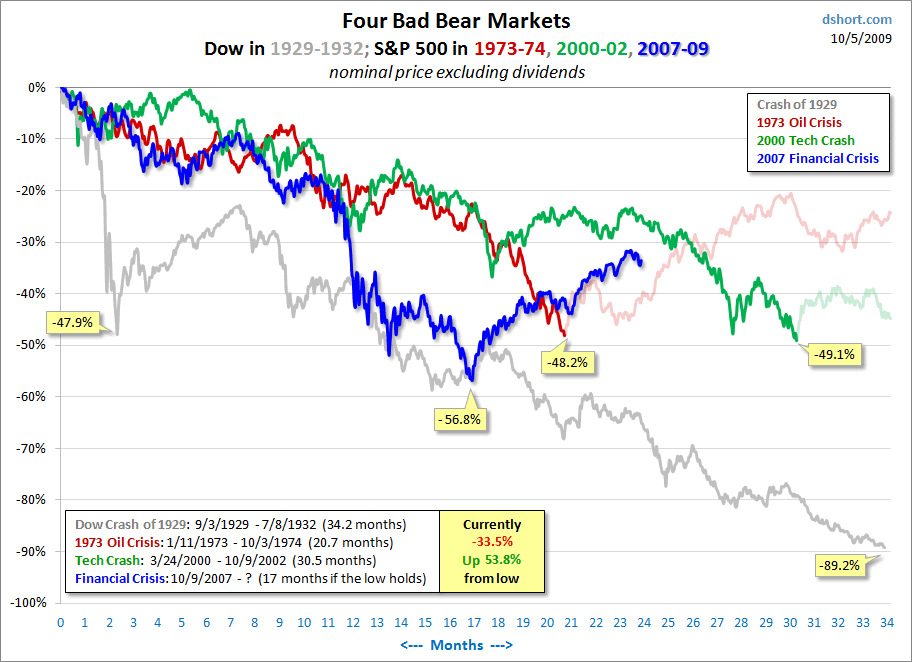
Some interesting changes in Doug Short‘s now infamous chart:

We have clearly diverged from 1929 (see below)

But before tossing ’73, I would try shifting it leftward a few months — the parallel still holds . . .

>
four-bears-large

Thanks, Scott!

Comments

Please use the comments to demonstrate your own ignorance, unfamiliarity with empirical data, ability to repeat discredited memes, and lack of respect for scientific knowledge. Also, be sure to create straw men and argue against things I have neither said nor even implied. Any irrelevancies you can mention will also be appreciated. Lastly, kindly forgo all civility in your discourse . . . you are, after all, anonymous.

25 Responses to “Updated: 4 Bad Bear Markets”

  1. leftback Says:

    The best modern parallel is missing – the Nikkei crash.

  2. VennData Says:

    The dollar’s been overvalued for years, the Asian exporters have been keeping their currencies “too low” for decades. The dollar needs to find a market-based rate that’s much lower. When the G7 and the new G20 stops talking about the dollar (as they have) you know the Asians (save China) have agreed to let their currencies appreciate. this is good.

    The dollar should drop, that’s good for global re-balancing. Repeating: it’s good.

  3. Gatsby Says:

    Barry, I know you love throwing out the 73/74 comparison, and from a purely chartist perspective, yes it is a great parallel. However that is where the parallels end.

    73/74 was smack in the middle of the inflationary 1970s with inflation over 10% in 1974. We are currently in a deflationary environment (even if you aregue we are not delfationary we are harldy inflationary)

    Valuations were lower in 73/74 than they are today and dividend yields were higher. In 1974 the S&P 500 had a P/E Ratio of 7…not 26

    And the big one…unemployment. The BLS reports that the average rate from 73/74 is 6.3%. We will be lucky if we end 2009 below 10%.

    I know there are holes in my perspective ( fell free to point them out) but I am feel that there is value in making a counter-point.

    ~~~

    BR: I agree with all of those — but its the 50% sell off followed by the huge rally that is so parallel

  4. callistenes Says:

    Barry and @leftback, actually his whole site is pretty cool.

    http://dshort.com/articles/2009/mega-bear-quartet.html
    http://dshort.com/charts/mega-bear-2000-comparisons.html?mega-bear-2000-extended

  5. emmanuel117 Says:

    @Venndata

    If China doesn’t appreciate, the other exporters are going to start getting pissed as Chinese exporters take away market share.

  6. HarryWanger Says:

    Nice chart. All four of those are vastly different. So really you can discern nothing from this. What we do know is the dollar continues to fall and markets continue to rise. That won’t change anytime soon. At least until the dollar gets to 72. By that time we’ll be +12,500 or more on DJIA.

  7. cstarliper Says:

    To this point, measured from the trough rather than the beginning of the bear market, it actually parallels the 1929-30 bear rally almost perfectly. Move the current market to the left over top the grey and you’d get that.

  8. JasRas Says:

    The longer term chart at dshort.com that compares this market since 2000 to the Nikkei since 1989 and the Dow 1929-1949 still looks similar…enough to rhyme..

  9. Myr Says:

    BR says, “We have clearly diverged from 1929 (see below).”

    It’s not “clear” at all that we have diverged from 1929. Just scroll down that *very same blog* and you’ll find the following:

    http://dshort.com/charts/mega-bear-2000-comparisons.html?mega-bear-2000-extended

    This chart shows that the current market is very much like the one in 1929 and the great bear 1990 bear market in Japan…both were caused by a credit bubble just like our current situation. The crisis of 1973 had nothing to do with the bursting of a massive credit bubble.

  10. Kingfish9 Says:

    We should be comparing the current market to 1937-1942

  11. JasRas Says:

    @Myr- While the credit bubble in the 70′s was nowhere as large, one could argue our country was suffering through one somewhat. We had funded a war for well over a decade. We had pumped massive amounts of money into a space race. We had created and funded Johnson’s “Great Society” programs. So while the consumer was not part of the “credit bubble”, the government at that point had gotten in so deep that Nixon effectively revalued our currency by taking it off of gold. Unfettered, it “fixed” government problems, but shifted it in the form of inflation to the general population. In addition, we had probably come off the peak of Union power in America. The seeds of the automotive and steel industries were sown in the 1960′s and 19 70′s when the Unions got too greedy and management was too weak. Poor decisions were made–hence the huge legacy overhangs of today.

    It isn’t the same, but it is still symptoms of the same problem… Thankfully, at that time, the babyboomers were entering into their prime spending/expense years. 1st house, new job,…. buy, buy, buy…spend, spend, spend… Now they won’t retire, so the new echo-boom generation that could possibly “save” us is being frustrated by crappy jobs serving coffee to babyboomers who could get enough of anything in their life…

  12. ben22 Says:

    Barry,

    I would also make similar counterpoints as some have above.

    Credit was also about to have a massive expansion in the mid 70′s, while any trader or mm has to leave room for the upside here, even now, one has to question the massive yoy change in consumer credit and the employment situation and ask what this means for equity prices if credit deflation is to truly take hold. Bad.

    Given all the DGDF chatter today one might also look at this chart and ask what the DOW looks like priced in Gold right now. Ugly.

  13. JohnDoe Says:

    What if we shifted the 2007 crisis to the left, it is then still very similar to the 1929 crash. Even this current rally is quite similar, although longer in duration.

  14. jc Says:

    The gov actions (Bush/O’B) taken thus far are consistent with a depression not a recession and you can overlay the current chart with 1929 on to see parallels.

    The employment measurements are a lot different between now and the first great depression and we’re heavily services now vs manufacturing back then but where will discretionary spending come from now with the home ATM out of service and jobs still disappearing?

    How much does the dollar have to drop before we start exporting FIAT designed Chryslers from Michigan and open local call centers?

  15. Myr Says:

    JasRas,

    Total Credit outstanding as a percent of GDP in the 70′s was around 150% of GDP as opposed to 350% today and 300% during the Great Depression. Our current problems are all due to an enormous credit bubble and that didn’t exist here in the early 70′s- it did exist here in 1929…and 1990 in Japan.

  16. WaveCatcher Says:

    What this tells me is that the market COULD go down from here, but doesn’t necessarily have to go down, at least not right away. And vice versa.

    Be prepared for the unexpected.

  17. JasRas Says:

    @Myr, Not disagreeing with size, just cause. Recessions are either inventory related or credit related. Arguably, there was not an inventory glut that caused the 1970′s. It was more likely from the items listed above. I agree it is nowhere near the size of the problem now or Japan or the ’30s. Nonetheless, I think one could argue it was credit related.

  18. contrabandista13 Says:

    First, there is absolutely no reason to be making comparisons unless, you are of the mind that all things are not only equal, but they remain so.

  19. constantnormal Says:

    I find it incredible — to the point of unbelievability — that given the number of variables and the changing mix of people and situations driving the markets, that anyone would believe that patterns in markets repeat over broad expanses of time, or that there are only 4 patterns of bad bear markets and the current one should match prior declines, especially given the unprecedented intervention by the Fed, and the unprecedented domination of trading by a huge concentration of power among a handful of large firms.

    While it is possible to convince me that there might be “trading patterns”, the standard TA stuff, this comparing past downturns having completely different characteristics and expecting to garner any meaning or understanding boggles the mind.

    It is equally possible that the current rally could move upward another 50%, or drop 50% from here. The chart above offers no clue as to which is more likely.

  20. jc Says:

    Comparisons are odious… but a necessary part of life. There is no good without a bad, there is no good without a best. We can’t go thru life where everything is OK.

    That being said, this economy really sucks the big one.

  21. JasRas Says:

    @constantnormal- while I understand some of what you are saying–so many variables, so many things different, each time, each place, has it’s own uniqueness…why compare? Because even if the intervention is “greater than ever seen in the U.S. ever before”, all that affects is the amplitude of the corresponding reaction. So what? That isn’t as important as the reaction itself- which is uniquely human, regardless of whether it happened in the 1930′s, whether you were Japanese, or a Babyboomer planning to retire in the next five years. That human quality–the reaction to crisis, the reaction to “relief” of crisis, then the following reaction to “real problems take time and not government wand waving”…. those reactions are the same every time and the timing between the phases is very similar….which gives us some perspective and hopefully a preview (past is prologue type of thing) Charts don’t chart indices or stock or commodities—they graph human reaction to the various inputs affecting the particular index, stock or commodity. There is a famous saying that charts don’t repeat, but they often rhyme. Why they do this is because despite all the advancements of man, we can not vanquish our primal fear, greed, joy, and sadness that make stock prices do what they do.

    Does that make sense?

  22. constantnormal Says:

    @Harry Wanger 4:27 pm

    “At least until the dollar gets to 72. By that time we’ll be +12,500 or more on DJIA.”

    I agree, except possibly for how low the dollar will be allowed to go. Given that it was around 72 last summer, it seems likely that they would slide it to at least that level. But what’s to prevent it moving down to 70, 68, 0r 62, with the Dow and every other equity index moving sharply higher?

    This is not a pointless question. There are countervailing forces that rise as the dollar declines — the cost of imports rises, American labor and products become more competitive globally (which in turn sparks opposing reactions from other nations, threatening trade wars and currency interventions), and equity valuations rise to even more historic stratospheric levels.

    The improved global competitiveness of American labor and products will take some time to work their way through to produce improved revenues, so profits will be a lagging indicator this time around.

    But that’s the optimistic view. The pessimistic view says that on the way to a newfound American competitiveness, something goes awry, and the economy crashes. It’s a picture far too complex for my simple mind, and likely to be beyond sophisticated econometric models as well, given how the parameters have moved well beyond historical extremes, and the number and complexity of the network of interacting relationships.

    But I tend to think that the USD index is a key metric in all this. 72 is the “safe” answer, given that we have been there before. It will require much lower levels if we are to become economically competitive again. But with rising enduring unemployment, soaring health care costs, and a complete lack of financial reforms being implemented, it seems unlikely that we will be able to arrive at a USD index of (for example) 60 with an intact society.

    In the words of Danny DeVito from Taxi, “There is a number …” but just what is that number? It would provide a useful gauge for how high the markets can rise.

  23. constantnormal Says:

    @JasRas 8:51 pm

    did my previous post to Harry provide some illumination as to my concerns?

    I don’t think that the charts will help in this — every significant bear decline has a significant bull rally that ends it, and vice versa.

    The only important thing is where the turning points occur, and I don’t think the chart can provide sufficiently precise (e.g., + or – 20%) clues to derive the turning point in the current situation. Gotta add more variables to the mix than simply equity prices. Looking at a chart of prices vs time is looking at a one-dimensional slice of an N-dimensional object. If the other N-1 dimensions are behaving in a similar manner, then it makes sense to compare these charts. In similar situations, there may be similarities sufficient to make it worthwhile. Otherwise, the complexity of the system makes it all nonsense.

    But it’s a great device to spark discussion.

  24. JasRas Says:

    @Constantnormal – I don’t disagree with you regarding the mechanics and complexities of micro and macro economics. If the dollar fell enough, undoubtedly the cost of our labor force would start being attractive to some others (Germany, let’s say) and perhaps attract an acquisitive company to our find country to buy a moth-balled factory, hire our workers and have output to meet their North American demand…

    We can look through this prism economically (at least a dozen ways), fundamentally (you name it…), technically (candlestick, fib, elliott, pnf, whatever),…mix one or two together, use all three, there are so many variables…toss in government intervention–does it shorten or prolong the recovery or lack thereof? blah, blah blah…

    All I was saying is if you fail to consider the thread that connects it all: humans, human behavior, the whole psycho-babble thingy… you know the same part of the brain fires up when a person has picked a winning stock as when a meth addict re-ups? Yeah, we are pretty basic primates. You know that government is trying to do just what those damn subcontractors tried to do on my kitchen renovation: the quickest, cheapest, laziest solution, that will get the short term reward they want (a check, or re-election depending…) No difference between the legislator with a JD from an Ivy League school with the right upbringing and a drywaller with a GED from Newark. The motivation is the same: get this problem out of my hair–quick.

  25. skysurfer Says:

    @ Constantnormal -

    While I don’t disagree that the dollar can go lower, my question is who is left to sell? On a Bloomberg podcast they were discussing that 93% of analysts were bearish on the dollar. That is about as much of an one sided trade as you can get.

    With the RBA making an interest rate increase last night, the Independant article and gold making new highs, the pressure on the Fed to defend the dollar is increasing. There is little doubt that the Fed wants to depreciate the dollar, but it must be done in an orderly manner. I believe that their is an increasing risk that the Fed is about to lose the appearance of an orderly decline in the dollar unless they make a move to defend the dollar, more than just talk. Bloomberg has an article tonight with Fed Governor Thomas Hoenig advocating an increase in rates “sooner rather than later”. I know talk is cheap, but it is the second time in the last couple of weeks where a Fed governor has brought up a tightening of monetary policy before the market expects.

    Can you imagine the short squeeze in the dollar if they rose rates in the near future? That could be the catalyst for the next leg down. I don’t think that China, Japan, or the petrostates would mind a higher dollar and increased treasury prices, if for no other reason to unload them at higher prices.

    Here is the link: http://www.bloomberg.com/apps/news?pid=20601087&sid=a6LBSwKI1KNE

80 queries. 0.437 seconds.

