
US Newspaper Circulation Falls 11%

Email this post Print this post
By Barry Ritholtz - October 26th, 2009, 6:00PM

The latest info is out on the state of Newspapers in the USA (via WSJ), and it aint pretty:

“Circulation at many of the largest U.S. newspapers slid sharply during the six months ended in September, a sign of deepening trouble for the industry and of publishers’ efforts to shed unprofitable readers.

Weekday circulation for 379 U.S. dailies dropped 10.6%, based on a cumulative average for the six months ended Sept. 30 compared to a year earlier. It was the sharpest falloff in more than a decade.”

The Audit Bureau of Circulations report noted the Wall Street Journal overtook USA Today as the country’s largest newspaper by weekday circulation. The Journal sold an average of 2.02 million copies and online subscriptions during the six months ended Sept. 30, a slight 0.6% increase from the same period in 2008.  (UPDATE: The Journal’s gains were primarily online)

Gannett Co.’s USA Today’s average weekday circulation slipped 17% to 1.9 million during the same period. Other big falls:  San Francisco Chronicle (Hearst Corp) dropped 26%, and the NJ Star-Ledger (Advance Publications) fell 22%.

>

Ouch!
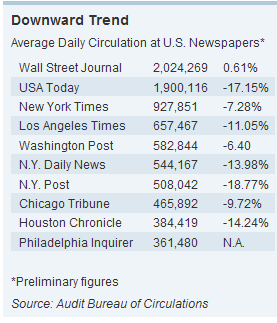
news media circ
Sources WSJ, Audit Bureau of Circulations

>

UPDATE: October 27, 2009 5:54am

Jake gives us the chart to go with the data:
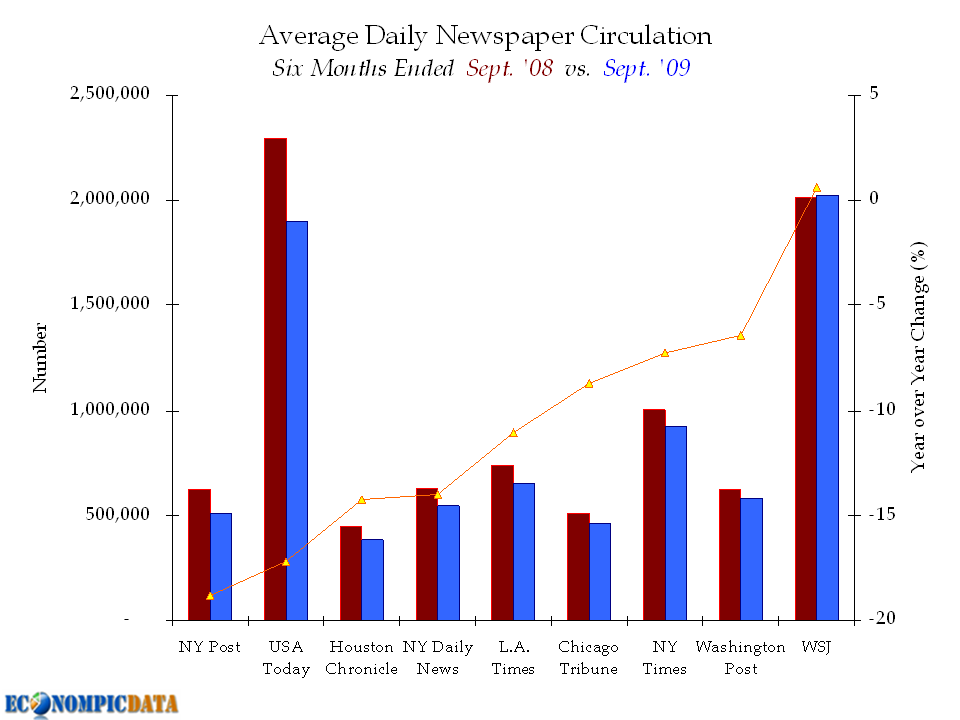
newspapers

46 Responses to “US Newspaper Circulation Falls 11%”

  1. thfiv Says:

    Who needs papers when we have “The Big Picture” to read?

  2. bergsten Says:

    I’m not surprised. Our local paper (part of a chain) is so bad it gets YESTERDAY’S weather wrong.

    Today there were multiple glaring typos, the funniest being in an article about menopause making some women miserable, the picture was captioned “Janet Miserable says…” Roman numerals are beyond them too — a Saw VI review interchanged IV and VI in a few places.

    They now charge extra for weekly TV listings. You need an electron microscope to read the comics. The web has eaten away virtually all of their classified revenue.

    And, as a Chinese friend put it once, you can’t even use it to wrap fish — the ink comes off!

  3. Mike in Nola Says:

    A shame about the Houston Chronicle. It is quite a good newspaper with some excellent columnists. One of its problem is that any accurate reporting is considered too liberal by the teabaggers around here.

    I did notice that it is now offering online subscriptions, which may be the future of almost all newspapers.

  4. uno Says:

    My guess is that, collectively, we’re all a little tired of paying for ‘news’ that is all too typically ‘olds.’

    Every times I buy a paper to read while having a Sunday morning to myself, it seems that every time my overall reaction is one of: “didn’t this happen a few days ago?” And of course, it did.

    My encouragment for the “news”papers is that they get out of the timely-news business and get into the “what’s-going-to-happen-next” business. Actionable-information-wise, no one seems to have a lock on a broad enough areas of interest. Even the web generally sucks at this.

    And if they don’t know what I’m talking about, maybe they should just go out of business. Enough’s enough.

  5. call me ahab Says:

    uno Says-

    “Every times I buy a paper to read while having a Sunday morning to myself, it seems that every time my overall reaction is one of: “didn’t this happen a few days ago?” And of course, it did.”

    true- and there is no help for that dilemma-

    the “old timers” read the paper

  6. Mannwich Says:

    @ahab: Exactly, meaning Generation X was/is the last generation to read the newspaper in significant numbers. They will continue to die a slow death, much of it deserved.

    The only papers I get now are the local Star Trib Mon – Friday (weekends online) and Sunday NYTimes. Am getting close to cancelling both soon though. The quality and timeliness of both has declined dramatically.

  7. blueoysterjoe Says:

    There is a romantic side of me that is pretty sad about all of this, but at the same time, I haven’t subscribed to a newspaper in ages.

    The internet is just a better product in my opinion. When I compare the quality of the work done by Barry, pk, Greenwald, etc. to the editorial columns in traditional media, it’s just embarrassing. The newspaper has been parading mediocrity as wisdom for too long.

    So I am sad, and good riddance.

  8. vine2wine Says:

    Defaulting Homeowners + More Joblessness = Less subscribers

    Not totally sold on 100% of the 10% going to readers turning to the web. Spinsters.

  9. M Says:

    It is a shame. Craigslist ain’t going to cover the city council meetings.

  10. jc Says:

    Once you get out of the habit of reading a daily paper you never go back. I’m sure the ad revs are down a LOT more than the circulation. Detroit, once the #5 metro area doesn’t have a daily apaper anymore – and the city can’t sell their foreclosed props for a dollar!

  11. danm Says:

    At thanksgiving, I was arguing with my brothers, huge Montreal Canadiens fans, that when the 2nd shoe would drop in advertising budgets, it would send all the pro sports teams reeling.

    To prove my point, I set out to find the budgets of the largest advertisers. Interestingly, after going through the 2008 annual report, I could not find the advertising budgets of many of the sponsors when a few years ago, I had no trouble whatsoever getting those numbers.

    10 years ago, we used to get a few flyers in the mail. Then the publisac made it’s appearance. Around 2005, it got really thick and now it’s twice a week, just as thick.

    You can’t walk anywhere without stepping on some advertising. I’m surprised Cottonelle hasn’t put some on each strip.

    Anyway, I am convinced the advertising budgets will drop like a rock. They were cut in 2003 but they shot back up with the rate cuts.

  12. JasRas Says:

    It is sad. While I realize these are relics of a dying age, I hear some of the questions that have been asked about their demise. If there are no newspapers, who gathers the news and how are they paid? A secondary question, who edits and maintains quality of the news?

    Think of how many posts by Barry are from a news source. How is this news going to be found in the future? Are they all going to work for Google and Yahoo? Or will it all be AP, UPI, Reuters, and the Googles and Yahoos will pay for the feed with advertising money?

    I only look at newspapers when traveling and that’s b/c they place it at my door…I’ve been getting nearly all my news online since the mid-1990’s. Gannette did to newspapers what ClearChannel did to radio–ruin them.

    I still believe there is a place for local newpapers, but they need to concentrate on local only. It would be a much smaller operation, but would fill a spot. But that could be done as web content as well…

  13. Rikky Says:

    the demise of the newspaper isn’t so much the death of news, it’s the death of the monopoly the big papers have had on the country before technology leveled the playing field. it’s similar to what cable did to the big 3 TV stations. now these biased, out of touch with the general populace information channels are being exposed for what they are, and aren’t. no longer do we have to be held captive by their interpretation and bias being interjected into the story to advance their views of the world. die quickly i say. now if only our government will let the zombie banks die in a similar fashion!

  14. VennData Says:

    By spreading this information, you’re emboldening the kindle users, TV-watchers, and blog-onlies.

  15. Mannwich Says:

    @Rikky: I totally agree. I don’t watch TV anymore either to get my news, EVER. It’s a complete farce and waste of time. The papers and MSM are always looking for the quick, cheap, and often recycled sensationalized story. They all do the SAME thing in that regard, which is why more people are tuning out.

    If the papers and the MSM on tv put out a better product, people would consume it. Once they finally go away, then something better should fill the void, and in many respects already is with many of the options on the Internet.

    I’m a newspaper guy too, but the bottom line is most of them just aren’t compelling to read anymore. I used to look forward to reading the Sunday Times over some coffee and take a few hours to do it, sometimes all day if I felt lazy enough, but now I rip through only a few sections in about an hour or so. It isn’t because I’ve lost interest in the news. It’s because they’re a mere shell of their former self.

  16. tawm Says:

    The WSJ is a notable exception to this trend, with good reason. Although far from perfect, and slipping in some ways, it is still far above the rest of the MSM print media in offering a valuable product.

    In contrast, my local paper splashed a huge photo and coverage of visiting Obama campaigning for CT Sen Chris Dodd across the front page last week. The endless campaign and breathless cheerleading will not sell (enough) papers.

    Then again, many of the newspapers are changing their business models from advertiser-dependent, to government underwriting. Wait and watch.

  17. ironman Says:

    And people doubted us when we predicted the New York Times’ daily circulation would drop below 1 million in 12-18 months, 18 months ago….

  18. danm Says:

    The WSJ is a notable exception to this trend, with good reason
    ————-
    Let’s see when when the needed attrition occirs in the financial world.

  19. Andy T Says:

    Yeah, this has been a trend a long time going. I tried to think about what it would take to save ‘newspapers’ and can’t really think of anything. The best thing they could do now is give Kindle’s away and then just tell subscribers that they’ll zap the news to them on the Kindle. Shut down the expensive paper printing process.

    The whole “news cycle” has changed completely and there’s no going back.

    Does Warren B. still own the WaPo? Maybe time to go ahead and write that investment off. There ain’t no ‘moat’ there anymore.

  20. DL Says:

    Good news for tree-huggers.

  21. Winston Munn Says:

    There is hope yet that Rupert will go broke!

  22. JoWriter Says:

    @ M , who said, “It is a shame. Craigslist ain’t going to cover the city council meetings.”

    True and as a former news correspondent covering local news that breaks my heart. BUT, the current newspapers, except the local ones, as JasRas correctly points out, don’t cover city governments and school districts now. That’s one of many reasons they are losing circulation and that is damaging to our political processes. The people don’t have the information they need to make good political decisions.

    When was the last time you saw an actual budget number? Not how much the school or county or city or state is ’short,’ thus needing a tax increase, but an actual budget total? When was the last time anybody published budget information controlled for population and inflation, as BR does from time to time on various federal govt operations?

    I’m currently covering business news for a tiny, local weekly general interest newspaper, and while the editor can’t spell and the other reporters are almost totally lacking background on government issues, the paper is still doing a better job than the big-city, sophisticated dailies in our state.

  23. some_guy_in_a_cube Says:

    So an oligarchy of families lose their longstanding control of the US media. Who cares?

  24. TerryC Says:

    Here’s a little project for an energetic journalism student and his or her professor:

    Take the front page on any given day from the top 100 circulation papers in the country. Show this to 1000 or so adults at random (let’s due some true sampling here, NOT 1000 people from Manhattan). Record whether or not anyone actually READS any of the front page articles, how many of the articles are written exactly the same or are from the same source (AP, Reuters, etc.), and ask the people to rate the articles as factual, opinion, liberal, conservative, etc. I think you will find that readership is down because there really are only about five different newspapers in this country. Too bad, but they’ll all be dead in 20 years.

  25. JasRas Says:

    In our region of the country, small papers have come out that somewhat fill the gap. Some are weeklies, some whenever they have enough to do a run.

    My question to all who say who cares or good riddens is still; who is going to gather your news? Who is going to pay the news gatherer? BR makes his dough not from this site, but from FusionIQ. This site is an amusement, not to mention mostly an aggregator of bylines. If no one is there to write the news because they can’t make a living at it, then what? Go to Google’s news area and find a byline from a person working at Google. There aren’t any.

    I think in some things we’ve gotten so use to getting something for nothing, we place no value in how it affect us. At some point, someone will have to figure how to monetize news again or it will cease to exist. Sadly, the same thing is happening in Magazines (although there are too many).

    Without magazines and newspapers, I fear the quality and quantity we are accustomed to will decline.

    I don’t have a Kindle, but anyone out there- what would you pay for a subscription to quality news on it? How many of you pay for news on the internet? WSJonline?

    I’m curious where we are 3,5,7 years from now… will Amazon pick up the flag and become a news outlet by hiring journalists to create content for their Kindle? Or will I subscribe to new on iTunes and pay that way? I know, “there’s an app for that…” Will displaced journalists mix with VC and create something that hasn’t even been thought of yet?

    It sounds like we all agree that newpaper, tv, and magazine are dead. Does news migrate to radio? Radio while antiquated is still an amazing medium. If one could get rid of ClearChannel, RadioOne, et al…maybe a renaissance for radio could occur. Thoughts?

  26. wunsacon Says:

    I canceled my print subscription to “CNBC Sucks”, Evening Edition. Mr. CNBC continues drawing the scandalous images himself. In pencil. Who wants that anymore?

  27. uno Says:

    @JasRas asked : It sounds like we all agree that newpaper, tv, and magazine are dead. Does news migrate to radio?

    More likely, as a guess on my part, “news” such as it has been defined just outright dies…and I’m unconvinced that that’s a horrible thing. Let’s face it: one man’s news is another man’s propaganda. People see what they look for, especially if it makes them angry. Witness the phemomenon of Rush Limbaugh. I don’t know a conservative who watches/reads him…and I don’t know a liberal who doesn’t like to foam at the mouth now and then at what he says. Whatever that is.

    We’ll likely see ever more extreme swings in the mad-dog barking from the left and right sides of the political spectrum. Unless of course we ignore them…just like we ignore the newspapers. And Rush. And insulting comments (from whatever quarters) aimed towards the American populace. And the war(s). And…did I miss anything? Oh, yeah…health care. That’s a really important issue…at least, so says the headline on the local newspaper. Which is going out of business.

  28. Goldilocksisableachblond Says:

    One glaringly obvious fact explains the relative outperformance of the WSJ and it has nothing to do with it being a ” superior ” product . People that read the WSJ have money . They read it to find ways to get more money or to get their right-wing talking points , if they read it at all.

    Joe Schmoe might subscribe to USA Today , the Post , or even the Times when he’s financially secure — for the sports , comics , politics , Sudoku , whatever — but he’ll let it go when times are tough.

    For the money crowd it’s hardly worth the effort to cancel , even if the paper just goes straight to the recycle bin.

    Notice the contrast vs. the WSJ : NY Post and NY Daily News , and USA Today = most downscale readership = worst performance.

  29. M Says:

    JoWriter, I hear you. There seems to be a deflationary cycle in the newspaper business — lower revenues pay for fewer resources so the quality of the news suffers and the subscription base is reduced and that lowers the revenues…

    My local paper is very self-consciously trying to be more like TV and internet news. But, of course, they always get scooped because traffic jams, fires and balloon boys are all pictures and present tense. Yesterday’s superficial coverage today isn’t worth much. Anyway, I can read the wires on line and I don’t mangle them to fit the space available. I want my paper to read state and local legislation and report on it and record the votes, keep a record of public announcements and to do enough investigative journalism so that our officials at least have to worry a little bit about the light as they steal the silverware. I only want a new edition when they have something to say. The Sunday Times at it’s height was great even though almost everything in it was “olds” because it was timely enough to be relevant, well researched, written and edited. Sadly, I don’t see an obvious model for making my ideal of a paper turn a buck.

  30. Mark E Hoffer Says:

    WASHINGTON – October 23 – Hundreds of activist organizations had their internet service turned off last night after the US Chamber of Commerce strong-armed an upstream provider, Hurricane Electric, to pull the plug on The Yes Men and May First / People Link, a 400-member-strong organization with a strong commitment to protecting free speech.

    “This is a blow against free speech, and it demostrates in gory detail the full hypocrisy of the Chamber,” said Andy Bichlbaum of The Yes Men. “The only freedom they care about is the economic freedom of large corporations to operate free of the hassles of science, reality, and democracy.”

    After suffering embarrassment at the hands of the Yes Men on Monday, the Chamber immediately threatened legal action, then followed through Thursday by sending a Digital Millennium Copyright Act (DMCA) notice to Hurricane Electric Internet Services. In the DMCA notice, the Chamber claimed that the parody Chamber website operated by The Yes Men constituted copyright infringement, and demanded that the site be shut down immediately and that the creator’s service be canceled…”
    http://www.commondreams.org/newswire/2009/10/23-5

    to the Q: What will ‘replace’ Newspapers? If we think that the i-net is, still, a ’90’s-style ‘wild west’, the Federales have some ‘News’ for us..

    “Business Group Tries to Take Down Parody Site After Embarrassing Prank
    San Francisco – Attorneys for the U.S. Chamber of Commerce have issued a takedown notice in an attempt to silence a parody website that was posted in support of the Yes Men’s embarrassing prank poking fun at the Chamber’s stance on climate change legislation.

    In a letter sent to the Chamber’s attorneys today, the Electronic Frontier Foundation (EFF) demands that the baseless claims be withdrawn immediately.

    “We are very disappointed the Chamber of Commerce decided to respond to political criticism with legal threats,” said EFF Staff Attorney Corynne McSherry. “The site is obviously intended to highlight and parody the Chamber’s controversial views, which have sparked political debate and led high-profile members to withdraw their support from the Chamber.”…”
    http://www.eff.org/press/archives/2009/10/22

    and, to the Q: Where will are ‘news’ come from? Note, that the 2nd clip comes from EFF’s “Press Room’ page..and, also: “…Curley–”just a nerd from Kansas,” as he puts it–hasn’t won a Pulitzer or worked at a major daily. But since teaching himself to build Web sites 10 years ago, he appears to have figured out what most newspapers haven’t: how to do the Internet right. He calls it “hyperlocal” multimedia journalism, and his news and entertainment sites are sucking in audiences, advertisers, and revenue; they’re racking up national and international awards; and, most important, they’ve begun delivering profits. The sites Curley and his team build grow out of an uncanny feel for what matters to customers and an ability to translate that knowledge into imaginative, indispensable tools that forge a connection and habit with readers–just as newspapers once did. But his sites allow readers to do far more than they can with print: Users can compare historical home prices, street by street or neighborhood by neighborhood; receive a text alert about a Little League rainout, the weather, or the fishing report; click on a map to assess local hurricane damage; chat with the subject of a story or its reporter; check out a weekly high-school sports roundup and daily news “vodcast” (short for video on demand)….”

    “The sites Curley and his team build grow out of an uncanny feel for what matters to customers and an ability to translate that knowledge into imaginative, indispensable tools that forge a connection and habit with readers–just as newspapers once did.” Newspaper readers are People, afterall..
    http://www.fastcompany.com/magazine/110/open_hyper-local-hero.html

  31. dizzy Says:

    this aired lasted week in australia http://www.abc.net.au/mediawatch/transcripts/s2718294.htm

    it seems like Murdoch (the younger) will be attacking free broadcasters operating on the web

  32. JasRas Says:

    @ uno. Agreed.

    “More likely, as a guess on my part, “news” such as it has been defined just outright dies…and I’m unconvinced that that’s a horrible thing. Let’s face it: one man’s news is another man’s propaganda.”

    Let’s all just subscribe to Playboy and save something worthwhile! :-) ) The interviews are great.

  33. uno Says:

    @JasRas: They have interviews in Playboy now? Might have to buy one just to stay in touch with human prospect. Love that intellectual stuff. OK…and the party jokes.

  34. flipspiceland Says:

    @Uno

    Precisely.

    What is ‘newsworthy’ in ‘reporting’ about the Semites killing each other for 17,500 days, in Israel? This news got olds about 40 years ago. This ’story’ doesn’t even need reporters. Just print a daily thing like a box score and guess how many from each side were maimed, killed, tortured, or abducted.

    What would be ‘newsworthy’ is which politicians have offshore bank accounts, the balances, and who paid them off. The sales of a newspaper that reported the depth and breadth of the filthy corruptees, their counter parts in the defense and other government departments would be phenomenal. Try and find a ‘journalist’ who will do the leg work required to investigate that and one who will hold the people who vote these thieves into office term after limitless term.

    The real problem with print media and increasingly web-based sources is that it just plain ain’t news.

  35. andrew.wellas Says:

    Ha……. this is a bit troubling, but as rightly said by DL “It’s a good news for tree huggers”

    Fact remains that online media gets hold of news the very instant it occurs, while in print version it has to appear only on next day edition…….. Many a times it do happen that news no more remain BREAKING NEWS….. and we go through the ones which we had already read on different news websites.

    Economists forecast a near end to recession, and here the figures are dropping down……. But if we carefully try to analyze the scenario, this is not happening with just newspapers…. In fact consumers are now inclining more and more towards online media as compared to print media….

    If we look into coupons redemption too….. Coupon Clipping is slowly becoming outdated. http://www.bizreport.com/2009/04/study_youngsters_get_hip_to_coupon_clipping.html states that though clipping coupons from newspapers remains a popular activity, but young shoppers indicate that they would be very likely to use online coupons. (http://www.mediapost.com/publications/?fa=Articles.showArticle&art_aid=103290)

    For me this in fact is a good sign …… shifting from Print Media to Online Media…. which always is more environmental friendly……

  36. MinnItMan Says:

    TV news is hardly worthy of criticism in that it it is virtually impossible to get beyond its anecdotal and phony dualistic nature. Print journalism, on the other hand, is not so constrained by its medium. My ex-wife is a newspaper editor and I have great professional respect for her and her colleagues, but I also know there is a point where what they do is nearly useless to me: where I actually already know as much, or more than they do. Their expertise is the hard work of reporting and editing reporting… but producing a product that doesn’t have me in mind as a consumer. I can extrapolate this to just about any beat. As a lawyer, I long-ago realized (2nd week of law school, maybe, once I realized that I actually could still read a newspaper) that any news that is reported concerning courts or the legal system is merely notice that something is going on that I may want to check out myself. Regarding my specialty, I will know significant developments generally before they do, and I will or will soon have access to superior interested-party “experts” that aren’t on their call-list for quotes.

    The flip side of this phenomenon is foreign correspondence journalism where a few (or one) reporter[s] “control” the story. I am sure these folks do know a lot more than me. However, even granting professionalism, lack of bias, etc., how can I honestly believe I’m getting enough information when newspapers implicitly recognize the problem by having 3 or 4 reporters and/or columnists generating copy on the significance of the Vikings losing to the Steelers?

    My two local papers are shells of their former selves, although I think the reporting that they still do is far superior to what was in there ten years ago. They do a pretty good job with far less than they used to have.

    The WSJ, in particular, is largely a disgrace, having missed the story of the generation within its own forte, the obvious signs of the coming financial meltdown years ago. And that pre-dates Murdoch. Sure its editorial page and its e/p reporters were all over Fannie and Freddie (rightly so), and the Fed’s bad timing on interest rates (rightly so), but the story was deeper than that, and the proof that they didn’t get it was evident in their initial dismissal of the “subprime problem” as isolated, contained, or the consequence of the CRA, if it was a problem.

  37. How the Common Man Sees It Says:

    I’m not buying the 11% drop as a shift away from the papers this time. I’ll blame this drop on the recession. The reason being there are many companies that are reporting about the same drop in their revenues. If the economy picks up again but the papers remain on the mat then I’ll give a little more credence to the decline.

  38. rj Says:

    “The internet is just a better product in my opinion. When I compare the quality of the work done by Barry, pk, Greenwald, etc. to the editorial columns in traditional media, it’s just embarrassing.”

    I have to take issue with this.

    1. Barry still uses the newspapers and editorial columns for a lot of his source material as it gives him something to bounce off. In other words, he excels very much as a sort of reactionary columnist. If this source material went away, Barry’s blog would suffer.

    2. There are a lot of idiots on the internet, most of whom hide by ambiguity to give themselves a veneer of credibility, and some of them have far too much readership for comfort. There’s another financial blog I read and one of them linked to an article once that she wanted us to read, and the article was written by a 9/11 conspiracy nut that believes the Rothschilds and the New World Order are going to destroy us all.

    3. Who’s going to do the in-depth reporting now? We know that the money on the internet can’t sustain a newspaper model. Yesterday, Yahoo shut down Geocities, and one person commented on it in a story I read that “Geocities was the first example 10 years ago that you can have something incredibly popular on the internet and still not able to make money on it.” A blogger sure as hell doesn’t have the time or money or sources to do it, nor the credibility because he gets lumped into all bloggers, both good and bad, and unfortunately there are a good number out there that are complete crackpots. Bloggers are a lot like the Libertarian Party in that respect. I just feel like the death of newspapers is going to lead to even less criticism of decisions of the social and political elite because there will be few people with credibility that can criticize them.

  39. rj Says:

    http://sports.espn.go.com/espnradio/player?context=podcast&id=3976937

    A good perspective on the death of newspapers and what it means from a sports point of view in the middle of this podcast from March. The guy hosting the podcast, Bill Simmons, whose dream as he put it was to be a sports columnist for the Boston Globe when he first broke into journalism and now is the most popular “internet sports journalist”, has been touching on this a lot with various people.

    Another point I forgot to pick up on. He later in another podcast talked to Bob Ley, one of the first employees at ESPN who has been there since, and Ley made the point that in the state of Connecticut there’s a budget crisis going on in government and that their local paper, the Hartford Courant, was covering it with front-page coverage every day. If there was no Hartford Courant, who would be covering the issue and letting the public know what is going on? It’s certainly not going to be Barry Ritholtz. It’s largely only going to be people inside the state of Connecticut that are interested in government and politics, and that’s very likely only going to be biased points of view from Democratic and Republican partisans. So instead of democratizing journalism, I think the internet is more just going to take us back 130 years to the late 1800s on a political level, where the sources of information were openly biased in favor of one side or the other and any hope of neutrality is gone. Who is the most popular internet guy that covers politics based on site hits, isn’t it Drudge who is openly Republican?

  40. hue Says:

    MinnitMan,

    as a former reporter, i know the limitation of the medium. reporters are generally writers with no expertise in the field we are writing about. what i meant is that if you have knowledge, real expertise about stocks or law, you wouldn’t become a writer. you would work for a hedge fund or practice law.
    regarding your specialty, of course you will know significant developments generally before we do, and you will have access to superior interested-party “experts” that aren’t on our call-list for quotes. but we’re not writing for you, we’re writing for the masses. it would take an attorney to have the superior access, and if you have a law degree, why would you toil at a newspaper for pennies? most true experts don’t want to be quoted in the paper, so we are limited to the people who are willing to talk to us, and on deadline too. (i say we but i left journalism 10 years ago.)

    reporting is not a well paying profession. most of the reporters don’t work at networks or the NYT.

    all the people cheering the death of newspapers (as others have said here) you will find that bloggers like Barry can’t do his analysis without the original grunt work by reporters.

    it’s also the economics of the web. Chris Anderson at Wired says if newspapers got rid of the paper editions, it would lose half of its cost, but 75% of its revenues. it’s a death spiral. craig’s list and many other sites have already poached the ad revenues. many people think papers are dying because of ideology or boring writing or subjects — technology is the bigger killer. if you are getting information for free at TBP, why would you pay for it at a news site? but soon, there will be no news sites to generate information for Barry to analyze. welcome to the freemium world.

  41. MinnItMan Says:

    “most true experts don’t want to be quoted in the paper, so we are limited to the people who are willing to talk to us, and on deadline too. (i say we but i left journalism 10 years ago.)

    reporting is not a well paying profession. most of the reporters don’t work at networks or the NYT.”

    I agree with the first part, but until recently, I would take [a little bit] issue with the second. I’m not saying that reporters and/or editors were well-paid, but they weren’t in sack-cloth either. [Until recently] A second-tier guild paper compensated reporters pretty well in salary, and very well with respect to non-monetary benefits. No, they didn’t get rich, but they had job security and a way-more-interesting-than-average job than other people making about the same $$$$$. Small point, and I certainly don’t derive any pleasure from these folks getting reverse-adjustments, furloughs, etc. And I certainly don’t think there is any obvious replacement for the value of primary reporting that will be lost as dailies become even more unviable.

  42. hue Says:

    MinnItMan, i don’t know what you consider second-tiered and well compensated. in 96, i worked at Dow Jones News Service, a guild shop like and part of the WSJ, for $46K in NYC, that is the edge of poverty in Manhattan.

    from there I moved to a regional paper in the Carolinas for $40K, a raise from the cost of living. not bad for a single guy, but i could not have supported family. newspaper salaries have historically been horrid until woodstein and Watergate drawing more talent. even so, the smartest high school kids don’t go into journalism in the past 30 years. they’re certainly not going to now.

    but i knew that, the pay, when i went into the biz. that is why i eventually left. i was an interesting job, for energetic younger people, i was neither energetic and getting older. at DJ news, i sat the GM’s CFO office asking questions and met many interesting regular people. slowly i realized my Wall Street sources were making 10 times my salary and more and they weren’t 10 times smarter than me, they just chose a better profession. but Wall Street pay is changing too. i posted this earlier here, but i can’t get my arms around Raj at Galleon’s bail of $1ooM, and net worth of $1.3B (i’m not saying he’s guilty of anything, but the money is surreal.)

    finally, journalists have written about layoffs and reduction in work forces and dying industries for years, and now they really understand how that feels.

  43. MinnItMan Says:

    Sounds like you were at the State or Observor, and your numbers are what I thought they’d be. I’m not saying the money is/was great, but money isn’t the motivator [after a certain point] for most journalists I know. Bylines are, until you win a P (and then many of those folks become 3bl/yr coasters). Senior reporters [were] making about $70K – not a lot. A number of them I knew took RIFs and became private researchers of PR flacks for, maybe, $100K plus, still not a lot of $$$$.

    On balance, though, I think reporters now (last few decades) are far more capable (and less corrupt) than the older ones. Ethics codes and J-school (a mixed blessing) have made it more of a profession, and with fewer and smaller-ed-staffed dailies, competition for the few jobs there are is intense. That’s why I said earlier that even though the newspaper are shells of their former selves in some ways, the reporting they still do, is generally a lot better.

    Bottom line is we as a society will not know what we had ’til it’s gone. I think we agree on that.

  44. hue Says:

    you’re good it was at the Noise and Disturber in Raleigh. the paper won a Pulitzer covering the pork industry (business and environmental implication of it) before i got there. there were more pigs than humans in NC. who’s going to pay for that kind of reporting?

    Joby Warrick one of the two excellent reporters on that series left soon for the WaPo and is still there. Pat Stith chose to stay at the N&O, even though he could have gone anywhere.

    the switch to PR is not easy, the mindset is very different the opposite of journo thinking, even if the money is better. i did it for a short time for Schwab in SF during the Internet boom gold rush bubble. i had a sign-on bonus (can you imagine that for a former journo) then a pink slip within a year. this decade is nothing like what we thought in 1999. let’s partly like it was 1999.

    on a tangent, you probably know that Jim Cramer was a former reporter, editor of the Harvard Crimson. he was working in Tallahassee and i think was among the first people to arrive at the dorm of the Ted Bundy killings. (i’m too lazy to google it.)

    yes, agree of not know what we had.

  45. hue Says:

    yikes, agreed with not knowing what we had. the real reason i got out of journalism was my English skills ;-)

  46. andrewJESAITIS » Blog Archive » Saving Journalism: How to beat free Says:

    [...] I know that many in journalism are not fans of paywalls, as they destroy the concept that access to news is a right and have had mixed economic results. I say “mixed results” because while the Wall Street Journal maintained its paywall it gained standing as the number 1 US daily publication. In fact, the Wall Street Journal was the only major paper to gain market share last year. [...]
