
What Follows Record Setting Dow Quarters?
With futures deep in the red, let’s take a contrary look at how markets do after big quarters. The quarter ending 9/30 saw the Dow putting in its best Q since ‘98, up a solid ~15%.
With everyone waiting for a pullback, and yesterday and today viewed as the probable start, perhaps its time to review some history. What has happened historically after markets have put in record setting quarters — 15%plus?
For the most part, momentum has trumped mean reversion historically. Jim Bianco crunched the numbers, and he found that “stocks returned an average of 1.33% over the month following one of these record quarters, 3.46% over the following quarter, and 9.95% over the following year.”
It is worth noting that these average returns following quarters of 15%+ performance are nothing out of the ordinary. The average monthly return over all periods in the DJIA since 1900 is 0.58%, the average quarterly return is 1.66%, and the average yearly return is 6.90%. If anything, the average returns following huge quarterly gains actually outpace the average returns during all periods.
Perhaps another way to look at it is these record setting rallies, especially following a a big selloffs, are themselves a form of mean reversion.
Here’s the tabel of past 15% quarters:
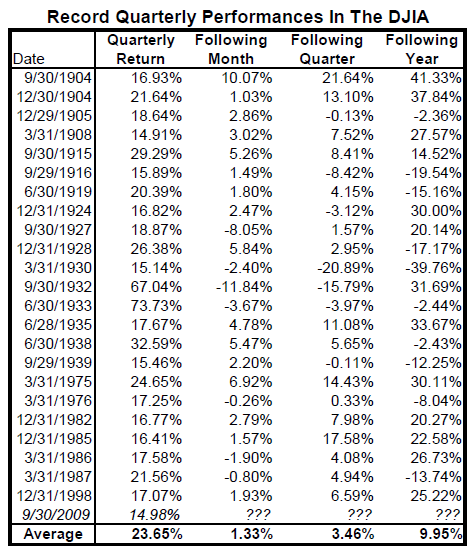
courtesy of Bianco Research



October 2nd, 2009 at 10:07 am
Taking a quick look at the data, it seems that the probability is the upcoming year will be either hugely up or hugely down (only 4 times has the change been less than double digits). Perhaps a good strategy would be to buy long dated, out of the money puts and calls on the S&P?
HCF
October 2nd, 2009 at 10:16 am
Even after the big Q, you could have the dow up over the next year. The problem with the over the next quarter, 6 months, year breakdown is it misses the interim moves.
Lets say for example the DJIA is at 12,000 in SEP 10. How does it get there? Does it go from 9800 to 12,000 in a sustained uptrend? Or does it go from 9800 to 8200 t0 11,000 to 10,500 to 12,000???
October 2nd, 2009 at 10:28 am
As I’ve covered for you in the Professional Edition Fed Report, the Fed will still be pumping some liquidity into the system at a reduced pace and the Treasury will be pushing and pulling over the next 3 weeks. Once those Treasury CMB paydowns end around October 22, it should be prime time for bears
to take control. However, based on what happened Thursday, the wheels will apparently start falling
off early, although I would thing that the later part of October would be prime time for a potential market crash. We should get some kind of bounce possibly with a 13 week cycle low late next week.
But I would expect the up phase of that cycle to be very short lived, if it shows up at all. If the 6-7 week cycle is dominant, then it will be 2-3 weeks before a real bounce.
Under the circumstances, I think the biggest risk here is staying long. The second biggest risk is missing a chance to get short. It may be time to start shorting intraday rallies.
We’ve been thoroughly conditioned to buy dips, or to be afraid to go short in the fear of getting squeezed when the dip buyers come it. It’s under just those conditions that the market can go into an entrenched downtrend, leaving timid short sellers sitting on the sidelines waiting for that shortable bounce that never comes.
October 2nd, 2009 at 10:36 am
Does the flow of “information” have an impact on trading/performance? [Does the fact that--just as recently as the mid-90s---information that used to take a day to disseminate, now is done in 60 seconds change the nature of speculation/trading/investing?]
Yes, many theories about speculation are relatively unchanged—and reversion is as solid as it gets…
Still….enough of the landscape has changed that drawing conclusions from October of 1916 on the basis of September-1916 seems a bit silly.
The chart is interesting.
Unfortunately, it’s utterly useless…and I suspect downright dangerous if any “probability” estimate is derived from it.
And…even if the instantaneous flow of information is irrelevant in comparing different periods–the chart only has a sample size of 20-25. I realize that there have not been many 15% quarters, but that doesn’t change the fact that only fools (and social scientists) draw conclusions from such small samples…at least this was according to a recent poll of 5 statisticians conducted by Gallup.
October 2nd, 2009 at 10:36 am
Market will now rally based on the thought process that another stimulus package is in the offing, not to mention more bailouts, all used with an increasingly worthless dollar, of course.
October 2nd, 2009 at 10:40 am
@Mannwich:
You got that right.
Who is going to bailout U.S govt?
October 2nd, 2009 at 10:43 am
The Chinese? Japanese? Then our nukes?
October 2nd, 2009 at 10:46 am
How long until Harry Wanger comes out of the woodwork and proclaims “It’s a screamin’ buy!”?
HCF
October 2nd, 2009 at 10:49 am
Looks like markets just filled the gaps from yesterday. If they break 50dma, watch out below.
S&P weekly looks ugly.
October 2nd, 2009 at 10:49 am
@HCF: Wanger will come AFTER the rally or dop today to proclaim “victory” either way.
October 2nd, 2009 at 10:53 am
Barry, I am an avid reader and typically think the analysis is great, but I am having trouble with this post. The record setting quarter for the DJIA was Q2 when it jumped over 20%. Following your rationale that momentum trumps mean reversion following a record quarter, we can see that indeed it already has as the 15% Q3 return has already been higher than the 3.46% average for the following quarter and the 9.95% average for the following year. It seems it would be more accurate to show 6/30/09 as the last row of the table and have it filled out through the “following quarter” with a ??? only in the “following year”. Or, possibly more interesting, show strong 6 month returns and then the following month, quarter, and year.
Just a thought…
October 2nd, 2009 at 11:18 am
my forecast: I dont know the actual outcome hence i am still in cash.
but if i had money which i wanted to g@mble with then i would be on the below possibilities:
after 12-18 months:
highest probability…. +25% or -30%.
reason: lack of new factors to stimulated economic growth….but government printing will keep the reflation going so that most worker drones stay at work.
low probability:
Geo-Political factors can send the market down by upto 70%:
1)Middle east getting blown up sending price of oil to >$400/barrel (leading to more wars for control of oil)
2)Trade war between USA and (China+USA haters=russia, venezuela, some islamic countries)
3)Swine flu getting bigger than anticipated
4)Commodities speculation….or USD backlash by commodities producers(and owners)
low probability bullish case:
Consumer may not be in as bad shape as being predicted(example >10 million people can afford to pay around $100/month for cell phone service like iPhone)
Capital is worthless right now since it can barely earn 1% in short term….and will lose due to monetary expansion in the long run. which means it is better to use it to buy some good company which can benefit from economic rebound if it can happen.
imagine if you were to give 30 year loans at 2-3% to absorb all the debts of the consumers….isnt it possible to get them back to normal spending level…..such that the bleeding/downward spiral can be stopped.
do you guys really think….all the governments in the world with the printing press at their disposal may not be able to achieve the above….I think the odds are not that bad.
October 2nd, 2009 at 11:30 am
techy
You mean can we continue to borrow and spend irresponsibly and kick the can down the road some more to avoid dealing with our problems and sacrificing for future generations, etc.? Unfortunately our record says, yes, we can. And we’re trying to do just that.
But there are other forces at work that counter that. Like currency pressures and interest rates that will rise, eventually. Like if our govt tries to take on all our debt at low rates to get us spending again. That will implode the currency and spike interest rates, setting off high inflation.
I hope that’s not where we end up going. But I don’t put it past our shortsighted politicians and populace.
October 2nd, 2009 at 11:49 am
And what’s the point of this research ? To prove that, stocks will continue to go up because they have been going up ?
I know this is all about momentum, but analyzing it without the context of economic realities in those times doesn’t seem sound analysis. Better analysis has been presented on this blog – like typical duration and gains of bear market rallies etc.
October 2nd, 2009 at 11:50 am
@techy
You ramble incoherently. Please be more succinct. Also – the DEBT MOUNTAIN is unsustainable, idiot.
LB is short but with tight stops here. Expecting another downward probe before long.
October 2nd, 2009 at 12:01 pm
[...] What happens after record setting quarters for the Dow? (Big Picture) [...]
October 2nd, 2009 at 12:25 pm
As usual, no one has pointed out the real problems with this chart. Is the sample size big enough? What is the standard deviation? Is it significant at any kind of confidence level? The answers are no, not calculated, and likely not. Anyone out there take statistics 1?
99% of these type of “analyses” are statistically irrelevant and have zero predictive value.
October 2nd, 2009 at 12:44 pm
leftback…
such civility?? i would love to hear your argument. been saying this the last 8 months….and i can see it happening, and it is possible that it will continue…
what kind of debt is sustainable and what is not? no even the economist cant asnwer that question….
and remember history cannot explain the future.
say if debt is 60 trillion and GDP =13.8 trillion,
what if we grow debt to 80 trillion and GDP to 30 trillion (inflation)
(not happening right now….right now deflation is still the strong guy in the room….)
its all a matter of balancing all the variables…and making sure nothing blows up, bt its not impossible.
BTW: please spare me the idealistic talks….lets focus on whats being done….whats possible….what is the less painful solution.
October 2nd, 2009 at 12:58 pm
Techy,
You lay out a scenario that is somewhat plausible, if unlikely. Regarding your example:
say if debt is 60 trillion and GDP =13.8 trillion,
what if we grow debt to 80 trillion and GDP to 30 trillion (inflation)
The problem is that we get decreasing marginal gains in GDP with each additional dollar of debt so while both debt and GDP can go up, debt will (necessarily) go up much faster than GDP. Denninger has some good charts on this. This makes your scenario flawed.
Hence LB’s reference to debt mountain.
October 2nd, 2009 at 1:11 pm
@techy: What is the “least painful solution” to whom? That is the question that must be asked. I think we know the answer by our “best & brightest’s” policy decisions – - they’re trying to save themselves and their friends first, lasts and always, above all, mid or long term consequences to everyone and everything else, be damned. This has always been about preserving the status quo. In fact, it’s like that everywhere you look these days – - elite special interests feverishly working to perserve the status quo no matter what happens to everyone else.
October 2nd, 2009 at 1:11 pm
@techy: What is the “least painful solution” to whom? That is the question that must be asked. I think we know the answer by our “best & brightest’s” policy decisions – - they’re trying to save themselves and their friends first, lasts and always, above all, mid or long term consequences to everyone and everything else, be damned. This has always been about preserving the status quo. In fact, it’s like that everywhere you look these days – - elite special interests feverishly working to perserve the status quo no matter what happens to everyone else.
October 2nd, 2009 at 1:31 pm
that guy…
i was kind of hinting about debt created out of printing(Treasury owes the FED say 20 trillion at 4% interest rate and any future needs get fulfilled by more printing)
i am not an economic major…please correct me if i am wrong (with explanation please).
so debtors owe the savers 60 trillion…..but debtors print 60 trillion, reducing the value of money by say 50%….it does look like transfer of wealth from savers to debtors…
yes the bad news is, Debtors own the printing press.
who would have thought that it is possible for the FED to print around 10 trillion and give it to the banks…and the gov?? (with barely noticeable change in USD exchange rate and commodities prices)
but they did it right?
wait a minute…while they were doing this interest rate stayed pat or maybe went a bit lower…..Hmmm
October 2nd, 2009 at 1:47 pm
[...] start. The Dow’s 15% rise in 3Q — the best quarterly performance since 1998 — prompted Jim Bianco, CEO of Bianco Research, to research what’s happened historically after stocks [...]
October 2nd, 2009 at 3:28 pm
Rio beat Chicago, Tokyo and Madrid in winning to host 2016 Olympics.
Tells me IOC is giving consideration to BRIC nations. It also shows the status of emerging markets. China and now Brazil. Wonder the 2020 Olympics will be held in India.
http://www.lemonde.fr/sport/article/2009/10/02/jo-2016-chicago-et-tokyo-eliminees-de-la-course_1248630_3242.html#ens_id=1246301
October 2nd, 2009 at 5:06 pm
There were a half dozen bear market rallies during the depression. The gov actions taken so far have been consistent with a depression not a recession and I’d be very surprised if we don’t have more dramatic downs and ups before we rurn to “normal” new or old.Actually with the size of the US debt we’ll never return to the old normal we’ll be paying for the recklessness of our big bankers with euro level tax rates forever.
October 2nd, 2009 at 8:28 pm
@Techy,
More civily than our Limey Cricket Fan(the british, while known for societal propriety nonetheless have a large contingent of brusque realist punters, innit?):
I’ve said in real terms this charade will be seen for what it is in determining the REAL bottom. You can only hide from the truth for so long. You can devalue the currency, yes, however that will not equate to the economic recovery. It can play out into a “bifurcated reflationist” economy as we said a year ago, however, the underlying fundamental structure will still be quite muntered.
As i recommended, examine price elasticity in any equity holding, and watch out for the backlash of the retail investor throwing in the towel.
Strong Balance Sheet companies with less variable FCF due to price inelasticity and constant demand for product, combined with pricing power will still survive, and those with divvies are better options to choose for a LT investment to counteract the vagaries human opinion can have on share price. They will also benefit from the printing press action. In the near term, we are due for a hard road. Preserve cash for interesting possibilities in “generational buys,” not holding against inflation. See also:
http://www.ritholtz.com/blog/2009/08/wednesday-10-spot-2/#comment-209262
http://www.ritholtz.com/blog/2009/10/media-appearance-the-kudlow-report-10-01-09/#comment-221626
October 3rd, 2009 at 10:34 am
[...] What follows a record setting Dow quarters? [...]
October 3rd, 2009 at 12:52 pm
No offence (haha) to the Brits, Cricket, or Elby. Cheers!
October 5th, 2009 at 9:43 am
[...] What follows record setting DJIA quarters (short): http://www.ritholtz.com/blog/2009/10/what-follows-record-setting-dow-quarters/ Where all that cash in money market funds is going [...]