Budget Deficit Blowback

Email this post Print this post
By Marion Maneker - November 30th, 2009, 8:59PM

One of the striking things about about the deficit crisis that seems to loom over the United States is the probability that it will force a massive change in American expectations. In Newsweek this week Niall Ferguson beats the deficit drum. His fear is that US will have to give up its position as superpower:

As interest payments eat into the budget, something has to give—and that something is nearly always defense expenditure. According to the CBO, a significant decline in the relative share of national security in the federal budget is already baked into the cake. On the Pentagon’s present plan, defense spending is set to fall from above 4 percent now to 3.2 percent of GDP in 2015 and to 2.6 percent of GDP by 2028.

Over the longer run, to my own estimated departure date of 2039, spending on health care rises from 16 percent to 33 percent of GDP (some of the money presumably is going to keep me from expiring even sooner). But spending on everything other than health, Social Security, and interest payments drops from 12 percent to 8.4 percent.

This is how empires decline. It begins with a debt explosion. It ends with an inexorable reduction in the resources available for the Army, Navy, and Air Force. Which is why voters are right to worry about America’s debt crisis.

Ferguson fears the consequences of a withdrawal of American hegemony. But there’s a different threat here too. The US has relied on the military to provide economic benefits for a long time.

The military is our secret Keynesian weapon. William Kristol was the first to say that if we needed to spend stimulus money, it should be most quickly and efficiently spent through the Pentagon. It is often overlooked how much we depend on the military to provide jobs, vocational training and government subsidies to industry.

Many have argued that this is a very inefficient way to achieve those economic goals.

But it is the way we’ve chosen since the Reagan build-up began 30 years ago. Like the massive overhaul in our entitlement programs that will be forced by the deficit spending on financial system bailout, the loss of military Keynesianism will cause great disruption within the American economy.

Source:

An Empire at Risk
by Niall Ferguson
Newsweek; November 30, 2009

http://www.newsweek.com/id/224694

One less Gartman fan north of the border

Email this post Print this post
By Tim Iacono - November 30th, 2009, 8:15PM

Dennis Gartman of the Gartman Letter appears to have a rather vocal critic in Fabrice Taylor at The Globe and Mail, this item appearing earlier today casting a dim view on all things Gartman, the lone exception being a style that is almost always engaging and entertaining.

Gartman fund needs less talk, more action
Dennis Gartman never shies away from declaring a bubble when he sees one, or thinks he does.

09-11-30_gartmanToday the bubble is in gold. Mind you, the bubble was in gold several months ago, too. If it was a bubble at $700 (U.S.), I suppose, it’s an even bigger bubble today. But that doesn’t prevent Mr. Gartman from owning gold. The man works in mysterious ways.

Vox rarely declares a bubble, but we make an exception today: The bubble is in Dennis Gartman. When you start calling Warren Buffett an “idiot” while you lose money for your own investors, you’re way too big for your britches.

Whether you’re just vaguely acquainted with his work or an avid reader, you must have asked yourself at one point if Mr. Gartman actually makes any money for himself or for his readers by trading. Until recently, there’s never been a reliable way to gauge. Now there is, and it’s not particularly impressive.

At first it sounded as though the Hulbert Financial Digest had taken on the task of tallying Gartman’s winners and losers, clearing through the performance haze that seems to come with most investment newsletters, but, that is not the case.

It seems that, earlier this year, Gartman started an investment fund whose performance is now subject to a much more thorough accounting than any staffer at Mark Hulbert’s operation could provide.

Launched last March, the Horizons AlphaPro Gartman ETF is managed by the man himself using the wisdom he dispenses in his newsletter.

The fund launch was well-timed, coming as it did just as stocks were about to start one of the greatest runs of all time. Mr. Gartman’s investors, though, are down. The units, sold to investors for $10 a few months ago, closed at $9.12 on Friday, giving the ETF a market cap of about $52.5-million.

But the market is up 30 per cent since the fund launched. What’s up with that? Mr. Gartman didn’t get back to me, but the people at Horizons AlphaPro tell me the fund is intended to be market neutral, meaning it won’t move with the market. Why? Because it’s long and short, and supposedly constructed in such a way that the market’s performance has no net effect on the returns. The only thing that does have an effect, in theory, is the manager’s skill. It may be early days, but Mr. Gartman’s performance has been found wanting.

He’s expected to return between 6 and 12 per cent regardless of the market. Eight months in, he’s nowhere near that.

Apparently, one of the fund’s big losers was a bet against Berkshire Hathaway that was made all the worse by the label “idiot” being applied to the legendary investor from Omaha.

While it was conceivable that Berkshire shares might sink over the summer during what turned out to be anything but a “sucker rally”, the potential upside to calling Warren Buffet an “idiot” completely escapes me.

ooo

Tim Iacono is a retired software engineer and writes the financial blog “The Mess That Greenspan Made” which chronicles the many and varied after-effects of the Greenspan term at the Federal Reserve. Tim is also the founder of the investment website “Iacono Research” that provides weekly updates to subscribers on the economy, natural resources, and financial markets.

Some Thoughts on Twitter

Email this post Print this post
By Barry Ritholtz - November 30th, 2009, 5:30PM

I have to admit that this comment from ESPN writer Tim Keown resonated with me:

“I know the whole Twitter/Facebook social-networking revolution is supposed to transform the way we communicate with each other. But for the most part it looks to me like just another way to avoid human interaction while tossing out meaningless tidbits of minutiae.

“I admit to coming at this from a certain bias. Maybe it’s age, or the complete lack of desire to be held prisoner by another electronic device — or app or site or whatever — but I have absolutely no interest in knowing where people are and what they’re doing at all times. You’re in the supermarket and can’t believe the price of asparagus — fine. Leave me out of it. I have no interest in being given 140-character opinions or observations or updates — even from people I know and like.”

Visualizing the Fortune 500 in America

Email this post Print this post
By Barry Ritholtz - November 30th, 2009, 2:30PM

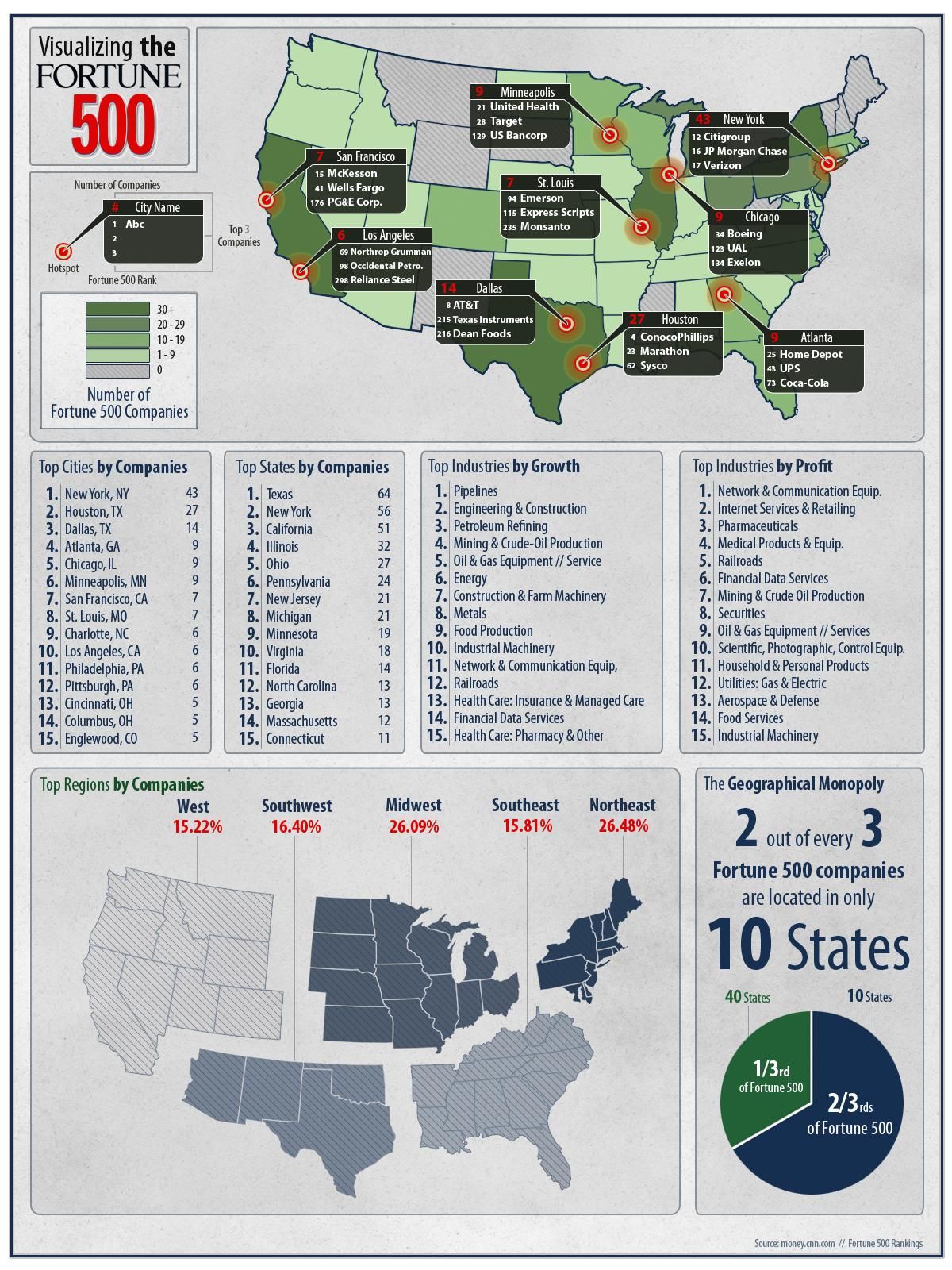
Via Focus.com, we have this interesting map of where the Fortune 500 are located:


click for ginormous map

fortune500-full

Krugman: “The deficit doesn’t matter”

Email this post Print this post
By Tim Iacono - November 30th, 2009, 1:04PM

Well, apparently there is at least one thing that former Vice President Dick Cheney and Nobel Prize winning economist (and unofficial White House adviser) Paul Krugman have in common. They both feel the same way about deficits – they don’t matter.
IMAGE

On yesterday’s This Week with George Stephanopoulos, Krugman made what sounded like an off-hand remark, one that almost didn’t even seem worth saying as it was so obvious to everyone in the room (except maybe George Will).

From the ABC transript:

Important political fact, which is that whatever you would do with the deficit, the public won’t notice. In 1996, a majority of Republicans thought that the deficit had increased under Clinton, even though we had in fact been on an incredible run. So no, I mean, the deficit doesn’t matter. The economy matters. And that’s why somehow or other, Obama has got to get jobs being created.

Yes, I know. The national debt is now over $12 trillion, not the $11.5 trillion as depicted above. No one really seems to care – $11 trillion, $12 trillion, $20 trillion?

It’s only money.

Tim Iacono is a retired software engineer and writes the financial blog “The Mess That Greenspan Made” which chronicles the many and varied after-effects of the Greenspan term at the Federal Reserve. Tim is also the founder of the investment website “Iacono Research” that provides weekly updates to subscribers on the economy, natural resources, and financial markets.

Questions for Bernanke

Email this post Print this post
By Guest Author - November 30th, 2009, 12:45PM

Bob Eisenbeis is Cumberland’s Chief Monetary Economist. Prior to joining Cumberland Advisors he was the Executive Vice President and Director of Research at the Federal Reserve Bank of Atlanta. Bob is presently a member of the U.S. Shadow Financial Regulatory Committee and the Financial Economist Roundtable (bio here). He may be reached at Bob.Eisenbeis -at- cumber.com.

~~~
November 30, 2009

Bob Eisenbeis is Cumberland’s Chief Monetary Economist. Prior to joining Cumberland Advisors he was the Executive Vice President and Director of Research at the Federal Reserve Bank of Atlanta. Bob is presently a member of the U.S. Shadow Financial Regulatory Committee and the Financial Economist Roundtable. His bio is found at www.cumber.com. He may be reached at Bob.Eisenbeis@cumber.com.

In an unusual communication on Sunday in the Washington Post, Fed Chairman Bernanke drove a stake in the ground to his inquisitors in advance of his confirmation hearing latter this week. He wrote about the Fed’s role in stemming the financial crisis and the importance of not tampering with the structure of the Federal Reserve. He makes a number of points.

First, he argues that despite the public outcry at the costs, the bailout of financial institutions saved the country from financial and economic collapse. Second, he admits to regulatory failures on the part of the Fed and its foreign counterparts, but argues that these have now been fixed. Third, he argues that because of the Fed’s unique role in monetary policy it is also qualified to continue its role in supervising large, complex institutions. Fourth, he states that it is important to maintain the independence of the central bank, especially since not to do so would run counter to trends in other countries.

Critical assessment of these arguments will obviously take place during Confirmation and Congressional hearings, but there is a risk that the key issues will soon be forgotten as the regulatory reform process unfolds.

Let us consider the points raised above. First, his assertion that Fed actions saved the US economy is not verifiable. Such assertions aren’t evidence, nor are the claims for Bernanke’s special expertise. What we do know is that the rescue efforts cost taxpayers more – several multiples more – than the thrift crisis of the 1980s. In fact, the final taxpayer cost of saving AIG may probably exceed the entire cost of the thrift crisis. No analysis has as yet been done of the true exposure to counterparties of AIG, Bear Stearns, or Lehman Brothers. What we do know is that the unwinding of Lehman Brothers under current bankruptcy statues has proceeded in a more orderly way than most might have guessed.

Read the rest of this entry »

Chicago PMI best since Dec ’07 but market awaits the ISM

Email this post Print this post
By Peter Boockvar - November 30th, 2009, 11:14AM

The Nov Chicago PMI was a better than expected 56.1 up from 54.2 in Oct and vs the forecast of 53. It’s the highest since Dec ’07 and measures the direction of change, not the degree. New Orders rose to 62.8 from 61.4 to the highest since May ’07 and Backlogs were up 4.6 pts to 46.5. Production, which follows new orders, though fell 6.3 pts. Employment remains well below 50 but did rise 3.6 pts to 41.9, the highest since Sept ’08 (48.8). Inventories rose 2.7 pts but are still very lean at 34.9 and thus still little evidence that the large destocking seen is being followed by restocking. Prices Paid rose 4 pts to the most since Nov ’08. Today’s better # follows also an upside surprise in Oct but the stock market didn’t respond then as it waited for the national ISM report to reconcile the regional surveys. The Chicago PMI though does confirm that manufacturing will be a key part of the hoped for recovery as consumer spending still remains uncertain.

Consumer Prices: Inflation or Deflation ?

Email this post Print this post
By Barry Ritholtz - November 30th, 2009, 11:00AM

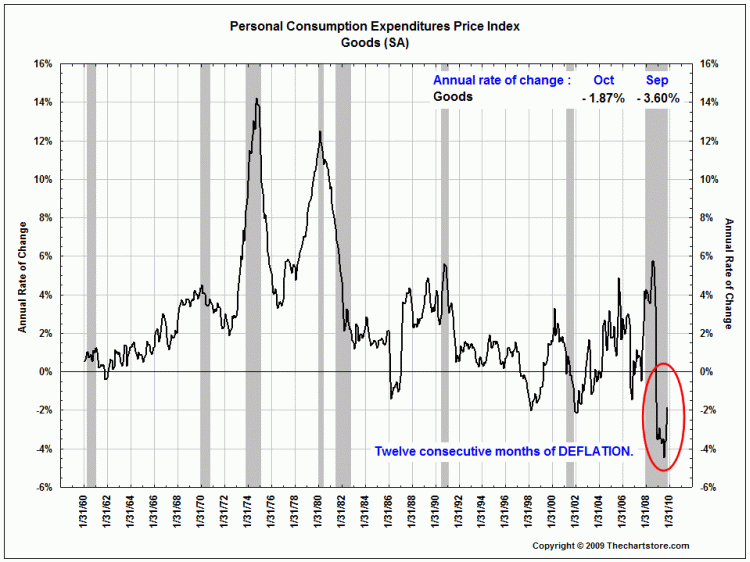
Since we have spilled so many pixels on retail and consumer spending, let’s look at some charts as to what and how much Americans have been spending on various items.

Is this Inflationary or Deflationary ?

>

Personal Consumption Price Index

11-27-09 PCE Indexes - 2

>

PCE without Food and Energy

11-27-09 PCE Indexes - 1

All charts via The Chart Store

Say What?!

Email this post Print this post
By Michael Panzner - November 30th, 2009, 10:47AM

Foreign Policy has just published a list of its “top 100 global thinkers” and the winner is…

1. Ben Bernanke

for staving off a new Great Depression.

Chairman, Federal Reserve | Washington

The Zen-like chairman of the U.S. Federal Reserve might not have topped the list solely for turning his superb academic career into a blueprint for action, for single-handedly reinventing the role of a central bank, or for preventing the collapse of the U.S. economy. But to have done all of these within the span of a few months is certainly one of the greatest intellectual feats of recent years. Not long ago a Princeton University professor writing paper after paper on the Great Depression, “Helicopter Ben” spent 2009 dropping hundreds of billions in bailouts seemingly from the skies, vigilantly tracking interest rates, and coordinating with counterparts across the globe. His key insight? The need for massive, damn-the-torpedoes intervention in financial markets. Winning over critics who have since praised his “radical” moves (including Nouriel Roubini, No. 4 on this list), he now faces an uphill battle in his bid for permanently expanded Fed powers. The radicalism is far from over.

Say what?!


Source:
The FP Top 100 Global Thinkers
Foreign Policy, December 2009
http://www.foreignpolicy.com/articles/2009/11/30/the_fp_top_100_global_thinkers?page=0,0

Berlin Keynote Address: Barry Ritholtz

Email this post Print this post
By Barry Ritholtz - November 30th, 2009, 10:00AM

Last week, I addressed an audience of fund managers and investment professionals in Berlin; Here are the highlights from my 45 minute Keynote speech:

Part one: How the actions of the Federal Reserve changed everything in 2002-2007:

Part two: Eight months after Armageddon seemed upon us, the US economy shows signs of life:

Part three: Where next for stock markets?

49 queries. 1.022 seconds.