
Autos in the Economy

Email this post Print this post
By Barry Ritholtz - November 8th, 2009, 5:15PM

Floyd Norris puts the auto industry into context of the larger US economy, in a few simple charts:

>

click for larger charts
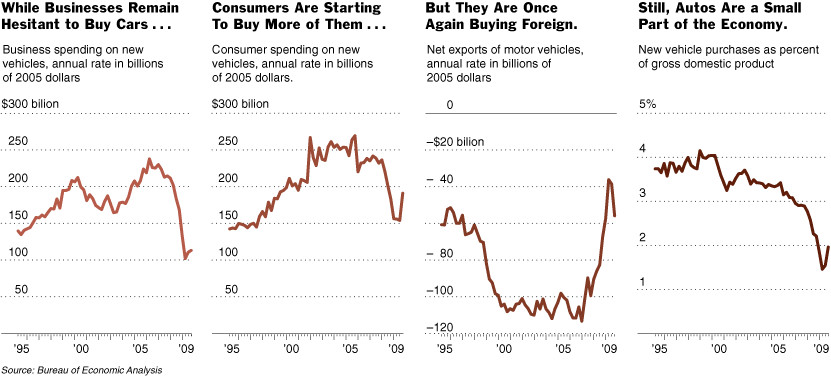
1107-biz-CHARTSweb

graphic courtesy of NYT

>

Source:
Car Buyers Come Back, but Not in Droves
FLOYD NORRIS
NYT, November 6, 2009

http://www.nytimes.com/2009/11/07/business/economy/07charts.html

23 Responses to “Autos in the Economy”

  1. holl Says:

    Mr. Ritholtz, you find a lot of good info. Do you ever sleep? lol

    Great job!

  2. brianshf Says:

    Autos themselves may be relatively small, but what”s the pct of GDP when you sum the entire supply chain that a finished car or truck requires?

  3. danm Says:

    Ratio going from 3 cars per household (or whatever it is today) to 2 to 1 as boomers slow down.

    Better make cars that Asians want. Oops, I forgot, they make their own!

  4. bsneath Says:

    Auto loans are just one more example of the decadent credit expansion practices that got us where we are today. It wasn’t that long ago when your auto loan choices were 36 or 48 months. Now they can be 72 months or more. It was great when the terms were being lengthened and your monthly “cash flow” would let you buy ever more expensive cars. But literally pay backs are hell. Now the loans are being paid back and I suspect terms on new auto loans are being shortened.

  5. KidDynamite Says:

    aren’t they a much bigger part of the “Shadow economy?” ie: jobs, financing, etc… in other words, vehicle sales as a % of GDP severely understates their impact right?

  6. willid3 Says:

    bsneath, new loans are just as long. they just have higher interest rates. and they much more picky about who gets them than before. the biggest driver of the length of the loan was how much the cars cost (though they are still less than what they used to cost versus income. the problem is incomes haven’t gone up but have been declining and we have lots more to spend on than before).
    and oddly enough even in the GD, car loans were more likely to get paid back than any other loan. and i suspect that still true today.
    and we never were really much of a car exporter. we bought almost all that we ever produced locally, and that made a large number of people involved in sales of new cars (would include almost all of the manufactures and the dealers too, plus their finance arms, plus a big junk of the banks, credit unions etc).

    and people eventually have to replace them. after all there are a lot of them, and there are still a lot of people owning them, and won’t keep them for 20+ years (at the current rate or replacement) and how many of us will keep any of our cars that long? and that replacement rate is lower than the one from the GD.

  7. JoWriter Says:

    KidDynamite – I don’t know whether just using sales is a good measure of economic impact, but my questions is: how much of a bailout did GM and Chrysler get as a function of their impact on our economy?
    [x billion $ auto co bailout/y billion $ GM and C's auto sales]

    How does that impact compare to the USG’s bailouts of banks and AIG as a function of their impact on our economy?

    And finally, why aren’t the C4C and $8K housing tax credits seen for what they really are? Bank and auto industry bailouts? Who gets the money when someone ‘buys’ a house or car under those programs? Not the consumer – the banks and auto companies.

  8. Pete from CA Says:

    @KidDynamite

    So if I buy a car for $20K that should be counted as the $20K I pay plus the $20K received by the people manufacturing the cars?

  9. Mark E Hoffer Says:

    speaking to point of “making Cars, others Want to Buy..”

    we might do well to revisit items like: http://clusty.com/search?input-form=clusty-simple&v%3Asources=webplus&query=Kearns+v.+Ford
    http://clusty.com/search?input-form=clusty-simple&v%3Asources=webplus&query=Tucker+Automobile
    and, loosely http://clusty.com/search?input-form=clusty-simple&v%3Asources=webplus&query=SEMA

    to get the question of Why? have we had a State-sponsored Oligopoly, entrenched, by D.C., in Detroit?
    How has that worked out for us?
    And, now, why are We paying, Wholesale & Retail, to maintain its existance?

    Did we, ever, believe that Competition led to Improvement?

    And/Or that, maybe, Freedom to Fail has provided more to the Citizens of the Country than any mioribund Bureuacracy could, even, Imagine?
    ~~
    KD’s point is Correct, the Auto Industry is responsible for far more than, just, it’s U$D-measured Retail Sales..

  10. rj Says:

    The last chart is false. It doesn’t account for everything that goes into buying a new car, such as components, forging, machining, assembly, shipping, advertising, etc.

  11. bsneath Says:

    Finley: Jobs a low priority for Democrats

    http://detnews.com/article/20091108/OPINION03/911080309/1008/OPINION01/Finley–Jobs-a-low-priority-for-Democrats

    They are not very happy in the motor city

  12. KidDynamite Says:

    @ Pete – no – i didn’t say that. what I said was that the impact of the auto industry is a lot greater than the notional sales value of the end product as a percentage of GDP.

    and by the way – i’m far from an American Auto Industry sympathizer.

  13. rj Says:

    To KidDynamite, correct.

  14. Calvin Jones and the 13th Apostle Says:

    bsneath:
    Finley is full of shit. While I agree not enough attention is being paid to job creation. He is wrong on everything else. He’s whining about Boxer and that committee vote last week? The Republicans are the party of “No!!” Doesn’t Finley understand that.

  15. arthur.i Says:

    How did we ever arrive at the place where it is normal practice to get something now and pay for it later?

    Why not save your money and then buy a car. Once you have that car, save a little money for the 10 years you are driving it so you will have the money to buy a new car when you need it.

    How did Americans get sold such a scheme to not only have to pay for the things they need but to pay an added charge on top for everything. And some of those charges (30% interest on credit cards) can add up with enough time to exceed the actual worth of what was originally purchased.

    Being in debt must be like living in Hell. Owing money on things you bought in the past must be like being a slave. A modern day nation of slaves.

    How did we become so fooled?

  16. Simon Says:

    Off Topic but this looks important to me. Richard Koo speaking at CISC. Long impassioned and very interesting talk

    http://csis.org/event/great-recessions-lessons-learned-japan

    Some key take away points being a) interest rates are very unlikely to rise because net demand for money is unlikely to increase anywhere until balance sheets are repeared. b) Non recourse loans on US households represent a huge hazard should house prices fall further c) Only governments can fill the demand gap while balance sheets area being repeared d) Currency fluctuations are likely to be wild and not easily predictable while all countries try to achieve an export advantage and all there are no strong economies e) Neoclasical economic theory is not an adequate framework for a balance sheet recession

  17. Simon Says:

    Sorry credit for the above goes to Prieur du Plessis Investment Postcards so it will probably turn up here directly from him.

  18. Bruce in Tn Says:

    http://www.bloomberg.com/apps/news?pid=20601057&sid=a9.ZzZW5rvEk

    Stock Rally Just Getting Started Before Rates Rise

    Nov. 9 (Bloomberg) — Stocks around the world are falling at the fastest rate since the worst of the credit crisis on concern central banks will start raising rates, a signal that triggered the biggest rallies over the past three decades.

    Benchmark indexes from New York to Tokyo to Frankfurt have lost an average of 4.4 percent since Oct. 19 on speculation policy makers will curtail stimulus measures before the global economy revives. History shows stocks have climbed 92 percent of the time in the six months before government borrowing costs began the biggest increases, data compiled by Bloomberg show.

  19. bsneath Says:

    Simon Says: “Neoclasical economic theory is not an adequate framework for a balance sheet recession”

    Probably the most important take away. It explains why so many people are advocating “balance the federal budget”, “stop quantitative easing”, “raise interest rates”.

    They fail to understand that this time it is different from past recessions and extremely similar to the great depression. There is no private sector demand today and it will not be forthcoming until balance sheets are painfully repaired. The “tough love” responses that are appropriate during a typical business cycle recession would be a disaster in today’s economic environment.

    The question is not should be stimulate the economy through deficit spending. Yes, we must. The question ought to be, “How do we stimulate the economy in a manner that results in long term investment rather than one time government outlays?

    Germany has used past recessions as an opportunity to stimulate their export industries by providing lavish investment tax credits. Perhaps we should be looking at similar ideas. We should be identifying what sectors of our economy where we have the greatest comparative advantages and how we can promote their development to become efficient exporters (agriculture as one comes to mind.) We should be identifying what sectors of our economy we can develop to strengthen domestic production over imports (domestic oil production is an obvious response) and we should be identifying what public sector investments will strengthen our domestic economy (highway capacity to eliminate bottlenecks to commercial traffic in urban areas).

  20. Bruce in Tn Says:

    bsneath:

    I’d take the other side of your thesis. The best way for the government to run a deficit and be more likely to get us out of this is cut taxes. Allows the most efficient use of the extra money to the consumer/taxpayer/businessman. Government pork, it should be obvious, is not the long term solution.

    Raise taxes when things are better…

  21. Its Me Says:

    I have the same appliances that I bought when I built my house 15 years ago. The same washer, dryer refrigerator, dishwasher, compactor and stove. Yes most are on their last legs.

    In that time I can count 9 cars that my wife and I have owned over the same period. The automobile is still king of the economy. I don’t buy that cars are too small a part of the economy to matter.

    What’s the next single largest part of the economy?

  22. bsneath Says:

    Bruce in Tn Says: The best way for the government to run a deficit and be more likely to get us out of this is cut taxes.

    BTn – I appreciate your comments and I do not disagree. General tax cuts would be a much better solution than the creation or expansion of governmental programs and they would be effective in stimulating the economy quickly. Further private sector investment should be promoted through tax cuts and no through government attempting to “guess” at which industries will succeed or even worse, targeting industries that will not succeed but that are politically correct. (Much of that has happened in the stimulus bill and much of it will end up being wasted resources that the private sector could have invested far more wisely.)

    There is some concern that individuals would not necessarily spend tax cuts and thus there would be less consumption or job creation. Much might be saved, used to pay down debt (although in the long run these are not a bad things either) or would promote consumption of imports at a time when we would be better off to be stimulate domestic sectors.

    My point is that if we are going to spend future tax dollars (and that is in essence what we are doing), it should be for things that will improve our economy and our ability to create jobs in the future. Investments, not-one time outlays.

    Obama’s stimulus package increased funding for police officers. OK this is good, but after the funding goes away, so do the police officers, so does the economic value of the stimulus. It is a one time shot.

    But lets say we build additional lanes on the Interstate in or around Nashville. When the project is done, trucks and commercial traffic (and commuters) will save time and money and the Nashville economy will be a somewhat better place to conduct business because transportation costs have been permanently lowered.

    That is my point. Lets use government outlays to invest, not to spend.

  23. Mark E Hoffer Says:

    bsneath,

    w/this “Lets use government outlays to invest, not to spend.”

    as opposed to: “The best way for the government to run a deficit and be more likely to get us out of this is cut taxes.”

    and your ex. “we build additional lanes on the Interstate in or around Nashville.”

    wouldn’t you agree that, after Tax Cuts, if the People of Nashville, and Tennessee, thought that was a good Idea, they have the ‘Cash’ to build it themselves?

    or, in other words, where, or when, has a Command-and-Control Economic model proved effective?

    or, differently, When all Roads lead to D.C., the People, of the serveral States, are left in the dust..