Consumer Prices: Inflation or Deflation ?

Email this post Print this post
By Barry Ritholtz - November 30th, 2009, 11:00AM

Since we have spilled so many pixels on retail and consumer spending, let’s look at some charts as to what and how much Americans have been spending on various items.

Is this Inflationary or Deflationary ?

>

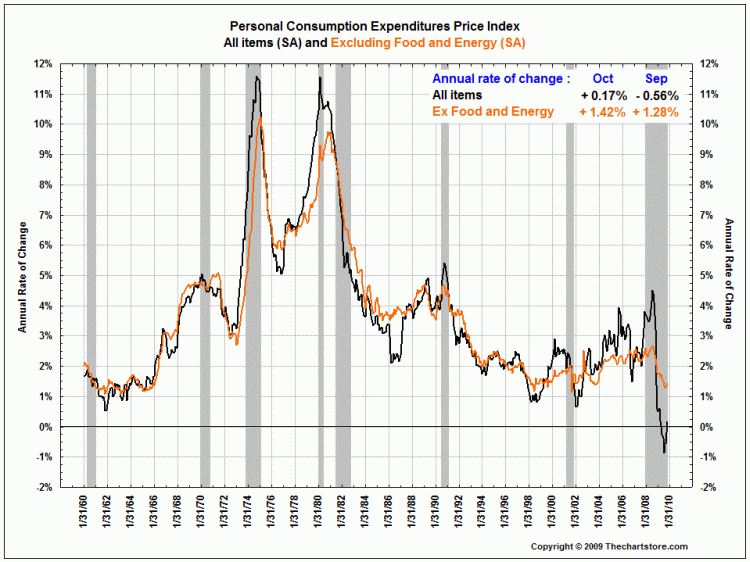
Personal Consumption Price Index
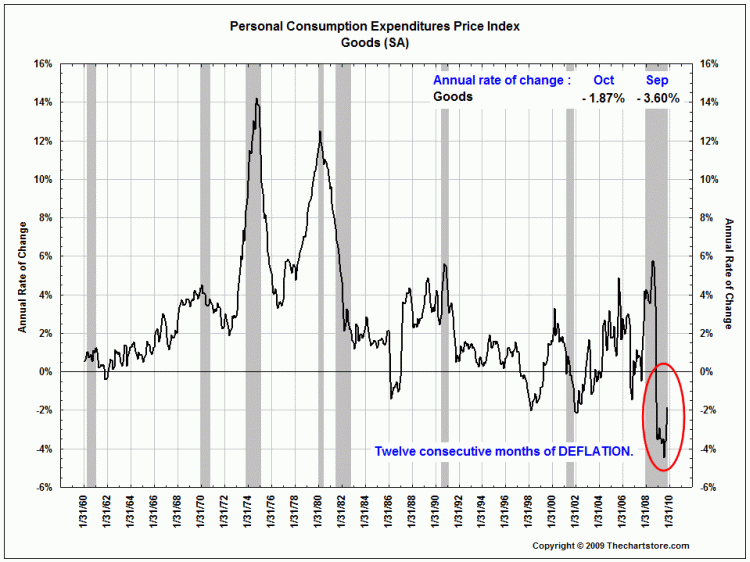
11-27-09 PCE Indexes - 2

>

PCE without Food and Energy

11-27-09 PCE Indexes - 1

All charts via The Chart Store

Comments

Please use the comments to demonstrate your own ignorance, unfamiliarity with empirical data, ability to repeat discredited memes, and lack of respect for scientific knowledge. Also, be sure to create straw men and argue against things I have neither said nor even implied. Any irrelevancies you can mention will also be appreciated. Lastly, kindly forgo all civility in your discourse . . . you are, after all, anonymous.

21 Responses to “Consumer Prices: Inflation or Deflation ?”

  1. Adult Franklin411 Says:

    Looking at 73-74 I’m wondering if ex energy is really ex energy, or whether fuel prices (transport costs) are just passed along to the consumer in the other items. I get that ex energy means minus auto and home energy, but I still wonder.

    Also, this chart cries out for a moving average trend line, IMO. Interesting all the same.

  2. Free Market Extreemist Says:

    Further Illustrating Gold as the next great Bubble to Burst

  3. Marcus Aurelius Says:

    Kinda’ hard to blow a bubble with a relatively fixed quantity commodity. Maybe the “law” of supply and demand was only a guideline.

    They can trade all of the futures they want, but can’t back them. When the futures implode (when some big player wants to take delivery and there’s nothing to be delivered), gold goes up. Why do you think the dollar and gold were decoupled in the first place?

  4. cdrueallen Says:

    My personal inflationary data point is that my Kaiser individual health insurance policy just went up by 10%.

  5. Mannwich Says:

    @cdrueallen: Deflation in the things we don’t need but inflation in the things we need perhaps?

  6. jonpublic Says:

    Deflation. Deflation. Deflation.

    All my costs are going down down down except for services.

    China is making everything ridiculously cheap. What I don’t understand is how on economy will survive with smaller and smaller margins on everything.

  7. b_thunder Says:

    The charts show that:

    A) We’re in a deflation, unless food/energy is removed from the index, i.e. “core” shows growing prices,
    and
    B) When oil and food prices were running wild in 2007- 1H2008, the “core” was much lower than the PCE, but we were told that the “Core” was the number that mattered (as if people don’t eat, drink, drive, use electricity, etc)

    Put A and B together and what do we have? If you use PCE, then the Fed lied to all of us, and/or is cherry-picking the data sets to justify its policy (“core” in 2007-2008″, and PCE now,) or, if you use “core” then ther’s NO DEFLATION and the Fed’s lose money policy is unwarranted (unless the Fed’s aim is a permanent wealth transfer from the savers and the middle class to the bankster’s elite. But it can’t be their goal, can it?)

  8. scepticus Says:

    “What I don’t understand is how on economy will survive with smaller and smaller margins on everything.”

    An excellent question.

    Interest rates are a rough proxy for profitability (i.e. return on capital), at least in a non ponzi economy.

  9. constantnormal Says:

    “What I don’t understand is how on economy will survive with smaller and smaller margins on everything.”

    Some things we can infer …

    1) it will be a “smaller and smaller” economy.

    2) the smaller businesses will be squeezed out first — and because these provide most of the national employment, unemployment will continue to soar, probably exceeding most “expert” projections.

    3) as the larger businesses continue to downsize to maintain profitability and enhance productivity, there will come a point where they start lopping off business units, entire segments of their business, in order to continue shrinking. These “orphaned” business units will become the new layer of small businesses, and will be squeezed out of existence in due course.

    The real question is: Where does this all end? Will we be reduced to a tiny nation of shopkeepers (that were the former GM, IBM, GE, etc)?

    And how will the CEOs continue to keep raising their compensation when the businesses they are extracting it from keep getting smaller?

  10. scepticus Says:

    “1) it will be a “smaller and smaller” economy.”

    I don’t see how that follows at all. Lower margins drives business to look for economy of scale.

    I’m not sure how your points 1 and 2 are reconciled with each other.

  11. Thor Says:

    The largest expense of any household (by far) is housing – either rent or mortgage payments. What happens to these numbers when you plug housing in?

  12. constantnormal Says:

    @scepticus 12:52 pm

    Then I take it you see GDP expanding merrily away, as the prices of everything contract in a gradual deflationary decline? All this via the miracle of “economies of scale”?

    It all sounds to me a bit too much like that old car salesman guffaw producer: “we lose money on every one, but make it up in volume”.

    Except of course, that we are not losing money, by virtue of the reductions in employment producing high levels of “productivity”.

    But in the limit, that doesn’t work, as after everyone has been laid off (surely a long, LONG way off, as between 80% and 90% of everyone who wants a job still has one), who will buy the products, and with what?

    That is what takes me to the question “where does it all end?”. Clearly, we are not going to the limiting scenario of everyone losing their means of income. But the more jobs that are lost, the heavier the burdens for the society as a whole, right along with the debt load it is carrying.

    This is why wars are such a historical popular means of ending depressions — they reduce the amount of people, a lot of debt gets destroyed (along with the debtors), and the surplus of goods is also destroyed. Nowhere to go but up.

    Wake me up when there is a sustained improvement in capacity utilization — whether it occurs via economic recovery, or via destruction of capacity.

  13. Adult Franklin411 Says:

    Lower margins drives business to look for economy of scale.

    No, it drives them to invent hidden fees and use agreement loopholes so that they can suck every last penny out of consumers.

  14. Mannwich Says:

    So true, Adultf411. The racket economy beating the golden goose to a pulp.

  15. willid3 Says:

    maybe its just representative of the falling incomes? the average income has been falling as is now back to where it was last century. that along with job losses, and job exports mean that the potential consumer base has shrunken. throw in relearning the old lesson from the GD of not buying much, not trusting the banks or stock markets either, you end up with a lot less interest to buy stuff. which lessons demand, which lessons prices.

  16. Pat G. Says:

    Depends upon your definition of either and the components of life which most effect your situation.

  17. cdrueallen Says:

    @Mannwich: Exactly. All the electronic junk I don’t want gets cheaper while the cost of health care and education soars. My Thanksgiving gratitude moment was that I don’t have any children I need to put through college.

  18. sickmint79 Says:

    deflation of stuff you don’t need, inflation of stuff you do.

    we’re not going to have any real deflation because the fed doesn’t want that and is perfectly capable of preventing it. no gold tied to those dollars to hold them back at all.

  19. The schizophrenia continues - Steve Cook on Disciplined Investing - InvestorsInsight.com | Financial Intelligence, Advice & Research / Investment Strategies & Planning for Individual Investors. Says:

    [...] The chart on inflation (deflation):    http://www.ritholtz.com/blog/2009/11/consumer-prices-inflation-or-deflation/    Politics  DomesticThe three most disturbing revelations from Climategate [...]

  20. DiggidyDan Says:

    http://www.ritholtz.com/blog/2009/04/top-10-things-the-letters-gm-stands-for/#comment-159166

    Yup. That about summed it up back then.

  21. RodgerMitchell Says:

    Perhaps even more revealing is the graph showing the relationship between deficits and inflation. You can see it at http://rodgermmitchell.wordpress.com/2009/09/07/introduction/, item #8.

    Rodger Malcolm Mitchell

76 queries. 0.330 seconds.