Friday Night Jazz: Newport Jazz Live

Email this post Print this post
By Barry Ritholtz - November 13th, 2009, 6:30PM

Newport-728x90

>

This is truly a Friday Night Jazz: Via the NYT, we learn that Wolfgang’s Vault has a substantial collection of pristine audio recording from the Newport Jazz Festival.

Some of the recordings will blow you away — I suggest the Count Basie concert, but all 3 are excellent (free registration required).

There is also Art Blakey and the Jazz Messengers (1959) and Dakota Staton (1959).

>

Thank me after you’ve listened to some of these gems . . . more stuff after the jump

>

Source:
Historic Sounds of Newport, Newly Online
BEN RATLIFF
NYT, November 10, 2009

http://www.nytimes.com/2009/11/11/arts/music/11vault.html

Featured Artists

  • Count Basie & His Orchestra
    Count Basie & His Orchestra 07.02.1959
    One of the most important figures to come out of the Swing Era, Count Basie presided with regal authority for 50 years over a dynamic big band that defined the art of group swing. This 1950s edition of the Count Basie Orchestra, sometimes known as the “new testament” band, was running smoothly on all cylinders in this dynamic show. The uncanny tightness in the horn section provides maximum punch, and vocal performances by Joe Williams and Lambert, Hendricks and Ross complement the band beautifully. This was easily one of the most invigorating and memorable sets of the 1959 Newport Jazz Festival.

  • Dakota Staton

    Dakota Staton 07.03.1959
    A wonderful interpreter of ballads as well as an inveterate swinger, Miss Dakota Staton is one of those singers from the 50s who seems to have fallen through the cracks of time. And while she may not be as widely regarded today as jazz vocal legends like Billie Holiday, Ella Fitzgerald and Sarah Vaughan, the sheer expressive power of her voice is undeniable and her dramatic delivery as compelling as her tough, sassy stage presence. Staton’s scintillating performance at the 1959 Newport Jazz Festival was one of the highlights of that Saturday evening.

  • The Jazz Messengers

    The Jazz Messengers 07.04.1959
    A dynamic presence and charismatic personality who led his hard-swinging ensembles from the drum set, Art Blakey was a widely respected figure in jazz for nearly 50 years. A super talent scout as a well as an exciting player on the bandstand, he recruited scores of emerging talents into the ranks of The Jazz Messengers over the years. The lineup that Blakey brought to the 1959 Newport Jazz Festival on July 4th included the stellar young trumpet sensation Lee Morgan (just six days shy of his 21st birthday at the time of this gig), bassist Jymie Merritt, pianist Bobby Timmons and tenor saxophonist Hank Mobley.

>

click thru to Vault, then click PLAY for streaming concert
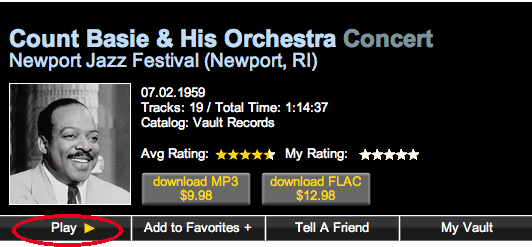
basie pop up
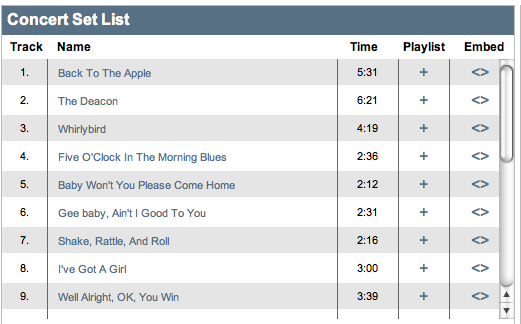
Basie set

>

Comments

Please use the comments to demonstrate your own ignorance, unfamiliarity with empirical data, ability to repeat discredited memes, and lack of respect for scientific knowledge. Also, be sure to create straw men and argue against things I have neither said nor even implied. Any irrelevancies you can mention will also be appreciated. Lastly, kindly forgo all civility in your discourse . . . you are, after all, anonymous.

12 Responses to “Friday Night Jazz: Newport Jazz Live”

  1. Count Basie Orchestra Says:

    Concert Summary

    Count Basie – piano
    Billy Mitchell – tenor sax
    Charlie Fowlkes – baritone sax
    Marshall Royal – alto sax
    Frank Wess – tenor sax
    Frank Foster – tenor sax
    Joe Newman – trumpet
    Thad Jones – trumpet
    Wendell Culley – trumpet
    Snooky Young – trumpet
    Al Grey – trombone
    Benny Powell – trombone
    Henry Coker – trombone
    Freddie Green – guitar
    Ed Jones – bass
    Sonny Payne – drums
    Joe Williams – vocals
    Lambert, Hendricks & Ross – vocals

  2. LostinATX Says:

    This website is fanfrakingtastic. I would thank you BR, but I signed up a couple weeks back.

  3. harry1867 Says:

    Thanks for the link Barry,

    Our Monday night band attempts some of these charts (with limited success). Great site!

  4. gloppie Says:

    Thank You Barry, this awesome recording is helping me wake up this morning, I gotta work.
    Have a great day !!

  5. Dennis Says:

    Awesome sound quality, too.

  6. Shake, Rattle and Roll With Count Basie « Kicking Over My Traces Says:

    [...] (Hat tip: Barry Ritholtz at The Big Picture.) [...]

  7. London Stud Says:

    Thanks for the awesome link. My dad, born 1922 loved this guy. He was listening to this quality stuff while I was listening to KISS. Man did he use to scratch his head. Now I know why…

    LS

  8. beaufou Says:

    Great stuff,

    for my rainy jazz nights I go to Joe Jackson, great musician.
    http://www.rollingstone.com/artists/joejackson/albums/album/321510/review/5946102/body_and_soul

  9. Keith - Hermosa Says:

    As much as I hate to say it, I think Jazz is a dying art. I go to the Lighthouse in Hermosa Beach, CA for Jazz on Thursdays and for Sunday Jazz Brunch. The Lighthouse was THE Westcoast Jazz venue in the 1950s. A quick Amazon search will give you a laundry list of live albums recorded there by a variety of Jazz greats. And basically every Jazz great played there. This past Thursday there were 5 of us in the audience watching the Charles Owens Quartet, which was fantastic. If a 60 year old Jazz venue with no cover can only pull 5 people with no cover, the future is not bright. And if it weren’t for the efforts of 83 year old Gloria Cadena booking the shows for free out of love for the art and the venue, it would already be gone.

    If you stop in, tell Gloria (Glo) that Keith sent you.

  10. dcsos Says:

    When Bill Graham passed on, his son sold the name to Clear Channel for $$$$$
    from what I’ve heard, Wolfgang’s is the result of that transaction!

    The Fillmore lives on!

  11. dasht Says:

    “Thank me after….”

    Indeed. Thank you very much.

    -t

  12. dasht Says:

    Keith, re “Jazz is a dying art (?)”:

    Well, the problem is that music theory is more or less exhausted. All the big shifts in Jazz during the 20th century were breakthroughs in applied music theory (new rhythms, new tambres, new uses of harmony, new song forms). That pattern extends back well before the 20th century in western music – e.g., the differences between the baroque, classical, and romantic eras. By the late 20th century, the space of possible music was at least roughly completely mapped out with representative samples to be found from just about every region of that space. Everything from here on out is derivative of the past in a way that it wasn’t, say, 40 years ago. Among the genres, Jazz alongside orchestral and chamber were the forms most concerned with theory breakthroughs as opposed to just tweaking knobs on existing forms. Thus, those three forms have something of an existential crisis if you believe in them as “living” forms as they were back when.

    -t

62 queries. 0.181 seconds.