
Futures Down 235 as Global Markets Tumble 3-5%

Email this post Print this post
By Barry Ritholtz - November 27th, 2009, 7:22AM

As noted yesterday (Look Out Below!), the sovereign debt default warning by the nation of Dubai (UAE) has caused some turmoil.

It is the excuse to send the Yen to a multi-decade highs, rally the US dollar, pressure stocks overseas, and pound the US Futures. Futures on the Standard & Poor’s 500 Index are down ~3%. Gold is down $26, while Crude oil fell nearly $4, and is back under $75.

In terms of exposure to Dubai, JPMorgan Chase & Co. writes that the Royal Bank of Scotland Group underwrote more loans than any institution to Dubai World; In terms of capital at risk, HSBC Holdings has the most in the United Arab Emirates.

Emerging Markets Index fell 2.6%, Asian Pacific Index slid 3.3%, while South Korea’s Kospi slumped 4.7%%.

FORECAST for the day (A/K/A my wild ass guess):  This is the sort of day that last year would have produced a down 500+ points situation. For the past 6 months, a deep opening gap down has brought buyers out of the woodwork. But its half a day, and I’m not sure if there will be time for that. My gut says that we end up closing down 100 or less on holiday volume (minus 40 would be ideal).

If that is wrong, and the US markets close down 2% or worse — lots of technical  damage done to key trend and support lines — than Monday could be a blood bath. But that is the lower probability outcome IMO.

Enjoy the day . . .

~~~
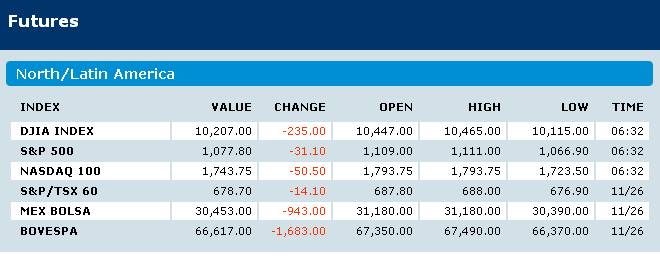
Futes 11.27.09

Comments

Please use the comments to demonstrate your own ignorance, unfamiliarity with empirical data, ability to repeat discredited memes, and lack of respect for scientific knowledge. Also, be sure to create straw men and argue against things I have neither said nor even implied. Any irrelevancies you can mention will also be appreciated. Lastly, kindly forgo all civility in your discourse . . . you are, after all, anonymous.

112 Responses to “Futures Down 235 as Global Markets Tumble 3-5%”

  1. Mike in Nola Says:

    Also note oil down almost $4 overnight on top of a drop yesterday. Now down to 74.

    Also drops in both precious and base metals.

    Unwinding of commodities carry trades could be more dangerous than a stock tumble because of large leverage and well documented huge stockpiles of commodities that no one needs.

  2. danm Says:

    LOL! Another 1/1,000,000 black swan event.

    When will people understand that it’s not because they can’t measure them that they don’t exist.

    When yields are below 60 year + averages and emerging markets are borrowing at dirt cheap rates, you’ve got to expect the unexpected.

  3. Patrick Neid Says:

    In the spirit of the holidays the market gods are allowing us to buy some things at a discount. No different than going to Macy’s today.

  4. Mark E Hoffer Says:

    “Enjoy the day . . .” w/o Doubt, BR~

    also, events like these are helpful to understand what is meant by http://www.crawfordperspectives.com/ “seeing less than favorable potents in the astral projections”..

    and, as always, take it FWIW, your orbit may perturb..

    past that, Hope everyone had a good Thanksgiving, we might do well to remember that it’s Everyday~

  5. danm Says:

    Unwinding of commodities carry trades could be more dangerous than a stock tumble because of large leverage and well documented huge stockpiles of commodities that no one needs.
    ———–

    When you consider that at least 200 skyscrapers were built in Dubai in the last 5 years, that an empty city was built in China and not counting all the other real estate activity worldwide, something tell me that if world trade slows down, commodities aren’t going to fare too well.

    But then again, if the Fed starts buying up new issues of treasuries directly to fund the deficit, making it acceptable for all other countries to do the same, maybe infrastructure projects will just take off some more and boost commodited some more.

    Who knows?

  6. Mike in Nola Says:

    danm:

    Judging by the rise in treasury prices, the Fed won’t have to do any buying for the moment. In fact, all they would need to do to fund the deficit is to provoke a little crisis now and then :)

  7. danm Says:

    Mike:

    My forecast is that there will be more and more black swan events coming from emerging markets over the next year.

    Many of their reserves will probably dwindle as they try to contain the shocks.

    By that time, all the money will have already come back home, foreigners won’t be able to fund the US defict anymore and these will need to be funded by Amercians or the Fed.

  8. torrie-amos Says:

    As negative as I am, imho, we got beginning of month next week, and new money may be put too work so a down market is good, sooooooooo, key is where we are at next friday imho. Next Friday is underemployment numbers, which should be a bullish catalyst and most likelythe real tell……actually a 7-10 week pullback would be good for the market, imho.

  9. danm Says:

    My forecast is that there will be more and more black swan events coming from emerging markets over the next year.
    ——-

    In 98, LTCM losses were peanuts vs. what we are seeing today, yet the world was freaking out. Today losses are by the trillions and no one bats an eye.

    This Dubai thing was 100% predictable as far back as 9 months ago. Who did not see the video on YouTube? Despite the evidence, Dubai World could get easy financing up to a few days ago.

    Obviously, bankers could not care less. Even if they know the deals will collapse, they don’t care because they have nothing to lose and everything to gain. That’s what the bailouts have done.

    So anybody who thinks the markets have stabilized is deluded. This is the calm before the storm.

  10. danm Says:

    5 years ago, investors were lending because they wanted to believe that real estate would go up forever.

    Today, investors are lending because they know the Fed will pick the tab.

  11. Steve Barry Says:

    I need someone to poke a hole in my logic…here goes:

    looking at Total Credit to GDP, which is now up to 375% BTW, we will probably some day, (when?) be back at 150% or lower. Using 150%, on a current GDP of 14 Trillion, we should be at 14 X 1.5 or 21 trillion in debt right now. Since we have 52 Trillion, that is around 30 Trillion in excess US credit. The US is about 20% of world GDP, but probably about half the debt. I’ll conservatively add another 20 Trillion for excess credit in the rest of the world. That means we have at least 50 Trillion in excess debt globally that cannot be serviced properly given GDP.

    Am I making any errors and what are the ramifications?

  12. hue Says:

    a black friday on black friday? dubai dubai debt http://bit.ly/55IkiJ beware of the snapper http://bit.ly/4A3ryE

  13. danm Says:

    Am I making any errors and what are the ramifications?
    ——

    You are assuming there won’t be inflation.

  14. scepticus Says:

    “I need someone to poke a hole in my logic”

    happy to oblige.

    Beware ‘total debt’ figures. The debt that matters is bank credit / M3.

    Imagine I borrow $1M from bank A, and then lend the whole lot to my mate B for a slightly higher rate than the bank gave me.

    Now total debt is $2M, but what has really changed? The money supply (deposits at banks) has not changed and remains at $1M. When my mate B pays me back, I pay the bank back. Point is, the real economy here is my mate B and bank A, I am just a parasitic intermediary. We can see that the real economy only needs to generate the income to pay back the $1M, not $2M.

    So M3 is ~ 14tn (GDP will be > 14tn, since GDP = M3 x velocity), and total debt is 50tn. That means that every $ of bank credit money has been relent 50/14 times by non bank institutions.

    Also, consider that an economy with large debt will have an asset position against its liability position. Casting around ‘net debt’ figures without some assessment of what’s on the other side of the trade is very misleading.

  15. Steve Barry Says:

    CNBC is shellshocked…calling this a buying opportunity…saying we’ll look back in a week and say it was nothing. It is a nightmare for them for this to happen on the day they are supposed to be all happy Black Friday talk. We’ll hear lot of “we are off the lows” later on, even if it is 10 points.

  16. danm Says:

    The problem right now is that every time a shock hits, the fed needs to react with hundreds of billions.

    So basically we can expect the shocks to get bigger and bigger and the volatility to increase.

    So maybe the stock markets can keep on averegaing 10% per year but we’ll be seeing more -20% and +35% along the way.

    This volatility is usually devastating for retirees. Even if long term returns can still average 10%+, these will not be accessible to them. And of course advisors will be telling them that they need to be there if they want to retire.

  17. Steve Barry Says:

    @ scepticus:

    What you say makes sense, but it also should have made sense for the the last 80 years. The question remains…why is total credit to GDP so far above any other time back to 1920. The only other time even remotely close was a spike during the New Deal/Depression.
    Also, you have greatly increased risk, because all this ‘re-lending” must be going to weaker and weaker borrowers down the chain.

  18. hue Says:

    “My forecast is that there will be more and more black swan events coming from emerging markets over the next year.”

    while i agree, but i have the nitpit. black swans are by definition unexpected and hard to predict or forecast http://bit.ly/65iGzk those emerging market events wont be black swans, bad white swans you see coming?

  19. scepticus Says:

    steve barry, what has changed is the introduction of securitisation and various other forms of financialisation.

    Yes it has increased risk by spreading it out but without the required transparency that should have gone with it. When people say that the FIRE sector has got too big wrt the real economy, this is what they mean.

    Go back to the 50s or 60s and the total debt is only about twice that of M3, not 4 or 5 times.

    I agree its a problem, but not because of the screamingly high total debt figure, because that is not all debt that needs to be payed back by the real economy.

  20. Steve Barry Says:

    Hue is right…a black swan would be me getting hit by lightning…it’s not really a black swan if I go out into open field during a thunderstorm holding a lightning rod. That is just taking extreme risk and having it blow up…that is our current “crisis”. I hate when that is called a black swan.

  21. scepticus Says:

    steve barry, I agree its a problem, but not because of the screamingly high total debt figure, because that is not all debt that needs to be payed back by the real economy. I would say the main risk of it is falling velocity of money due to the general uncertainty inherent in all this relending of bank money and blurring of risk.

  22. Steve Barry Says:

    Erin Burnett has no makeup on…wonder why…doesn’t look too bad.

  23. hue Says:

    i’m sceptical of your analysis scepticus,

    if mate B doesn’t pay you back, you don’t pay the bank back. so in a fractional banking sense, that $50T is not being paid back. that $50T is out there on various banks’ books. each loan that is re-lent needs income generated to pay it. if we say then that the Fed will just suck all of up with another tarp, then $50T may not exist, in our fiat socialist money system.

  24. Steve Barry Says:

    @scep:

    Also, if we have deflation, GDP drops, yet the debt stays constant…that is why the CBs are trying to stoke INflation and pay back debts in cheaper dollars.

  25. hue Says:

    ok i’ll try this again, first one hit spam filter for some reason

    i’m sceptical of your analysis scepticus

    if mate B doesn’t pay you back, then the bank can’t pay the fed back. each loan that is re-lent needs to generate income to make payments. so in a fractional banking sense, the $50T of debt is out there. if the fed suck all of that bad money in another tarp, then maybe bad debt doesn’t exist in our fiat, s o c i a l i s t i c (that was what the spam filter snagged) banking system.

  26. Climategate Says:

    100 Dow points haircut sounds as a reasonable prediction.

    This is all overhyped on low volume short-term noise. US fundamentals are getting stronger and stronger. Next week nobody will care about Dubai anymore.

    Next week Abu Dabi will step in and buy Dubai assets on the cheap. The global markets will rebound — squeezing all the shorts that were sucked in on this low volume hysteria.

    European markets are all up today already (signs that the market participants begin to realize that yesterday’s selloff hysteria was greatly overdone).

  27. DSB Says:

    Good analysis man. I dont agree with markets lately, but you seem to be right on the target.

  28. Steve Barry Says:

    Those saying Dubai is not important…not a big deal…have you already forgotten the famous last words “sub-prime is only a small part of the economy”?

    It doesn’t take into account the leverage or the fact that these are symptoms of the larger problem still out there.

  29. bsneath Says:

    OT – God’s Work Knows No Boundaries

    Goldman, ABN misled investors during IPO: court

    https://news.fidelity.com/news/news.jhtml?cat=Top.Investing.RT&articleid=200911270915RTRSNEWSCOMBINED_TRE5AQ2KB_1&IMG=N

  30. Mike in Nola Says:

    Steve: Had CNBC on mute earlier this week and she looked a little pudgy as she does today. Either PMS or pregnant, as I don’t think CNBC would tolerate its babes getting fat. Would break CNBCSuck’s heart.

  31. torrie-amos Says:

    Steve,

    imho, you’re analysis is okay, taking it down too real world is different, it’s more who is in a strong fianancial position and who is not, and how many nots can tread water over time so that total sales are not materially disrupted, ie, why you always get stimulus, stimulus replaces buying power of the debt burdended losers…………it’s why i harp on 85 oil, it’s the metric that effects all players, imho, that price kills all debtors at once, and harms sales for the strong while input costs rises thus there profits take hair cuts…………volatility and velocity have a huge impact on budgeting for the future, which if you’re one man and want too paint house, you can start a business, yet, if you’re looking at any mid-size business 5-20 million, unless you have some super competitive edge and a guaranteed strong market position for the future it makes things tough………..so, yeah, you get big huge buy-outs, for market share, ie sales and cost cutting, cause you got deep pockets and see out 5-10-15 years……………..it’s why you hear sirens of protectionism, that just another word for, man we need sales and need em now…………also look at japan, how have they hung on for twenty years, well, they had a lock on cheap electronics and auto’s and making machines that make things……………during the 20 years, hey lost the cheap electronics race too other countries, did great with auto’s and machine mfg was good, yet, since they got zero energy and no diversity they were stuck with these three legs, all while they carried banks on there banks, now the piper is come too rest when the demographics suck big wind, and auto’s are toast cause you got chepaer mgf’s in other asian countries, you’re own are too big and bloated, although products are good and will sell, yet, you’re american comp now has govt backing and they’ve cut into you’re competitive advantage with BK’s, ie, the cost advantage, and now machine sales suck wind also…………so what is japans future competitive advantage????????

    here in merica, at least you got saudie of coal, goldman sachs the worlds banker or banksters, military, oil we have protected and not tapped, the best farming area’s in the world, the most navigable country on the planet with rivers, roads, railroads, and shorelines, a history of innovation………….so, where we’ve screwed the pooch on the balance sheet, you can build a good arguement for a damned good fighting chance, we are probably the only country where we could do blanket protectionism and do just fine, not much growth, yet, little detiorations, we could feed and fuel and build all we need just fine, setting up a hammer mfg in indiana that’s been shipped overseas 20 years ago is not hard

    another reason why I say United States of Airlines, which are still going just a 7 year grind grind grind

  32. dougc Says:

    Hue

    Our bankers are socialists? Theywant to share their bad loans with us not their wealth.

  33. anti Says:

    I strongly believe that the Wall Market is overbought..a bubble fuelled with the hundrends of billions printed dollars, the p/e’s have rocketed to unprecedented hights, and of course thanks to the weekness of dollar.
    The market will reverse rapidly and violently when the scenario of the double dip recession starts to become bone and flesh. By then i wouldnt like to be inside a market which has gone too soon so far.

  34. hue Says:

    um it’s not all about energy, China pegged it’s currency to the dollar, making its good cheap to export. Japan’s currency is the reason it can’t compete with China. if China would float its currency than it would soar like the yen.

  35. Climategate Says:

    As per Bloomber, Dubai Exposure:

    UK Banks – 57%
    French banks – 13%
    German Banks – 12%

    The rest is spread among local Persian banks, other EU countries, Japan and the rest of Asia, and very tiny US bank exposure (less than 1%).

    CDS markets are very thinly traded. A few CDS trades spiked the spreads and started the global panic.

    This CDS problem (illiquid, non-transparent, and used as market manipulation vehicles must be fixed).

  36. CTX Says:

    IF we drop only 100 or less for the day, then you are damn good Ritholtz! (though I am hoping for a huge meltdown) IF we have a huge melt down today then damn- some of your readers will buy you that Rage against the Machine plus an added bonus- Britney Spears

  37. scepticus Says:

    “if mate B doesn’t pay you back, then the bank can’t pay the fed back. each loan that is re-lent needs to generate income to make payments. so in a fractional banking sense, the $50T of debt is out there.”

    don’t forget that loan defaults do not destroy money. So when my mate fails to pay me back, I have to default to the bank, the bank takes a write down but the money is still out there in someones deposit account (presumably not my mates though). So the ability of the real economy to pay down debt has not declined.

    in any case, the situation in which my mate fails to pay me and I fail to pay the bank is bascially the same as the case where my mate has cut out the middleman and just took the loan out from the bank A and therefore defaults direct to the bank. In the former case the bank writes down $1M, and $2M of net debt is destroyed, and in the latter case the bank takes a $1M writedown and $1M of net debt is destroyed. What matters here is the bank writedown (which is the same in both cases) , since it is these writedowns which destroy bank capital and constraint future lending, which is deflationary.

    of course since defaults don’t destroy money eventually when the bank gets re-capitalised the defaults start to look inflationary becuase the banks abaility to lend has been restored by the money supply has not been reduced.

  38. jeffg Says:

    I am not sure I place as much significance on this mini trading day as BR does. It can be manipulated either way towards the close.

    ~~~

    BR: I place almost no significance on day-to-day — its mostly noise.

  39. CNBC Sucks Says:

    Did someone mention moi?

    With regard to Erin Burnett having no makeup on, I thought I had already established the reason long, long ago: http://cnbcsucks.wordpress.com/2008/06/11/erin-burnett-takes-a-shower-at-the-cnbc-studio-each-day-at-noon/

    The CNBC babes getting fat would not disappoint me

    Yawn, this Dubai news is yawn. Futures were down 235, but now they are down only 154. When are you guys going to learn that Baby Boomer investors shrug off ALL news as meaningless. We can have World War III and nuclear winter and your freaking Dow will rebound. When are you peeps gonna learn? Baby Boomer investors don’t care about news; they care about THEIR needs. It’s the “ME GENERATION”. News is no news. It’s all about THEM. Sex, drugs, and rock and roll. When are you peeps gonna learn?

    Suckas.

  40. torrie-amos Says:

    hue,

    my point was that from a competitive advantage standpoint japan had 3 plus’s and one minus, china for the last 30 years has had cost advantage of cheap abundant labor, it games up with latest technology, and a fairly stable albeit communist country, so it’s growth story growth growth growth, japan’s growth is challenged by too many things now, right now our own growth is highly questionable, and without some type of growth debt will catch up, worldwide over last 30 years alot of it was built on cheap credit and cheap energy, they can keep the credit cheap, can they keep energy cheap……..heck we now have a hundred years of nat gas thru last ten years of technology in drilling and new mapping techniques, it’s a big boon because we got nat gas pieplines all over the us of a

    85 oil is my own inflection point for crushing what extra money middle class has thru simple metrics of prices of gasoline, it all came crashing down when gallon cost 4.50, imho, no way could we handle that again without significant repurcussions, thus, if 85 is breache, a hundred is not that far away, and a hundred get’s you in major domo trouble again

    there’s a good article on zero hedge analyzing the real cost of people foreclosing, that it is like a 14 billion a month stimulus package, makes one think a little differently

  41. How the Common Man Sees It Says:

    Ahhhh….Barry? Do you know if anything is happening to Goldman because of this? Maybe someone can give them a call over there to see if they are uncomfortable because of this news? Maybe we could start up a collection for them just in case? They could probably use the money anyway. Are there any banks that we aren’t using that we can surrender to them? Sort of as a peace offering? How much money do you think those salvation army collection plates have raised to date this year? Maybe we could use that?

    We wouldn’t want to see them put in any undue hardship because someone else may have messed up a trade that they may have originated…..and triggered. God wouldn’t be pleased! And we definitely don’t want God mad….or madder I suppose

  42. Mike in Nola Says:

    Looks like the PPT is in action. Would love to see the Fed audited to see what they are up to. Probably flooding the world with $$ to keep the carry trade going. Only way to keep the bubble inflated.

  43. Mannwich Says:

    I’m with CNBC Sucks here. Yawn. So bored, I’m going to the gym. We’ve seen this movie before. Dip buyers are waiting in the wings.

  44. Mannwich Says:

    @Common: Don’t worry at all about Goldman. I’m sure they’re “well hedged” and will profit off of this mini blow up as well somehow.

  45. Robert M Says:

    Two things
    One coincidence isn’t correlation but it has been amazing these last two days looking at the FED auctions this week. They reached their highest levels of oversubscription. when you see Rick Santelli doing his imitiation of a cat on a hot tin roof you have to wonder.
    Two, I believe you’re underestimating the impact this event is having on the market place. Everyone is looking for the one off tsunami. It is more like Dam Busters. The bombs being CDS. I have no information on CDS written on Dubai debt but I can’t believe the Euro countries are letting their financial institutions write them. We know for a fact there has been reining in of them in our country(USA) so I suspect once again the US taxpayer is on the hook. I don’t think the public will tolerate them being paid off again.

  46. nanotot Says:

    BR-

    What’s the precedent for massive Sovereign default in international law?

    http://www.bloomberg.com/apps/news?pid=20601087&sid=aiU3EjfF.Phg

  47. scepticus Says:

    @CNBC: “Baby Boomer investors don’t care about news; they care about THEIR needs. It’s the “ME GENERATION”.”

    I guess that reverses when those boomers are on average old enough that they are spending those portfolios rather than adding to them. The resulting decline in saving rates should see a nice decline in the markets no matter what anyone does.

    The younger cohorts of the boomer generation will be the most in harms way.

  48. hue Says:

    scepticus, we’re getting too granular, but defauts do destroy money, the bank’s money. no matter how we describe it, i agree it’s deflationary. if debt destruction is deflationary, then in theory the value of the dollar should rise as dollars are destroyed. what’s going on though is the banks aren’t writing down those bad loans, derivatives. if they did, then they would be insolvent. anyway, i’m no accountant, just play one in the comments.

    torrie, i get what all you are saying, but i’m pointing out one huge competitive advantage that China has (along with all you mention) is the currency. if the renminbi is allowed to rise, it would crush China’s exports and all of those advantages.

    well back to analyzing football games, another thing i’m an armchair expert of.

  49. hue Says:

    scepticus, one last thing, apparently your mate couldn’t get a loan from the bank and came to you. why would he pay higher interest from you or the same interest if he could get it from the bank. now you and he have bad credit and can’t get a new loan from the bank that can’t lend.

  50. scepticus Says:

    “if debt destruction is deflationary, then in theory the value of the dollar should rise as dollars are destroyed. ”

    maybe we’re to granular, but hey what the hell.

    dollars do not get destroyed by defaults. what gets destroyed is bank shareholder’s future claims on bank income, and therefore that banks propensity to lend.

    loan repayment destroys dollars. defaults don’t in themselves change M3 one little bit.

    the other thing that OUGHT to destroy dollars is bank failures when depositorsd get wiped out (so yes defaults en masse should lead to dollar destruction) but deposit insurance means that even bank failures can’t destroy money, because we’ve guaranteed most all deposits. This latter is why big banks can’t be allowed to fail. what needs to happen to rebalance things is that the number of deposits (unsustainable claims on future income all) needs to be reduced, but deposit holders object of course.

  51. CNBC Sucks Says:

    hue, thank you. I am thinking of starting Beanie Wells against the Titans this weekend. Andy the Sigma Nu blogger got the jump on me in the Ritholtz FF league yesterday (because of the cowardly Lions and Wade Phillips) and I am thinking of adjusting my gameplan by going with Beanie’s upside over Tim Hightower’s consistency. The conventional wisdom is that the Titans are tougher versus the run than versus the pass (hence, Hightower was the original choice), but Tennessee’s run defense seems a bit undersized and something that Beanie could have a big game against. I also did not see the Titans do a lot of eight-in-the-box or blitz much against the Texans on MNF.

    What say you, football analysis armchair expert?

  52. scepticus Says:

    hue, people borrow to speculate. I can borrow money from a bank and buy junk bond.

    also this re-lending of bank credit is essentially what derivative are. Bank credit is a (base) money derivative. A re-lending of bank credit is therefore a credit-derivative .

  53. insaneclownposse Says:

    regardless of the effects of the potential dubai default, the dollar is getting crushed today. This has HUGE implications if there is no longer a flight to the dollar in times of risk aversion. Like the “run out and buy all the canned goods and ammunition you can right now type of implications.”

    Perhaps the U.S. is a lot closer to currency implosion than everyone thinks. Seriously, we might be DONE FOR. TIME TO PANIC!!!!!!!!!!!!!!!!!!!!!!!!!!!!!!!!!!!!!!!!!!!!!!!!!!!!!!!!

  54. danm Says:

    Steve Barry:

    1st of all, this debate on what defines a black swan is just like in 2005 when everyone was trying to define a bubble and a few months ago a depression.

    Red herrings let me tell ya.

    2nd of all, all debt is backed by money. So if your debt keeps on climbing that means somebody out there has the money. If it’s 0.1% of the population, then you’ll get deflation because there is no way this group will be able to spend enough in the general economy to stimulate it. And with deflation, the debt will get written off.

    There is no freakin’ way debt can keep on going up without GDP going up to the levels you mention. Either you get inflation or the debt gets written off.

    The reason why Japan got deflation was because it was printing while the whole world was increasing capacity. And it was the first country in that situation. The US will be printing while capacity will be shrinking and all the other developed world are in the same position!

    The whole world ecnomy has been built around a consuming America. The only way we can get growing capacity is if their wages increase and they start consuming what we’re not. That will not happen overnight. The US needs to export but the whole world will be fighting this for the next 5 years. The ones with the money today and the clout are the ones who have been exporting, in emerging markets AND AT HOME for most developed countries. These exporteres are currently lobbying in every country to get their leaders to devaluate the currency. Governments will be forced to print print print. We are seeing it in Canada for crying out loud!

    All you deflationists are deluded. This deflation is temporary. Governments right now are playing a game of chicken. Just like Nortel did not want to be the first to announce a drop in orders, governments are waiting for the next shoe to drop.

    Governments can create inflation at will. All they have to do is flood the market with a lot of currency. They have not done it yet but they will in due time. A few months ago , bailouts were unfathomable and 1b losses were unbearable. Now most appreciate the bailouts tandnearly no one bats an eye at 1 trillion losses. In due time, the population will be happy to get handouts from the government.

    The US needs inflation to wash out foreign investors holding US treasuries and they will get it because they can do it.

  55. insaneclownposse Says:

    full disclosure – I own a lot of GLD.

  56. Steve Barry Says:

    @Insane:

    Please recheck the situation…the dollar was down to 1.51 euro before this news…now below 1.5…dollar has rallied on this news.

  57. HarryWanger Says:

    Good call, Barry – market is definitely shaking off the news now that the “experts” have told us not to worry. After a potential bomb was dropped over Thanksgiving, I’d be worried about it exploding over the weekend. But we have the shoppers out to make everything ok.

  58. insaneclownposse Says:

    I’m looking at DXY which, according to my quotes, opened at 75.80 and now trading at 74.97. Am I getting bad info on that?

  59. Steve Barry Says:

    I’m still convinced we are headed for deflation…50 Trillion too much debt globally (and I’m sure it is under reported and GDP is over-estimated)…the Fed has increased their balance sheet by a Trillion or so…they can’t print enough money fast enough to fill the hole.

  60. hue Says:

    mr. sucks, i only do football pools. no fantas y league for me. blogs, facecrack and twitter suck all of my free time, no time for fantasy football. i’m in a college football confidence pool and an NFL spread pool this year, instead of a NFL confidence pool. picking against the spread is pure gambling. at the end of the game, if your team ahead, the team is not trying to score for all the people who picked them based on the spread.

    i’m trying to figure out whether USC will be assigned 12 or 1 point versus UCLA, or picking UCLA for the upset. what say you? care to help me with all 12 games?

    scepticus, when i’m talking about deviratives, i’m talking about products like CDS, and CDOs that they banks bought for themselves, as well as the loan assets on their books. now i’m really confused. i guess we weren’t talking about the same derivatives after all. but you’re right, we all borrow money to shop and to speculate.

  61. Steve Barry Says:

    The INflation occurred over the last 50 years…saying more inflation can get us out of the crisis and payback the debt is mad.

  62. danm Says:

    they can’t print enough money fast enough to fill the hole.
    ——–
    Why can’t they? Because of ethics?

  63. DeDude Says:

    Mike@7:54

    Actually the fed should be bying more treasuries instead of wasting money by giving it out for free to the banks.

    The fact that we are allowing these banksters to borrow at low interet rate from “we the people” (the Fed), to lend at higher interest rate to “we the people” (bying treasuries) – and score a fat and sure profit at “we the people’s” expense – is outrageous. If money from the Fed needs to be put into treasuries, it should be done by direct purchases, not via private profiteers. If banks take free money from the fed they should be required to lend it to the private sector or consumers (no safe investments in government bonds and no gambling in commodities and other markets).

    Steve@8:29

    Your link is giving total Credit on 3/3/08 as 49.6 Trillion (or 350% GDP) are you sure it has gone up not down since then? Do you have a recent number to support the 375% or is that an estimate?

    In any case most of the actual underlying debt is corporate and consumer, so it will be disposed of in the normal manner – by default. The owners of CDO’s and corporate bonds will take a haircut. I do not know who that is, but my guess is that there are a lot of pension funds (regular peoples retirements), that will take a serious cut. Baby-boomers will go baby-bust, and have a lot less comfort in their retirement than they had planned. Regular hard working people f*cked once again – and the world will go on – as always.

    RE: Erin Burnett and makeup, she mush have been crying and it all started running, so better wipe it all off than looking like a singer from Kiss ;-)

  64. hue Says:

    well danm, i think Lehman was a black swan because they didn’t see the Reserve Fund, money market domino. what you describe with emerging markets are events we’re waiting to happen. it’s all semantics over the crisis. the fed wants inflation because it can control that, or easier to perhaps deal with. deflation is a death spiral. but count me as a deluded deflationist.

  65. insaneclownposse Says:

    I like the deflation thesis, but the wildcard is the currency. If the Fed would behave responsibly, the deflation trade would be a cakewalk.
    Anyway, it’s very important to watch the behavior of the dollar because nothing really holds it up except the fact that it is widely held. If the dollar cracks, obviously it would be catastrophic for all of us here in the States.

  66. danm Says:

    The INflation occurred over the last 50 years…saying more inflation can get us out of the crisis and payback the debt is mad.
    —–
    Go read your history books, every freakin country not respecting the gold standard has done it!

    Either they write it off or they print. They’ll print.

  67. Steve Barry Says:

    @danm

    because so much would start breaking first they would have to stop…you see what commodities and gold have done with very little economic rebound. They would also have to stop because our creditors will not stand for it, unless they themselves are insane. If you take out a mortgage, does the bank let you pay them back in toilet paper?

  68. danm Says:

    Hue:

    Dubai World is a black swan because they thought Abu Dhabi would back them up.

  69. CNBC Sucks Says:

    hue, for your college football gambling questions, you should consult with cvienne. I think these days, he spends most of his financial blogosphere time on the Sigma Nu blog. I try to talk around that blog’s existence, but Jeff Mannwich might be able to help “get you in”. ;)

  70. CNBC Sucks Says:

    Debt schmebt, default schmault, Black Swan Black Schwan.

    It would not surprise me if Hank Paulson (yeah, he’s still involved) dashes off a run of $60 billion on the money printing machine at the CNBC studio — the one by Melissa Lee’s snack bar, not the one next to Rebecca Jarvis’ tanning booth (that one is low on toner) — and FedExes the cash to Sheik Al-Maktoum, and politely asks him to just STFU, we’ve got you covered.

    Enjoy the rest of your weekend.

  71. Andy T Says:

    @danm

    “2nd of all, all debt is backed by money. So if your debt keeps on climbing that means somebody out there has the money.”

    That’s the single DUMBEST thing I’ve ever seen written here, and that’s saying A LOT.

    Andy T.
    Chairman of Sigma Nu blog (You kill me CNBCS)

  72. Steve Barry Says:

    @DeDude

    I calculate Total Credit as a % of GDP myself, using this link for total credit:

    http://www.federalreserve.gov/releases/z1/Current/accessible/l1.htm

    and dividing by GDP from this link (click on full release and tables…use Table 3)

    http://www.bea.gov/newsreleases/national/gdp/gdpnewsrelease.htm

    As of 6/30/09:

    Total Credit was 52.79T…GDP 14.15T…52.79/14.15 is 373%

  73. insaneclownposse Says:

    Steve Barry:

    I think you illustrate the crucial flaw in the Fed’s QE program and why such a massive program is so reckless. They have no way of knowing how much printed money will cause “so much to start breaking.”

    The only data they get in real time is market data, which is forward looking. All the other numbers are from the rearview mirror so to speak. It’s very possible for them to print enough money to destroy the currency and not realizing it until long after the damage has been done and after it is too late to do anything about it.

  74. hue Says:

    i’ve lurked the Sigma Nu blog, but i didn’t hang around cause it seems like they’re active or daytraders. i’m now a swing trader or longer term trader/investor/speculator because my short term trades moved against me, and i’m waiting and waiting and waiting for the reversal ;-)

  75. danm Says:

    Andy T:

    I never said reserves, I said money.

    You go try and tell everyone that their savings and bank accounts are not money yet if they all went to the bank at once, they would get peanuts.

    There is an asset backing that debt. As long as that asset is not written off that debt does not get written off. And currently the Fed is allowed to monetize worthless assets.

    Sorry, you’re the one off base. Go attack someone else.

  76. Steve Barry Says:

    Our economy is a broken down jalopy and the fed is trying to floor the gas pedal…it will break down pretty soon.

  77. Andy T Says:

    danm: I never said you said reserves….I quoted your line directly.

    When you buy a TV for $1,000 bucks, in credit, what money backs that debt up? There is none. It’s just a promise. The asset you have on the other side of the ledger is a TV that will be worth no where close to $1,000 bucks ever again. So, there is a “gap” that must be filled between what you owe and the value of the asset you bought that has subsequently depreciated in value.

    This is how a “credit money” system is created and grows. Intermediaries that we have entrusted (banks) are the ones that created credit (money) out of thin air–not the Fed. These cavaliers of credit will keep pumping the credit/debt out as long as there is someone willing to take on the debts. When the music stops, as it did in 2007, everything contracts. The Fed is not ‘in control.’ They just think they are….

  78. scepticus Says:

    the whole inflation deflation thing is rather irrelevant. In a proper deflation – like when everyones deposits are not guaranteed, falling bank asset values (either due to mark to market or default or declining demand for credit or all of these) cause banks to fail which wipes out depositors. This reduces the claims on future income in line with the reduction of bank assets. Also during a proper deflation incomes fall faster than people can save, so saving rates go negative, like they did in the GD1.

    In an inflationary response to a credit crisis, the outcome is the same, future claims on income are removed and people find it hard to save because inflation devalues their savigs quicker than it increases their incomes.

    However a lot of people seem to expect the kind of deflation where saving rates rise, depositors are protected and incomes fall more slowly than prices. That is not going to happen, so ideally we’d go with whichever of the two options above results in the quickest recovery to a position from which sensible progress can be made.

  79. DeDude Says:

    Danm;

    “all debt is backed by money”

    I think scepticus just explained how $2M of debt can be backed by $1M of money and that when you extend the “chain” of lending (via CDO’s and making other CDO’s from slices of CDO’s etc.), then you can have many millions of debt only backed by $1M of money.

    “Governments can create inflation at will. All they have to do is flood the market with a lot of currency”

    I don’t think that is true. If they printed one thousand trillion dollar bills and those bills were just laying in bank vaults that would not create any inflation of all – its just pieces of paper. To create inflation you have to create velocity of that money. In some cases you can create velocity of money by creating more money, but not when all everybody (banks, consumers, businesses) want to do with additional money is to pay down debt or save it for later. That is why the only thing right now that can counter deflation and create economic growth is to print money and let government spend it (they can as a matter of policy decide to spend that new money rather than pay down debt).

  80. danm Says:

    When you buy a TV for $1,000 bucks, in credit, what money backs that debt up?
    —————-
    Sorry Andy but you are WRONG.

    You obviously do not understand how money is introduced into an economy. When a 1000$ debt is taken, 1000$ was introduced into the economy. You got the TV and somebody got that 1000$. As long as that 1000$ debt exists, 1000$ is circulating somewhere.

  81. hue Says:

    we’re getting all Orwellian, arguing over definitions.

    the word credit comes from the Latin “credere” which means “to believe, or to trust.” That’s really all you need to know about the modern financial system. When the “credere” is gone, the whole thing unravels, and it works both ways, from lender to borrower, and from borrower to lender. http://bit.ly/6zD8g3 except the Fed can print crederes

  82. Mannwich Says:

    @hue: Good point. I would argue the “BELIEF” is there (right now) but the “TRUST” really isn’t, and rightfully so. That’s the issue.

  83. danm Says:

    As long as that 1000$ debt is there, there is 1000$ (which is money) somewhere, in a bank account, in a mattress, in a share, in a bond….

    Money is somebody’s debt. If they default on that debt, that money if worthless but it’s still freakin’ money!

    And I am not even arguing anymore because it just goes to show how many intelligent people still do not know how money is created.

  84. mthomas Says:

    good summary article on the Dubai situation and how it may impact the gold sector going forward, given that it has performed so well but is unique from all other asset classes because many people still view gold as real money: Gold Price Dives to $1,138 on Dubai Default

  85. DeDude Says:

    Steve; thank you for the link. It seems like the debt went from $35T to $50T in the period 2003-2007 – fitting well with the idea that a lot of the expansion was from reseling of reseling of reseling of loans, thereby expanding book debt without increasing real net liabilities (if it was all ending up in actual consumer spending, the GDP should have exploded by $15T in those 4 years). In the past two years we have hit a top of $52.9T in Q1 of 09 and now are moving down. That also fits well with the death of creating more debt by reseling, reseling, reseling….. The bankster cash cow of reseling debt to take a juicy fee has been slaughtered, so we will see a contraction in total debt as all that crap is unwinding.

  86. danm Says:

    If they printed one thousand trillion dollar bills and those bills were just laying in bank vaults that would not create any inflation of all – its just pieces of paper
    ——–
    True.

    Right now they’ve been giving it to banks who are doing just that, but in due time they’ll give it to those who will need to spend it.

  87. scepticus Says:

    lets get the definitions right. liabilities circulate as money. Banks issue liabilities, but keep the debt for themslves. M3 is teh total measure of dollar denominated liabilities.

    So the money in circulation is strictly speaking a claim on another, not a debt. The debts are held as financial assets in bank ledgers, the assets do not circulate.

    cash and base money is a liability of the state.

    everything else is bank liabilities.

    so there isn’t any money. Just liabilities/promises/claims, public and private.

  88. scepticus Says:

    “Right now they’ve been giving it to banks who are doing just that, but in due time they’ll give it to those who will need to spend it.”

    They’ve been doing that for 30 years. A helicopter drop to j6p can be made by an unfunded tax cut. An unfunded tax cut is identicial to dropping money to workers. This is how bernanke’s helicopter would actually work.

    Given the public debt has been expanding for decades now, I’d argue that this equivalent to an unfunded tax cut (since there has clearly been spending without taxes).

    So the helicopter drop has been going on unnoticed for ages, which in part is the reason for the strong inflation of recent times.

    And the drop is not offset by debt issuance, since that issuance pays interest and is therefore a financial asset which adds liquidity to the private sector.

  89. hue Says:

    thx manny, i should have put that in quotes because i lifted that from pepe depew, link. “5 things” is a must read.

  90. Steve Barry Says:

    Assets can be financed by debt or equity…the first thing you learn in accounting is Assets=Liabilities + Equity…it works for your house, a business, the economy.

    Your House: Your home value is the asset price. In a normal situation, the liability associated with it (the mortgage) is less than the asset price and you have some equity in the home. Home prices are illiquid in that you can’t sell your house on demand in an open market at a spot price…it is a long transaction and there may not be a quilified buyer who can get financing knocking at your door. The problem we face here is declining asset values that are pushing homeowners into negative equity (underwater) and they owe more than the asset is worth. Plus qualified buyers with jobs and financing are shrinking.

    Business: Businesses raise cash by issuing debt (bonds) or equity (stocks)…again A=L+E…note if you have high liability and low equity (are highly leveraged) a small drop in asset prices will wipe out all the equity. (see Bear Stearns and Lehman)

    In the aggregate economy, if you can grow assets without taking on more and more debt, that is preferrable…the opposite has occurred recently…it has taken more and more debt to get GDP to grow. It was a mirage. The answer so far has been to create even more debt for bailouts. Not very innovative.

  91. torrie-amos Says:

    all damn is saying is, “don’t fight the fed”, why, cause they make rules and it is a fact they change rules and laws at there own will whenever they feel like it, especially in times of crisis to avoid the proverbial…social unrest…..ben has already shouted from the rooftops how he will solve the problem, re-inflate, he has re-iterated that over the last month, the question only becomes at what point does this re-inflation implode, the general belief is ohhh a new bull market, etc. etc., the coralary is ben and the boys are insane, there is not enough air to blow the bubble back up, ie, debt……….ben and boys have painted themselves in a corner, they scream we will have no inflation yet depends on how you measure it…………….if a plasma goes down 30% and a gallon of gas goes too 4 bucks, some say it evens out, others say, that’s just silly………..

    imho, Black Swan events are extremely rare and lehman and bear do not qualify, companies going bk is standard stuff……….the only Black Swan was in first week of August 2007 when every market worldwide dislocated for 3 days………that week has set everything else in motion, similar to what 9-11 did too airlines……..airlines are still flying, ordering new planes, etc., and they have been thru a 100 dollar swing in oil, of course the hedge, etc……..the one thing is clear though is they have cut capacity by 50% and are extremely lean and mean and yet there balance sheets still suck horrendously and are always a quarter or two away from huge losses, or a small profit too keep em going, there is an implicit demand threshold at 400 bucks a round trip, anything above and forget about it…………the point being the world is not coming too an end, its just an utter grind with almost no progress

  92. Andy T Says:

    @danm. You’re just too smart for me. I feel like I’m debating with Vizzini from from Princess Bride…

    “You have truly dizzying intellect.”

    http://www.youtube.com/watch?v=3EkBuKQEkio&feature=related

  93. call me ahab Says:

    if all debts are backed by money- is it possible then- for everyone to scrape together all the money available in the economy and pay off all the outstanding debt-

    no-

    outstanding debts would have to be written down/off for all debt to be extinguished-

    so i don’t buy danm’s argument

  94. hue Says:

    interesting last 10 minutes. the sellers overwhelmed the ppt.

  95. scepticus Says:

    “outstanding debts would have to be written down/off for all debt to be extinguished-”

    while I also have issues with danm’s logic, the above is also incomplete I think. Note that in the absence of government created money (i.e. a pure credit economy), writing off all debts would destroy all banks and therefore destroy all deposits at the same time when the banks failed.

    there would be no money left.

    However all banks failing in the case with government fiat money wouldn’t destroy base money, so that would remain. And nothing in theory to prevent base money being expanded to the level of the old credit money, but once all banks have failed whether you have 2tn or 15tn base money is neither here nor there.

  96. Steve Barry Says:

    even the PPT gets complacent, LOL.

    In an ironic twist, if there is a PPT that intervenes to keep the market above a true clearing price, it would likely ultimately cause a massive crash…and they probably don’t even realize this, sadly.

  97. hue Says:

    chairman of Sigma Nu, about danm do you really mean it? anybody want a peanut?

  98. Steve Barry Says:

    Why don’t I trust any CNBC guest with either a bow tie or a fancy handkerchief in their pocket?

  99. call me ahab Says:

    i guess my point is-

    in this hypothetical situation- and all the money that was available was scraped together to pay down debt- there would still be outstanding balances on total debt-

    so- all debt cannot be backed by money- the money supply doesn’t come close to amount of debt that is outstanding

  100. danm Says:

    call me ahab:

    Go to the Fed’s website. The definition of money creation is black on white. In case you don’t trust the Fed, go to the bank of Canada. If you don’t trust them it’s in all economics books.

    Look. You buy a TV. You go to the bank and borrow 1000$. It’s a debt.

    You give your 1000$ to the seller. He does whatever he does with it. But it stays somewhere in the system on somebody’s “book”, on the asset side, until the debt is paid off or written off. That 1000$ is money. That’s the definition.

    But if the guy puts his 1000$ (money) in the bank, the bank will lend it to someone else. So someone else now has 1000$ of money (there are basically no reserves anymore!). So now we have 2000$ of money in the system but there is not 2000$ in the bank.

    There are now 2000$ in money on the asset side of the balance sheet,
    There are 2000$ in money on someone’s liability side of the balance sheet.

    Debt = money

    But the is only a depreciated TV backing the whole thing… and future labor of course.

  101. danm Says:

    call me ahab;

    Sorry ahab but you are mixing up money and money supply.

    Money supply is a subset of the total money. You have M1, M2, M3… These are all subsets of the total.

  102. eren Says:

    you were close -100+(-)40 ==> -140 :) lol.

  103. danm Says:

    Sorry ahab but you are mixing up money and money supply.
    ————-
    I meant mixing up money with the narrower definitions of money supply such as M1, M2…

  104. DeDude Says:

    So a 200K mortgage can be sold to someone who puts it into a CDO that is sold to someone, who slices it up and puts it into another CDO etc. 3 times until it is sold to investors for real money. So the 200K mortgage (or the home) now represent 800K of assets and 800K of liability on some balance sheets somewhere. You have a default and recover 100K from the auction of the house. Provided that the end investors take the full loss and only get 100K back for their 200K payed/invested, then 600K of assests and 600K of liabilities have disappeared without a trace or any effects (just like the trillion dollar bills in a vault are just paper with no effect). In other words you can “repay” 800K of debt with only 100K of “tears” (sorry if I am not using the economically correct terms, I am not a pro).

  105. Andy T Says:

    @danm

    “Go to the Fed’s website. The definition of money creation is black on white. In case you don’t trust the Fed, go to the bank of Canada. If you don’t trust them it’s in all economics books.”

    You’re on a roll danm. Now you have written the funniest thing I’ve read today….”If you don’t trust them it’s in all economic books.”

    Yeah, economics books and central banks have been really hitting it out of the park with their understanding of such matters.

    There may be an alternate view on money supply. I strongly recommend that you get through this essay on “credit based money supply”…this guy many not have all the answers, but it’s certainly an explanation that does better than the neo-classical models that have become “group think” within central banks and economics textbooks….

    Spoiler Alert: Money gets created in ways not described on the Fed’s Website.

    http://www.debtdeflation.com/blogs/2009/01/31/therovingcavaliersofcredit/

    Peace.

  106. scepticus Says:

    “so- all debt cannot be backed by money- the money supply doesn’t come close to amount of debt that is outstanding”

    lets clear this up.

    The private sector has no net financial assets, all liabilities are matched against assets. sums to zero.

    The banks create assets and liabilities.

    A non bank may create a new financial asset by relending bank liabilities, however this is also matched by a new financial liability. Still sums to zero. Only thing has changed is total amount of liabilities and assets.

    the government can create base money which is a government liability and therefore represents a financial asset in the private sector not matched by private sector liability.

    onlt the government can provide the private sector with NET financial assets.

  107. call me ahab Says:

    i guess my point is- the Fed cannot print enough USD to compensate for credit money destruction that is occurring-

    is that a fair enough statement?

  108. danm Says:

    the money supply doesn’t come
    ———–

    The money supply is usually calculated as a total of liquid assets.

    For example, if someone borrows 1000$ and puts in in a demand deposit, this will be considered money. If another borrows 1000$ to buy a house, this will not be considered money.

    But when you are looking at money creation, 2000$ of money was created.

    I guess it’s all semantics once again.

  109. danm Says:

    Andy:

    I read that report a while back and I thought it was moot. It’s the old debate of what came firts, the chicken or the egg. Today’s reserves are probably close to 0. So the banks can make loans without deposits.

    When textbooks talk about deposits being first in line, it’s more of an example. You have to go to basics when you are explaining it!

  110. call me ahab Says:

    danm-

    i don’t think any one is arguing that credit creation does not create money- but you touched on why it doesn’t easily work in reverse-

    the money from a loan can be used to purchase an illiquid depreciating asset such a furniture- and sure the furniture store got their $- but the borrower- the one who owes the debt which was used to buy the furniture- cannot easily pay that debt back w/ his asset- because it is illiquid and is only worth a fraction of its original value-

    if the borrower defaults- the bank eats the loss- so the debt is not backed by money- but backed by an illiquid asset w/ little value-

    reality- the debt was really backed by the borrower’s earned income and his ability and willingness to repay the loan

  111. danm Says:

    All I am saying is that somebody’s debt is somebody’s asset. They are counting on that money until something proves to them that they won’t be able to get it back.

    And all assets have a monetary value which can vary from 0$ to infinity. Maybe not in most definitions of the money supply but in the broadest sense of the definition of money, all assets are money.

    That 1$ bill in your pocket is definitely money. No argument there. But it’s also debt. It’s an IOU. So you’re a creditor. Somebody owes you 1$ worth of goods or services. What you’ll get for that dollar is another issue. You believe it’s a buck, maybe someone out there won’t want to touch it when you want to use it. But in your head you call that money until you can’t use it anymore.

    Same thing for banks holding the debt. That debt is an IOU. They’re creditors just like you. And they also call it money until they are forced to write it down.

  112. Michael Weiss Says:

    It stinks not having oil.

    Dubai Background

    Dubai is one of 7 Emirates that make up the United Arab Emirates. Abu Dhabi, with huge energy reserves and a sovereign wealth fund thought to be worth $630 billion, is the richest of them. Its banks are major creditors of Dubai and its companies, but news that they are no longer willing to keep buying or refinancing the debt of Dubai’s major companies shocked the global markets.

    Dubai and U.S. Housing Speculators Play the Same Game

    Dubai has very few energy resources and raises little money via income tax due to its competitive tax policies. The state has consistently run deficits and the Emirate’s growth has therefore been funded via the money markets.

    A huge property-led boom saw money pile into infrastructure and construction projects (sound familiar?). Similiar to being on the cover of Sports Illustrated, building the world’s tallest building has always been viewed by investors as a sign that a local economy is about to head south.

    Dubai World, the most indebted of Dubai’s state-sponsored companies, owes $60 billion of which $22 billion must be refinanced by 2011.

    Worries About Impact Of Dubai Crisis Generate Substantial Selling Pressure

    The U.S. stock market opened sharply lower (down roughly -3%) on Friday, November 27, 2009 in a reaction to the financial crisis in Dubai. The downward momentum comes after Dubai World asked to postpone payment on some of its $60 billion in debt. Worries about a default by the city-state have raised significant concerns about the impact on banks.

    The markets closed down roughly -1.5%.

    Mark Minervini Comment on Dubai Sell Off

    I view short term turmoil in countries and nations outside the U.S. as a long term positive for U.S. stock and bond markets. Similar to the Asia crisis in the late 1990′s, these foreign calamities highlight the relative safety of the U.S. and bolster U.S. credibility. I made this same comment during the Asian crisis, which turned out to have the same effect.

    A Counterintuitive Scribe
    I will leave you with one counterintuitive comment by James Hillman from his book, Kinds of Power: A Guide to Its Intelligent Uses:

    “Wherever we see an increase we feel its weight. All the numbers going up no longer portray the optimistic spirit, but instead indicate monstrosities, epidemics, ugliness, future disaster, extinction. Growth has taken on a cancerous tinge. To use the word now sends a message of potential danger, whether the growth be in debt, the population, the underemployed, the homeless, the dimension of cities, the size of government, the particles in the air, the tax rate, the cost of living, the cholesterol count, even the rising numbers on the bathroom scale. Going up now means decline. What was before the measure of progress has become a sign of
    problems.”

    You might be thinking that this was written to describe the current economic challenges, however his book was written in 1995. Did the world recover, indeed. Will the U.S. and global growth recover this time around…indeed.

101 queries. 0.641 seconds.
