State & Local Taxes Plummet

Email this post Print this post
By Barry Ritholtz - November 10th, 2009, 8:50AM

Via the Rockefeller Institute of Government, an independent research firm focusing on state and local governments, we get some nasty data and fugly charts.

The overview paints a picture of state and local governments in economic distress:

• State tax collections for the second quarter of 2009 showed a record drop of 16.6%, the second consecutive quarter in which revenues fell more sharply than during any previous time on record.

• Forty-nine states saw total tax revenue fall during the quarter,
with 36 states reporting double-digit declines. Both those numbers were up from the first quarter of this year.

• For the year ending in June 2009, the period corresponding to most states’ fiscal years, total state tax collections declined by $63 billion or 8.2% from the previous year. That loss is also a record, and is roughly twice the amount states gained during the year in fiscal relief from the federal stimulus package.

• Preliminary figures for July and August for 36 early-reporting states show continued deterioration, with overall tax collections dropping 8%. Early indications of September income tax payments provide further evidence of more troubling news for states during the third quarter of 2009.

• Local tax revenue declined by 2.8% in nominal terms and 4.2% in real terms, marking the first such decline since 2003.

This data is to be expected in a deep and protracted recession. Job loss and retail sales slowdown directly reduces tax revenue. That is the nasty; Now, for the fugly:

Both Income Tax and Sales Tax Declined Sharply
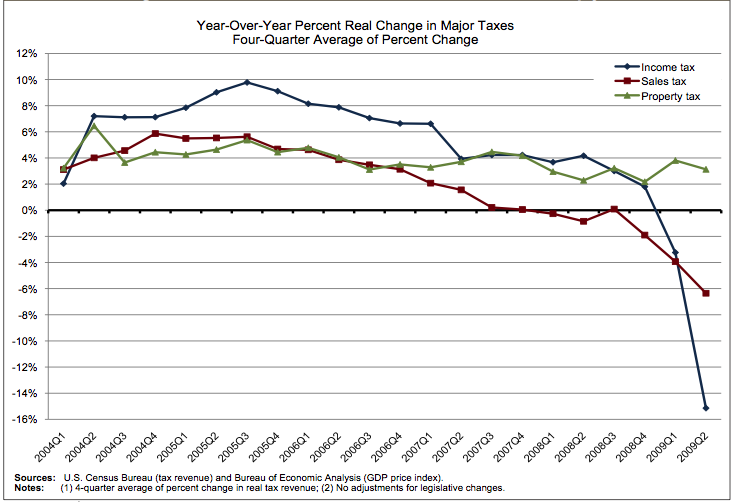
Income Tax and Sales Tax

State Taxes Are Faring Worse Than Local Taxes
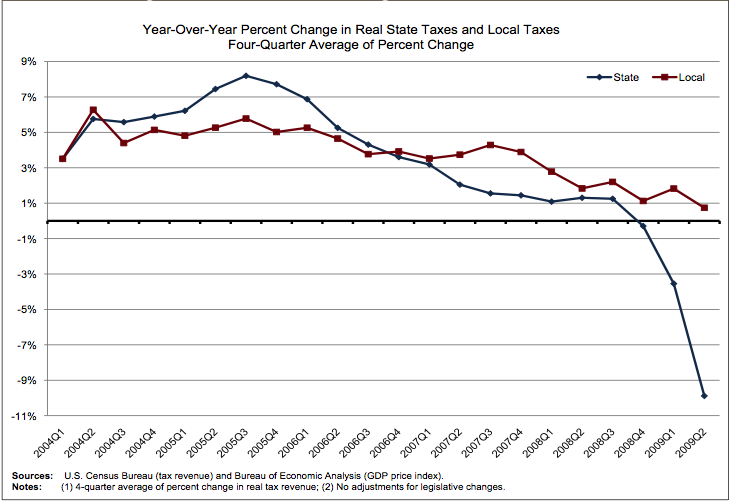
State Taxes Worse Than Local

>

Source:
State Tax Revenues Show Record Drop, For Second Consecutive Quarter
Lucy Dadayan and Donald J. Boyd
The Nelson A. Rockefeller Institute of Government

http://www.rockinst.org/pdf/government_finance/state_revenue_report/2009-10-15-SRR_77.pdf

27 Responses to “State & Local Taxes Plummet”

  1. Marcus Aurelius Says:

    For state and local governments, looks like property taxes are the last cash cow standing. Property owners, both commercial and residential, are already under water — it’s going to be interesting (in a morbid kind of way) to watch government suck them dry.

  2. bsneath Says:

    Local property tax changes have a lagged effect. Since municipalities fiscal years (and ad valorem tax changes) generally begin October 1st., the impacts were delayed until the third and four quarters of this year. This is why the local govt employment figures were so dismal for September. They were cutting back employment levels to get down to their new fiscal year budgets.

    We will see further reductions in the future.

  3. tradeking13 Says:

    Obama will stimulate ad infinitum. There’s nothing to worry about. It’s all good.

  4. Bruce in Tn Says:

    Barry,

    Just wondering…what have property taxes done in Japan since 1990? There was a tremendous loss of real estate value, and I am just wondering, IF we are Japan, what did property taxes do over the last 20 years?

    B in T

  5. thfiv Says:

    Revenues from taxes not taxes. Taxes or tax rates are up.

  6. ashpelham2 Says:

    I know there is significant waste in local and state governments, but it’s nothing compared to what Federal government is doing. So, to me, that means state and local have less to cut out out of the budget, plus they are the providers of necessity services such as fire protection, water, sewer, trash, etc. One can only cut so far before those cuts get into necessary services, and the public starts to really notice. I mean, I don’t notice if NASA gets it’s budget cut, but I sure notice if nobody picks up our garbage full of diapers for a week or two.

    Stimulate away!!!

  7. tawm Says:

    Killing the Golden Goose? Doesn’t matter — the public sector unions’ contracts are locked up tight….

  8. Transor Z Says:

    @Bruce: Here’s something by Nathan Lewis I just found related to your question about Japanese property tax policy during the 1990s.

    The government, aware of unsustainable asset valuations, embarked in a draconian series of steps to depress property prices throughout the 1990s. This not only blew away the froth of unsustainable valuations, it also demolished the real, fundamental value of property. They began with a series of tax measures on January 1, 1990 — the first day of the bear market — which eliminated certain preferential capital gains tax treatments for property. To take a few of a great many such steps which followed: In 1992, the tax rate on short-term capital gains (under 2 years) on property was raised to 90%. Long-term gains were taxed at 60%. A 0.3% National property tax was introduced (this was several multiples greater than existing property taxes). A City Planning Tax of 0.3%. A Registration and License Tax of 5% of the sale value of a property. A Real Estate Acquisition Tax of 4%. An Office Tax of 0.25%. A Land Ownership Tax of 1.4%. Even the regular property tax, the Fixed Assets Tax, was effectively raised by several multiples. From 1990 to 1996, Japanese property values imploded by as much as 70%. However, the revenues from this tax rose by 46%. You can do the math.
    http://www.newworldeconomics.com/archives/2009/052609.html

  9. tawm Says:

    Good time to be a renter.
    Anecdotally, the long-time mayor of our suburban NYC metro area city is not standing for re-election. No-one seems willing to discuss the likely coming sh*t-storm in municipal finances….

  10. HCF Says:

    @Marcus:
    >Property owners, both commercial and residential, are already under water — it’s going to be interesting (in a morbid kind of way) to watch government suck them dry.

    I’d love to see that too, except what will happen is that local/state governments will tax with one hand, while the federal government hands back a bailout with another hand. Kind of a sick joke where money is continually circulated through the government, with a large fraction of it magically disappearing each cycle

    HCF

  11. mars10 Says:

    There will be a minor boost for states this quarter from short term capital gains, assuming the market remains strong into the year-end. (Taxachusetts, where I live, is especially sensitive to this factor, with a beastly 12% tax on short-term gains.)

  12. Mannwich Says:

    Wow, Transor. There you go. If that happens here (and they gotta find the dough somewhere, right?), maybe that’s when the pitchforks will come out. Are people who are buying now not aware that they’re probably FAR better off renting (there’s rental space here everywhere, signs all over the place) than buying for maybe AT LEAST the next 3-5 years?

    Our property taxes are slated to up 11% next year, I believe.

  13. beaufou Says:

    I suppose States could just lie and make up higher numbers, who’s counting electronic dollars anyway?

  14. Mannwich Says:

    @beaufou: Maybe they should extend the “extend and pretend” game to all, including We the Sheeple? It’s been working so well everywhere else it’s been tried thus far.

  15. beaufou Says:

    Mannwich,
    my thought exactly, since there seems to be no defined value anymore, let it be justice for all.

  16. AS Says:

    In reference to Bruce’s question about property taxes in Japan:

    I wonder if ANY country has property taxes as high as the US?

    Not many places where the major part of public education is financed via property tax.

  17. Mannwich Says:

    @AS: I suggest that you read Transor Z’s post above.

  18. Bruce in Tn Says:

    Thanks Tranzor Z…about as I would have imagined…

  19. Transor Z Says:

    I don’t think things will play out the same way here in the US as they did in Japan in the 90s. Government seems to be trying to boost RE prices/values, not puncture the bubble. I actually think what’s going on right now is more subtle in some ways.

    Suburban school districts are having budget problems, resulting in larger class sizes and reductions in staff/services. Here in Mass. we have statewide standardized tests called MCAS that are published annually and school districts are ranked by performance. For family buyers in the lower home sales bracket — the only things moving right now — this makes certain communities less attractive. This creates a feedback loop that will further depress home prices in suburban communities whose schools are struggling.

    There are not many home sales in affluent communities, not many foreclosures. But outside of places like Hingham, Newton, Brookline, Milton and Westwood, it will be interesting to see how this impacts working-class towns over the next few years.

  20. Mannwich Says:

    @Transor: I agree, but we’re seeing our property taxes increase quite a bit every year, regardless of home valuations. To me, the property tax is the last “golden goose” they haven’t killed, beaten to a pulp, and picked clean, but they will in time.

  21. batmando Says:

    @ tawm at 9:57 am
    “Good time to be a renter.”
    Question is, will landlords be able to pass along increased taxes to tenants?

  22. AS Says:

    Mannwich, thanks, very interesting.

    Let me just ask a few Q’s that pop to mind when I read Nathan Lewis’s list:
    1. In 1992, the tax rate on short-term capital gains (under 2 years) on property was raised to 90%.
    MY Q: why should real estate get preferential treatment when sold? This kind of tax would stop flippers
    dead in the tracks. Good, I say.

    2. Long-term gains were taxed at 60%.
    MY COMMENT: see 1 above.

    3. A 0.3% National property tax was introduced (this was several multiples greater than existing property taxes).
    MY Q: Annually? COMMENT: NJ residents like myself would not mind 0.3%….

    4. A City Planning Tax of 0.3%.
    MY COmment: I do not know how high city planning taxes are in various states. Maybe a builder can fill me in). I’ve heard it is not cheap to get all permits across the spectrum.

    5. A Registration and License Tax of 5% of the sale value of a property.
    My Q; One time fee, okay, it is high. Guess home owners will think twice before moving. Flippers need not apply.

    6. A Real Estate Acquisition Tax of 4%.
    Again, one time fee and high imho.

    7. An Office Tax of 0.25%.
    Nickel-and-diming folks, there as here.

    8. A Land Ownership Tax of 1.4%.
    Q: One time?

    At the end of the list, this:
    9. Even the regular property tax, the Fixed Assets Tax, was effectively raised by several multiples.
    Ok, if we are talking PROPERTY TAX we should compare regular US property tax with the Japanese equivalent.

    My point basically is: property tax is insidious and though some cannot be avoided for the public services rendered, paying let’s say 2% PER YEAR based on assessed value in states like NJ is a terrific burden on home owners. Looking at public records in my small community in central NJ, I see that
    your average, 60+ year old little brick house went from assessed value in yr 2000 of $ 165 000 to assessed value of $ 367 000 in 2007, last public record I can easily find. Annual property tax went from 3.1 % of a.v. ( appr $ 5100) to approx. 2% ($ 7700) of a.v. I can hear municipalities saying ” but we are lowering taxes”…..you know the spiel. The taxes are the straw that breaks the camel’s back of under water buyers….

    I say let’s revamp the way schools get their funding, and let’s do away with all the home ownership tax breaks (from deductibility to cap gains), and let’s stop throwing good money after bad in form of $8000 buyer’s credits so prices can find their own equilibrium.

    Ahhh……. hope over experience…. ;-)

  23. Mannwich Says:

    @batmando: I highly doubt it, not with all of the rental supply out there. Rental supply is increasing, while homes for sale are decreasing. Eventually a decrease in rental prices should suck housing prices down again. Key word being “should”, but it could take some time for this to happen, as we know.

  24. batmando Says:

    @ Jefff
    “Rental supply is increasing, while homes for sale are decreasing. Eventually a decrease in rental prices should suck housing prices down again”
    pretty much my thoughts. increasing downward pressure on home prices, as long-term holders of residential investment properties see declining ROI/ROA and seek to re-deploy capital (for which, i’m real short of ideas ;^)

  25. Brian Murphy Says:

    The US has low rates across the board compared with Europe . . . My dividends in Dublin are taxed at a 55% rate.

  26. gab Says:

    I made this comment in a post above, but I’ll repeat it here. Calif just reported a 7.1% increase in personal and corp income tax in October. This is before the 10% increase in withholding that went into effect in November.

  27. Barry Ritholtz Says:

    Beyond California: States in Fiscal Peril
    http://www.stateline.org/live/details/story?contentId=436547