
A LOST DECADE FOR JOBS
Lakshman Achuthan and Anirvan Banerji are co-founders of the Economic Cycle Research Institute in New York City.
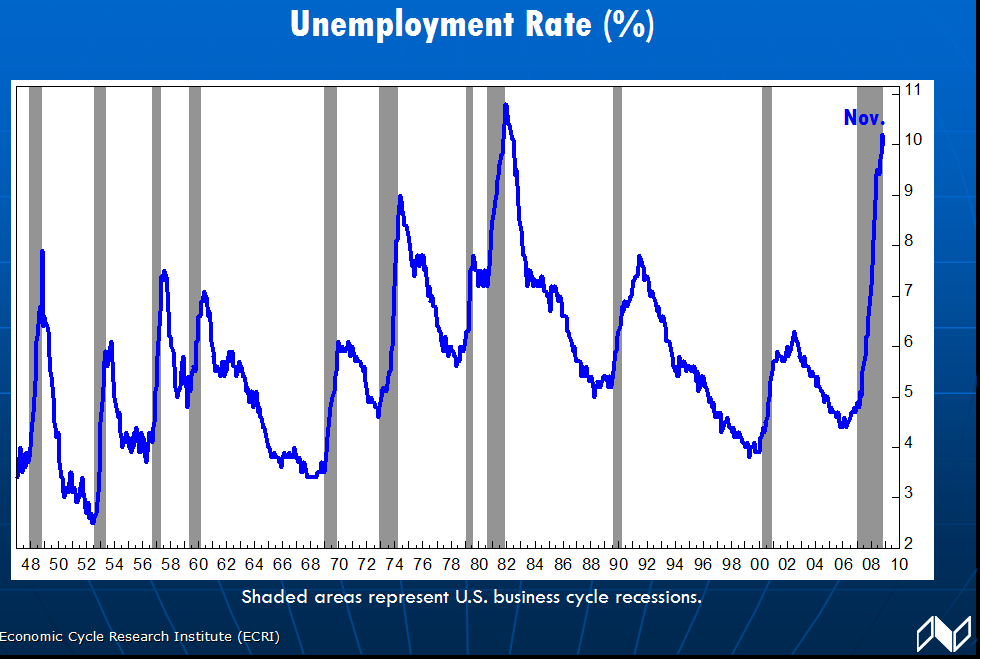
Last week’s news of a drop in the unemployment rate to ten percent is a welcome development. It was presaged by earlier strength in reliable leading employment indicators, which suggest that this improving pattern will persist next year. In November employers cut the fewest jobs since the recession began, but how should Americans interpret this news? With unemployment in double digits for the first time since 1983, many still worry about the jobless recovery.
This coming post-recession dip in joblessness is the good news. But, looking ahead to the later phase of the expansion, the post-World War II period shows disturbing cyclical patterns.
The jobless rate usually sees a sizeable drop during the economic recovery – and bigger recessionary spikes in unemployment are typically followed by larger declines during the first year of improving unemployment. So it would be no surprise if, a year after the unemployment rate begins to drop, it falls to the nine percent range.
The real problem is that the rate of decline in joblessness slows during the rest of the economic expansion. The annual postwar pace of decline in unemployment during these periods has been reasonably uniform, the median being 0.5% a year.
If that pattern persists, the U.S. economy needs to keep expanding without interruption until 2020 for unemployment to fall to its pre-recession low. Even to get back to 5%, often considered to be “full employment,” it would take a business cycle upswing lasting about as long as the record-setting 1991-2001 expansion. Should the next recession arrive earlier, as we suspect, it will take much longer. The implications constitute nothing short of a wake-up call for policy makers who promise to get job growth back on track.
Since World War II, there has been a clear easing pattern in the trend rate of economic growth during expansions, culminating in the 2001-07 expansion, which exhibited the slowest trend rate of growth on record – especially in terms of jobs. Ominously, during expansions following the initial year of revival, growth in non-manufacturing employment – now 91% of nonfarm jobs – has been falling in a parabolic fashion since the 1970s. A continuation of this pattern would mean well under a million jobs gained annually during the expansion following the initial jobs revival. If so, official projections that the jobs lost in this recession will be regained in four years are wildly optimistic.
The “great moderation” of business cycles once extolled by many economists, including Chairman Bernanke, is clearly history. Meanwhile, the trend rate of growth is shriveling. In other words, business cycles are back with a vengeance.
In fact, the combination of weak trend growth and the death of the “great moderation” is a recipe for more frequent periods of negative growth, i.e., recessions. Think of Japan over the last two decades, where 1% GDP trend growth made it easy for growth to fall below zero during periods of cyclical volatility, while China – with a 10% GDP growth trend – has not seen a recession in two decades.
In contrast, the conception, popular in some quarters, of an economy now destined to grow smoothly, albeit at a “new normal” anemic pace, is the sort of fantasy typically generated by extrapolative econometric models. In the real world, one never sees such slow and steady growth – especially in the wake of a severe recession featuring massive stimulus that will be difficult to withdraw smoothly.
The real risk is of more frequent recessions repeatedly aborting cyclical downswings in unemployment in coming years. The stark implication is that it will take much longer than a few years – perhaps decades – to get back to the jobless rates we saw only a couple of years ago.
What we have described provides only a historical baseline, rooted in the arithmetic of past cycles, unencumbered by the fallout from the Great Recession. Some consolation comes from the fact that past performance does not dictate destiny, and extrapolation from past patterns is not a reliable forecasting method, especially if the pattern is about to change.
So, it is at least conceivable that either enlightened policy measures, or good luck, or both, will result in a decisive break from these patterns. The silver lining is that even an economy dipping in and out of recessions and keeping joblessness cycling near historical highs is a navigable one for decision makers who keep a closer watch for recessions and recoveries.
~~~
December 7, 2009
Lakshman Achuthan and Anirvan Banerji are co-founders of the Economic Cycle Research Institute in New York City.


Tweet
Facebook
Reddit
Digg this!


December 7th, 2009 at 11:03 am
[...] Disclosures « A LOST DECADE FOR JOBS [...]
December 7th, 2009 at 11:35 am
The one thing that may provide a surprise to the upside is that the workforce may not expand nearly as much as people think. Baby boomers are getting into retirement age now. The better performing baby boomers are taking early retirement, and a number of less well performing ones are forced into retirement (the numbers of people who take social security before full retirement age is increasing). Furthermore, the number of illegal immigrants is being pushed down by a combination of better enforcement and lack of construction jobs. So I would not be surprised if the pattern of unemployment recovery is different this time.
December 7th, 2009 at 11:35 am
Looking at the choppiness of the historical unemployment numbers, it would seem to be early to unfurl the “Mission Accomplished” banner, after a single down month. Perhaps after 3 out of 5 months have shown declines, or a decline of more than half a percent in a single month …
December 7th, 2009 at 11:44 am
@DeDude — watch the boomers (who have for the most part, seen their inadequate-to-begin-with retirement savings seriously shriveled) decide to defer retirement until they are kicked out the door. And I fully expect, as soon as the mid-term elections are behind us, to see legislation (quickly) passed that moves out the minimum retirement age for collection of Social Security benefits, while at the same time scaling down the growth in benefits over time (in particular, allowing benefits to shrink when the COLA shrinks).
If we’re going to follow the Japanese model of a slowly dwindling economy, it is insane to not allow Social Security benefits to shrink when persistent deflation lowers the cost of living.
But I agree, the pattern is likely to be different this time, I’m just not sure how the mix of advancing technology (automation), offshoring, birth rate slowing, and restrictions on immigration will combine to produce a result.
In the past we have been blessed with a strong immigrant work force combined with a strong domestic manufacturing economy. Those things are absent now, along with the demographic changes you so accurately noted. The boomers will continue to have a major influence on the economy, just as they have all their lives.
December 7th, 2009 at 11:52 am
Nice to hear yet again that Washington DC has no clue as to what is really going on. To wit, “we” are renewing Bernanke as chief driver for our economy. As the article points out, he’s a Great Moderation guy living in a boom-bust world. Buckle up.
December 7th, 2009 at 12:08 pm
constantnormal Says: “But I agree, the pattern is likely to be different this time, I’m just not sure how the mix of advancing technology (automation), offshoring, birth rate slowing, and restrictions on immigration will combine to produce a result.”
To which one might add; currency valuations, global economic growth and credit contraction.
I am torn between the traditional signs that we are in an economic recovery (i.e. temp jobs growing) and the fear that the economy is only showing positive signs because of artificial and unsustainable props & “this time it really is different”. My gut is still with the latter.
December 7th, 2009 at 12:19 pm
[...] What kind of GDP growth will it take to meaningfully lower the unemployment rate? (Calculated Risk also Big Picture) [...]
December 7th, 2009 at 12:37 pm
Tim Duy has a very good blog on this.
Tim Duy’s Fed Watch
Structural and Cyclical
http://economistsview.typepad.com/timduy/
December 7th, 2009 at 1:07 pm
bsneath
But that’s just the thing, it’s not different this time from past credit contractions and resultant depressions. It’s only different from periods of time that don’t match in terms of the larger controlling macroeconomic factors. We’ve just convinced ourselves (once again in the history of mankind) that we’re smarter and better and more modern, etc. and won’t suffer the same result.
I continue to argue that those who foresee a post WWII type vigorous recovery are the ones who are on the “it’s different this time” wagon. Because the ignore the huge effects of unsustainable debt and the resultant contraction that must come about.
But from what I’ve read from you I think you understand this as well.
December 7th, 2009 at 2:12 pm
Most of the comments are really saying that it’s different this time. Maybe so. But to me what’s scary about what ECRI is saying (and remember, these guys have actually been optimistic about the short-term economic recovery) is that they are merely looking at past patterns. Even a continuation of these past patterns looks scary, and that’s their point. So if the comments here are on the mark, and it’s much worse this time, what does it mean? That’s the point everyone seems to be missing, because they think it’s just about what’s different this time — ECRI is saying things look horrible longer term even if nothing’s different this time!
December 7th, 2009 at 2:18 pm
Onlooker from Troy Says: “But that’s just the thing, it’s not different this time from past credit contractions and resultant depressions.”
OfT: Agreed. The recessions of the past (40 years at least) have been of the cyclical (overheat, raise rates, inventory correct, pent up demand resumes) variety. During that period of time the consumer population was on a rapid growth track. Thus the party always resumed once the punch bowl was brought back. More cars, houses, stuff.
Differences with this economic “event” include massive credit contraction – possibly far greater than in the 30s – excessive supply of houses, CRE, and a structural (demographic) decline in labor force participation and consumer demand.
But then it also includes a far more aggressive Federal Reserve and a global economy that has the “potential” to pull us forward through exports.
I would contend that had the Government (while much of what they have done was extremely wasteful) and Federal Reserve not been as aggressive as they had, then we undoubtedly would be redefining the term “Great Depression” today.
As it is, I still feel (not think) that the problems are just too great to be overcome through government policies. And I truly hope I am wrong. I’ll gladly take a Japan style lost decade over a 30s type failed decade.
December 7th, 2009 at 2:24 pm
bsneath i would also add the decline of jobs in general. when we export jobs, and don’t have any thing to replace them, you end up with fewer of them. and incomes tend to contract to go with that, which is what we have seen. with no new jobs on the horizon, not sure that a real recovery is possible. and the lost decade has shown one thing, if you give every benefit to business, but take away any benefit from employees (aka consumers) you can only get growth using credit. and when credit blows up, then you end in reverse. and there has been very little done for employees (aka consumers) for at least 8 years
December 7th, 2009 at 2:47 pm
willid3 Says: i would also add the decline of jobs in general.
Good point. You just made me realize that we are perhaps undergoing the third structural change in employment.
First: Agrarian – from nearly all workers to just 2 or 3 per 100.
Second: Manufacturing – down to about 12 per 100 and falling rapidly
Now: Services – Software and robotics are automating so many of the services done by people in the past. e.g. Amazon in lieu of bricks and mortar, back office processing, travel, eventually health care, etc. etc.
And in the future:
1) What are people going to do for a living?
2) How do incomes get fairly distributed in this new era? (this is not a leftist philosophy, rather just trying to rationally understand the future)
December 7th, 2009 at 3:45 pm
Constantnormal;
The current numbers from social security administration suggest that more people than usual are starting their SS before full retirement age. That excess is probably forced retirement and many of those people will likely continue to look for work. However, some may find that they actually can live on less than they would have liked to, and just give up. For that reason the growth in jobs needed to break even on U3 may be less than previous. When boomers realy get going on retirement we may even find that U3 can fall even if no new jobs are created. I agree that there are a lot of other factors pulling in a different direction. All I am saying is that any model build on presumption of “normal” work force expansion may end up overestimating unemployment in the future.
December 7th, 2009 at 4:38 pm
I believe the way out of this jobs glut is to do more with infrastructure. There are many, many major tasks that we could be undertaking here in the United States that Americans can and would do. They should have no expectation of great “wealth” from those jobs, but rather, the ability to earn a living and feed themselves. I was in favor what Obama was talking about when he was campaigning, but there has been little done so far, while he’s been busy trying to ram through healthcare changes that most of America sees as a worse alternative.
Much could be done in the way of broadband, highways, schools and hospitals, bridges, updating our energy grid to accomodate electric automobiles. This is the time, when jobs and unemployment are at their most bleak, that a President or Leader (if we have one left besides Jack Donoughy) could push that kind of agenda with ease. Since small business is having trouble in this “new normal”, small business should accomodate the needs at hand, and if we are busily working to build out our Nation’s infrastructure and support, small business would flourish.
Alas, politics and pork spending will win out again.
December 7th, 2009 at 7:35 pm
ashpelham2 Says: “Much could be done in the way of broadband, highways, schools and hospitals, bridges, updating our energy grid to accommodate electric automobiles.”
Precisely. These are long term investments where the payback in future economic efficiency would justify the debt financing used to pay the costs. Further the work is performed by the private sector.
On the other hand, when we subsidize the retention of state and local government jobs, we are only providing a temporary fix with little lasting benefit but we will be paying for it with 30 year Treasury Bonds. Does not make one iota of sense.
The government is acting no differently than the irresponsible homeowner who refinanced his mortgage and spent the proceeds on a wide screen and a cruise.
December 8th, 2009 at 8:53 pm
Regarding the demographic impact on unemployment prospects in the context of our article:
Our research highlights the pattern of decline in unemployment during past expansions. While the trajectory of joblessness may have shifted in individual expansions due to demographic ebbs and flows, the post-recovery rate of decline in unemployment over the post-recovery period of expansion has still been relatively stable over many decades covering a couple of generations – including the baby boomer years – that included significant demographic shifts. Therefore, if the upcoming expansion follows past patterns, it will take a decade-long expansion – give or take a couple of years, depending on demographics, deleveraging and other diverse differences from cycle to cycle – for joblessness to decline to its 2007 lows.
The real issue is different. The key point is that such variations are likely to be rendered academic by more frequent recessions, which result naturally from slow trend growth and higher cyclical volatility. Under the circumstances, even if the post-recovery pace of decline in unemployment is faster than usual, declining unemployment is likely to be aborted by fresh recessions before it has a chance to return to its earlier lows. Therefore, while demographics could alter the rate of decline of joblessness at the margin, the broad thrust of our findings remains intact.
The bottom line is not so much that, given historical patterns, it will take a decade or so of uninterrupted expansion to get back to some sort of “full employment.” The real issue is that even this scenario is improbably optimistic, because of the likelihood of more frequent recessions. This would be a very different economy from what we have been used to since the early 1980s, and navigating such an economy will require close attention to business cycle timing.
December 12th, 2009 at 12:23 pm
[...] The sobering reality, is that we may be heading towards a lost decade for jobs. [...]
December 16th, 2009 at 9:33 am
[...] The sobering reality, is that we may be heading towards a lost decade for jobs. [...]
January 30th, 2010 at 5:19 pm
[...] 80’s and it is still very hard to say what the job market will look like in the near future. Achuthan and Banerji (2009) suggest that it will take much longer than a few years – perhaps decades – to get back to the [...]