
Well worth watching!
click for video
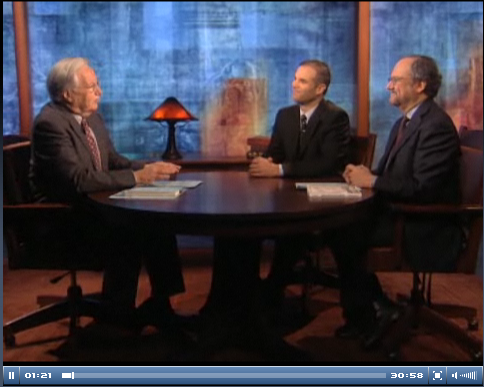
(Transcript after the jump)
BILL MOYERS: Welcome to the Journal.
Something’s not right here. One year after the great collapse of our financial system, Wall Street is back on top while our politicians dither. As for health care reform, you’re about to be forced to buy insurance from companies whose stock is soaring, and that’s just dandy with the White House.
Truth is, our capitol’s being looted, republicans are acting like the town rowdies, the sheriff is firing blanks, and powerful Democrats in Congress are in cahoots with the gang that’s pulling the heist. This is not capitalism at work. It’s capital. Raw money, mounds of it, buying politicians and policy as if they were futures on the hog market.
Here to talk about all this are two journalists who don’t pull their punches. Robert Kuttner is an economist who helped create and now co-edits the progressive magazine THE AMERICAN PROSPECT, and the author of the book OBAMA’S CHALLENGE, among others.
Also with me is Matt Taibbi, who covers politics for ROLLING STONE magazine where he is a contributing editor. He’s made a name for himself writing in a no-holds-barred, often profane, but always informative and stimulating style that gets under the skin of the powerful. His most recent article is “Obama’s Big Sellout,” about the President’s team of economic advisers and their Wall Street connections. It’s been burning up the blogosphere. Welcome to both of you.
BILL MOYERS: Let’s start with some news. Some of the big insurance companies, Well Point, Cigna, United Health, all surged to a 52 week high in their share prices this week when it was clear there’d be no public option in the health care bill going through Congress right now. What does that tell you, Matt?
MATT TAIBBI: Well, I think what most people should take away from this is that the massive subsidies for health insurance companies have been preserved while it’s also expanded their customer base because there’s an individual mandate in the bill that’s going to provide all these companies with the, you know, 25 or 30 million new people who are going to be paying for health insurance. So, it’s, obviously, a huge boon to that industry. And I think Wall Street correctly read what the health care effort is all about.
ROBERT KUTTNER: Rahm Emanuel, the President’s Chief of Staff, was Bill Clinton’s Political Director. And Rahm Emanuel’s take away from Bill Clinton’s failure to get health insurance passed was ‘don’t get on the wrong side of the insurance companies.’ So their strategy was cut a deal with the insurance companies, the drug industry going in. And the deal was, we’re not going to attack your customer base, we’re going to subsidize a new customer base. And that script was pre-cooked so it’s not surprising that this is what comes out the other side.
BILL MOYERS: So are you saying that this, what some call a sweetheart deal between the pharmaceutical industry and the White House, done many months ago before this fight really began, was because the drug company money in the Democratic Party?
ROBERT KUTTNER: Well, it’s two things. Part of it was we need to do whatever it takes to get a bill. Never mind whether it’s a really good bill, let’s get a bill passed so we can claim that we solved health insurance. Secondly, let’s get the drug industry and the insurance industry either supporting us or not actively opposing us. So that there was some skirmishing around the details, but the deal going in was that the administration, drug companies, insurance companies are on the same team. Now, that’s one way to get legislation, it’s not a way to transform the health system. Once the White House made this deal with the insurance companies, the public option was never going to be anything more than a fig leaf. And over the summer and the fall, it got whittled down, whittled down, whittled down to almost nothing and now it’s really nothing.
MATT TAIBBI: Yeah, and this was Howard Dean’s point this week was that this individual mandate that’s going to force people to become customers of private health insurance companies, the Democrats are going to end up owning that policy and it’s going to be extremely unpopular and it’s going to be theirs for a generation. It’s going to be an albatross around the neck of this party.
ROBERT KUTTNER: Think about it, the difference between social insurance and an individual mandate is this. Social insurance everybody pays for it through their taxes, so you don’t think of Social Security as a compulsory individual mandate. You think of it as a benefit, as a protection that your government provides. But an individual mandate is an order to you to go out and buy some product from some private profit-making company, that in the case of a lot of moderate income people, you can’t afford to buy. And the shell game here is that the affordable policies are either very high deductibles and co-pays, so you can afford the monthly premiums but then when you get sick, you have to pay a small fortune out of pocket before the coverage kicks in. Or if the coverage is decent, the premiums are unaffordable. And so here’s the government doing the bidding of the private industry coercing people to buy profit-making products that maybe they can’t afford and they call it health reform.
BILL MOYERS: So explain this to the visitor from Mars. I mean, just this week, the Washington Post and ABC News had a poll showing that the American public supports the Medicare buy-in that-
ROBERT KUTTNER: Right.
BILL MOYERS: By a margin of some 30 points-
ROBERT KUTTNER: Right.
BILL MOYERS: And yet, it went down like a lead balloon.
ROBERT KUTTNER: Look, there are two ways, if you’re the President of the United States sizing up a situation like this that you can try and create reform. One is to say, well, the interest groups are so powerful that the only thing I can do is I can work with them and move the ball a few yards, get some incremental reform, hope it turns into something better. The other way you can do it is to try to rally the people against the special interests and play on the fact that the insurance industry, the drug industry, are not going to win any popularity contests with the American people. And you, as the president, be the champion of the people against the special interests. That’s the course that Obama’s chosen not to pursue.
MATT TAIBBI: And I think, you know, a lot of what the Democrats are doing, they don’t make sense if you look at it from an objective point of view, but if you look at it as a business strategy- if you look at the Democratic Party as a business, and their job is basically to raise campaign funds and to stay in power, what they do makes a lot of sense. They have a consistent strategy which involves negotiating a fine line between sentiment on the left and the interests of the industries that they’re out there to protect. And they’ve always, kind of, taken that fork in the road and gone right down the middle of the line. And they’re doing that with this health care bill and that’s- it’s consistent.
BILL MOYERS: If you were Republican, wouldn’t you feel right now that it’s going your way? I mean, the Democrats control the White House, they control Congress and the only thing they’ve been able to make happen this year is escalate the war in Afghanistan.
MATT TAIBBI: The Democrats are in exactly the same position that the Republicans were in once the Iraq War turned bad. All the Republicans have to do now is sit back and watch the Democrats make a disaster out of this health care effort. And they’re going to gain political capital whether they’re in the right or not. And I think it’s a very- it’s a terrible thing for the party.
BILL MOYERS: Some of your progressive readers and colleagues are going to take issue with you, of course, because there are progressive figures like John Podesta, of the Center for American Progress, Kevin Drum, and others who say, look, this bill has its real problems. It’s got some real toxic qualities to it. But it’s not as bad as Kuttner and Taibbi think. This is the Senate bill, it covers 30 million-plus more people, has subsidies for low-income families, spreads the risk, lowers some premium costs, creates some exchanges where people can shop for better coverage and prices. You know, don’t be too hard on it.
ROBERT KUTTNER: Well, my co-editor, Paul Starr in the editorial in the current issue of “The Prospect” takes exactly that position. Don’t be too hard on Obama, he inherited a really difficult situation and we’re making incremental progress. If we could’ve done better we would’ve. Paul and I disagree about that. I mean, I think one of the challenges of a president is to transform the reality rather than just work within its parameters. I think the other problem, frankly, is that those of us who consider ourselves progressives invested so much in this remarkable figure, Barack Obama. And we read our own hopes into him. We saw him as a potentially great president. We saw this as a potentially transformative moment, I certainly did, where he could’ve chosen to be the kind of president Roosevelt was. And it turns out that’s not who is characteralogically and that’s not how he chose to play the moment.
BILL MOYERS: Yes or no. If you were a senator, would you vote for this Senate health care bill?
MATT TAIBBI: No.
BILL MOYERS: Bob?
ROBERT KUTTNER: Yes.
BILL MOYERS: Why? You just said it’s designed to enhance the fortunes of the industry.
ROBERT KUTTNER: Well, it’s so far from what I think is necessary that I don’t think it’s a it’s a good bill. But I think if it goes down, just because of the optics of the situation and the way the Republicans have framed this as a make or break moment for President Obama, it will make it easier for the Republicans to take control of Congress in 2010. It will make Obama even more gun-shy about promoting reform. It will create even more political paralysis. It will embolden the republicans to block what this President is trying to do, some of which is good, at every turn. So I would hold my nose and vote for it.
MATT TAIBBI: My feeling on it is just looking more concretely at the health care problem, this is a bill that to me doesn’t address the two biggest problems with the health care crisis. One is the inefficiency and the bureaucracy and the paperwork which it doesn’t address at all. It doesn’t standardize anything. The other is price, which has now fallen by the wayside because there’s no going to be no public option that’s going to drive down prices. So, if a health care bill that doesn’t address those two problems, to me, is- and additionally is a big give-away to the insurance companies because it provides, you know- it creates this new customer base, it’s something I personally couldn’t vote for.
BILL MOYERS: Aren’t you saying that in order to save the Democratic President and the Democratic Party in 2010 and 2012 you have to have a really rotten health insurance bill?
ROBERT KUTTNER: Well, when you come down to one pivotal moment where a bill is before Congress and the administration has staked the entire presidency on this bill and you’re a progressive Democrat are you going to vote for it or not? Let me put it this way, if I were literally in the position that Joe Lieberman is in and it was up to me to determine whether this bill live or die, I would hold my nose and vote for it even though I have been a fierce critic of the path this administration has taken.
BILL MOYERS: But doesn’t that further the dysfunction and corruption of the system that you write so often about? I mean, you said a few weeks ago that our failed health care system won’t get fixed because it exists entirely within the confines of yet another failed system, the political entity known as the United States of America. You said we have a government that is not equipped to fix actual crisis. So if Bob votes for a bill that in his heart and in his mind he does not believe really helps the situation, isn’t he furthering a government that can’t solve the actual crisis?
MATT TAIBBI: I think so. I understand his point of view. But I my feeling is that if you vote for this bill and it passes, that’s your one shot at fixing a catastrophic and completely dysfunctional health care system for the next generation maybe. And I think it’s much better for the Democrats to lose on this issue and then have to regroup maybe eight years later, or six years later, and try again and do a better job the next time than to have it go through.
ROBERT KUTTNER: We’re going to have to do that anyway. In other words, these fights never end. We’re going to have to go back and make a fight another day. And hopefully, that won’t be 20 years from now. Hopefully, it will be six years from now. I think if this bill goes down it’s going to be even harder to get the kind of legislation we want because the Republicans are really going to be on the march. So, the Democrats are really between a rock and a hard place here, because if it loses, there’s one set of ways the Republicans gain. If it wins, there could be another set of ways that the Republicans gain. And this is all because of the deal that our friend, Rahm Emanuel struck back in the spring of passing a bill that’s a pro-industry bill that doesn’t really get at the structural problems.
MATT TAIBBI: But that’s the whole point. If the Democrats had used as a political strategy, we’re just going to do what the vast majority of our constituents want and pass a bill that was real, that had real teeth to it, that provided real benefits and actually fixed the problems then, you know, the political benefits that the Republicans could’ve had after the passage of the bill would’ve been very limited it seems to me. They could’ve only gone that one direction and criticized that you know, as a, you know, a socialist give-away. They couldn’t have criticized it as an industry give-away and ineffective.
ROBERT KUTTNER: Look, this is not Monday morning quarterbacking.
MATT TAIBBI: Right.
ROBERT KUTTNER: I mean, I was making the same criticisms that you were at the time. But now we’re down to a moment of final passage. And maybe my views are very ambivalent. But I would still vote for it because I think the defeat would be absolutely crushing in terms of the way the press played it, in terms of the way it would give encouragement to the far right in this country that we can block this guy if we just fight hard enough, if we just demagogue it.
MATT TAIBBI: But couldn’t that defeat turn into- that crushing defeat, couldn’t that be good for the Democrats? Couldn’t it teach them a lesson that, you know, maybe they have to pursue a different course in the future?
ROBERT KUTTNER: Well, you’re younger than I am.
BILL MOYERS: Matt, Senator Russ Feingold of Wisconsin, a very progressive member of Congress who’s been at this table wanted a public option. He says this health care bill appears to be the legislation that the president wanted in the first place.
MATT TAIBBI: Yeah, I mean, I think that makes sense. Yeah, it’s quite obvious that at the outset of this process, the White House didn’t want, for instance, single payer even on the table, you know, when Max Baucus had his initial discussions in committee on this bill, he invited something like 43 people to give their ideas about, you know, how the bill might look in the future. And he didn’t invite a single person from- who was an advocate of single payer health care. So that was never on the table. And it’s quite clear that the public option was looked at more as a political obstacle for the White House as opposed to something that they really wanted. They kind of used it as something to scare the Republicans and the moderates with. And that’s really all it ended up turning out to be.
BILL MOYERS: Yeah, if he had wanted a public option, if he’d wanted a Medicare buy-in, he could have tried to persuade the public and the Congress.
ROBERT KUTTNER: That’s what’s so galling. Yeah.
BILL MOYERS: Galling?
ROBERT KUTTNER: I mean, if you if you roll back the tape he could’ve played it so differently and he could’ve gotten a better bill. But we are where we are.
MATT TAIBBI: I mean, that’s what George Bush did when he wanted to get something unpopular passed or something that was iffy. I mean, he just took, you know, if there were any recalcitrant members, he just took him in the back room and beat him with a rubber hose until they changed their minds. I mean, he could’ve taken Joe Lieberman back there and said, look, if Connecticut ever wants a dime of highway money again, you’re going to have to play ball on this thing. That’s what the president does. I mean, the president has an enormous amount of power. The leaders, the majority leaders have an enormous amount of power. And if they want to pass something, they can do it. And especially when there’s a tremendous public mandate to get something like this passed. I just- the idea that they couldn’t do this was- is a fallacy.
BILL MOYERS: But members of Congress, they take the same contributions from the same insurance and real estate and drug industry. You look at the list of contributions to members of Congress- they are as saddled by obligations as the President, right?
ROBERT KUTTNER: Well, some are and some aren’t. I mean, the House, at least, just passed a bill that’s over $100 billion to extend unemployment, extend insurance benefits in the interim prevent lay-offs at the level of state and local government. Now, you have a group of Democrats, and this is the real pity of it. The Democrats are supposed to be the party of the average person. You have the so-called New Democrats who are really the party of Wall Street. And then you have the Blue Dogs who are fiscal conservatives. And if you look at what happened in Barney Frank’s committee to the financial reform bill, he’s a pretty good liberal, he ended up looking like a complete stooge for industry because in order to get a bill out of his own committee, he had to appease the 15 New Democrats, so-called, who were put on that committee mostly by Rahm Emanuel when he was the-
MATT TAIBBI: Sort of as a means to raise money.
ROBERT KUTTNER: As a means to raise money. So Melissa Bean, who’s a two-term Democratic Congressman ends up being the power broker because she controls 15 votes on Barney Frank’s committee of what she’s going to allow out of committee and what she isn’t.
BILL MOYERS: Why does she control 15 votes?
ROBERT KUTTNER: Because there are 15 New Dems, and this is the centrist caucus that particularly specializes in taking money from the financial industry.
BILL MOYERS: You call them centrist, don’t you mean corporate Democrats? I mean-
ROBERT KUTTNER: Corporate, yes, sorry. That’s too kind. They’re corporate Democrats who were put on that committee because Rahm Emanuel felt that there’s no better place than the House Financial Services Committee if you want to shake down Wall Street, to put it bluntly.
MATT TAIBBI: There’s a great example of Melissa Bean’s power was when the banks wanted to pass an amendment into the bill that would have prevented the states from making their own tougher financial regulatory rules. And Bean put through this amendment that basically said that the federal government would have purview over all these laws. And it passed. And this was the kind of thing that the banks wanted. They just go to Melissa Bean, she puts that amendment in there and it and it gets through.
BILL MOYERS: If you were Barack Obama in a city that’s overrun by money, how would you try to fix it?
ROBERT KUTTNER: I would go over the heads of the special interests to the people. I think there’s a lot of sullen apprehension, frustration out in the country. And I think the people are hungry for leadership. He’s not doing that sufficiently.
MATT TAIBBI: It’s absolutely a political winner for the president to hit Wall Street very hard and do all the things that he’s supposed to be doing right now. You know, that all the things that FDR did. If he did those things, if he remade Wall Street in the way that it needs to be remade, he would do nothing but gain popularity. And I think that’s the strategy he should have pursued.
BILL MOYERS: But what if by nature, that’s not what he wants to do? What if, by nature, he prefers to head the establishment, than to change it?
ROBERT KUTTNER: Then he runs the risk of being a failed president. And I do have the audacity to hope that he’s a smart enough, principled enough guy, that some time in his second year in office, he’s going to realize that he’s at a crossroads.
MATT TAIBBI: This isn’t a purely political problem. This isn’t just a question of how does Barack Obama get reelected. This is a serious problem. He has to put aside maybe his inclinations to think about what he can do to actually fix the country. And it’s, you know, desperately in need of fixing. And so, if he’s not that guy, he has to become that guy.
BILL MOYERS: You say it’s a serious problem. But isn’t from your own experiences, your long experience, your recent experience, isn’t this the fundamental question issue of why it’s not working, that there’s too much money canceling out other imperatives, other needs, other possibilities?
MATT TAIBBI: This is the fundamental question. Is there a way that we can have a politician get elected without the sponsorship of special interests? Can we get somebody in the White House who’s independent of the special interests that are in the way of real reform? And that’s the problem. We haven’t been able to have that happen. And we need to find a way to have that happen.
ROBERT KUTTNER: Right. And I think it’s not accidental that the last three Democratic presidents have been at best, corporate Democrats. And one hoped because of the depth of the crisis and the disgrace of deregulation and ideology, and the practical failure of the Bush presidency, this was a moment for a clean break. The fact that even at such a moment, even with an outsider president campaigning on change we can believe in, that Barack Obama turned out to be who he has been so far, is just so revealing in terms of the structural undertow that big money represents in this country. The question is: Is he capable of making a change — he’s only been in office less than a year — in time to redeem the moment, redeem his own promise?
BILL MOYERS: When you talk about corporate Democrats, exactly what do you mean?
ROBERT KUTTNER: I mean Democrats who are reluctant to cross swords with the corporate elite that has so much power in this country, whether it’s the Wall Street elite or whether it’s the health-industrial complex.
MATT TAIBBI: And I think, you know, back in the in the mid-’80s, after Walter Mondale lost, I think the Democrats made a conscious decision that they were no longer going to rely entirely on interest groups and unions to fund their campaigns, that they were going to try to close that funding gap with the Republicans. And they made a lot of concessions to the financial services industry to big corporations. And that’s who they are now. I mean–
ROBERT KUTTNER: That’s a little too harsh. Just the pity of it is there are probably 40 Democrats in the Senate who are not corporate Democrats. And there are probably 200 Democrats in the House who are not corporate Democrats. If we could push a little harder, we can take back our political system and have a democratically elected set of officials who are the kind of counterweight to big money that we need in order to get reform.
BILL MOYERS: So Democrats have their own obstructionists?
ROBERT KUTTNER: Yeah. You have Republican wall-to-wall obstructionism, which is partisan. And with a few exceptions, Republicans are totally in bed with big business. And you have just enough Democrats who are in bed with big business that it makes it much harder for progressive Democrats to follow the agenda that the country needs.
ROBERT KUTTNER: It just takes a lot of guts. It takes a lot of nerve. It takes a willingness to be somewhat radical.
BILL MOYERS: What you mean, radical?
ROBERT KUTTNER: I mean, confronting the elite that really has a hammerlock on politics in this country and articulating the needs of ordinary people. Now, in Washington, that’s considered radical.
BILL MOYERS: I was thinking about both of you Sunday night when President Obama was on 60 MINUTES and he said…
PRESIDENT OBAMA: I did not run for office to be helping out a bunch of fat cat bankers on Wall Street.
BILL MOYERS: Then on Monday afternoon, he had this photo opportunity in which he scolded the bankers and then they took it politely and graciously, which they could’ve done because the Hill at that very moment was swarming with banking lobbyists making sure that what the President wants doesn’t happen. I mean, what did you think as you watched him on 60 MINUTES or watched that press conference?
MATT TAIBBI: It seemed to me that it was a response to a lot of negative criticism that he’s been getting in the media lately, that they are probably looking at the President’s poll numbers from the last couple of weeks that have been remarkably low. And a lot of that has to do with some perceptions about his ties to Wall Street. And I think they felt a need to come out and make a strong statement against Wall Street, whether they’re actually do anything is, sort of, a different question. But I think that was my impression.
ROBERT KUTTNER: I was appalled. I was just appalled because think of the timing. On Thursday and Friday of last week, the same week when the president finally gives this tough talk on “60 Minutes,” a very feeble bill is working its way through the House of Representatives and crucial decisions are being made. And where is the President? I mean, there was an amendment to put some teeth back in the provision on credit default swaps and other kinds of derivatives. And that went down by a handful of votes. And to the extent that the Treasury and the White House was working that bill, at all, they were working the wrong side. There was a there was a provision to exempt foreign exchange derivatives from the teeth in the bill. That–
MATT TAIBBI: Foreign exchange derivatives are what caused the Long Term Capital Management crisis–
ROBERT KUTTNER: Sure.
MATT TAIBBI: A tremendous problem.
BILL MOYERS: Ten or 12 years ago, right?
MATT TAIBBI: Right.
ROBERT KUTTNER: Yeah. And, Treasury was lobbying in favor of that. There was a provision in the bill to exempt small corporations, not so small, I believe at $75 million and under, from a lot of the provisions of the Sarbanes-Oxley Act requiring honest accounting. Rahm Emanuel personally was lobbying in favor of that.
BILL MOYERS: So you had the Treasury and the White House chief of staff arguing on behalf of the banking industry?
ROBERT KUTTNER: Right. Right. And so here’s the president two days later giving a tough speech. Why wasn’t he working the phones to toughen up that bill and, you know, walk the talk?
BILL MOYERS: Get on the phone with the Chairman of the Committee and say, if you want that dam in your district, I want your vote on this.
ROBERT KUTTNER: Right.
MATT TAIBBI: Right.
BILL MOYERS: And that’s what you mean?
ROBERT KUTTNER: Yeah.
BILL MOYERS: You might praise them in public, but you threaten them in private, right?
MATT TAIBBI: Exactly, yeah. They have–
BILL MOYERS: Nobody’s afraid of Obama, you know. You go to Washington as you do, report from Washington. Nobody’s afraid of him.
MATT TAIBBI: Right.
ROBERT KUTTNER: This style is rather diffident. His style is rather hands-off. He’s very principled. But, if you’re going to be a politician, you have to get in there and mix it up. And to the extent that his surrogates are mixing it up, when it comes to reforming Wall Street, they’re mixing it up on the wrong side.
BILL MOYERS: Well, explain this to me. What is your own take on why he chose Geithner and Summers and people from Goldman Sachs and Wall Street to come and be his financial advisors, instead of choosing Stiglitz–
MATT TAIBBI: Volker–
BILL MOYERS: Some of his advisors from the progressive wing of the Democratic system?
MATT TAIBBI: Most people that I’ve talked to have taken one of two positions on this. One is that Obama was naïve, that he doesn’t know a whole about the financial services industry, and he felt the need to rely upon people who’d been there before, people who’ve had these jobs before, and you know, who have this expertise. And there’s another school of thought that look, he took more money from Wall Street than any other presidential candidate in history. Goldman Sachs was his number one private campaign contributor. And if you just look at the evidence, it’s just really business as usual. This is what the Democratic Party has done since the mid-’80s. They’ve relied heavily on the financial services industry to fund their campaigns. And it’s the quid pro quo. They gave a lot of money to help these guys run, and in return, they get the big jobs, you know, in the White House.
BILL MOYERS: But here’s how they repay him. This is on “The Huffington Post:” “Bank lobbyists launch call to action to crush financial reform. The American Bankers Association issued a call to action on Wednesday urging its lobbyist and member banks to make an all-out effort to crush regulatory reform in the Senate.” This is how they reward his own tolerance towards them, right?
ROBERT KUTTNER: Right. And you’ve got to play hardball against these guys now. I do not want to leave this show with your viewers thinking this has been just a council of despair. So will you allow me to play Pollyanna for 30 seconds? Because I think this guy is nothing if not a work in progress. He’s nothing if not a learner. And I think there is a chance. I don’t think I would bet my life on it but I think there’s a possibility that by the fall of 2010, looking down the barrel of a real election blowout, you could see him change course, if only for reasons of expediency, but hopefully for reasons of principle as well, if he feels that the public doesn’t have confidence that he is delivering the kind of recovery that the public needs. This is a guy who is a very smart, complicated man. And I think don’t speak too soon, for the wheel’s still in spin. I don’t want to totally give up.
MATT TAIBBI: Yeah. I mean, obviously, it’s too early to completely abandon hope that he’s going to turn things around. But I think that’s a belief that’s not really based on evidence. If you look at the evidence of how he’s behaved so far, and who he’s got, you know, working in the White House, and who he’s getting his money from, and how the party has behaved over the last couple of decades. You’re really basically relying upon the impression that he gives as a kind, decent, warm-hearted intellectual guy. That’s what the basis of that faith that there’s going to be this turnaround. It’s really not anything that’s actually concretely happened that would give you reason to think that.
ROBERT KUTTNER: The other thing that’s missing, if you compare him with Roosevelt or LBJ or Lincoln, the other thing that’s missing is a social movement. In all of these great periods of transformation, you had social movements doing a complicated dance with the president, where sometimes they were working with him, sometimes they were beating up on him. That certainly describes the civil rights movement and Lyndon Johnson. It describes the abolitionists and Lincoln. It describes the labor movement and Roosevelt. Where’s the movement?
BILL MOYERS: Coming down to the office this morning, the cab driver turned and said, “You see the newspaper this morning?” And he turns and hands me the NEW YORK POST. “It’s Wall Good: Wall Street Earnings Soar to $49 Billion in the First Three Quarters of the Year … Profitability has soared because revenues rose … Wall Street bonuses for employees in the city may be as much as 40 percent higher than in 2008.” What would you say to the President about this? Does he know?
ROBERT KUTTNER: I think, to some extent, the White House lives in an echo chamber. They do these public events that are intended to demonstrate that the president’s listening, that he’s feeling our pain. Congress gets a very bad rap. But I was invited to speak to the House Democrat caucus a couple a weeks ago. And they are furious. They can’t publicly embarrass their president, but they go home on weekends and they talk to their folks and they hear the individual stories of suffering. And they feel that certainly the Treasury, to some extent the White House, just doesn’t get it and the Republicans are going to end up with a narrative and the Tea Party folks, it’s the far right that is on the march when ordinary people need a champion.
BILL MOYERS: So, what are people to do?
ROBERT KUTTNER: I think there are there are things that are not too complex for people to understand. If the value of your home is going down the drain because the government’s not doing anything about an epidemic of foreclosures, that’s the kind of thing that people can talk about across a kitchen table. They do talk about it across the kitchen table. And you need more leadership like a Marcy Kaptur or a Maria Cantwell, elected officials who get it, who have not been bought and paid for by Wall Street stirring up people and turning this into a movement.
MATT TAIBBI: And that’s really where Barack Obama’s failings are the biggest. This is exactly where we need a president with the communication skills that he has. I mean, he’s probably the one person who could help all of America make sense of all this stuff. And he’s not doing it. I mean, he’s doing these photo ops, you know, earlier in the week, with a couple of bankers. It’s a kabuki dance to show that he’s against Wall Street. But he’s not explaining to people how all this stuff works. And that’s the problem.
BILL MOYERS: Are you a cynic after all your reporting this year?
MATT TAIBBI: No, not at all. I mean, I think on the contrary. I think cynicism is accepting all this as, you know, politics, as the way it is. I think we have to not accept what’s going on. And that’s not being cynical. That’s being helpful.
BILL MOYERS: But is it naïve to think that in a country of so many clashing interests, we might get better results from the political system than we’re getting right now?
ROBERT KUTTNER: I think there are periods of American history when the political system rises to the occasion. It certainly did with the civil rights movement. It certainly did in the 1930s. But there’s no guarantee that it’s going to come out the way it needs their come out. So I wouldn’t give up on the political system. I mean, you have to keep fighting and working to rebuild democracy. Democracy is the only possible counterweight to concentrated financial power. And ideally, that takes a great president rendezvousing with a social movement. One way or another, there is going to be a social movement. Because so many people are hurting, and so many people are feeling correctly that Wall Street is getting too much and Main Street is getting too little. And if it’s not a progressive social movement that articulates the frustration and the reform program, you know that the right wing is going to do it. And that, I think, is what ought to be scaring us silly.
MATT TAIBBI: We are starting to see signs of a little bit of a grassroots movement. I mean, the stuff, you know, people who are refusing to leave their homes after they’ve been foreclosed upon. There are little pockets of movements you know, groups that are organizing against foreclosures all across the country. And this is one small slice of the economic picture that where it’s quite clear what’s going on, and people can really understand the relationship that they have with the financial services industry. And I think if, you know, there it’s possible to imagine a movement coalescing around something like that.
BILL MOYERS: Matt Taibbi, Robert Kuttner, thank you for being with me on the Journal.
MATT TAIBBI: Thank you.
ROBERT KUTTNER: Thanks, Bill.

What's been said:
Discussions found on the web: