
Case Shiller Home Prices: Improvement Moderating

Email this post Print this post
By Barry Ritholtz - December 29th, 2009, 9:12AM

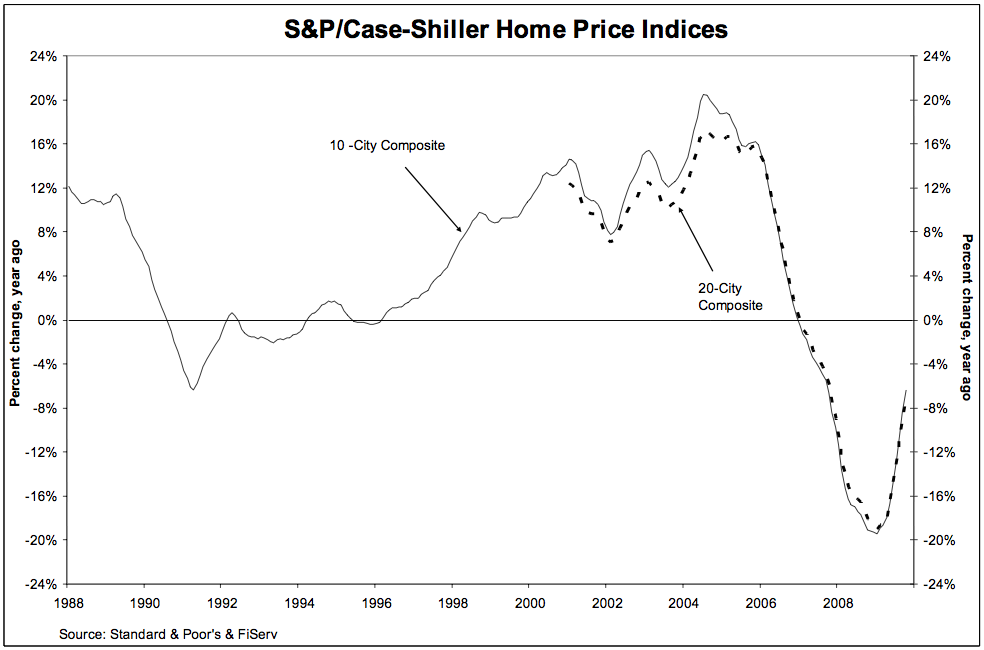
The latest data from Case Shiller, covering the October 2009 period, shows an ongoing improvement in price data.

This was the 9th consecutive month of gains. As the chart below shows, year-over-year data for the 10-City and 20-City Composite Home Price Indices, fell 6.4% and 7.3%.

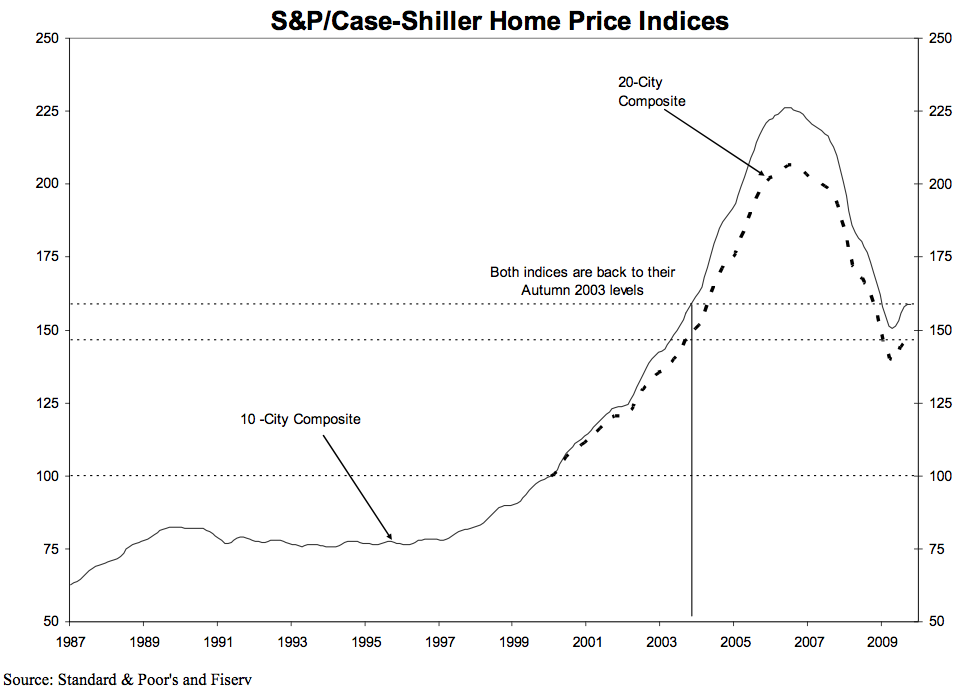
Peak-to-date figures for the indices through October 2009 are -29.8% and -29.0%; Peak to trough (April 2009) composites are down 33.5% and 32.6%, respectively.

S&P noted “The turn-around in home prices seen in the Spring and Summer has faded, with only seven of the 20 cities seeing month-to-month gains, although all 20 continue to show improvements on a year-over-year basis.

>

Case Shiller Index October 2009

click for bigger graphic
All data courtesy of S&P/Case Shiller

>

More charts after the jump . . .

National Prices = Autumn 2003

click for bigger graphic
>

Source:
Home Prices Still Improving but at a Moderating Pace
S&P/Case-Shiller 29-Dec-2009 09:00

http://www.standardandpoors.com/indices/sp-case-shiller-home-price-indices/en/us/?indexId=spusa-cashpidff–p-us—-

Comments

Please use the comments to demonstrate your own ignorance, unfamiliarity with empirical data, ability to repeat discredited memes, and lack of respect for scientific knowledge. Also, be sure to create straw men and argue against things I have neither said nor even implied. Any irrelevancies you can mention will also be appreciated. Lastly, kindly forgo all civility in your discourse . . . you are, after all, anonymous.

28 Responses to “Case Shiller Home Prices: Improvement Moderating”

  1. Rikky Says:

    what bothers me is what’s not showing up in the charts. sizable inventory of underwater properties with some % imminently heading for foreclosure; banks stretching out the problem by delaying taking back properties, home prices still too high retarding a more healthy market, the government practically owning the funding for real estate transactions. all of these factors makes for a very murky future prediction.

  2. Barry Ritholtz Says:

    Agreed.

    My expectations are that housing will NOT see a “V” recovery — that a long period of slow, muddling awaits. More foreclosures, more layoffs, mediocre improvements.

    Expect prices to stay flat for a while, as it awaits immigration/population growth to sop up excess supply

  3. Mannwich Says:

    No recovery in housing means no real recovery in the economy. Has the economy ever bounced back in “V” fashion without housing leading the way?

  4. Transor Z Says:

    So RRE is still up ~55% from benchmark at the beginning of the decade.

    cough cough ponzi cough

    Ah-ah-ah choo-ponzi economy-ooo!

  5. wally Says:

    “As the chart below shows, year-over-year data for the 10-City and 20-City Composite Home Price Indices, fell 6.4% and 7.3%.”
    “all 20 continue to show improvements on a year-over-year basis.”

    It is hard to reconcile two such statements in one report.

  6. Free Market Extreemist Says:

    Way to cherry pick the negative items!

    Fair & Balanced Indeed

  7. Transor Z Says:

    Per David M. Blitzer, Chairman of the Index Committee at Standard & Poor’s:
    “Coming after a series of solid gains, these data are likely to spark worries that home prices are about to take a second dip. Before jumping to conclusions, recognize that the one time that happened at the beginning of the 1980s, Fed policy saw dramatic reversals, which is very different from the stable and consistent Fed policy we have today.” [emphasis added]

    This is actually an interesting quote from Blitzer. First, it sure sounds like a slam against Volcker. And it is also interesting because Bernanke and Greenspan before him have insisted that the Fed’s ability to influence asset bubbles is limited. See e.g. Bernanke’s responses to Jim Bunning’s questions posted by Barry a couple of weeks ago:

    [T]hree important challenges would have to be surmounted before tighter monetary policy could be deemed an effective response to bubbles: First, we would have to be confident in our ability to detect bubbles at an early stage in their development, given substantial lags in the effects of monetary policy on real activity and inflation, and the general need for policy to ease in response to the economic weakness that follows a bubble’s collapse. Second, we would have to be confident that the steps we took to restrain a bubble in one sector would not cause so much harm in other sectors as to leave the economy worse off, on net, than if we had not acted. Finally, we would have to be confident that an adjustment in the stance of monetary policy would be effective in restraining the bubble itself. It is not clear that these conditions can all be met. And even if they could, we would still have to determine that some alternative to tighter monetary policy would not be a better way of responding to the problem.
    http://www.ritholtz.com/blog/2009/12/bernanke-named-time%E2%80%99s-%E2%80%98person-of-the-year%E2%80%99/#comment-242164

  8. Kltpzyxm Says:

    “It is hard to reconcile two such statements in one report”

    I have to agree. How is -6 and -7% “improvement”

    Just because prices are no longer falling at 20% YOY that is an improvement. Only if they were falling at 22, then 25%, would we say there is no improvement. If prices were to keep falling at ever increasing rates, we’d have houses costing less than a car very soon.

  9. Barry Ritholtz Says:

    heh heh

    “Less bad” — somehow better than “more bad” . . .

  10. droubal Says:

    It still seems that real estate is still very expensive, particularly in big cities like New York, Boston, Chicago, San Francisco
    An internet site today shows what you can get for $500k and it’s not much in those places. Basically, a one bedroom condo. Reasonably priced property means long commutes. With many foreclosures still to come, I would think prices will continue down for some time.

  11. MayorQuimby Says:

    And WHEN can we expect those 6 million in shadow inventory to hit the market? I thought so…

  12. MayorQuimby Says:

    “Expect prices to stay flat for a while, as it awaits immigration/population growth to sop up excess supply”

    …into an increasingly unstable job market, spiking energy prices, rising property taxes and MUCH MUCH higher Federal taxes (healthcare or not – .gov needs to raise taxes). Then you add in the 6 million shadow homes as well as new supply and then maybe boomers leaving cold areas and things are looking shaky. I don’t think housing will be a good investment for many many years to come.

  13. Transor Z Says:

    You can also add tighter credit to the list. Being able to treat a home like a savings bank through HELOCs and periodic refis is going to be much harder. So far the focus has been on home prices but home equity has just gotten a lot less liquid and you can expect that to stay for a long time because the banks are dumb but they’re not stupid.

  14. HarryWanger Says:

    Well, you got housing then you got the consumer. From Redbook report today:

    “So far for the month of December, Redbook’s sample shows a plus 3.0 percent year-on-year rate, which is solid but Redbook’s November-to-December comparison is minus 4.5 percent, a deeply negative reading that points to trouble for the Commerce Department’s ex-auto ex-gas category.”

  15. gc Says:

    Aren’t these numbers always looking backward? If monthly payments are calculated with interest at 6.25%, it seems that prices will need to move lower. The news should also already tell us who or what financial arrangements will replace the flow of money to all those borrowers who will be buying the homes. The S&L’s do not look ready to resume the borrow short and lend long role that they played leading up to their crisis in the 80′s/90′s. I do not see any indication that Summers/Geithner are raising Angelo Mozilo and the securitization of mortgages as the engine of funding/paperwork writing machine for home finance. To keep prices rising, we would seem to need an ongoing supply of cheap money with a way of putting it in buyers’ hands with no questions asked. Will this happen without a lot of people intentionally creating it?

  16. bonddad Says:

    This is what I wrote about the housing market in my year end review (cue shameless plug):

    New homes have cleared excess inventory. That’s a healthy development because it indicates the overall glut of that particular market is gone. But while sales have bottomed, they have not advanced as strongly as existing home sales.

    The pace of existing homes sales has increased smartly this year. However, we still have excess inventory along with a high months of inventory at the current sales pace.

    The housing market is healing as evidenced by the sales pace of existing homes and the inventory situation in the new homes market. However, the pace of new home sales and inventory situation in the existing home sales market is still troubling and indicates we still have some room to improve.

    But, considering where we started the year, this is good progress.

  17. Steve Barry Says:

    Once the bubble overshoots to the downside and is adjusted for the coming deflation, the index will be well under 75. Bottom will be in 2015.

  18. mike Says:

    Barry,

    The logic that prices remain fixed and that the general public (immigrants/citizens) will yield to heavily subsidized market forces and over-extend themselves once again is hopeful at best. The fact is time, resources, and government subsidies are all running out and all the suckers have already been suckered. The fact is prices will go where they need to go (down), if not then our great nation will go where it needs to go (down).

    America is mimicking Japan’s “Lost Decade” step-by-step like karouke. Zombie banks, zombie businesses, zombie real estate…………….

  19. call me ahab Says:

    BR says-

    My expectations are that housing will NOT see a “V” recovery

    so . . .reading between the lines- all in on the V recovery for the rest of the economy-

    you go Barry!

  20. rootless_cosmopolitan Says:

    If you are surprised that the Case Shiller index shows a m-o-m improvement in October, after the surge in buying in summer due to the first-home-buyer tax credit, be aware that the index is an average over three months. That is, the improvement in the data in August and September is still included in the October data point.

    Looking at this graphic,

    http://tinyurl.com/yexwm32

    I consider it quite likely that the increase in prices is just a temporary wobble due to massive government intervention and also linked to the same irrational optimism that has driven up the stock market to overpriced levels again. I rather expect that house prices will resume their decline toward pre-bubble levels when the effect of the programs fades. I’m with Steve Barry here.

    Disclosure: I have a special interest in further declining house prices, particularly in New York City. I would like to buy an apartment in Manhattan, but can’t afford it yet at the current price levels.

    rc

  21. call me ahab Says:

    bonddad-

    so . . .as rates climb . . .already uo .5% in the last few weeks . . .and incentives to support housing such as tax credits are eliminated . . .

    you think housing is looking peachy- this line especially–

    The pace of existing homes sales has increased smartly this year

    so . . .let’s analyze- the tax credit was going to expire (alas it was eventually extended) and everyone who was on the fence in the resale market bought- w/ settlements used as the barometer to gauge sales numbers

    absolutely different situation w/ new construction- where new contracts are used to determine sales- so . . .anyone who wanted to get in on the homebuyer tax credit would have had to sign a contract much earlier to allow for build time and closing by 11/30/2009 (the original expiration date of the “homebuyer tax credit”)- so no one was signing contracts in November because they weren’t going to get in on the “homebuyer tax credit”-

    so . . .an economic observation- if you want more of something, subsisdize it-

    resales for November up due to the tax credit

    new home sales down because no tax credit

    my guess- you will see seasonally adjusted numbers resume the down trend as rates increase, umemployment remains high and higher priced homes above GSE limits stagnating due to a limited mortgage market

  22. fusionbaby Says:

    No one has mentioned the flood of resets (alt-a, option-arm) that will begin in the next year. Government will probably use Freddie and Fannie to deal with that (some sort of mods or forgiveness programs) and who knows what else (besides tax credits) they’ll attempt to handle this coming reset tsunami.

    Unemployment/wages/small business performance/savings rate… are some of the key determinants for RRE’s future. They don’t look good, so how could RRE look good?

    I predict sidewards motions and incremental drops in valuations over the next few years (descending lower case w’s) as RRE aligns with actual affordability.

    We’re in a depression. Look how long it took for homes to begin appreciating after they hit bottom in the 30′s.

  23. rockitz Says:

    Question:

    If there is a significant devauation of the dollar relative for foreign currencies, won’t the prices improve considerably as foreign buyers come in and scoop up properties priced in cheap dollars relative to their own native currencies? This seems to have been what happened in Argentina in the ~2000 timeframe.

  24. Case/Shiller – For Better or Worse « The Finance Outsider Says:

    [...] a comment » Barry Ritholz at The Big Picture put up a post about the latest Case Shiller numbers, which basically show a still-declining housing [...]

  25. Jerry 369 Says:

    Agree,with everything said.But I can’t figure out for the life of me why the market’s won’t even fart out a little 10/20%correction already!A little relief,un button the pant’s. To put the market’s in perspective,anyone remember “Life of Brian?”The fat guy at dinner.After dinner mint sir?”Fuck off”This is our country on liberal/progressive steroids.When do we blow?I don’t know.But it sure feel’s like trouble ahead….”Excuse me while I…..In congresses general direction”…..
    Jerry

  26. philipat Says:

    I continue to believe that a Moving Total Chart would be a much more relevant way of looking at this series.

  27. diegonomics Says:

    Ahab said

    “so . . .an economic observation- if you want more of something, subsisdize it-”

    Thats right- the lower the cost, the more people want it. The tax credit was nothing but a more aggressive incentive than tax deductions on mortgage payments that have been around for many years. Tax deductions on mortgages ‘subsidize’ (read ‘reduce the cost of’) homes for home owners.

    I think it was a good thing that helped jump start sales and enthusiasm in the summer home buying season.

    ‘Cash for Clunkers’ was similarly successful, actually more so. We can make these temporary programs work, and I think we need one for jobs, the question is how to do it right. Face it, they’ve worked.

    To opponents who fear inflation, I say, go work that out with the gentleman over there that fears deflation!

  28. call me ahab Says:

    “I think it was a good thing that helped jump start sales and enthusiasm in the summer home buying season.”

    you are a fucking idiot

88 queries. 0.445 seconds.