
Existing Home Sales Inordinately High; +44% Year Over Year

Email this post Print this post
By Barry Ritholtz - December 22nd, 2009, 10:15AM

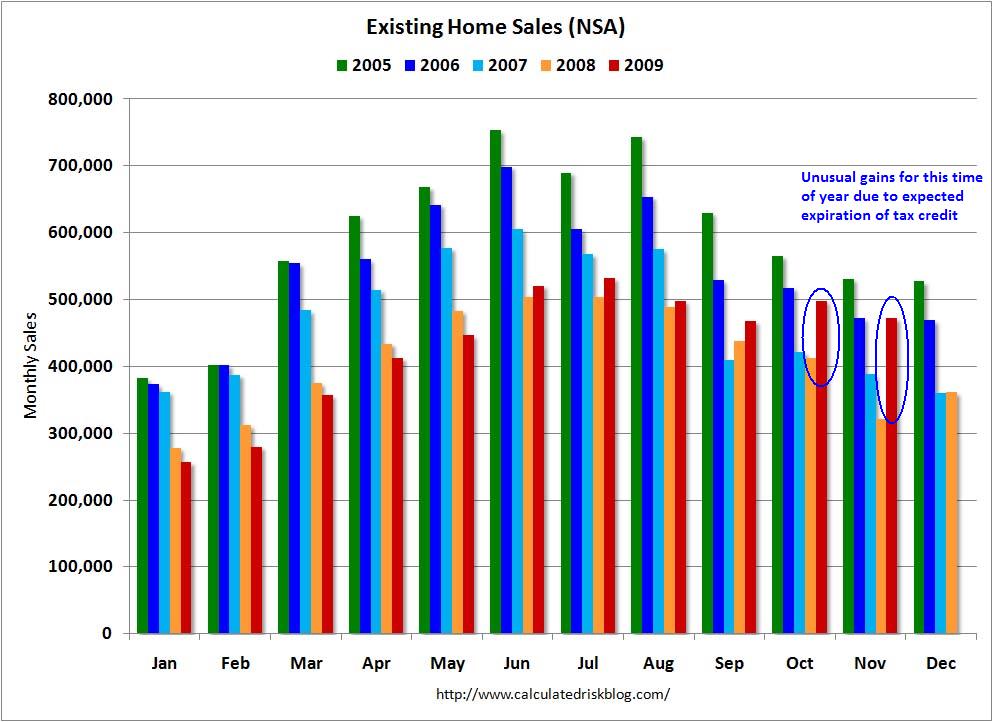
Here is a sign that things are artificially stimulated: Abnormally high Existing Home Sales for November 2009, pushing ginormous annual gains:

“Existing-home sales – including single-family, townhomes, condominiums and co-ops – rose 7.4% to a seasonally adjusted annual rate of 6.54 million units in November from 6.09 million in October, and are 44.1 % higher than the 4.54 million-unit pace in November 2008. Current sales remain at the highest level since February 2007 when they hit 6.55 million.”

Now granted, we are comparing the heart of the credit crisis, a very weak seasonal period one year ago, with the present sub-5% mortgages and the (expected end of) a government home buying credit.

Sales are up as prices continue to fall. Lower priced homes — especially Condo and Coop sales — were up a whopping 60% over last year.

While seasonal adjustments might have impacted the monthly data, the year over year numbers are simply off the charts.

Other data points:

-The national median existing-home price was $172,600 in November 2009, 4.3% below November 2008.

-Single-family home sales jumped 8.5% (SA annual rate) 5.77 million in November; Up 42.1% above November 2008.

-The median existing single-family home price was $171,900 in November, down 4.4%from a year ago.

-Distressed properties accounted for 33% of sales in November;

-First-time buyers purchased 51% of homes in November

-Total housing inventory at the end of November declined 1.3% to 3.52 million existing homes (6.5-month supply);

-Unsold inventory is 15.5% below year ago levels, and the lowest since April 2006;

-Existing condominium and co-op sales in November were unchanged monthly, but gained 60.1% from a year ago.

-Median existing condo price was $178,000 in November, down 3.1% from year ago levels.

Bottom line: Improving sales numbers, falling home prices, reduced inventory, distressed sales still driving the narrative.

Bill over at Calculated Risk notes that going forward:

• Months-of-supply will now increase sharply as sales plunge. Do not be fooled because months-of-supply is close to “normal” levels. This is primarily because sales were distorted by the tax credit.

• Excess inventory includes existing home inventory, rental units (vacancy at record high), and various shadow inventory.  This is still near record levels.

• House prices are now falling again – and this will show up in the Case-Shiller index soon.

• This is probably the end of the “good” housing news for a while.

Here’s a NSA chart:
>

EHSNovNSA

Chart courtesy of Calculated Risk (annotations mine)

>

Source:
Another Big Gain in Existing-Home Sales as Buyers Respond to Tax Credit
NAR, December 22, 2009

http://www.realtor.org/press_room/news_releases/2009/12/another_respond

Comments

Please use the comments to demonstrate your own ignorance, unfamiliarity with empirical data, ability to repeat discredited memes, and lack of respect for scientific knowledge. Also, be sure to create straw men and argue against things I have neither said nor even implied. Any irrelevancies you can mention will also be appreciated. Lastly, kindly forgo all civility in your discourse . . . you are, after all, anonymous.

22 Responses to “Existing Home Sales Inordinately High; +44% Year Over Year”

  1. Marcus Aurelius Says:

    Is inventory being reduced, or are we moving backwards more slowly? If I remember recent news correctly, prime mortgage defaults are also way up. Seems to be a contradiction in trends. I think we’ll have another big leg down in RE values based on nothing more than supply and demand.

    Buy now, and be priced in forever.

  2. wally Says:

    When you take government money and use it to bribe the stats, what you get is bribed stats.

  3. SwimUpstreamToWealth Says:

    It will be interesting to see the next few months. I suspect November was strong as folks chased the expiring tax credit, or what they thought was expiring. With so much demand pushed forward and the Fed supposedly halting MBS purchases in March, the true tale of housing should emerge in 2010. Oh, and add the recasting option ARMs into the mix as well.

  4. Marcus Aurelius Says:

    Post was updated before I finished typing — I guess that answered my question, re: inventory.

    I stand by my prediction.

  5. Mike in Nola Says:

    Inventory is largely hidden. Many foreclosure candidates and REO’s kept off the market.

  6. Free Market Extremist Says:

    Thats a nice looking chart.

    Things are definately getting worse – maybee i should buy more gold?

  7. Barry Ritholtz Says:

    Another chart:

    EHS Nov 09

  8. Rikky Says:

    this is going to end in tears the question is when. the massive government pump cycle will run its course and the self-reinforcement paradigm they’re looking to enable will be short lived. you need a healthy job market to effect such a self-sustaining cycle and there’s no evidence that once you take away the external stimulus you’ll get it. if someone can please explain to me where these decent paying jobs for americans are coming from i’m all ears…

  9. Brian Louis Says:

    Shadow Inventory’ of U.S. Homes Climbs, Report Says
    http://www.bloomberg.com/apps/news?pid=20601087&sid=auKSnUtGaDC4&pos=5

    Dec. 17 (Bloomberg) — The number of homes that may be in the pipeline for a sale because of foreclosure and delinquency climbed about 55 percent to 1.7 million at the end of September, according to estimates by First American CoreLogic.

    The “shadow inventory” rose from 1.1 million a year earlier. Such properties include those taken over by banks and mortgage companies and those where the loans are at least 90 days delinquent, the Santa Ana, California-based research firm said in a report today. The number of unsold homes listed for sale was 3.8 million in September, down from 4.7 million a year earlier, First American said.

    Unemployment in the U.S. is helping drive foreclosures, which may slow the real estate recovery as more houses come on the market. Total inventory — including the shadow supply — was 5.5 million in September, down from 5.7 million a year earlier.

    “While the visible month’s supply has decreased and is beginning to approach more normal levels, adding in the pending supply reveals there is still quite a bit of inventory that will impact the housing market for the next few years,” First American said.

  10. bsneath Says:

    Have got to give them credit for doing everything in their power to keep the wheels from falling off. Can you imagine where housing prices, foreclosures, unemployment and the financial system would be today if home sales had continued to decline rather than rise as shown on BR’s second CR chart?

    Again if this were an ordinary recession, then I would agree with the “tough love” solutions that many are in favor of. But this is not. It is a balance sheet correction driven depression that Bernanke and Congress are fighting with everything that they got. If the Fed had not stepped in with ZIRP & QE and Congress with the $8k give aways, who knows, we might be looking at 15% unemployment, double the foreclosures, another round of failed banks and economic paralysis where nobody is willing to spend money on anything out of abject fear for the future.

    Everything is relative and I am grateful for what they are doing in spite of the popular opposition. My biggest concern is Bernanke announced the end of QE too soon and mortgage rates will rise too early.

  11. HarryWanger Says:

    Do you think this rise in existing home sales will mess with sellers psychologically now? If homes are selling so well, why wouldn’t I raise the price on my house or at least stand pat. Is this type of thinking in itself going to play a role in slowing sales? Of course, if that were to happen and sales fall again dramatically, prices will plunge accordingly. That’s what happens when you artificially create demand. Screws with people psychologically.

  12. DeDude Says:

    Stimulus working and doing exactly what it was designed to do, just like the cash for clunkers. Those who think this is all due to the tax credit and that we will fall into the abyss as soon as spring gets old will be proven wrong. Those who think this is natural growth and that we soon will be back to the good old days of 2007 will be proven even more wrong.

  13. bsneath Says:

    DeDude Says: “Those who think this is all due to the tax credit and that we will fall into the abyss as soon as spring gets old will be proven wrong.”

    Boy I hope to be proven wrong!!!

    Actually I get what you are saying, but I am not certain there is any government policy that can avoid an inevitable second drop in the economy. People were living off of credit because wages did not keep up. Now people are living off of government subsidies because both credit and wages have tanked.

    I think it will take a very long time for these imbalances to work out and I do not know if the government can play the role of lender/subsidizer of last resort for that long.

    The only “good news”, if you can call it that, is that most of the developed economies are in the same boat, averaging 10% deficits this year. Thus there is less worry about a collapse of the dollar when Europe and Japan are pursuing the same policies and when our biggest trading partner ( and banker) keeps its currency pegged. Thus the Fed has some latitude to keep the helicopters flying. Only questions are, for how long and will they be able to put out the fires?

  14. Robespierre Says:

    I can not possibly trust any of the numbers put out by these people or the government. Look at the GDP revisions. When they announced %3.5 they revise down what %40? It is always a “miss” on the upside (except when there is Treasury offerings). What happened here” Have they found a way to bring back Goebbels?

  15. Brendan Says:

    I know it’s not popular to be bullish (or at least not-bearish) on RE around here, but I seem to remember a lot of people (including some that hang around here) screaming at the top of their lungs a few years ago that home prices needed to fall because “poor them” had been diligently saving for a down on a home, but missed the bottom and now couldn’t afford to get into one and felt they would be stuck in an apartment forever. The post usually implied that they had lost because they played by the rules. Assuming they were telling the truth, wouldn’t those people be exactly the ones buying now (seeing record low interest rates and few signs that prices will continue down in the short term)? We talk a lot about the shadow inventory, but not the shadow pent up demand from “responsible” buyers who decided not the buy during the bubble years. Low interest rates + home prices approaching 5-year ago levels alone would be enough signal for many to jump in (when weighed against the risk of miss the opportunity again, rising interest rates and further rent costs and lack of a tax write-off). Add a first-time buyer incentive and signs that interest rates have bottomed, and it seems pretty reasonable that the people who have been waiting aren’t going to wait any longer.

  16. Transor Z Says:

    This is a pretty darned provocative chart, no two ways about it.

    Back in August Barry had a RE where folks discussed, among other things, shadow inventory of 29% of homeowners looking for an opening to sell:
    http://www.ritholtz.com/blog/2009/08/zillow-underwater-mortgages-may-reach-30/

    Anecdotally, I had a weird thing happen in November. I have a saved search on Zillow that usually gives me 6-10 properties that match my criteria a couple times a week. Out of the blue I got an email report one day with 79 matching properties. Never happened before or since. The first thing that crossed my mind is that somebody was unloading REO.

    One of my favorite movies is The Great Escape. I love the part where they’re digging the tunnel and everybody goes out to the yard with a bag of dirt hidden in their trouser legs so they can dump the dirt inconspicuously so the German guards don’t notice.

    As long as prices keep going down, somebody is losing money in these transactions, if only on paper. That’s not a rising tide lifting all boats.

  17. Pete from CA Says:

    @Brendan

    It’s about buying at a reasonable price, not about buying at the bottom or about affordability. Where I live the median price is still way above 3x the median income.

    Even if you are bottom fishing, what makes you think 5-year-ago prices are the bottom?

  18. Market Talk » Blog Archive » Housing’s Narrative - More Sales, Lower Prices Says:

    [...] Home sales also rose an “inordinately high” 44% from a year ago, FusionIQ CEO Barry Ritholtz says. [...]

  19. CTX Says:

    I remember several months ago NAR put in whole page ads in the NYT telling people now was the best time to buy a house..another joke organization

  20. fusionbaby Says:

    The fundamentals are still going down. They’ll be more unemployment, more saving, more frugality. Plus, Alt-A and Option-ARMS will begin to reset and hit hard in the next 1.5 years. National RE valuations on average could go down another 30% over the next 2 years.

    I await “the bottom” so that I can load up my portfolio with some great residential income properties.

  21. DeDude Says:

    bsneath; I don’t think the economy is going straight up from now. It is pretty obvious that the government spending growth from the stimulus package has prevented the great depression and stopped the fall, but the private sector growth that we need is going to have a hard time materializing until we get some serious growth in consumer class income. In the current system that only comes if unemployment gets under 5% (or if by some miracle we got 60 liberal senators so the structural imbalances you mention could get fixed).

    However, I do not believe that government spending is this big bad negative (compared to the big good positive or privat spending), when it comes to economic effects. From an economic standpoint it makes little difference whether you and I endulge ourselves with another bedroom to our house and a big ugly Cadilac SUV, or we endulge ourselves in letting “we the people” tax us and use the money to build a safe bridge that we can use when we drive our littler Ford SUV’s across the river to our littler houses. The economic effects are the same whether our indulgences are on personal or collectively owned products. However, just like increases in private consumption without income to support it is unsustainable, government spending has to be matched with increased taxation of the rich, to make it sustainable.

    To me the biggest danger is that the GOP has gotten away with being the party or NO (no plans, no alternatives, no compromises, no drop in voter support). It is almost certain that they will get their 41 senators after next election and from then on all policy will be stalled, as they persue their relentless goal of seing this country and its current president fail. I agree that we will get a second drop in the economy (precipitated by the next round of mortgage resets and the end of the stimulus package) and at that point we will need to have an effective government that can take action (just like they did here in the first round), if we have partisan gridlock that is not going to happen, and then the second dip could get almost as bad as the first.

  22. Higher-End Homes Still Declining | The Big Picture Says:

    [...] most recent Housing data makes clear the dominance of low end sales. As noted earlier, last month’s existing home [...]

76 queries. 0.366 seconds.