
IMF: Riskier Lenders Spent More Lobbying
The IMF’s latest working paper — A Fistful of Dollars: Lobbying and the Financial Crisis — is yet another indictment of the nexus between Wall Street and Washington.
We know from previous reports that the lobbying of most aggressive, freest spending banks led to the greatest return in bailout monies. The IMF shows that it also led to riskier lending with less supervision and regulation:
“Our analysis establishes that financial intermediaries’ lobbying activities on specific issues are significantly related to both their mortgage lending behavior and their ex-post performance. Controlling for unobserved lender and area characteristics as well as changes over time in the macroeconomic and local conditions, lenders that lobby more intensively (i) originate mortgages with higher loan-to-income ratios, (ii) securitize a faster growing proportion of loans originated; and (iii) have faster growing mortgage loan portfolios.”
Our analysis of ex-post performance comprises two pieces of evidence: (i) faster relative growth of mortgage loans by lobbying lenders is associated with higher ex-post default rates at the MSA level in 2008; and (ii) lobbying lenders experienced negative abnormal stock returns during the main events of the financial crisis in 2007 and 2008.”
The authors identify key goals of lobbying by banks. Lenders lobby to:
• prevent any tightening of lending laws that reduce the benefits of short-termist strategies over long-term profits;
• allow systematic underestimation of default probabilities by overoptimistic bankers;
• not just to originate loans that carry more risk, but to convince legislators that such lending is prudent;
• to thwart bills aimed at lax lending standards and riskier loans;
• to tighten regulations that restrict entry by others preventing competition;
• to have a higher probability of receiving preferential treatment in a crisis.
Hence, their conclusion that lobbying by banks can put the entire financial system at risk. How to fix it? A suggestion that today looks impossible, but should have been jammed through in March during the crisis denouement:
“Therefore, it provides some support to the view that the prevention of future crises might require weakening political influence of the financial industry or closer monitoring of lobbying activities to understand the incentives behind better.”
Unfortunately, given the regulatory capture of Congress by banks, it is unlikely to occur . . .
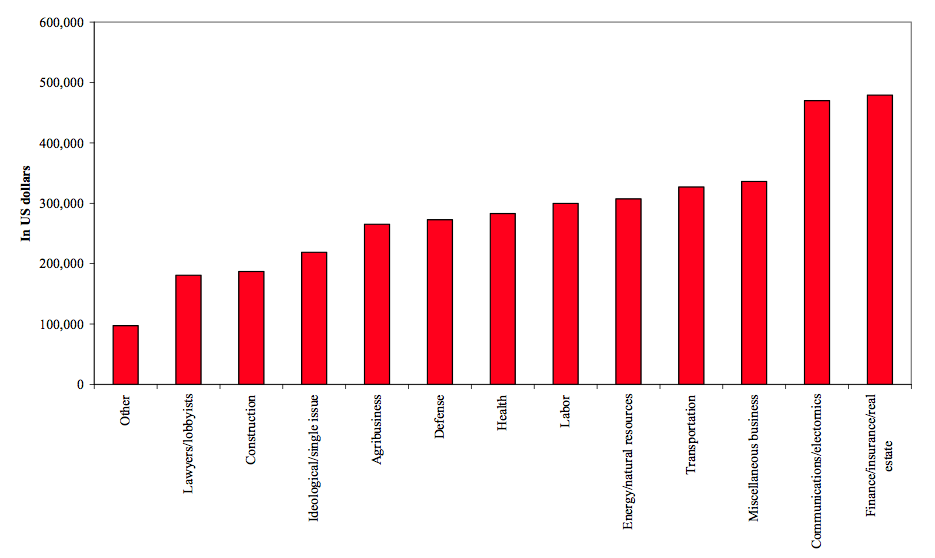
Lobbying exp/firm, by sector, 2006
>
Previously:
Total Campaign Contributions/Lobbying by TARP Recipients (October 11th, 2009)
http://www.ritholtz.com/blog/2009/10/total-campaign-contributions/
Source:
A Fistful of Dollars: Lobbying and the Financial Crisis
Deniz Igan, Prachi Mishra, and Thierry Tressel
IMF, December 2009
http://www.imf.org/external/np/res/seminars/2009/arc/pdf/igan.pdf



Tweet
Facebook
Reddit
Digg this!


December 30th, 2009 at 8:35 am
Barry – thank you for staying on top of the reg wars and financial reform. Very much appreciate your keeping it on top of the front burner. This post in particular took a lot of work to read such a report and then put up this post. Time and energy you’ve got a lot of alternative uses for.
Just wanted to give a shout out and tell you that some of us appreciate it and wanted to applaud publicly.
Muchas Gracias!
December 30th, 2009 at 8:35 am
Probably the best thing that could happen long term is an apocalypse not remediable by bailouts and forcing liquidations of TBTF institutions.
December 30th, 2009 at 9:18 am
I want to add my appreciation to dblwyo’s and others.
Unfortunately what your previous post discusses – how red state democrats are assigned to the banking committee, so they can get contributions from bankers – shows how horrible the problem is. As you said, this red-state-appointment posts was one of the best posts at its site, but it is also one of the most pessimistic. We needed a cheerleading-for-reform administration to deal with this problem, at the least, because obviously congress won’t. And we didn’t get that either. People will look back on this the way they looked back on the domination of government by the railroads and oil in the Gilded Age – without any Teddy Roosevelt in sight.
December 30th, 2009 at 10:55 am
Add my appreciation, Barry. This site is really comprehensive, informative and engaged in the reform process. I also think its populated with really good minds and interested parties. So its outstanding to be able to have really good information that I know is accurate and in context. I feel like I’m back in school!
I don’t think ritholtz.com is like so many other sites where people go to vent. Since I’ve been participating here, I’ve started going to Bloomberg TV, a little CNBC- financial stuff, which I don’t even know the vocabulary yet. It’s fascinating.
Congress has never been the greatest as a whole, but there have been great leaders in Congress. During the 2000s, Congress has really been brushed aside, and alot of us political animals are really post traumatic stress disorder cases. Another thing is that Congress usually needs some time, and a strong leader to champion a cause. Things have been moving so fast.
During the Revolutionary War, General Washington kept the Continental Army going for eight years on the promise that if they won the war, they’d finally be compensated. They won the war, but never were compensated, because the Congress at that time wouldn’t do it. Of course that was another age, when only blue bloods were in Congress, and the rank and file Army was composed of commoners. The blue bloods may have felt that the Continental Army fought for its own freedom, which at the time was a novelty.
Today, money is the mother’s milk of politics, and campaigns go on practically year around. One wins election simply to gather support and campaign funds for the next election cycle. I think the quickest way to get to things like banking reform and Wall Street oversight would be to simply take the money out of politics and make the candidates debate. Millions of dollars are spent on thirty second ads that add literally nothing to anyone’s understanding, just throw a name out and blurb it, like selling yogurt. We need kids that are smart enough to go to a candidates forum and tell the candidate ‘You’ll lose my vote advertising like that.’ Debates are infrequent, and often simply about avoiding a fatal gaffe. We need a richer, smarter election process. Richer here has nothing to do with money, on the contrary. To me thats green thinking, getting alot more, not by spending money, but by enrichening the processes and activities that make up our life.
The corporate media is just as culpable as Wall Street for turning Congressional politics into a bad joke. Wall Street didn’t wake up one morning and say to itself ‘Huh, today we’ll make the financial system collapse and create a run on the banks. The situation devolved over the last two decades. Its totally repairable, if we all realize that most of our institutions bear some responsibility.
December 30th, 2009 at 11:32 am
[...] (0) • Related Topics: Wall Street, bailouts, banks, regulation Barry Ritholtz has a good summing-up of a new paper (pdf) by three IMF economists on the link between lobbying and risk-taking by [...]
December 30th, 2009 at 11:36 am
[...] Lobbying and Bailouts: At the Big Picture, Barry Ritholtz looks at a paper by International Monetary Fund economists on lobbying and the financial crisis, calling it “yet another indictment of the nexus between Wall Street and Washington.” He writes: “We know from previous reports that the lobbying of most aggressive, freest spending banks led to the greatest return in bailout monies. The IMF shows that it also led to riskier lending with less supervision and regulation.” [...]
December 30th, 2009 at 4:14 pm
[...] Lobbying and Bailouts: At the Big Picture, Barry Ritholtz looks at a paper by International Monetary Fund economists on lobbying and the financial crisis, calling it “yet another indictment of the nexus between Wall Street and Washington.” He writes: “We know from previous reports that the lobbying of the most aggressive, freest spending banks led to the greatest return in bailout monies. The IMF shows that it also led to riskier lending with less supervision and regulation.” [...]
December 31st, 2009 at 4:23 am
As diegonomics posted, the way out of this is to take the money out of politics. The system as it stands today is broken. Anyone wishing to get elected or re elected to Congress has to raise lots of money. Corporations are the primary source for this essential money. The only possibility for removing the political need for this money is to have the government/taxpayers fund the elections.
It would save a ton of money in addition to moving the US back to a democracy. Presently taxpayers fund the elections albeit indirectly through Congressional paybacks at somewhere between 10 times to 1000 times the contributions. Without the need for paybacks Congressional decisions could be made in the best interests of the people rather than corporate sponsors.