~~~
HAPPY HOLIDAYS and HAPPY AND HEALTHY NEW YEAR!
ECONOMY
As first forecast last March, the U.S. economy was going to experience a V-shaped recovery that at first would be more statistically based. As discussed in the May letter:
“A dissection of the -6.1% decline in first quarter GDP will underscore why a turnaround in GDP is coming. The decline in residential construction subtracted -1.36% from GDP. However, single family housing starts have held steady for the last 4 months through April. With housing starts already down 80% from their peak three years ago, there is a good chance starts will continue to stabilize near 350,000, a very depressed level. By the time the fourth quarter arrives, the drag to GDP from residential construction could be near zero, and possibly a slight positive. Businesses slashed inventories a record $103.7 billion in the first quarter, which shaved -2.79% from GDP. Last week, 52 million Social Security recipients began receiving their $250 economic recovery checks. Along with other measures within the $787 billion fiscal stimulus plan, consumers will have more disposable income, which will lift demand in coming months. This will help align sales with production and inventories, so the large drag from inventories will be far less in the second half of 2009.
Business investment on new buildings and equipment plunged 38%, the most since 1947. This accounted for the bulk of the -4.68% non-residential investment subtracted from first quarter GDP. Although commercial real estate will remain weak in coming quarters, business investment has begun to stabilize. Even if business investment doesn’t pick up by the fourth quarter, the negative drag on GDP will be less.
The lone bright spot in the first quarter was a 2.2% increase in consumer spending, which added +1.5% to GDP. Although consumer spending will continue to be pressured by job losses and weak income growth, various aspects of the stimulus plan should help maintain consumer spending near first quarter levels.
This breakdown of first quarter GDP shows that most of the improvement by the fourth quarter will result because the extreme weakness in the first quarter will have flat lined, causing most of the GDP components to go from deeply negative toward zero. That may be better than the alternative, but it is no substitute for a healthy pick up in demand. It’s a bit like sitting down for a delicious five-course gourmet dinner, and only being served a plate of Cheetos.”
By the third quarter, most of the shifts had occurred, and various aspects of the fiscal stimulus were clearly evident in the 2.2% gain in GDP. Motor vehicle output added 1.45%, spurred by the Cash for Clunkers program. New homes sales were a net positive, aided by the $8,000 first time home buyers tax credit. A swing in inventories actually added .69%, and personal consumption contributed about 2%. Most of these factors, along with a gain in exports should help fourth quarter GDP to push 4%. But as I noted in the May letter, “The most important issue in the next 12 to 15 months is whether the rebound in the second half of 2009 and first half of 2010 will gain enough traction to launch a self sustaining economic recovery. The short answer is no one knows.”
As we enter 2010, the largely statistical recovery to date should strengthen, and include more gains from inventory accumulation, fiscal stimulus, and an irregular improvement in job growth. The loss of only 11,000 jobs in November likely overstated the near term health of the labor market, but there were other positives signs. As noted last month, temporary employment changes are a good leading indicator. In November, temporary jobs increased 52,400, the fourth consecutive month of gains. The workweek rose to 33.2 hours from a record low of 33.0 hours, and overtime hours also increased. As noted previously, job growth of 125,000 is needed to reduce the ranks of unemployed workers, and could appear by the end of the first quarter. If this is to occur, the historical record suggests that the four week moving average of weekly jobless claims will have to fall and remain below 400,000. Hiring for the 2010 census will peak in April and May, when up to 800,000 workers are needed. The average census job will require 20 hours of work each week, pay between $10 and $25 an hour, but only last for six weeks. I suspect the Census Bureau will be swamped with applications. In addition, every economic statistic will look much better when compared to the extraordinary weakness in the first quarter of 2008.
As discussed in the September letter, there are a number of secular headwinds that will weigh on the economy for 3 to 5 years. Total debt as a percent of GDP has risen from $1.65 in 1982 to $3.70 in 2009. Household debt is now 97% of GDP, up from just 44% in 1982. The burden of total debt and household debt cannot be lessened with lower interest rates, since interest rates are already at generational lows. As this debt was being assumed over the last 25 years, annual GDP was higher than it otherwise would have been. Since consumers will not being able to increase their debt at the same pace, annual GDP growth will be slower, until the ratio of household debt is a good deal lower than it is today. My guess is that it will fall back to 90% or less, before consumer balance sheets will be healthy enough to support a new secular economic expansion. The savings rate was almost 10% in 1982. Although it has climbed to 3% to 4%, it is likely to rise further as consumers cut back on their spending. This task will be made more difficult, if the economy grows more slowly in coming years, since personal income will also grow more modestly. Another drag on growth will come in the form of higher federal taxes to lower the massive deficits that are being created by Congress. In addition, the overall level of regulation is going to increase, which will add to the cost of doing business in the U.S.
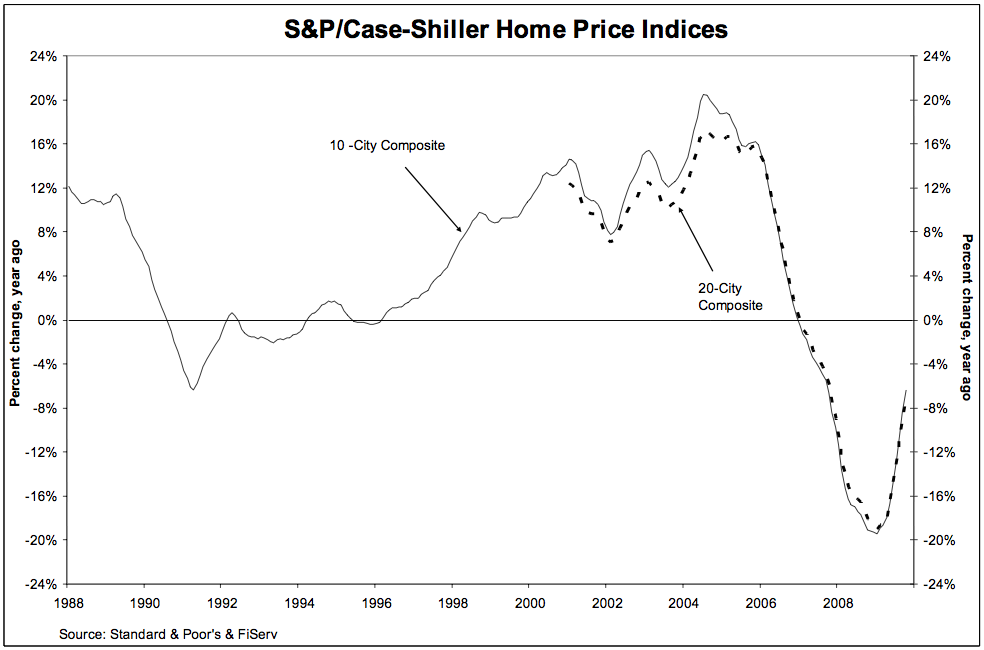
There are also a number of cyclical headwinds that will weigh on growth in the next 2 years. Banks of all sizes have billion more in losses to work through. Commercial real estate has not bottomed, and this will affect many mid sized banks that were overly aggressive in their lending to regional commercial developers. Residential home prices are likely to decline further, as the foreclosure pipeline is still building. Although the labor market should continue to improve, the level of unemployed and underemployed workers will remain high for most of 2010, which will restrain consumer spending. This will force banks to keep lending standards high, and the volume of new lending lower than it needs to be to support a sustainable recovery. State spending has averaged 6% annually over the last 30 years. Revenues are down 11% as of September 30, which is forcing states to raise taxes and cut their spending. All of these factors should result in a sub par recovery that does not inspire corporations to substantially boost their business investment plans or their hiring. Each of these secular and cyclical headwinds are significant, but the combination of all of them interacting and reinforcing each other will be a formidable hurdle for the economy to make a smooth transition from the stimulus spurred V-shaped recovery, into a self sustaining recovery that can gains traction as 2010 unfolds.
In addition, by the end of the first quarter in 2010, the Federal Reserve will have phased out the majority of the special liquidity facilities that have been especially supportive of the credit market in general, and the mortgage security market specifically. The housing market will be hurt, if mortgage rates rise as I expect. If rates rise too much, the Fed may step in again. As noted in its post FOMC statement for the December 16 meeting, “The Federal Reserve is prepared to modify these plans if necessary to support financial stability and economic growth.”
Read the rest of this entry »