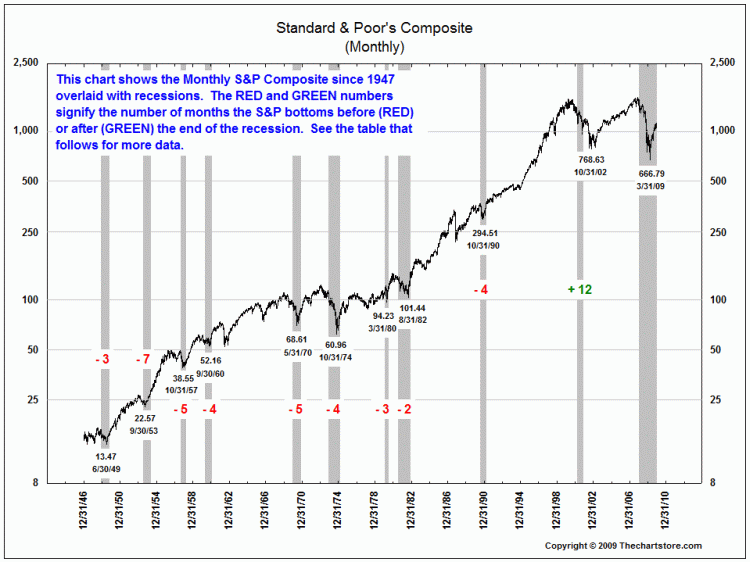
S&P500 Bottoms vs Recessions
Over the past week, relatively good economic news (headlines, anyway) have some people discussing a recovery in 2010.
That got me thinking: If the market bottomed in March 09, how often does that anticipate an economic recovery ?
Ron Griess (of The Chart Store) had the answer. Typically, the markets bottom 3, 4 or 5 months in advance of the recession’s end. However, it has been as much as 7 months (1954) and in 2001, the market did not bottom until 12 months after the recession’s end.
>


Tweet
Facebook
Reddit
Digg this!


December 24th, 2009 at 11:46 am
Note: I have previously argued that the NBER mislabeled the end of the 2001 recession.
Given the weak employment data, they could have dated the official end about 6 months after the November 2001 end they declared.
Perhaps post 9/11 attack, the NBER thought they were being patriotic, but all they did was screw up the data…
December 24th, 2009 at 11:57 am
First, the 2002 stock market was affected by 9/11, anthrax, SARS, etc. etc. Otherwise the S&P likely would have followed the pattern of prior recessions.
Secondly, although based on prior S&P behavior the chart makes a compelling argument that we are now out of the recession, “this is not your fathers typical recession”. It is driven by a collapse of credit availability, demand and capacity. The only things keeping it from becoming a depression are 12.5% government spending deficits, zero interest rates and trillions in quantitative easing. Thus the recovery of the S&P could easily be a head fake caused by excessive liquidity and not indicative of a lasting recovery.
time will tell – it always does.
December 24th, 2009 at 12:32 pm
BR wrote:
It’s likely they mislabeled the official start of it as well. A pretty good argument can be made that September 2000 really marked the beginning.
I would argue though that May-June 2002 (six months after November 2001) is a year too premature for the true end of that recession. June 2003 makes a lot more sense in that regard, noting that going from the peak of the Dot-Com Bubble in August 2000 to the end of its deflation phase in June 2003 would be a key reason for selecting these particular starting and ending months.
December 24th, 2009 at 1:19 pm
Isn’t it painting with too broad a brush to treat all recessions as interchangeable? I would suspect that the behavior of inventory adjustment recessions vs credit contraction recessions to be quite different.
December 24th, 2009 at 1:20 pm
There are only recessions on your graph, no depressions. That’s the difference.
December 24th, 2009 at 2:55 pm
fwiw, here’s my summary
We were in a bear market in 2001, with the street short, 9-11 hit, one could say similar too oct 87 market crash……………once markets re-opened massive 35% short covering rally……….than another prime shorting opportunity, down we go 40%
Bottom is oct-march of 2002-2003, fed gins it up again, worldwide capitalism is working out well in china, rusky, and other places, at the lows with fed backing you buy commodities, and so you had lot’s of money from two good bear times if you were deft
Fed keeps rates low, the world is rocking, george loads up strategic petro reserves, dollar slowly fades on the sell the currency buy commodity rothchild famed war trade that always works.
Now all the smart money has so much money it needs a home and with rates low, they loan it out for real estate, and the beat goes on.
Now, the big boys see green shoots everywhere, let’s get us some 40-1 leverage.
Than a rolling stone encore of tumbling dice……………………….
World Peace is better than social unrest, all countries stimulate at once and start talking to each other, hmmmmmm, we screwed this one up good, we better be better.
7 Billion Souls in the naked city now
demograhically emerging markets want a higher standard of living, they will not be denied, cause merica and europe and a few others are pretty much on a per capita basis as good as it gets
mercia-20 barrells a year per person
europe-14 barrells per
emergin-4 barrells
younger population, willing to work hard, schools, hospitals roads and bridges, etc. etc.
okay, so where does the future lie, who knows, i’m on jim rodgers side, fiat money is not all that bright, where business is blowing and growing profits will be higher and better and where the money will be made, adjust accordingly
my one negative will not change, higher oil hurts us and hurts us bad, last time we cracked at 140 a barrell, imho, this time we got problems at 100 based on our present environment, if history rhymes, we get too 100 wiggle and walk for a few months and then revisit the downside
December 24th, 2009 at 3:17 pm
They can’t crank rates to0 soon right because that would hurt housing to much IMO. Wage inflation won’t start until there is enough work to raise them. What will the new populace supported bubble be? Green Tech? Health care and bio engineering? Good Questions.
December 24th, 2009 at 4:40 pm
OT Xmas shopping wrap up. I hit an outlet mall in Tinton Falls NJ and was surprised how sparse the crowd was. A saleswoman at a jewelry place asked me if the other stores were busy and I said “not really”, she said the store was closing in Feb, she said” it’s the rent, $14K/mo”. The outlet center has been open a couple years, the neighbors Walmart was slow too. 10% unemployment (heading to 11% per Biderman of Trimtabs) will do that.
Merry Christmas everyone!
December 24th, 2009 at 5:01 pm
Ned Bushong nails it!
December 24th, 2009 at 6:52 pm
Predicating anything based on the relative values of your US based stock markets, whatever their name or flavor, is pointless. They are ALL gamed. The ONLY useful piece of information that can be extrapolated from them is just that. That they have absolutely no relation to reality.
Looking at what is transpiring around the world, not just in America, suggests the high probability that ALL paper currencies will SOON FAIL.
How are we (globally) going to recover and move forward from that catastrophic global event?
I don’t know, and any one else who tells you today that they know, are guessing, or hoping.
We CAN work to make changes for the better. (And I think that is going to be very HARD work)
I will volunteer this. Although certainly not the only country with this problem, the problem in your country has become acute. Your government has clearly become corrupted and subverted. Your financial organizations openly and apparently without fear of reprisal, commit fraud and theft. Your judiciary no longer inspires belief that the rule of law is being enforced.
There are bright lights in the darkness. I have over the last few years seen a number of social, academic,even political people (admittedly not many) in your country who clearly do see the problems. From some of them (and a whole lot more who are going to be needed) will come the possible solutions.
If they succeed. They are faced with a resourceful enemy, cunning and essentially criminal in nature. Who at the moment are in the dominant position.
But, they have miscalculated. I do not think they intended for the structures that they helped create to come tumbling down the way I think they are going to.
Good Luck people. In the coming struggles, lift up your perception to the larger world, not just your little part of it. What you are enduring, what you are fighting for, is the same thing that people All OVER the world are going to be doing.
Have a good Christmas holiday with family and friends and look to find the positives for the future.
December 25th, 2009 at 12:10 pm
What if the S&P hasn’t bottomed yet? It is debatable that we are still in the midst of a retracement before our continual move down. A great example is the Nikkei after Japan’s boom and bust.
December 25th, 2009 at 11:56 pm
As a chart-reader, I find it curious to see that there is no other instance of a double-top in the SP500 since WWII.
Because there is no other instance of a debt deflation post-WWII, I find that chart-reading of patterns in these last three years of markets are not as useful as other markets. Increasingly, the equities markets are driven by debt market events.
December 27th, 2009 at 11:17 am
[...] For what it is worth the S&P 500 has retraced 50% of its losses. (Big Picture, ibid) [...]